Games as semiotic focus

Define a game as “a set of rules that focuses and directs thought, feeling, intention.”

Most human games are overwhelmingly involved with human semiotics. Human feeling, thought, and intention overwhelmingly operate within and are defined by human semiotics.

Humans are semiotic animals who live within semiologies as much or more than their natural environments. Few of us can even comprehend our natural environments save through a semiotic system.

A semiology is a signal system, a system of signals. Humans need and want their signal systems to be organized; from this arises culture and psychology.

From this arises the many games of human semiotic organization. Humans crave meaning—a synonym for semiotic organization and focus—and thus play games (as defined above) with their intentions, thoughts, emotions, behaviors, instincts, perceptions, desires, and so on. Without meaning, focus, purposive semiotic organization, life is dismal and many humans destroy themselves and others for this alone.

Human semiotic organization can be beneficially reorganized in two basic ways:

  • Through general thought, which mainly changes how we focus and what we focus on. This region of organization includes all culture and science, including mainstream psychology and its treatments.
  • Through analysis of the most basic elements of semiotic organization, individual semiotics and semiologies. To do this at the individual level, two individuals are needed because you cannot successfully analyze your own semiotics by yourself. This is so because a great number of human semiotics are fundamental to both psychology and communication. They do not exist independently.

The goal of reorganizing individual semiologies is to optimize them. As individual semiologies optimize, individual psychologies inevitably optimize apace. Much is possible at this level that is not possible at the general level of psychological theory.

Reorganization at this level is done through individual semiotics, the actual signals of individual communication and psychology alike. To play this game—the game of semio-psychological reorganization and optimization—you have to have rules. Here they are.

Me on the outside vs me on the inside

Psychology as “signs of something else”

When we see a human behavior as a “sign of something else” we begin magnifying it.

When we live in a culture where people normally do this, we tend to think it is right to do this even to ourselves.

People often feel relieved when their “signs of something else” have been analyzed—either professionally or by self-administered questionnaires—to reveal what that “something else” is.

Once analyzed and categorized, the “something else” itself becomes a sign, or a meta-sign, a diagnosis that explains behavior while directing us to a cure based on whatever that “something else” is.

The DSM reads like a Ptolemaic system of circles and spheres. In it signs are identified, quantified, and classified to indicate what they stand for, what their “something else” is.

Professionals are needed to do this work of course, and though the manual rests on “scientific” tests and other measurements, it changes every few years and very few people are getting better because of it. Moreover there is very little consensus among thoughtful people, including psychologists, about what the classifications of “mental illness” or “personality disorder” actually mean.

This is a sure sign that something is wrong.

I submit that what is wrong is our systems of classification of mental disorder do not describe the actual disorders because these descriptions exist on a different level from the disorders themselves.

It is widely observed that many disorders as currently classified blend into each other, share attributes, are co-morbid. It is also widely known that when disorders are extreme, sufferers can exhibit symptoms of all of them.

This indicates that the human mind is a complex system that becomes disordered by over-emphasizing or under-emphasizing parts of its system.

And this may be why drugs, psychedelics, shock therapy, or shamanic rituals sometimes help. Because they reset the entire system.

If you don’t want to use drugs, can’t get psychedelics, don’t want to undergo shock therapy or shamanic ritual, I suggest you try FIML practice. If you have a good partner, are fairly intelligent, and want to truly optimize your psychology (not just terminate your ambiguous disorder), FIML will probably do this for you. In fact, even if you can get psychedelics, FIML is better.

A disorder is unique to its system and though we can speak of some generalities that may apply to it, these generalities exist at a different level from the disorder itself and cannot provide a cure.

To cure a disorder the disorder must be experienced as it is happening by the sufferer. If too much of the disorder is revealed at once or the sufferer is simply confronted with its classification, more harm than good may result. If small bits of the disorder are revealed over a longish period of time, however, the sufferer will be much more likely to gain beneficial insight into the disorder.

In my view, all people everywhere are deeply disordered and thus all people everywhere would benefit from FIML practice. People who may not benefit from FIML include, among others, those who cannot self-observe, who are severely alcoholic, whose disorder prohibits self-analysis (narcissism, for example) and, sadly, those who cannot find an honest partner.

Personality disorders and signaling

In my opinion, “personality disorders” are more easily understood as signaling problems.

All types of personality disorder involve dysfunctional signaling with other people. Signals are both sent and received in ways that result in suffering.

As currently defined, personality disorders “develop early, are inflexible, and are associated with significant distress or disability.”

Thus, if there are no significant brain injuries or other biological problems, all personality disorders (PD) develop through experience.

This means that during childhood the PD sufferer has received many bad signals (and/or interpreted many signals badly) resulting in their failing to form a coherent well-functioning internal signaling system.

The way to fix this is work with the signals. And the best way to do this is FIML practice. A professional psychotherapist cannot possibly provide this level of treatment.

This brings me to a second point: is there anyone who would not benefit from improving their signaling?

Why do we view psychotherapy as treatment designed merely to make us look and feel “average”? Why don’t we instead work to optimize our psychologies every day?

The Buddha said we are all crazy. We are. We all need to work on our signaling—our personality disorders—all the time.

The distinctions between one PD and another and those who have PDs and those who don’t are vague. This is because all PD problems (absent significant biological deficits, which may include intelligence) are idiosyncratic varieties of signaling malfunctions.

If signaling is the core problem, it should follow that all acquired PD will be classifiable as some kind of signaling malfunction. And that is precisely what we see.

Narcissism is a too simple signaling system. Borderline is an unstable signaling system. Compulsive, passive aggressive, histrionic, avoidant, and so on all are variations of a poorly formed internal signaling system.

The way to study this is through interpersonal semiotics; that is interpersonal semiotic analysis of real-time, real-world communicative signs and symbols.

All people need to do this to optimize their psychologies (their internal signaling systems). Why would anyone not want to do this? Maybe not wanting to do this is the surest sign of PD there is.

The hardest part about doing FIML is finding a willing and able partner. To me, this shows how pervasive bad signaling is. Most people will do almost anything but examine their own signaling with the help of another person.

Psychology as fundamentally signals

I propose that we largely discard all other paradigms for human psychology and replace them with one based on signals. Humans are semiotic entities who signal constantly internally and externally. No need for personality or self.

Signals are objective, measurable, quantifiable, and analyzable. And they are at the heart of everything we call “psychology.”

The most basic psychological paradigm still current today is personality. This concept should be greatly demoted, relegated to broad-brushing some genetic tendencies or matters involving personas.

Signals cover all psychological territory without exception, including everything we can now say based on personality. Bodies signal, brains signal, organs of perception receive signals, thoughts are signals, language is signals, biology signals, as does everything in physics.

No matter how you look at psychology, you will find signals. Using signals to describe psychology is almost always clearer, more succinct, and more precise.

Another basic paradigm for describing/explaining psychology is matter; psychology comes from the brain and the brain is matter. But then you get mind-matter problems, problems with top-down behaviors, loss of spirituality as an actual probability, and many problems with scale or behavior. Besides all matter signals!

So much simpler to describe how biological signals lead to thought and behavior. Or how top-down psychological signals affect biology.

Instead of “personality disorders” being vaguely defined and understood as ghostlike ephemera that seem to inhabit sufferers, we can define them as signal malfunctions that have arisen due to previous signal malfunctions, either biological, experiential, or semiotic.

A signal-based paradigm of human psychology would view individual psychology as a complex of signals, a semiology unique to each individual.

Narcissism has been discussed in this way. A signal-based analysis of other disorders can similarly make our understanding clearer and more efficient.

Borderline personality disorder, for example, can be viewed as a poorly integrated internal signaling system, a poorly functioning individual semiology. Due to the centrality of signals to all aspects of human psychology, we can expect borderline people to search frantically among others for the cohesion they lack in themselves.

If we understand psychology as a complex of signals, it becomes easier to categorize problems and discover treatments. It also becomes obvious that we can and should optimize this system even in healthy individuals by clearing up confused signals while removing bad ones.

Speech comprehension and context

A new study on speech comprehension shows that humans respond to the “contextual semantic content of each word in a relatively time-locked fashion.”

These findings demonstrate that, when successfully comprehending natural speech, the human brain responds to the contextual semantic content of each word in a relatively time-locked fashion. (Source)

This process is roughly illustrated here:

While I do not doubt these findings for simple speech in simple contexts, I do wonder what the results would be for speech in psychologically complex contexts, whether that speech is simple or not.

I wonder this because I am certain that in almost all psychologically complex contexts (those rich with subjectivity, emotion, idiosyncratic memory or association, etc.) the “contextual semantic content of each word” will necessarily be different, often very different for each speaker.

Psychologically rich interpersonal speech is almost always fraught with contextual differences that can be very large. Sometimes participants know these differences exist and sometimes they don’t. It is very common for speakers to make major mistakes in this area, the most important area of speech for human psychological well-being.

It seems possible that EEG with increased sensitivity might one day be able to detect “context diversion” between speakers, but even if complex emotional information is also included, people will still have to talk about what is diverging from what.

My comments are not meant to detract from the very interesting findings posted above. I make them because these findings illustrate how inherently problematic real-time mutual comprehension of the “contextual semantic content” of all spoken words actually is.

FIML practice is the only way I know of today to find profound real-time mutual comprehension of complex interpersonal speech.

Real-time, real-world analysis of interpersonal communication

A tool that can reliably augment real-time, real-world interpersonal communication will profoundly change our understanding of human psychology for the better.

Such a tool will provide us with data that makes intent, content, and psychological aspect manifest in real-time.

An AI-assisted EEG device could be an advance toward realizing that goal. Dan Nemrodov, of the University of Toronto, has succeeded in “digitally reconstruct[ing] images seen by test subjects based on electroencephalography (EEG) data.”

“When we see something, our brain creates a mental percept, which is essentially a mental impression of that thing. We were able to capture this percept using EEG to get a direct illustration of what’s happening in the brain during this process,” says Nemrodov. (Do you see what I see? Researchers harness brain waves to reconstruct images of what we perceive)

From this, you can see that a percept is a “thing” in the mind, an electro-checmical “structure” with imagery, thought, and emotion. Based on what is known about the physical, brains (like all matter) are fields or fields intersecting; superimposed fields with remarkable stability and complexity.

If we consider the brain as some sort of field array and its particles as excited points on it, we can see how “mind” could be retained in the field array even though its brain particles have become unexcited through changed attention or death.

Consciousness, Big Data, and FIML

Modern neuroscience does not see humans as having a discrete consciousness located in a specific part of the brain. Rather, as Michael S. Gazzaniga says:

The view in neuroscience today is that consciousness does not constitute a single, generalized process. It involves a multitude of widely distributed specialized systems and disunited processes, the products of which are integrated by the interpreter module. (Source)

Computer and Big Data-driven sociology sees something similar. According to Alex Pentland:

While it may be useful to reason about the averages, social phenomena are really made up of millions of small transactions between individuals. There are patterns in those individual transactions that are not just averages, they’re the things that are responsible for the flash crash and the Arab spring. You need to get down into these new patterns, these micro-patterns, because they don’t just average out to the classical way of understanding society. We’re entering a new era of social physics, where it’s the details of all the particles—the you and me—that actually determine the outcome.  (Source)

Buddhists may recognize in these insights close similarities to core teachings of the Buddha—that we do not have a self; that all things arise out of complex conditions that are impermanent and changeable; that the lion’s share of “reality” for any individual lies in being attentive to the moment.

Notice how similar Pentland’s insights are to Gazzaniga’s—the whole, or the common generalities (of society), can be far better understood if we can account for the details that comprise them. Is an individual mind a fractal of society? Do these complex systems—societies and minds—both use similar organizational processes?

I am not completely sure how to answer those questions, but I am certain that most people are using similar sorts of “average” or general semiotics to communicate and think about both minds and societies. If we stick with general averages, we won’t see very much. Class, self, markets, personalities don’t give us information as sophisticated as the detailed analyses proposed by Gazzaniga and Pentland.

Well then, how can individuals cognize Gazzaniga’s “multitude of widely distributed specialized systems and disunited processes” in their minds? And how can they understand how “the products” of those processes are actually “integrated” into a functional “interpreter module”?

And if individuals can cognize the “disunited processes” that “integrate” into a conscious “interpreter,” how will they understand traditional psychological analyses of the self, personality, identity, biography, behavior?

I would maintain that our understanding of what it is to be a human will change deeply if we can learn to observe with reliable clarity the “disunited processes” that “integrate” into a conscious “interpreter.” That is, we will arrive at a completely new understanding of being that will replace the “self” that truly does not exist in the ways most societies (and people) understand it.

FIML practice shows partners how to observe with great clarity the “disunited processes” that “integrate” into a conscious “interpreter.” Once these process are observed in detail and for a long enough period of time, partners will realize that it is no longer necessary to understand themselves in the “average” terms of self, personality, identity, biography, behavior, and so on.

Partners will come to understand that these terms denote only a more detailed version of a naive, static view of what a person is. Most psychology is largely a more detailed version of a naive, static view of what a person is.

We see this in Gazzaniga and Pentland’s findings that are derived from complex analyses of what is actually happening in the brain or in the multitude of real transactions that actually comprise a society. We can also see very similar insights in the Buddha’s teachings.

It is my contention that FIML practice will show partners the same things—that their actual minds and actual interactions are much more complex (and interesting) than the general semiotic averages we normally use to understand them.

From a Buddhist point of view, when we “liberate” ourselves from “attachment” to “delusive” semiotic generalities and averages and are truly “mindful” of the “thusness” of the ways our minds actually work, we will free ourselves from “suffering,” from the “ignorance” that characterizes the First Noble Truth.

_____________________

First published 09/01/12

Basic FIML practice

Mastering basic FIML practice is similar to mastering musical scales or the basic skills of any sport.

Basic FIML is a kind of mental training that allows you to identify, understand, and react to real-time communication problems quickly and efficiently.

FIML analyses put both partners on the same page. Over time, partners develop a wealth of experience that improves communication while also illuminating individual and interpersonal psychology.

It is a fact that it is difficult for people to talk about how they talk when their talking has become heated for any reason.

FIML is designed to make it much easier to do that. Once mastered, the basic FIML technique results in a kind of metacognition that makes interpersonal analyses of all kinds easier and more efficient. Instead of fighting you can have fun with communication missteps.

After basic FIML has been done successfully a few hundred times, the basic technique does not need to be used as often because the metacognition that has developed between partners can handle many more situations than before.

FIML optimizes communication between partners thereby also optimizing psychological well-being. Though basic FIML can be done less often as skills improve, just as in sports or music it is always best to practice the basics frequently.

You aren’t at the mercy of your emotions — your brain creates them

Psychological optimization

Biologically, human psychology in a vast network of interconnected cells  bathed in blood and chemistry.

Intellectually, we typically reduce this enormously complex system into terms that reflect types of behavior, such as narcissism, anxiety, dark triad, bipolar, OCD, self-esteem, etc.

While these reductions are helpful for understanding human psychology and showing us where to focus our attention, they cannot be expected to optimize our psychology.

To date, the human brain is the most complex thing we know of in the universe.

Once you have seen through your mom’s narcissism and its effects on you and have consequently been able to overcome much of your anxiety, are you then psychologically optimized?

Of course not. At best, you are then able to function better and feel better and, with luck, forgive your mom whose persistence in her narcissism was due to her enormously complex brain, same as yours.

So how do you optimize? Or how could your mom have optimized before you were born?

Clearly, it would have taken her years to correct her narcissism, let alone optimize her psychology. Same goes for you.

This is why all people need a system that works every day for many years. There is no other way to do it because optimizing a complex system requires tinkering at all levels over a long period of time and cannot be done quickly or be based simply on top-down category assessments.

The FIML systems works every day for many years gradually optimizing one part after another of our complex psychological systems. With current technology and understanding, I do not believe there is a quicker or more thorough way to do that.

An impediment to doing FIML is few people realize that their psychology is far from optimized. A sad aspect of doing FIML is realizing that you live in a world like that.

Fourth wave cognitive behavior therapy

The third wave of cognitive behavior therapy is a general term for a group of psychotherapies that arose in the 1980s, inspired by acceptance and commitment therapy (ACT).

To me, third wave therapies seem more realistic than older therapies because they accept emotions as they are and pay close attention to how they function in the moment.

The link above is well-worth reading. The frames of these therapies are also well-worth considering.

FIML, which I am calling a “fourth wave cognitive behavior therapy,” differs from third wave therapies in that FIML does not use a professional therapist. Instead, partners become their own therapists.

Moreover, how FIML partners frame their psychologies or generalize their behaviors is entirely up to them. Similarly, their psychological goals and definitions are entirely in their own hands.

At its most basic, FIML “removes wrong interpretations of interpersonal signs and symbols from the brain’s semiotic networks.”

This process of removal, in turn, shows partners how their minds function in real-time real-world situations. And this in turn provides the tools and perspectives to reorganize their psychologies in whichever ways they like.

FIML is based on semiotics because semiotics are specific and with practice can be clearly identified and understood. They give partners “solid ground” to stand on. Words, tone of voice, gestures, and facial expressions are some of the major semiotics partners analyze.

Using real-world semiotics as an analytical basis frees FIML from predetermined frameworks about personality or what human psychology even is. With the FIML tool, partners are free to discover whatever they can about how their minds communicate interpersonally (and internally) and do whatever they like with that.

Next-level metacognitive control

Experienced FIML practitioners enjoy levels of metacognitive control ordinary humans cannot even dream of.

This control comes after years of diligent FIML practice. It happens because the skills acquired through FIML combined with its metacognitive results allow practitioners to practice FIML on themselves.

FIML practice gradually removes virtually all communication error between partners. This error-removal process is ongoing because all living systems must continually remove waste and error to function optimally.

Successful FIML results in two major achievements:

  • very clear, optimally functioning cognition and metacognition
  • the skill-set needed to attain the above

When these achievements have been realized, FIML practitioners will find they are able to rather easily apply them to their own introspection, their own subjective states while alone.

Ordinary people cannot do this because they have not experienced the metacognitive states brought about by FIML nor have they acquired the skills to quickly remove error from their thoughts.

The FIML skills of quickly removing error from our thoughts cannot be acquired overnight. It must be built upon diligent practice and experience. You cannot imagine it into being.

Once these skills and experiences have become established in the mind as reliable functions, they can be applied to mental states while alone.

Real-life illusions

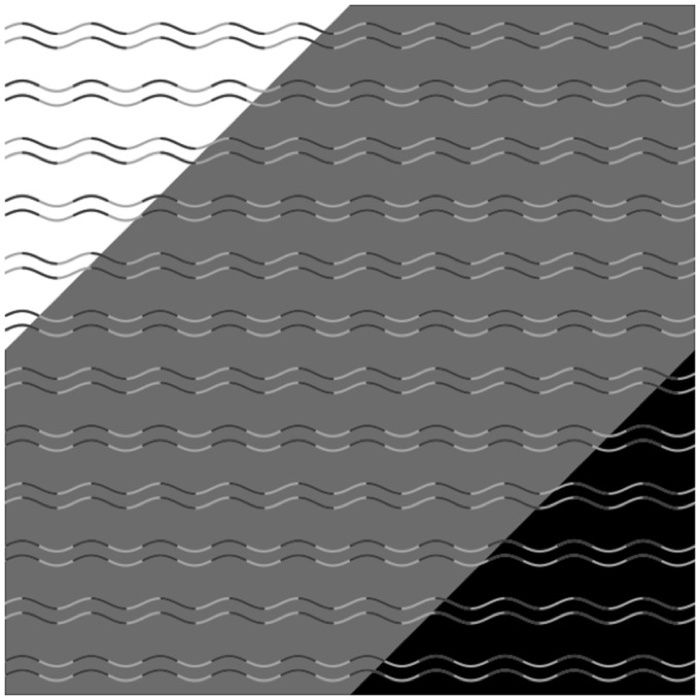
A new optical illusion has been discovered.

All of those lines are the same except for their colors. Most people see zigzags and curves. The zigzags are an illusion.

You can read more about this illusion here: This Crazy New Optical Illusion Shows if You Have ‘Curvature Blindness’.

Vision is our most trusted sense and yet it can be illusory. How much more then can our emotions and even our psychologies be illusory?

This is why FIML practice is essential.