Chief of Staff Eyal Zamir Wednesday night during a discussion in the Security Cabinet that the IDF is dealing with unusual pressure, even stating that he is “raising 10 red flags” and that the army is “collapsing in on itself.” His comments came against the backdrop of the multitude of tasks, the burden on reserve soldiers, the lack of progress in passing the conscription law, the extension of reserve duty, and, in the background, the establishment of new settlements.
The remarks sparked strong reactions in the political system. The leader of the opposition and chairman of Yesh Atid, Yair Lapid, said that “the Chief of Staff is warning of the collapse of the IDF – and the government is ignoring it,” placing the responsibility on the government.
Former Chief of Staff Gadi Eizenkot also emphasized that the political leadership will not be able to claim that it did not know, and called for the promotion of a compulsory service law for the entire population.
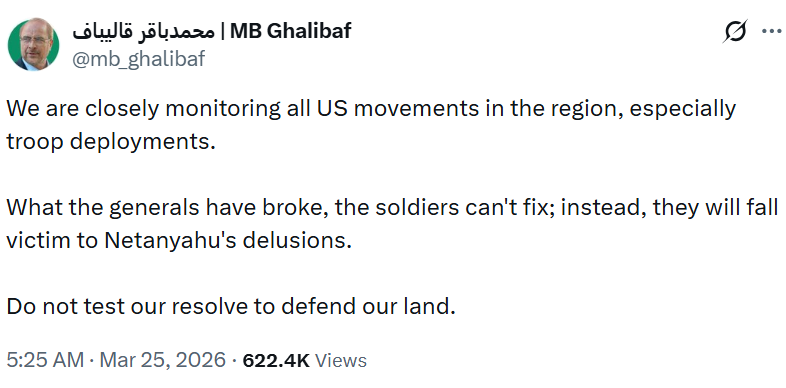
Furious Republicans stormed out of a classified briefing on Iran on Wednesday amid fears the US is preparing to invade the country as Tehran refuses Donald Trump‘s peace overtures.
With almost 7,000 US ground forces deploying or en route to the Middle East – including from the Army’s 82nd Airborne Division and the Marines – speculation is swirling about Trump’s rapidly developing plans for the war.
Now, a Daily Mail source inside the room has revealed stark new details, including a new set of objectives which may suggest that America is moving toward boots on the ground as Iran continues to strangle the Strait of Hormuz.
The lawmaker, speaking on condition of anonymity, said members were presented with three military objectives: Kharg Island, Iran’s crucial oil export hub; its nuclear material; and regime change.
It marks a stark shift from the four goals the White House has publicly stated: destroying Iran’s missiles, navy, armed proxies, and nuclear capabilities.
The lawmaker said that the White House must answer for its plans, particularly regarding Kharg Island and troops on the ground.
Benjamin Netanyahu gave Israeli commanders a 48-hour deadline to destroy Iran‘s weapons industry from his Tel Aviv bunker after reviewing Donald Trump‘s proposed peace plan.
Netanyahu ordered the Israel Defense Forces to strike as many high-value Iranian targets as possible as the US submitted a 15-point peace plan on Tuesday.
The Israeli prime minister and his top military advisers were alarmed the US plan did not go far enough to curb Tehran’s military capabilities, despite its tight restrictions on Iran’s missile stockpile and nuclear program.
Netanyahu’s Thursday deadline reflects deep concern within the Israeli government that Trump could reach a deal with Tehran at any moment, sources say.
Israeli officials present at Netanyahu’s underground meeting described the atmosphere as ‘tense.’
I’ve tried calling you and texting you multiple times since the February 9th hearing on antisemitism which you and Bishop Barron were absent from. I wished to discuss this with you privately. But again, unfortunately, you’ve provided zero response to me.
However, today, you publicly made the post which I am replying to now.
You have publicly stated that you agree with Bishop Barron’s recently issued statements wholeheartedly.
Please answer this question: Why did you say to me in person on September 8th 2025, at 8:26 in the morning, “if they are going to remove you for your support of the Palestinians in Gaza, then they will try to remove me too”?
I explained to you at this meeting, that I was being asked to resign from the commission by the White House at the behest of our colleague’s Paula White and Dan Patrick. You expressed that you were shocked I was asked to resign in August because of my Catholic position on Zionism, and outspoken support of innocent human life in Gaza. You fully supported me as indicated by your words.
I had expressed to both you and Bishop Barron months before the February hearing that I was asked to be removed from this commission due to my Catholic beliefs and my support of the Palestinians in Gaza. Both of you said that would never happen. But it did.
Can you please explain to me and to all Catholics the meaning of this apparent contradiction?
If there is no contradiction between what you said to me in August and why I’m presently removed, then please explain.
I believe I was removed from the religious liberty commission in February for the same reasons I was asked to resign in August.
The excuse for removing Boller I have read is she was being ‘disruptive’ by raising the Catholic position on Zionism and pursuing a real answer. If history is a guide, the most likely explanation for the White House Religious Liberty Commission‘s cowardly actions and lame excuse is they, too, have been infiltrated by Jewish Supremacists and are not in full control of their own commission. ABN
VP JD Vance’s 35-year-old chief of staff is Jewish pro-Israel strategist Jacob Reses.
Vance delivered a Jewish wedding prayer at Reses’ wedding in January. The Vice President hardly goes anywhere without Reses and maintains a close personal relationship with him.
While opposed to mass immigration, abortion, and strong on social issues like transgenderism, Reses is a fervent Zionist who celebrated the erection of Israel’s flag “over the rubble” of Gaza.
Reses has been outspoken about his Zionism from an early age. At Princeton, Reses served as treasurer of Tigers for Israel, where he vocally criticized a pro-Palestine student group that targeted the hummus maker Sabra over its alleged links to Israeli human rights abuses in the occupied territories.
Reses has publicly advocated for a coalition between conservative Christians and Jews. In September 2025, he reposted Joe Lonsdale’s post remarking that Jews should no longer be “squeamish” about the majority’s invocation of the “Christian deity” and other elements of the Christian faith.
It is long past time that in addition to the above, people like Musk realize that tens of millions of Whites have been poisoned, lobotomized, sensorially damaged and otherwise debilitated over several generations by a covert army of enemies which has infiltrated the West and grown up inside it. They look like us, talk like us, act like us but offer only false friendship and the ‘silent terrorism’ of destroying their perceived enemies (talented rivals to their global dominance fantasies) in ways that are all but impossible to discover, let alone prove. I know that some top people know about this but I do not know how many. It may be that when too few top people know about this, it works against them and us because they are terrified by what is happening. Musk’s post above is also true but that is only the software. ABN
Clélia Verdier has vivid memories of giving birth to triplets. She remembers the agonizing pain of labor, the joy of holding her daughters for the first time and the devastation when one died soon after.
The only catch? She was never pregnant, never went into labor and never became a mom. In reality, she was in a medically-induced coma in a hospital the entire time.
Verdier isn’t the first to dream up a whole life for themselves while in a coma, only to wake up and discover that none of it was real.
But for Verdier, 19, from Lyon, France, it was especially complicated to come to grips with the realization that the babies she felt like she had given birth to never even existed.
While she was only in the coma for three weeks, she said the realistic dream spanned across seven years
She explained to the Daily Mail that she ‘made a serious suicide attempt by taking a large amount of medication’ in June 2025, and was placed into a medically-induced coma for three weeks.
She remembers having ‘extremely intense’ dreams and nightmares during the coma, but because she was ‘not aware that she was in a coma’ at the time, they ‘became her reality.’
One dream, in particular, has stuck with her: the one in which she became a mother.
She explained that it seemed so real and she could feel both physical and emotional pain throughout the hallucination.
Iran wants Vice President JD Vance at the negotiating table to help end the ongoing Middle East conflict after Trump sent the nation a 15-point ceasefire plan.
Iranian officials reportedly said they would rather talk with Vance because top Mideast envoys Steve Witkoff and Jared Kushner ‘stabbed them in the back.’
‘The perception is that Vance would be intent on wrapping up the conflict’ as opposed to Kushner, Witkoff or Secretary of State Marco Rubio, sources told CNN.
Another Middle East source went further, telling The Telegraph Iran thought Kushner and Witkoff were ‘backstabbers.’
‘Vance is preferred. They don’t want to work with Jared and Witkoff because they stabbed them in the back,’ the source told The Telegraph.
I believe Trump feared for his life if he went against Bibi and that is the bottom-line reason for this war. Hardcore Jewish Supremacists will rejoice if all of the world turns into Gaza as long as they alone survive. ABN







 American Buddhist Net