Lead was examined in eleven studies [3, 22, 26–28, 33–38]. In 1973, Hohnadel et al. suggested that “sauna bathing might provide a therapeutic method to increase elimination of toxic trace metals” [38]. In two males, 36% and 50% of sweat lead was of molecular weight > 30,000, as measured by ultrafiltration, suggesting excretion of organic complexes rather than simple ions [22]. Lead excretion was lower in females taking birth control medications compared with females not taking medications, or males [28]. Haber et al. found that prolonged endurance workouts (rowing) ameliorated elevated blood lead levels in exposed workers but did not alter levels in control subjects and did not affect urine levels [26]. They suggested that the elimination route was not urine, but potentially sweat or/and bile. Omokhodion and Crockford carried out several studies of trace elements in sweat, including a study of lead ingestion by two human participants [34]. Sweat lead levels did not increase immediately with elevated blood lead, although the authors make reference to an older study with longer followup wherein lead in underarm pads doubled in the five days following ingestion. Omokhodion and Howard also reported higher lead in sweat of exposed workers compared with unexposed controls [35], and in another study that sweat and blood lead levels were the only two variables that correlated among blood, urine, sweat, and saliva [36]. The English abstract of a 1991 case report in Russian indicated that sauna increased excretion of toxic elements and resulted in clinical improvements [27]. Sweat lead levels up to 283 μg/L have been observed in nonoccupationally exposed subjects [38] and up to 17,700 μg/L in workers [37], where it is noted that lead in sweat may partially originate from material absorbed within the skin that was not removed by pretest cleaning protocols [35]. Indeed, although dermal application of lead via hair follicles, sweat ducts, and diffusion does not result in immediate increases in blood or urine lead concentrations, dermal absorption was demonstrated using the Pb-204 isotope [43], lead powder, and salt [37].
If you are concerned about exposure to toxic metals, the above links show that sweating can be a significant way to excrete them. Exercise and saunas both help speed removal. ABN
UPDATE: I checked into this further and found that, while sweating does remove toxic metals, the volume of sweat is low compared to urine and thus, generally, the kidneys and liver do more. That said, sweating can be an important supplement for toxic metal removal and may remove metals stored in tissues which are not easily removed through the water-soluble urine route. Infrared saunas appear to be very good at removing metals and fat-soluble toxins stored in adipose tissue. ABN
The Blue-eyed Darner is widespread across Western USA between the Pacific Coast and the Rocky Mountains. Its range extends into the Great Plains and Midwest (as far east as the Dakotas, Nebraska, Oklahoma, and Wisconsin); north into Western Canada and south into Mexico and Central America.
This is a must watch interview. Most Americans have no idea that Canadian media is controlled by the Canadian government; it’s what they call “cultural protection” where the rules and regulations of permissible speech are controlled by govt regulators and media are subsidized by govt. The overall objective is to control information and censor viewpoints that might be averse to the interests of the Canadian govt. That’s why most Canadians have no concept of granular details on policy matters; they just don’t get the information.
In this interview with the Canadian Broadcasting Corporation (CBC), U.S Trade Representative Jamieson Greer is discussing the trade conflict and breakdown with Canada’s version of Baghdad Bob, Rosemary Barton. I’m a little surprised the CBC would even entertain the discussion. However, as noted in the past few days there is increasing skepticism amid Canadians about who and what actually blew up the trade talks. Canadians are starting to show signs of suspicion; enter Ms. Barton on behalf of the Canadian government to try and control things.
USTR Jamieson Greer answers the questions in a most unfortunate manner; meaning, he told the truth. Greer outlined exactly why he suspects the trade talks broke down, and it has nothing to do with economics or trade, it’s all politics on the Canadian side. As Greer noted, there was no change to the trade agreement between President Trump and Prime Minister Carney’s lengthy phone call on Tuesday, and the Canadian decision to walk away on Friday. Greer was being very diplomatic, but Barton started getting the vapors. WATCH:
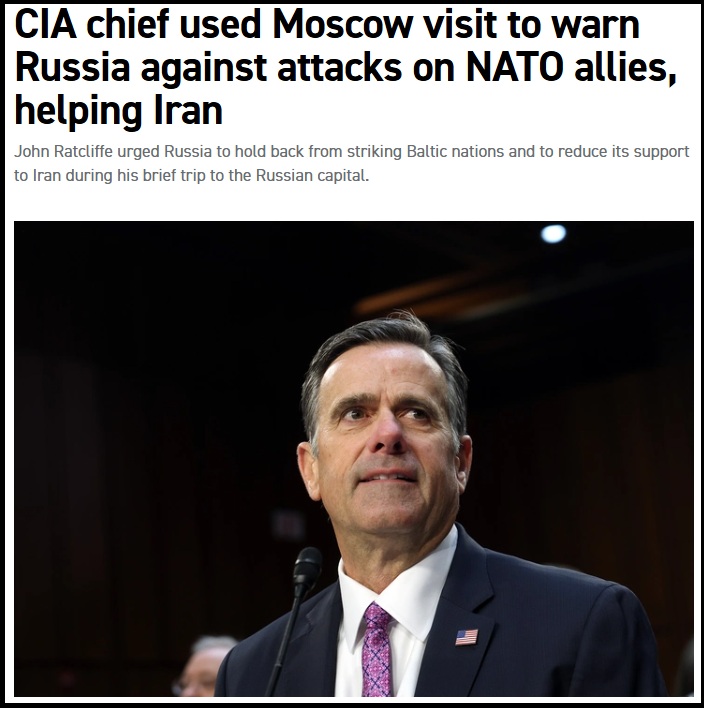
Western media are reporting that CIA Director John Ratcliffe traveled to Moscow, Russia, to warn his Russian counterpart Sergey Naryshkin, head of Russia’s Foreign Intelligence Service (SVR), about striking back against Baltic states. {CITATION} However, that’s only half of the story.
Director Ratcliffe wasn’t simply telling Naryshkin not to hit back; he was telling Naryshkin that European NATO provocations against the Russian enclave of Kaliningrad (between Poland and Lithuania) were not ‘fully’ sanctioned by the United States. {CITATION Aug 18}
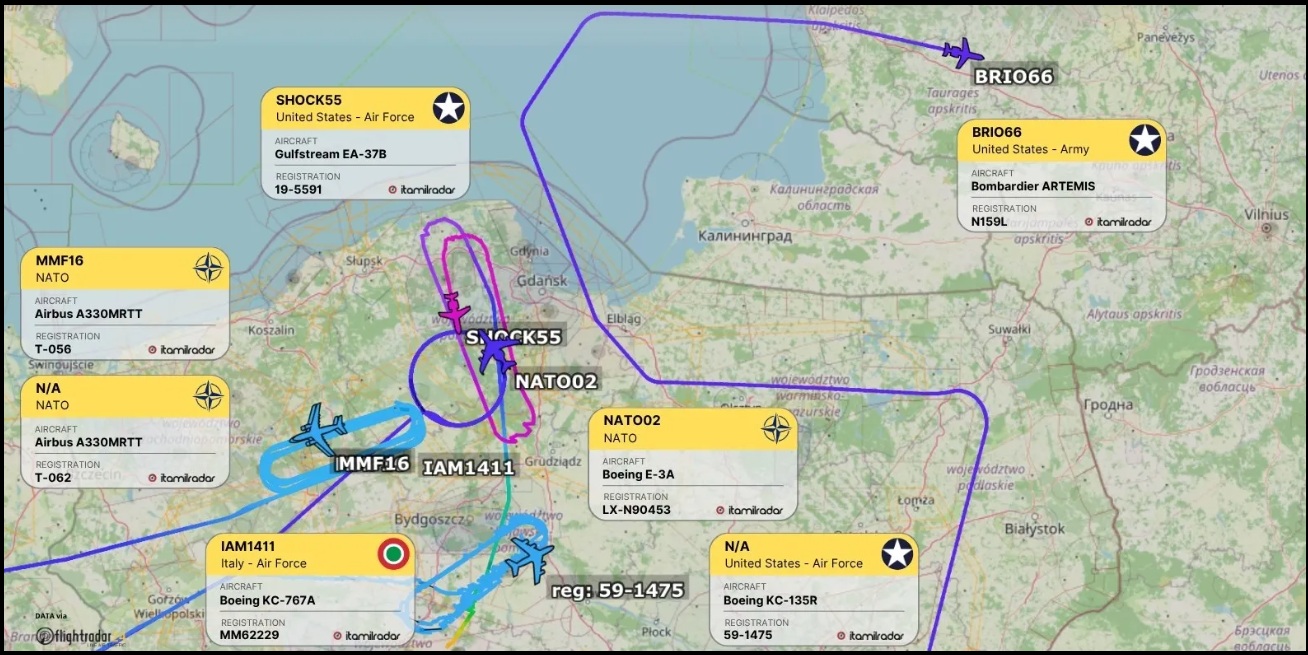
EU NATO members have been conducting provocative military operations and psychological warfare via NATO exercises all around Kaliningrad. They have been getting more aggressive with each series of maneuvers. The Trump administration (DoW) recently removed the head of U.S-NATO operations over this background strategy. What the western media will not tell us is that Lt. Gen. Charles Costanza, commander of the Army’s V Corps, was removed from command over this planned operation {citation Aug 7}.
Apparently, European NATO is increasingly trying to provoke expanded conflict with Russia, while President Trump and CIA Director John Ratcliffe attempt to tamp down the problems being created. This is all connected to the expanded drone activity recently reported in media (Germany – Leipzig airport and Romania citations}, which looks increasingly like covert Ukraine intelligence operations. There are some reports that western intelligence linked Russia to the Leipzig airport drone, so perhaps Director Ratcliffe also carried that intelligence message.
The bottom line is there’s a lot of sketchy ‘fog of war’ stuff happening, and U.S. intelligence has a responsibility to the Trump administration to try and contain any significant issues involving escalation. Hence, Ratcliffe’s message saying we are not trying to provoke you, so don’t put us in a situation where we end up defending NATO because you retaliate against all of this activity happening outside Ukraine’s borders.
Ukraine intelligence operations blew up the Nordstream pipeline {CITATION}, then dumped it in the lap of Joe Biden and walked away. That hot mess ended up with weeks of the U.S. having to fabricate some alternative narrative that Russia bombed their own pipeline. Ukraine intelligence services also carried out the bombing in Monaco {CITATION} then killed the Ukraine Intelligence asset to cover their tracks. Ukraine intelligence also carried out the bombing in central Moscow {CITATION – Balzi Rossi}.
So, who or what is essentially Ukraine Intelligence?
According to reports, a magnitude 4.4 earthquake on the Tibetan side triggered a massive ice avalanche, which then led to the flash flooding of the Bhotekoshi River in Nepal. Around 1,000 people are missing, and many have been killed.
New York’s Amish community is issuing an ultimatum to state bureaucrats: leave us alone or we’re packing up our buggies for greener pastures.
The threat has been sparked by a vaccine mandate fight that the 25,000 strong religious community is taking all the way to the Supreme Court.
It takes place as state Health Department officials continue to slap thousands in fines on tiny, one-room parochial Amish schools which have refused to comply with a Cuomo-era vaccine decree.
BERLIN. According to Forsa’s current „trend barometer“ for the news channels ntv and RTL, the AfD is in first place in eastern Germany (excluding Berlin) by a large margin. From the Baltic Sea to the Ore Mountains, 43 percent would vote for the opposition party if there were federal elections on Sunday.
Behind them are the Left Party with 16 percent and the CDU with 13 percent. The Greens and the SPD are tied with nine percent each. All other parties remain below the five percent threshold, including the FDP with three percent.
In August 2024, a hacker group called Handala breached the personal email of Ehud Barak, the former Prime Minister of Israel. Barak was one of Epstein’s closest associates.
Those emails were published by Distributed Denial of Secrets. Journalists Jack Poulson and Harrison Berger spent months going through them. What they found was a direct financial relationship between Ehud Barak and Scott Bessent, the man who is now running the United States Treasury.
Here is what the emails show:
(1) August 2013. Barak emails a senior Soros Fund executive about “ichiban,” a Japanese word meaning “number one.” It is the code name for a currency trade being run by Bessent at Soros Fund. The trade that would make $3.5 billion crashing the yen.
(2) December 2013. Barak emails about meeting with Bessent directly. He refers to Bessent as “Sterling” in the correspondence.
(3) May 2014. Soros Fund executives discuss seeding Bessent’s new hedge fund, Key Square Capital, with $100 million to $450 million. Barak is included in these discussions.
(3) February 2015. Barak has a direct meeting with Bessent scheduled. The emails reference ongoing financial discussions between them.
(4) May 2015. Discussions continue about Bessent’s fund launch and Barak’s financial involvement.
This is the same Ehud Barak who was business partners with Jeffrey Epstein. The same Barak who ran an intelligence-linked venture capital fund. The same Barak who was connected to Carbyne and TOKA, surveillance tech companies Epstein helped fund and sell to the US Government.
And Scott Bessent, who had this financial relationship with Epstein’s business partner, who was code-named in Epstein-adjacent communications, is now the Treasury Secretary of the United States.
The Senate had a chance to investigate. Ron Wyden tried to expand the Epstein probe to include financial connections like these. Senate Republicans blocked it, and in March 2026 they killed the bill.
The leaked emails exist. The financial relationship exists. The meetings exist. The Senate investigation was blocked. A follow the money on these financials would be revealing, so the question is why??
This is the man running the U.S. Treasury. The man weakening your dollar. The man who just got the president’s family a bank charter for their private digital dollar. The man who yesterday threatened to cut countries off from the dollar system entirely.
And his financial history runs through Jeffrey Epstein’s business partner.
In 2022, excavations at a cemetery in Pień, Poland, led by researchers from the Institute of Archaeology at Nicolaus Copernicus University, led to a mysterious discovery. In what they call Grave 75, they uncovered the 400-year-old remains of a young adult woman buried in a very unusual and unsettling way. A curved iron sickle was placed directly over her neck, with its blade pointing toward her throat, while a triangular iron padlock was attached to the big toe of her left foot.
Grave 75 was a woman who died at roughly 17–19 years old and was buried around the middle of the 17th century. Credit: Journal of Archaeological Science: Reports (2026). DOI: 10.1016/j.jasrep.2026.105967
A study published in the Journal of Archaeological Science: Reports pieced together archaeological and chemical clues to reconstruct the woman’s life, her death and the historical context for why she was buried so strangely.
A closer examination of her remains exposed tiny metallic threads near her skull, made of pure silver and gold-gilded wire from a luxurious silk headwear cap. These materials were incredibly expensive in the 17th century, suggesting she belonged to a wealthy family.
The analysis revealed that she was just 17 to 19 years old when she died, with radiocarbon dating placing her burial most likely between 1620 and 1674 CE at a 52.6% probability. DNA analysis found that she belonged to a rare maternal genetic lineage (haplogroup J1c2c1), with its origins in Scandinavia but virtually absent among modern Slavic populations. Yet isotope analysis of her childhood teeth showed she grew up locally in Pień.
CIA Director John Ratcliffe made an unexpected visit to Moscow, Russia, today.
According to flight data and new media reporting Director Ratcliffe flew into Latvia and from Latvia into Russia on a C-17 military transport plane.
VIA CBS – CIA Director John Ratcliffe is in Moscow, Russia, for meetings, sources familiar with the situation told CBS News on Tuesday.
We shall not speculate too much on the purpose and intent of the visit; however, overall, the direction points to intelligence sharing or notification.
Recently the British announced they would be sharing “storm shadow missile” technology with Ukraine in order for Ukraine to build them for themselves. The Storm Shadow (also known as SCALP-EG in France) is a Franco-British, long-range, air-launched cruise missile used for precision deep-strike attacks against high-value targets. Essentially, the Storm Shadow missile is the U.K version of the Tomahawk cruise missile.
Ukraine would be building those missiles with money provided by the EU from the confiscated Russian sovereign wealth fund. Russian Federation President Vladimir Putin likely doesn’t appreciate that very much.
According to Visegrad, “President Putin had a major event scheduled for today, with hundreds of people preparing for it. The event was canceled due to the visit of the CIA director, according to Kremlin pool journalists.” CIA Director John Ratcliffe is now returning home from Moscow.






 American Buddhist Net