The discovery could reshape how we study psychedelic compounds in nature and medicine
At West Virginia University (WVU), Corinne Hazel, an undergraduate major in environmental microbiology, examined morning glory plants for signs of protective chemicals. She wasn’t looking for new drugs or anything psychedelic. But nestled in the folds of a tiny seed coat was a hint of white fuzz.
That fuzz turned out to be a fungus that scientists had been seeking since the 1930s. And this included Albert Hofmann, the Swiss chemist who first synthesized LSD.
Hofmann offered the world LSD in the late 1930s by modifying a compound called lysergic acid, which he extracted from the ergot fungus Claviceps purpurea. That fungus grows on rye and other grains and is well-known for producing ergot alkaloids, a group of chemicals that can be toxic or medicinal depending on the dose.
Hofmann and others searched the plants for a fungus related to Claviceps purpurea, the rye-dwelling microbe that produces ergot alkaloids, a group of potent compounds with powerful biological effects. But for decades, that fungus remained a phantom.
Hazel found it almost by accident.
“We had a ton of plants lying around and they had these tiny little seed coats,” she said. “We noticed a little bit of fuzz in the seed coat. That was our fungus.”
With Panaccione’s guidance, Hazel extracted DNA from the fuzz and sent it for sequencing. The results confirmed what generations of chemists and botanists had only suspected: the morning glory harbored a previously unknown species of ergot-producing fungus.
“Sequencing a genome is a significant thing,” Panaccione said. “It’s amazing for a student.”
‘Science cannot solve the ultimate mystery of nature. And that is because, in the last analysis, we ourselves are part of the mystery that we are trying to solve.’ ~ Max Planck
Gödel’s Incompleteness Theorems demonstrate that any sufficiently powerful formal system contains truths that cannot be proven from within the system, implying that complete understanding requires a perspective outside the system.
In philosophical and theological interpretations, this limitation is often mapped to the distinction between immanent knowledge (within the system) and transcendent awareness (outside the system).
1. The Structural Limitation
Internal Incompleteness: Gödel proved that a system cannot prove its own consistency or grasp all its own truths; there are always statements that are true but unprovable within the system’s axioms.
The “Outside” Perspective: To comprehend the complete picture or verify the system’s consistency, one must step outside the logical framework, accessing a higher order of intelligibility or a “super axiom.”
2. Application to Buddhist Epistemology
Samsara vs. Nibbāna: In this analogy, the “system” represents Samsara (the cycle of existence and conventional logic), while the “outside” represents Nibbāna (the unconditioned state).
Transcendent Awareness: A being within the system (a sentient being) cannot cognize the ultimate truth of the system from within. Only by transcending the system—achieving Arahanthood or Buddhahood—can one “see things as they are” from the outside.
Greater vs. Lesser: Consequently, the “lesser” cognition (bound by internal logical limits and dualistic perception) cannot fully comprehend the “greater” transcendent awareness (which encompasses the total system from a non-dual, external vantage point).
3. Philosophical Implications
Limits of Human Reason: This aligns with the view that human reason and formal logic are inherently limited and cannot grasp ultimate reality without intuitive or transcendent insight.
God and the Super Axiom: Similarly, in theological interpretations, Gödel’s work suggests the existence of a higher intelligence (God) or “super axiom” that exists outside the created system, sustaining it from a position of complete knowledge that finite beings cannot access internally.
Thus, Gödel’s logic provides a formal mathematical basis for the idea that ultimate truth is inaccessible to the system itself, requiring a transcendent standpoint for full comprehension.
I would add that FIML practice allows us to step outside of the psycholinguistic system we use to communicate with our partner, and others. There is some chance FIML partners could become lost in a folie à deux, or shared psychosis, but odds of this are very low, imo, especially if partners frequently refer to philosophies, thoughts, ideas, and evidence outside of their world as a couple. FIML provides a kind of parallax for both partners psycholinguistic systems as well as the two systems working together as one. FIML cannot completely solve the inherent ambiguousness of interpersonal communication but it can improve our understanding (or resolution1) of our communications by at least one order of magnitude, or more. ABN
the process or capability of making distinguishable the individual parts of an object ↩︎
Bayesian belief or perspective in some respects possibly co-relates with FIML as both are able to update expectation based on accumulating data insight, particularly as a kind of Thomas Kuhnian or Zen insight. The more reductive method of scientific expectation cognizes realization, reality, as statistical summaries across repeated events. These two types correlate, in degrees, to Kantian Noumenon and phenomenon, and to his notion of categorical decisions.
Beginning with Cantor’s Uncountability and Power Set Theorems, then Godel’s two Incompleteness Theorems, and Tarski’s Undefinability of Truth Theorem, it is presently accepted proof in logic-mathematics circles that there is no earth-touching mudra Truth gesture within “Human, All too Human” ratiocination. Cf Wittgenstein’s “Whereof one cannot speak, thereof one must be silent.” Both Gautama’s mudra and Jesus’ comparable “mudra” of Silence standing in the “What is truth?” Biblical scene witness to a Truth-claim of Mind re which human inquiry thereat Cantor, Godel, Tarski, et al. have satisfactorily shown to be coincidentally incomplete and therefore indefinite.
__________
I completely agree with paragraph one above. That is precisely what FIML does and it is in line with both ancient and modern philosophy and modern mathematics and science. As for paragraph two, I also agree with it but want to add that Buddhist practice provides a fundamental experience, which is typically lacking in Western philosophy. That experience is the experience of the samadhi states, including nirvana which is the purest of the samadhi states. If we use words to describe nirvana, we might say it is the experience of pure awareness of pure consciousness. It is the knowable and observable ‘going out’ of delusion, leaving the experiencer with nothing but pure awareness. This is an attainable state in this life, achievable through meditation. ABN
To understand why CO₂ levels rise and fall over millennia, look at a glass of sparkling water.
When it’s cold, it stays fizzy. When it warms up, it goes flat as the CO₂ escapes into the air. The Earth’s oceans work exactly the same way. This is the principle of a solubility pump.
Cold water is a carbon sponge; warm water is a carbon chimney. Because the oceans hold 50 times more carbon than the atmosphere, even a tiny change in sea temperature causes a massive shift in atmospheric CO₂. This explains the time lag seen in ice core data.
Historically, temperature rises first, and CO₂ follows centuries later. Why? Because it takes a long time for the deep, cold thermal flywheel of the ocean to warm up enough to start releasing its stored carbon.
When the oceans finally warm—driven by those million-year Milankovitch cycles—they exhale CO₂. This natural outgassing is a primary driver of the atmospheric shifts we see in the geological record.
It is a biological and physical response to a warming world, not a trigger for a crisis.
The planet is essentially recycling carbon from its massive oceanic reservoir to its parched terrestrial landscapes. It’s a self-regulating system of incredible complexity and beauty.
In a recent episode of the American Alchemy podcast, Jesse Michels facilitated a thought-provoking dialogue between mathematician Eric Weinstein and astrophysicist Dr. Eric W. Davis, focused on the complexities surrounding Unidentified Aerial Phenomena (UAP). Over a four-hour conversation, they delved into the conspicuous absence of theoretical physicists in UAP-related programs, despite the presence of engineers and material scientists with direct knowledge of alleged crash-retrieval efforts. Weinstein’s frustration with this absence highlights a critical gap in understanding the physics behind UAP capabilities, suggesting that the challenges posed by UAPs extend beyond engineering to fundamental physics. The discussion raises crucial questions about the structure of research and the compartmentalization of knowledge in defense-related projects.
Weinstein’s analogy regarding the lack of physicists in UAP retrieval programs likens the situation to an orchestra missing its essential musicians, arguing that without the input of theoretical physicists, significant scientific advancements cannot be realized. Davis corroborates this notion by contrasting the disjointed nature of current retrieval efforts with the collaborative framework of the Manhattan Project, where various scientific disciplines worked cohesively towards a common goal. This point underscores a potential failure in the organization of UAP research, suggesting that a more integrated approach involving theoretical physics could be necessary to address the profound challenges posed by UAP phenomena.
The conversation also touches on the historical context of the Manhattan Project, illustrating how compartmentalization was a deliberate design choice rather than a flaw. This historical analogy serves as a lens to examine contemporary UAP research, prompting speculation about whether a similar compartmentalization exists today—one that may exclude physicists by design. The Wilson-Davis memo suggests that access to sensitive programs is tightly controlled, hinting at layers of classification that might keep theoretical physics work hidden from the engineers working on the retrieval efforts. This raises concerns about the efficiency and effectiveness of current UAP research frameworks and whether the critical insights from theoretical physics are being deliberately isolated from practical engineering applications.
Moreover, the discussion introduces the role of notable figures like Jeffrey Epstein and Robert Maxwell, who, through their connections to various scientific and governmental institutions, have been implicated in potentially surveilling or influencing the scientific discourse around advanced physics. Weinstein posits that Epstein may have had motives beyond finance, positioning himself at the intersection of theoretical physics and intelligence operations. This assertion, coupled with the exploration of the Department of Energy’s classification system, suggests that significant research related to UAPs may be occurring outside of public and even military scrutiny. The implication is that if physicists are indeed located in hidden layers of government or private institutions, the broader understanding of UAP technology and its implications remains obscured by both secrecy and a lack of interdisciplinary collaboration.
Researchers have found that humans are still evolving, and at a much faster rate than previously realised.
DNA analysis shows that over the past 10,000 years, the ginger gene has become more common among Europeans.
It means the red hair could increasingly become more widespread.
Other variants that appear to have become more common include a light skin tone, a lower chance of male-pattern baldness, a faster walking pace and higher intelligence.
Additional traits that have proliferated are a susceptibility to celiac disease, immunity to HIV, resistance to leprosy, a lower risk of rheumatoid arthritis and a lower body fat percentage.
‘…The sex lives of women with red hair were clearly more active than those with other hair colour, with more partners and having sex more often than the average,’ Dr Werner Habermehl, from the University of Hamburg, said. ‘The research shows that the fiery redhead certainly lives up to her reputation.”The sex lives of women with red hair were clearly more active than those with other hair colour, with more partners and having sex more often than the average,’ Dr Werner Habermehl, from the University of Hamburg, said. ‘The research shows that the fiery redhead certainly lives up to her reputation.
The White House has broken their silence on the disturbing string of deaths and disappearances involving scientists with knowledge of America’s biggest secrets.
During Wednesday’s briefing at the White House, Press Secretary Karoline Leavitt was asked for the first time about the ten people linked to space or nuclear secrets who have mysteriously died or vanished without a trace since 2023.
When asked if the Trump Administration was aware of the incidents and if the US intelligence community was already investigating whether they were connected, Leavitt did not have a definitive answer for reporters.
Among the most prominent voices dissatisfied with the government’s response to the alleged national security threat has been Tennessee Congressman Tim Burchett, who has claimed McCasland was deeply tied to the country’s secret UFO programs.
Burchett previously told the Daily Mail he had been demanding answers regarding the search for the retired general and others, but had received no answers from the US intelligence community – including the so-called ‘alphabet agencies’ such as the FBI.
‘I’ve been constantly ran down different rabbit holes with them, so I don’t have any need to talk to them at all,’ the congressman said in March.
‘The numbers seem very high in these certain areas of research. I think we’d better be paying attention, and I don’t think we should trust our government.’
Mushroom networks fire voltage spikes that travel consistently in one direction.
Scrambling the timing destroys the pattern, proving it’s biological, not noise.
The same signalling logic that brains rely on may be over a billion years old.
A neuron fires in milliseconds. A fungal thread takes three minutes to pass the same kind of message across two centimeters of wood shavings. The difference in speed is staggering, roughly 40 million-fold. But the underlying principle is the same: an electrical signal starts at one point and travels, directionally, to another. If that sounds like a coincidence, consider the timeline. Fungi and animals share a common ancestor that lived over a billion years ago, long before anything resembling a brain existed. The question isn’t whether neurons are impressive. They are. The question is whether they invented directional electrical signalling, or inherited it.
A new study by Andrew Adamatzky, a researcher at UWE Bristol, published in Scientific Reports, offers evidence for the inheritance theory. Adamatzky spent fifteen days recording the electrical activity of oyster mushrooms, Pleurotus ostreatus, the common edible variety you’d find in a grocery store. What he discovered is that fungi electrical signals don’t just flicker randomly. They propagate through the fungal network in one consistent direction, at a measurable speed, with a structure that disappears when you scramble the biological timing.
Fungi now join plants and slime molds in a growing catalogue of brainless organisms that can send electrical messages across their bodies. And because fungi split from the animal lineage so long ago, the capacity for this kind of signalling may be something life figured out well before it figured out nerves.
Adamatzky describes the mycelium as “a spatially extended excitable medium in which electrical signals propagate as ionic waves.”
The speed is telling. At 40 centimeters per hour, fungal propagation sits in the same range as ionic and calcium waves in plants and slime molds. All of these are incomparably slower than nerve conduction. But they share the same functional architecture: a signal that starts somewhere, moves directionally, and arrives somewhere else with a predictable delay. “Information is not encoded in fast all-or-none impulses but in the timing, duration, and spatial progression of slow electrical events.” writes Adamatzky.
Buddhism and Christianity meet at junctures like this. Buddhism is 100% about truth or as close to it as we humans can get. All Buddhist philosophy and practice falls into three categories: 1) morality and ethics; 2) mindfulness and samadhi; 3) wisdom or clear thinking, truthful thinking. The West is very strong in many areas, but weak in mindfulness and samadhi. Mindfulness and samadhi are fundamentally the experiential part of Buddhism, the experience of truth. For a Buddhist, a Christian who experiences spiritual truth is having a real experience. The Buddha used the word nirvana to describe ultimate spiritual experience, but if you want to call it grace or God’s love or some other word, that’s fine. Doesn’t matter how you get there either. A good Christian is as good as a good Buddhist. Buddhism is a living tradition based on a very deep Buddhist tenet — if something is true it is good Buddhism whether a Buddha said it or not. If something is not true, it is not good Buddhism, even if a Buddha said it. Buddhism is a living tradition because, based on sound evidence and experience, Buddhist practice and philosophy can and do change as the world changes; as our vocabularies change, as experiences and truth endeavors change, as new discoveries are made. On a personal note, I love these brave Christians. They do so much good. ABN
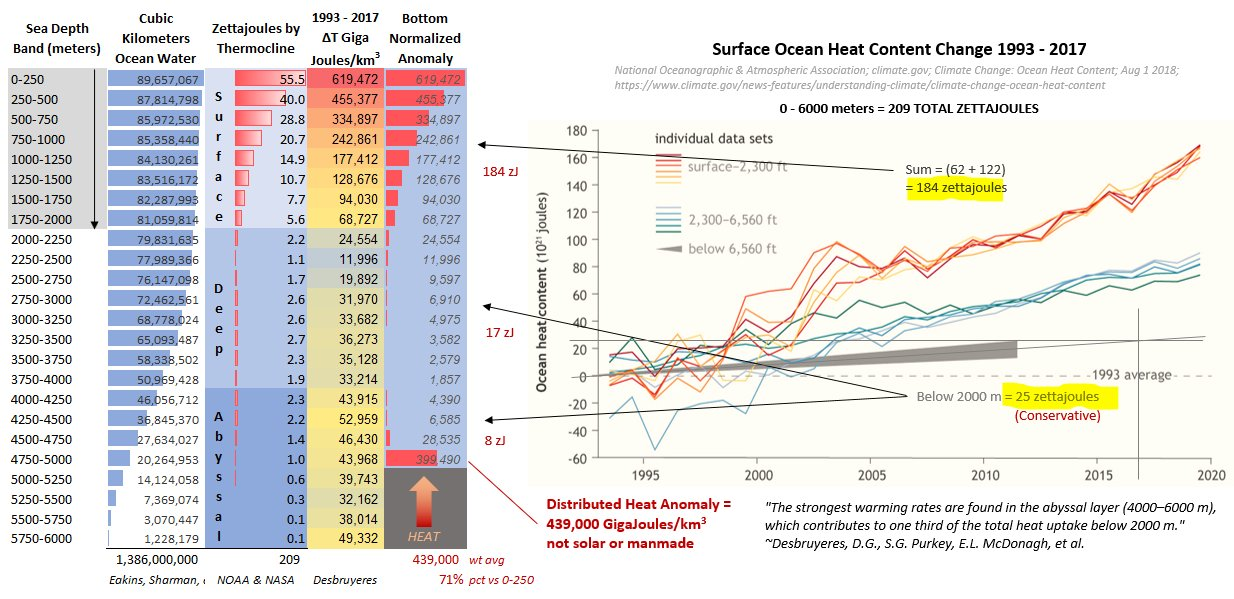
The entire heat capacity of the atmosphere is equal to the top 3.5 meters of the oceans. The remaining 3,700m of the abyss is Earth’s true thermal vault.
The truth is, the Earth is a water planet and oceans cover 71% of the surface to an average depth of 2.3 miles. Ocean currents carry warm water from the mid tropics to the northern hemisphere, then the currents return after a round trip of 1,000 years. Without these currents northern Europe would look like Greenland.
Warm waters from the Roman warm period (240BC to 400AD) are still just returning to the mid latitudes. The atmosphere by comparison is a gaseous envelope that retains almost no thermal energy, hardly any CO2 and is largely controlled by ocean dynamics.
The deep Pacific itself is so massive that it is only now receiving the cold waters from the Little Ice Age. We aren’t starting from scratch, we are mid-cycle in a 4.6-billion-year-old machine.
We’ve also reinvented the climate. Once, it was a word for the local weather of robins and sparrows. Now it’s a global ideological abstraction. We’ve lost our admiration for the natural world. We count CO2 in ppm while ignoring the satellite-proven greening of the Sahara.
It’s time to move past the light breezes and offshore winds and look into the deep. Ask yourself, is the 1.4°C warming since 1850 really an unprecedented crisis?
Most of us go through periods of stress in our everyday lives – but there are actually seven types of ‘hyperarousal’, according to a new study.
Researchers say the feeling of tension can be teased out into distinct subgroups.
This includes anxious, somatic, sensitive, sleep–related, irritable, vigilant and sudomotor – and each are characterised slightly differently.
Perhaps the most well–known, the ‘anxious’ feeling of tension, is defined by being worried or concerned about something bad happening in the future. It can also indicate feelings of guilt or fears about missing out on things.
Feeling ‘sensitive hyperarousal’ indicates emotional vulnerability and being easily startled, the scientists explained.
Another common source of tension is ‘sleep–related’ – defined by trouble falling or staying asleep and leading to trouble being mentally alert.
‘No previous study has addressed the unresolved question of whether hyperarousal may be one common…construct or rather has multiple dimensions,’ the team, from the Netherlands Institute for Neuroscience, wrote in the journal EClinicalMedicine.
‘This study discovered seven different dimensions of hyperarousal and provides a concise instrument to assess them.’
Psychology gets lots of stuff wrong, but generally does a good job with descriptive overviews like this. This study is based on a questionnaire of 467 adults, all of whom had some sort of psychiatric diagnosis. Seems worth thinking about. Anything well described constitutes or can lead to useful explanations, which may yield methods of control or intervention. ABN
While reading David Deutsch’s The Beginning of Infinity, I came across the following sentence:
What is needed is a system that takes for granted that errors will occur, but corrects them once they do—a case of ‘problems are inevitable, but they are soluble’ at the lowest level of information-processing emergence. (p. 141)
This statement comes from the chapter “The Jump to Universality,” in which Deutsch argues that “error correction is essential in processes of potentially unlimited length.”
Error correction is fundamental to FIML practice. In fact, the nuts-and-bolts of FIML practice could be described as being little more than a method for correcting errors “at the lowest level of information-processing” during interpersonal communication. This level is “the lowest” because FIML deals primarily with very short segments of speech/communication. In many posts, we have called these segments “psychological morphemes” or the “smallest speech/communication error” we can reliably identify and agree upon with our partner.
If you try to tackle bigger errors—though this can be done sometimes—you frequently run into the problem of your subject becoming too vague or ill-defined to be rationally discussable.
I haven’t read enough of Deutsch’s book to be sure of what he means by “universality,” but I do think (at this point) that FIML is universal in the sense that it will clear up interpersonal communication errors between any two qualified partners. “Qualified” here means that partners care about each other, want to optimize their relationship, and have enough time to do FIML practice.
We all demand that our computers be error-free, that buildings and bridges be constructed without error, that science work with error-free data as much as possible. But when it comes to communication with the person we care about most, do we even talk about wanting a method of error correction, let alone actually using one?
You can’t correct big errors if you have no method for correcting errors that occur “at the lowest level of information-processing,” to use Deutsch’s phrase. Once you can correct errors at this level, you will find that you and your partner are much better able to tackle bigger questions/errors/complexes. This happens because having the ability to reliably do small error-correcting gives you the capacity to discuss bigger issues without getting lost in a thicket of small mistakes.
Your ability to talk to each other becomes “universal” in the sense that you can tackle any subject together and are not tethered to static ideas and assumptions about what either of you really “means.”
FIML does not tell you how to think or what to believe. In this sense, it is a universal system that allows you and your partner to explore existence in any way you choose.
To use Deutsch’s words again, “error correction is essential in processes of potentially unlimited length.” Your relationship with your partner can and should be a “processes of potentially unlimited” growth, and error correction is essential to that process.