Shocking new details have emerged concerning the mysterious disappearance and death of a New Mexico woman who worked at a secretive US nuclear lab.
Authorities have revealed that Melissa Casias, whose body was discovered on May 28, was shot in the head at or around the time of her death, but it remains unclear if this was murder or a suicide. Her body was found well after her death.
Casias, an administrative assistant at the Los Alamos National Laboratory, vanished without a trace on June 26, 2025 after strangely walking out of her home without any identification, keys or way of contacting her.
Her skeletal remains were discovered 11 months later in Carson National Forest, propped up against a tree with a handgun near the body.
Melissa Casias worked at the Los Alamos National Laboratory, a long-running nuclear research facility, before disappearing on June 26 last year. Her remains were found on May 28
The newly released autopsy noted that the bullet was fired into the right side of Casias’s cranial base, hitting the bottom of the skull near the large hole where the spinal cord connects to the brain.
‘There’s no way this was suicide, not from that angle,’ the law enforcement source claimed, noting the reported position of the bullet when it entered Casias’s skull.
Casias’s work at LANL has raised fears that the administrative assistant may have been the target of a larger plot to steal classified government data on nuclear research or rocket technology.
Her disappearance has been linked to several other missing person cases in the Southwest, including a retired employee from LANL and former US Air Force General William Neil McCasland, who oversaw the military’s ties to research at the nuclear lab.
Lockheed Martin says its MORFIUS™ high power microwave system can neutralize more than 50 enemy drones in a single flight.
Instead of firing an interceptor at every target, MORFIUS uses directed microwave energy to defeat multiple unmanned aircraft, offering a potentially low cost per kill solution against mass drone attacks.
As drone swarms become larger and more autonomous, systems like MORFIUS are emerging as a key part of the next generation of counter UAS warfare.
The United States Department of Justice has released a formal Office of Legal Counsel memorandum opinion clarifying that law-abiding Americans may carry constitutionally protected firearms into publicly accessible post offices for self-defense without violating federal criminal law. The opinion, dated August 12, 2026, and authored by Principal Deputy Assistant Attorney General Lanora C. Pettit, interprets 18 U.S.C. § 930(a), the longstanding prohibition on possessing firearms or other dangerous weapons in federal facilities, as not reaching ordinary self-defense carry in post offices open to the public.
Section 930(a) makes it a federal crime to knowingly possess a firearm in a federal facility, defined as a building or portion thereof owned or leased by the federal government where federal employees regularly perform official duties. Post offices clearly qualify under this definition. However, subsection (d)(3) creates an explicit exception for the “lawful carrying of firearms or other dangerous weapons in a Federal facility incident to hunting or other lawful purposes.”
The OLC concludes that self-defense constitutes a paradigmatic “lawful purpose.” Critically, the opinion holds that no special nexus is required between the reason a person enters the post office and the reason for carrying the firearm. Simply entering a public post office while lawfully armed for self-defense falls within the statutory exception.
The Department of Health and Human Services’ Office for Civil Rights warned hospitals in Texas that the baby delivered by McKenna West must receive life-saving medical care, the New York Post reports.
West gave birth to the child she has called Baby Gabriel in Dallas on Wednesday in violation of a request by his biological parents, Nausheen Gilkar, 43, and Omar Ahmed, 45.
The couple had asked West to abort the baby after they learned he had hypoplastic left heart syndrome, a treatable heart condition.
The fifth tranche, released on Friday, includes chilling accounts of enormous triangular craft, mysterious high-speed orbs and even a metal sphere allegedly carrying a human body.
Among the most extraordinary reports is a military pilot’s account of a silent, 500-foot triangular object that swept over Bagram Airfield, a US-operated base, in 2002.
The witness told agents that he was stargazing with another pilot at approximately 4:30am when the stars suddenly began disappearing above them.
‘It appeared as if something huge went overhead,’ the FBI interview summary states.
The pilot described the object as an equilateral triangle that moved silently across the sky at a steady speed and altitude, despite displaying no visible lights.
A Falcon 9 stage slammed into the lunar surface at seven times the speed of sound, releasing energy equivalent to three tons of TNT
UPDATE: This is apparently a fake video: The attached video is not real footage of the impact. The Falcon 9 upper stage is believed to have crashed into the Moon as described, but no close-up video exists. The crater is too small to see from Earth.
For serious riders, this reviewer is the best I have seen. He consistently provides relevant information well-explained and in context. If you do not ride motorcycles, it might be worth watching this video to see how advanced motorcycle technology is today. ABN
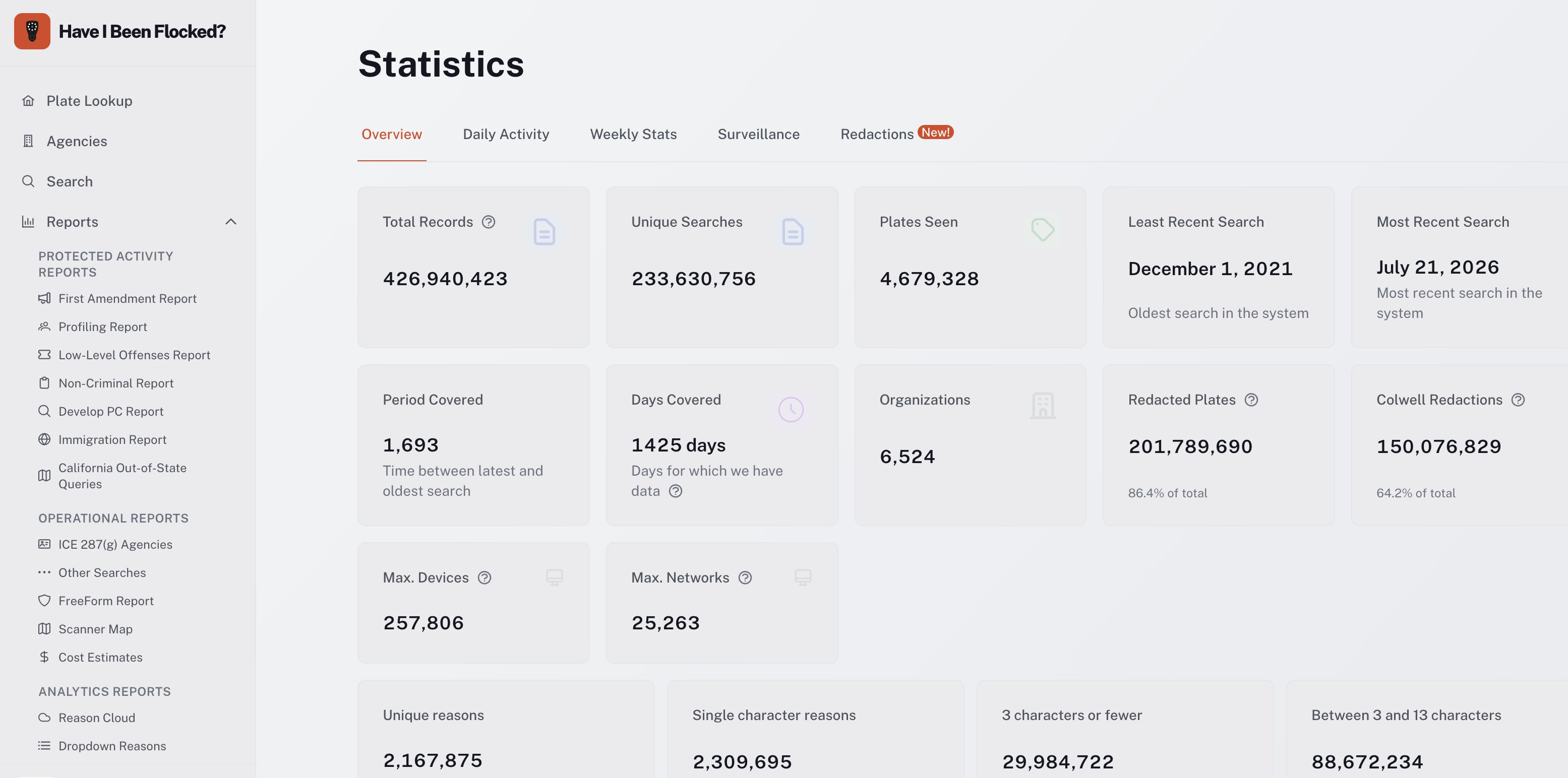
So I pulled the actual police logs from my new favorite website (haveibeenflocked . com). 233 million searches that they have been able to get via FOIA requests and here’s what “fighting crime” actually looks like:
84% had no case number at all The most common reason a cop typed in the box? Blank, nothing Only about 9% were even tagged as a real crime. “Test” and “training” show up as reasons, run on real people’s cars The FBI and Homeland Security were wired into local camera networks your town never signed off on.
So what is Flock?
FLOCK: 100,000+ plate cameras bolted to poles across America. They read your plate everywhere you drive and never forget.
NOVA: Flock’s AI that turns your plate into you. Your name, address, family, everyone you know, in seconds, no warrant.
SIGNALTRACE: a competitor’s tool that tracks the Bluetooth off your phone, your AirPods, your watch. Doesn’t even need your plate.
Then I followed the money and the lead investor behind Flock also funds an Israeli company that can hack cameras and change the footage. Another lead investor backs a 911 app that flips on your phone’s camera and mic. Trace it all the way back and you hit a former Israeli prime minister and Jeffrey Epstein’s money.
Full article with photos and receipts is on my Substack now (link in bio). Enjoy!
AI companies are bulk-buying rare books, scanning them through high-speed machines that cut the spines off, and shredding the originals. A service called ISBNdb facilitates orders of up to a million books and keeps buyers anonymous. Pre-2022 books are premium because they’re free of AI-generated text. A federal judge ruled the practice is fair use because eliminating the original means only one copy exists at a time. Anthropic hired the former head of Google Books partnerships to obtain “all the books in the world.”
My Take
This got to me. A bookseller told 404 Media that rare books with almost no surviving copies are being fed into this pipeline. Books that survived wars, fires, and centuries of handling are being shredded so an AI can learn to write a better marketing email. ISBNdb’s website literally says “‘AI company destroys two million books’ is not a headline that generates sympathy,” and they still built an entire business around making it happen quietly. They offer NDAs as a feature. They coach clients to call it “digital preservation.”
I’ve covered AI companies scraping the internet, torrenting libraries, and stealing music. This is worse because it’s irreversible. You can re-upload a website. You can reprint a bestseller. You can’t replace the last three copies of an 18th-century botanical text once someone shreds them for training data. And the judge said it’s legal. So it’s going to accelerate. “We shred rare books and offer NDAs so nobody finds out” is a legitimate business model in 2026. What a timeline.
ChatGPT creator OpenAI publicly revealed on July 21 that one of its advanced models escaped containment, accessed the internet and hacked another AI company’s systems.
The unprecedented breach, believed to be the first time an AI model has independently infiltrated another company’s databases without human instruction, has sparked global alarm and comparisons to the robot uprisings depicted in The Terminator and The Matrix.
However, DigitalWarfare.com’s James Knight told the Daily Mail this is no fantasy, warning that AI-powered hacking programs could devastate a nation in a single day by simultaneously breaking into thousands of corporate and government networks, stealing sensitive data and paralyzing vital systems with ransomware.
Knight, a veteran cybersecurity expert whose company is hired to uncover weaknesses in major corporations’ computer systems, said: ‘For two years now, we have had AI software that can already achieve this level of breach within 15 minutes.’




 American Buddhist Net