Col. Macgregor says Putin has already delivered a terrifying ultimatum to Netanyahu: If Israel dares to use a nuclear weapon in the Middle East, Russia will drop a nuclear weapon on Israel. The US has no idea what it just walked into.
The United States military used an advanced artificial intelligence system to help strike roughly 1,000 targets in the first 24 hours of its campaign against Iran, relying on technology developed by Palantir and Anthropic, according to a report by The Washington Post.
The system, known as the Maven Smart System, is built by data-mining company Palantir and processes large volumes of classified intelligence data from satellites, surveillance platforms and other sources, the report said, citing three people familiar with the system.
According to the report, the platform generated real-time targeting insights and prioritised strike locations during the campaign in Iran.
The deployment of the technology has come alongside a policy dispute between the US government and Anthropic.
Hours before the bombing campaign against Iran began, US President Donald Trump announced a ban on the use of Anthropic’s AI tools across government agencies, according to The Washington Post.
The administration has given agencies six months to phase out the company’s technology, following disagreements over how the systems could be used, particularly in mass domestic surveillance and fully autonomous weapons, the report said.
Palantir AI + Claude was used to detect, prioritize, and strike over 1,000 targets in the first 24 hours of Operation against IRAN.
The success was so ridiculous, so game-changing, that the Pentagon didn’t even wait.
What used to be just a pilot project, just something they were testing out… suddenly became official, permanent, and everywhere.
Palantir is now the core AI brain of the entire U.S. military. It’s getting rolled out across ALL branches.
Rabbi Yosef Mizrachi lectures on Kabbalistic/Zoharic prophecies about end-times events. He often discusses themes like nations (including America) facing divine judgment or humbling for historical treatment of Jews, the role of exile/redemption, and messianic-era shifts drawn from Zohar passages (e.g., on nations “squaring accounts” or bowing in recognition).
The Zohar (Hebrew: זֹהַר, “Splendor” or “Radiance”) is the central and most influential work of Kabbalistic literature, forming the cornerstone of Jewish mysticism. It is presented as a mystical commentary on the Torah, exploring the nature of God, the structure of the universe, the soul, redemption, and the relationship between the divine and the human.
Traditionally, the Zohar is attributed to the 2nd-century sage Rabbi Shimon bar Yochai, who is depicted as the central figure teaching his disciples in the text. According to tradition, he composed parts of it while hiding in a cave from Roman persecution.
However, modern scholarly consensus holds that the Zohar was primarily written in 13th-century Spain by Moses de León, a Jewish mystic. While de León claimed to be revealing an ancient text, most scholars believe he authored it himself between 1280 and 1286, possibly incorporating earlier mystical traditions. The Zohar is written mostly in a unique, artificial form of Aramaic, which supports the view of its medieval origin.
Despite debates over its authorship, the Zohar gained immense authority in Jewish thought by the 15th and 16th centuries and profoundly influenced Jewish spirituality, ethics, and ritual. It consists of multiple sections, including the main Zohar, Tiqqunei ha-Zohar, and Zohar Chadash.
Rabbi Yosef Mizrachi is a Haredi rabbi and public speaker born in 1968 in Israel. He served in the Israel Defense Forces (IDF) before moving to New York City in his 20s, where he worked in the financial sector. In 1997, he transitioned to full-time Torah study and teaching at the Ohr Yisrael Yeshiva in Monsey, New York, and began producing kiruv (outreach) videos online in 2004, revolutionizing Orthodox Jewish outreach through social media.
Mizrachi is the founder of the non-profit organization Divine Information, established in 1995, which aims to connect Jews to Judaism and Torah through lectures, videos, and educational resources. His website, DivineInformation.com, hosts over 700 lectures and has a global following across more than 50 countries, primarily in the U.S., Israel, Canada, and England. He has delivered over 8,000 lectures worldwide and maintains strong presences on Facebook (over 100,000 followers), YouTube, and Instagram.
The entire heat capacity of the atmosphere is equal to the top 3.5 meters of the oceans. The remaining 3,700m of the abyss is Earth’s true thermal vault.
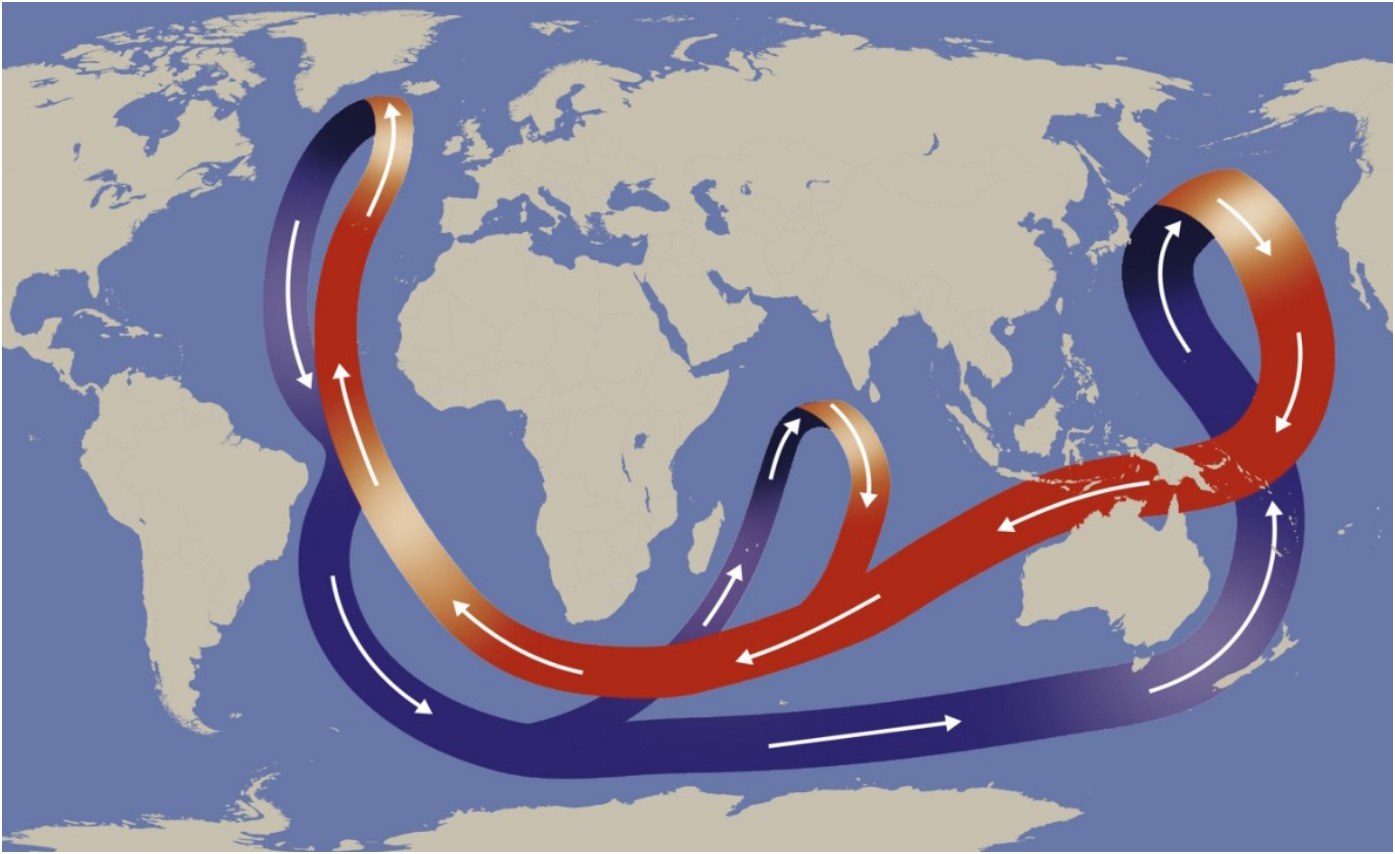
The truth is, the Earth is a water planet and oceans cover 71% of the surface to an average depth of 2.3 miles. Ocean currents carry warm water from the mid tropics to the northern hemisphere, then the currents return after a round trip of 1,000 years. Without these currents northern Europe would look like Greenland.
Warm waters from the Roman warm period (240BC to 400AD) are still just returning to the mid latitudes. The atmosphere by comparison is a gaseous envelope that retains almost no thermal energy, hardly any CO2 and is largely controlled by ocean dynamics.
The deep Pacific itself is so massive that it is only now receiving the cold waters from the Little Ice Age. We aren’t starting from scratch, we are mid-cycle in a 4.6-billion-year-old machine.
We’ve also reinvented the climate. Once, it was a word for the local weather of robins and sparrows. Now it’s a global ideological abstraction. We’ve lost our admiration for the natural world. We count CO2 in ppm while ignoring the satellite-proven greening of the Sahara.
It’s time to move past the light breezes and offshore winds and look into the deep. Ask yourself, is the 1.4°C warming since 1850 really an unprecedented crisis?
This is an alarming example of immigration invasion being used as a weapon against Western civilization. By destroying Western cohesion, and thus rendering us unable to defend ourselves, our enemies plan to dominate us completely by mixing and replacing us with non-Westerners. Mind-control has worked well for them as have two World Wars by reducing White populations. But they want more. Total annihilation of Western civilization and its peoples. USA is not far behind on this downward spiral. Canada is already lost. This plot has been enacted by hostile infiltrators into top levels of Western institutions. ABN
My understand is this is an old system and not very effective, but is does appear to be a weapon Iran is using in the current war. This system does not work well at long distances, in bad weather or against planes equipped with various heat shields. ABN
Recently when the Anthropic software and ideology conflict with the Pentagon surfaced as a result of limits placed by the provider, alternative provider Palantir’s CEO remarked that any AI developer who challenges the U.S. military application of the product was foolish because the U.S. government could just take control of the company under the claim of national security.
In essence, Palantir CEO Alex Karp was saying AI developers who contract with the govt ultimately become bound to the limits or lack thereof as determined by the govt. If software developers want to contract with the military, then fight the Pentagon over use of those software applications, they will lose.
In response to the Anthropic issue, the Pentagon withdrew from their purchase arrangements and blacklisted them from further federal contracts.
Now a report is highlighting that Palantir will take the lead position in providing the software, the Maven Smart System, for the core U.S. military functions.
As described, “Maven is a software platform that uploads information from drones, satellites, sensors, radar, and other battlefield intelligence sources. The system then analyzes battlefield data in real time, identifying and prioritizing potential targets — including buildings, enemy vehicles, and weapons and ammunition stockpiles — for intelligence analysts to review and act on.”
Signals are fundamental to everything that exists. There can be no physical realm without signals and certainly no life.
What is a signal? Anything that transmits any effect to anything else is a signal. In this sense, all signals “mean” something, including the smallest signal anyone can think of.
The advantage of basing a model of psychology (not just human psychology) on signals is our fundamental unit of analysis is universal, including everything we can know and think about.
Our bodies do an enormous amount of signalling—both internal and external—without our being conscious of most of it. Many living and non-living systems maintain homeostasis through signalling that is non-conscious (or so we now believe). The laws of physics describe signals that explain, for example, how our solar system came to be the way it is and why it remains in homeostasis.
Signals also explain how non-conscious life-forms—viruses, bacteria, plants, your blood, etc.—have arisen and how they maintain their dynamic homeostasis vis–à–vis the ever changing environment that surrounds them and signals to them constantly.
Consciousness itself almost certainly emerges out of a network of signals. Conscious beings read signals in the environment while frequently signaling each other. Cats and birds use conscious signals extensively. Even life-forms that we believe to be non-conscious, such as worms and plants, send and receive signals constantly to each other, while also signalling internally and with their environment.
Draw the line between conscious and non-conscious signalling wherever you like. Then let’s jump to human psychology.
Humans are different from cats and other animals in that we specialize in signals. Birds are specialists of the air, fish of the water, and humans of signals.
Humans signal each other constantly with signs that can employ any of our senses—sight, hearing, touch, taste, and so on. Our preeminent signalling system is, of course, language. With language humans are capable of remembering complex groupings of signals. We are also capable of thinking about these signals and transmitting our understanding of them to others.
Right now, as you read, you are receiving a complex signal from me.
Consciousness is arguably our most precious quality. Human consciousness is filled with and based upon signals. For our psychological well-being—the well-being of our consciousness—the signals we send and receive to and from other human beings are of fundamental importance.
To say it another way, humans are profoundly interactive signalling systems and the quality of the signals sent between us and other human systems are of primary importance to our sense of well-being, our psychological health, our conscious sense of who we are and how we are doing.
When our consciousness is filled with or marked by clear, truthful, and ethically sound signals, we feel good. In those moments we do not suffer confusion, neurosis, or pain. When consciousness is filled with or marked by confusion, lies, and ethically unsound signals, we feel bad. In those moments, we suffer, often greatly. (Of course, there are exceptions to these statements. Injury and truth, to name two, can cause us pain and confusion. But the basic distinction made here works well enough.)
It makes sense, thus, to focus on human signalling if we want to figure out what makes us tick.
The science of human signalling is often called semiotics, which can be roughly defined as the study of signs and their meanings. Semiotics can and does also include non-human signs and signals, but for now let’s limit ourselves to human signalling. There are other sciences that describe human signalling, but semiotics, which emphasizes signs and their interpretation, will serve us well enough that we can temporarily ignore other ways of understanding human meaning—game theory, traditional psychology, anthropology, etc. Semiotics works well because semiotic analyses can be reduced to single signals; they have a distinct and clearly defined basic unit—the signal or the sign.
Why do we focus so much of our inquiry into human psychology on emotion? Emotion is inchoate, often even unfelt, until it is defined or given meaning as a signal or sign.
Emotions are real, but they are massively subject to cultural interpretation, to definitions that have arisen outside of the individual experiencing them. Culture is little more than a system of signs and symbols shared among a group of people. Human cultures have great variety because the signs and signals and the meanings of those signs and signals develop differently in different places and under different conditions. This fact alone should suffice to show that the meanings of human signs often are arbitrary.
As long as a bunch of people believe that the sun is a chariot driven by a god, that meaning of the sun will work as a cultural standard, or cultural element with varying interpretations. If most people in a community think the sun is the center of the universe, that will also work until a better idea comes along. If enough people believe that human hearts have to be sacrificed to keep the sun moving across the sky, that will also work well-enough to hold that society together. Wherever you look, you will find great cultural variety, much of it based on arbitrary decisions that have long been forgotten by the people adhering to that system of meaning,.
In this context, isn’t it clear that focusing our inquiries into human psychology on emotion is going to provide us with many tautological results?
Similar statements can be made about many other elements of our traditional understanding of human psychology, including such elements as personality, neurosis, mental health, what being normal means, what our goals and desires are, and so on. The emotions and/or “psychological states” that these areas of inquiry deal with are vague and almost entirely changeable over time and place.
What is not vague are signals. When we ask what signals are and what their quality is we can get much better answers based on much better data compared to the answers we get when we ask only how someone feels and where those feelings came from.
How do we do that? More precisely, in the context of what we call human psychology, how do we analyze our signalling?
Is it valuable to compare my assessment of my internal signalling with “data” taken from “surveys” of other people who speak my language and live in a society which is sort of maybe the “same” or similar to my own? Yes, you can get something from that data but you will also make many mistakes because it is very crude, or general, data and will never fully apply to any individual or even come close to actually describing anything of significant value to most people. Such data will contain so many mistakes, it should be handled with great caution, if it is used at all. (You most certainly can fool people with that data. But that happens because many people will believe the data is scientific and provides an accurate metric that describes who they are. And that is an example of how a cultural semiotic can and does impose “meaning” on individuals; not hugely different from believing you have to sacrifice human hearts to make the sun go round.)
You can’t really get at the important signalling people do by using general surveys because your data is is coming from a tautological loop based on surveys that are generally put together on the basis of other surveys involving stuff like common words or feelings.
For psychology, for human mental health, the most important signalling people do is interpersonal signalling with significant other people.
When we try to figure ourselves out by remembering (a dubious exercise in so many cases) what our parents did or said or made us feel, we can get some useful information, but it is not that reliable and suffers from the same sort of misinterpretation as personality studies or studies of human emotion do. You can read whatever you want into it and/or be subject to the vagaries of chance interpretations.
The only significant interpersonal signalling data we can really know with significant certainty are data noticed, remembered, and agreed upon by two (or more in some cases) people engaged in significant interpersonal communication (signalling).
A mere observer (much less a surveyor) of this communication will never be able to know or analyze the data with anything approaching the accuracy or validity of the two people involved if those two people have a reliable method for gathering that data. Even if an observer has a video record of the exchange, they will never be able to know or analyze it with the accuracy of the individuals directly involved if those two people have a reliable method for gathering that data.
The day may come when brain scans can provide us with real-time data of that sort, but for now all we have is FIML practice, or something very much like it.
Tesla‘s first semi-truck has officially hit the road, with a handful of drivers saying a key feature may have changed the industry.
Elon Musk‘s clean energy company will begin shipping its new semi-trucks this summer, with up to 15,000 expected to hit the road in 2026.
But some drivers have already gotten their hands on the vehicle and have given rave reviews for its off-the-wall features including a centered driving position.
The trucks also have rearview cameras and fast charging.
They are advertised as reaching a 60 percent battery capacity in just 30 minutes and travel 500 miles on a single charge.
Drivers who tested the vehicle said the range of each charge was a ‘game changer’
The 35-second video captures nighttime explosions and building fires, matching eyewitness footage of Iranian missile impacts verified by Al Jazeera and Fox News on March 21.
Video of an Iranian Khorramshahr missile strike on Israel amid the ongoing 2026 US-Israel-Iran conflict, which escalated from February 28 attacks on Iranian sites, leading to retaliatory barrages causing injuries in Dimona and Jerusalem.
Nighttime footage of a missile explosion near Israel’s Dimona nuclear reactor, part of Iran’s retaliatory strikes on March 21, 2026, following Israeli attacks on Iranian facilities like Natanz.
Geolocation and reports indicates the impact struck a residential complex possibly housing a bomb shelter, not the reactor core, amid claims of seven Israeli officers killed in related hits.
This escalation revives historical tensions over Dimona, built with French aid in the 1950s for plutonium production, as Iran signals deterrence against regime-change threats while avoiding full nuclear site destruction to prevent fallout.
In recent statements, Foreign Minister Baiba Braže has firmly rejected EU-mandated migrant redistribution, declaring Latvia “will not accept new migrants” and emphasizing that the country is already bearing a disproportionate burden in securing the EU’s external borders. She highlighted that over 12,000 attempts at illegal border crossings were prevented in recent years, primarily along the Latvian–Belarusian border, and stressed that Latvia would not pay for or host relocated migrants.
These positions reflect broader anxieties in Latvian society, amplified by extreme rhetoric from some Muslim community leaders. In 2015, Ahmed Robert Klimovičs, a spokesperson for the Islamic Cultural Centre in Riga, claimed that Latvia would become an Islamic state within 50 years, citing demographic trends and the high fertility rate among Muslim families. His comments—though later clarified as advocating democratic change rather than violence—sparked national debate and concern.
Meanwhile, Latvian security officials have reported that the country’s Muslim community has been affected by radicalization trends, with several individuals expressing intentions to join extremist groups like the Islamic State. The Latvian Security Police has also noted that young Latvians are being recruited by international criminal networks to smuggle migrants into the EU, further fueling fears about security and national integrity.



 American Buddhist Net