BOMBSHELL: We Found the Money Trail Connecting Erika Kirk’s Family to DoD Military Tech Why is a $34M Fraud Associate Signing Lori Frantzve’s Defense Contracts?
EARLIER THIS WEEK: Candace Owens blew the lid off the Erpenbeck crime family connection, but the rabbit hole goes infinitely deeper. It leads straight into the military-industrial complex, Fort Huachuca, and the very drones spotted buzzing above Utah Valley University on the day Charlie Kirk was assassinated.
Here are the receipts proving that TPUSA is now in the hands of a family deeply embedded in federal defense contracting, organized fraud, and intelligence operations.
1* THE FRONT COMPANIES & CAGE CODES: Lori Frantzve (Erika Kirk’s mother) isn’t just a shady businesswoman—she is a registered U.S. defense contractor. She operates E3TEK Group, Inc. out of Scottsdale, AZ, under the Department of Defense CAGE Code 3J3R1. She also runs a subsidiary called AZ-TECH INTERNATIONAL, INC. Between these entities, Lori has quietly secured over $5 MILLION in estimated federal awards.
2* SELLING MILITARY DRONES: What exactly is Lori selling to the federal government? Military drones and defense tech (along with solar panels designated for Native American land).
Let’s connect the dots: On September 10, 2025, multiple witnesses reported unauthorized, military-style drones operating in the airspace around UVU during Charlie Kirk’s assassination. Erika Kirk’s mother is literally a multi-million-dollar government drone supplier. This is no longer just a coincidence.
3* “UNCLE RICK” IS ON THE PAYROLL: Remember Richard Erpenbeck? The man Erika calls “Uncle Rick,” whose brother served 20 years for a $34 million bank fraud scheme and whose father was convicted of a murder-for-hire plot?
Corporate filings for Lori’s defense subsidiaries explicitly list Richard Erpenbeck as a key associate. A family known for staggering financial fraud and burying cash on golf courses is now running multi-million dollar defense contracts and standing adjacent to the CEO of a billion-dollar conservative platform.
4* THE FORT HUACHUCA & INTELLIGENCE TIE-IN: Erika’s childhood “Tesseract” (Looking Glass) school was directly connected to Fort Huachuca, the U.S. Army Intelligence Center of Excellence. Witnesses already placed Erika, Brian Harpole, and Cabot Phillips at Fort Huachuca just days before the assassination.
Combine an Army Intelligence-vetted childhood, a mother selling military drones to the DoD, and a family history of racketeering, and the picture becomes terrifyingly clear. They are intelligence assets.
5* THE GRID COALITION: Lori’s companies are also deeply tied to the Secure the Grid coalition, involving established defense insiders like Frank Gaffney and Tommy Waller. They aren’t grassroots activists; they are entrenched military-industrial players who have successfully executed a hostile takeover of Charlie Kirk’s legacy.
TPUSA donors and the America First movement need to wake up. Charlie was an anti-war populist. His billion-dollar empire is now controlled by a family of defense contractors, fraudsters, and intelligence operatives.
There is an additional video with receipts at the link above that I am unable to post. The video above with Candace gives important background to this part of the story. ABN
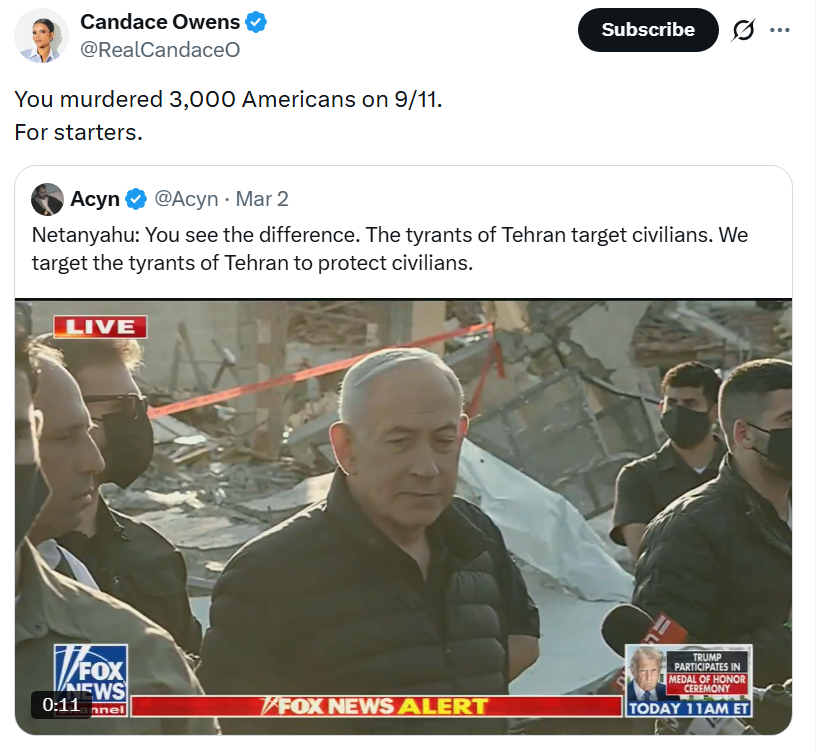
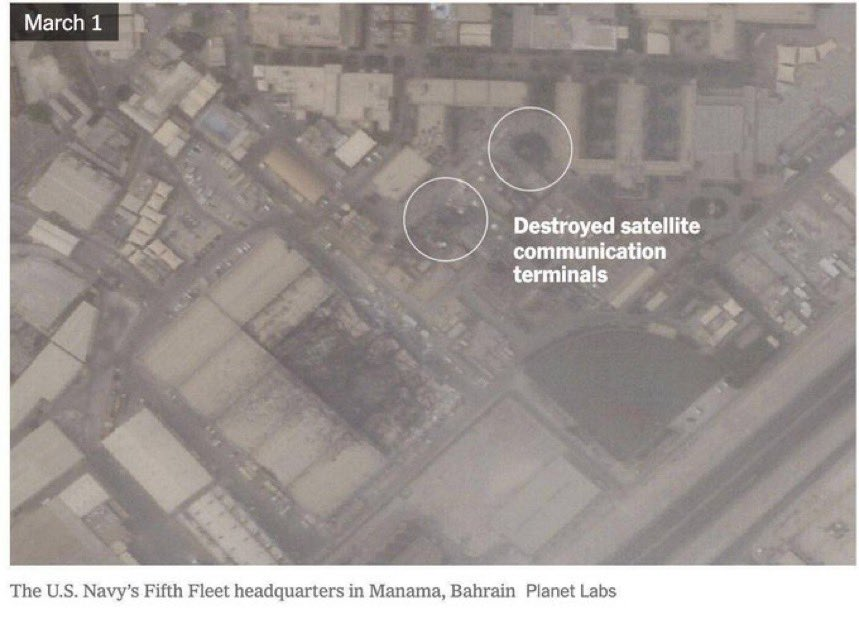
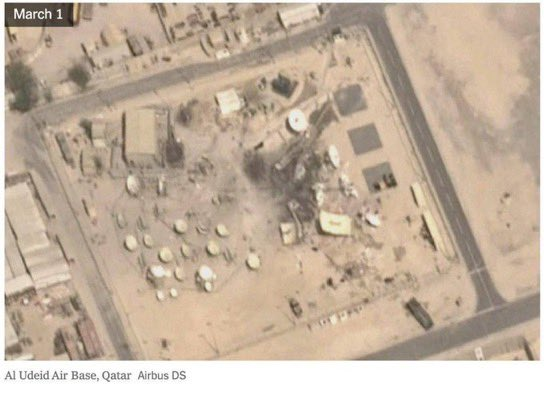
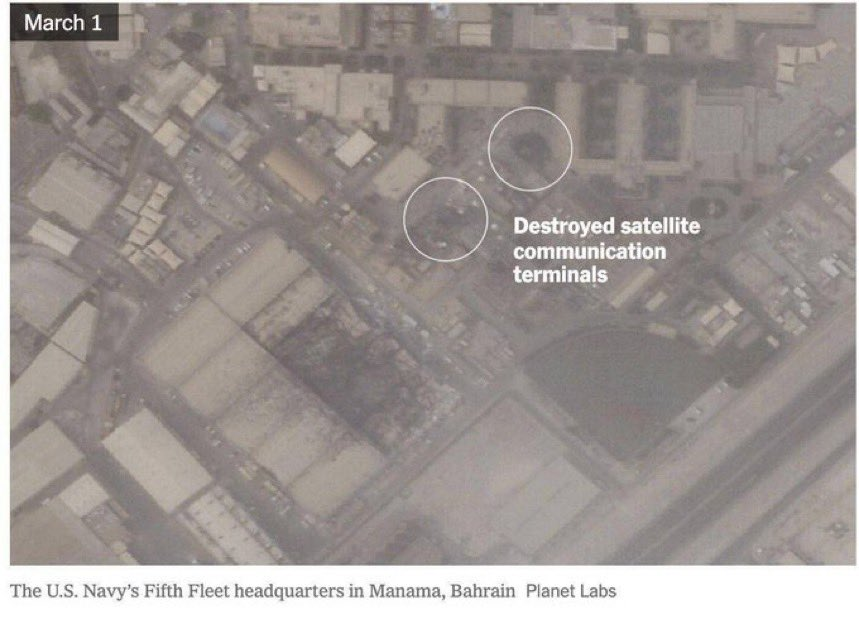
The New York Times — not a Telegram channel, not a Russian state broadcaster, the New York Times — has published satellite imagery confirming what Iran said it was doing while Washington was busy telling you it wasn’t working. Every major US base across the Gulf. Systematically and methodically.
Bahrain, Fifth Fleet headquarters, the nerve centre of American naval power in the region. Al Udeid Qatar — already missing its $1.1 billion AN/TPY-2 radar. Camp Arifjan Kuwait. Ali Al Salem. Prince Sultan in Saudi Arabia. UAE facilities. SATCOM terminals destroyed. Radomes cracked open. Satellite dishes gone. Missile tracking infrastructure — the AN/TPY-2 radar systems that coordinate every Patriot and THAAD battery in theater — targeted with what the imagery confirms was not luck but architecture.
Iran didn’t just strike US bases. It mapped the communication and coordination layer that makes American missile defense function as a unified system and then it peeled it apart, base by base, across five countries simultaneously.
This is not retaliation but doctrine. Thirty years of studying exactly how the American military machine sees, communicates, and coordinates and then, when the moment came, going straight for the eyes. The interceptors are blind. The magazines are depleted. The Navy can’t guarantee escorts in the Strait. Raytheon is being summoned to emergency meetings. South Korea is sitting exposed. And the New York Times just put the satellite pictures on the front page.
Washington built the most expensive military architecture in human history. Iran just showed you the blueprint for how to dismantle it. This is not going according to plan.
‘This is not going according to plan’. Unless it is; in which case, the real plan is to disrupt the entire region in preparation for dismembering Iran and probably using nukes to do that. The deep plan appears to be break Iran into a number of smaller countries, each with its own ethnic or religious group. This will make the entire region much easier to control. Israel is surely planning to become the hegemon of the region with USA fully backing it. A similar plan is what they have wanted for Russia all along — smash it into numerous smaller states. The deep reason for the Ukraine War is to do that. What are their chances for pulling this off? Probably pretty good. ABN
Consider the severe economic body blows to China in the past 14 months.
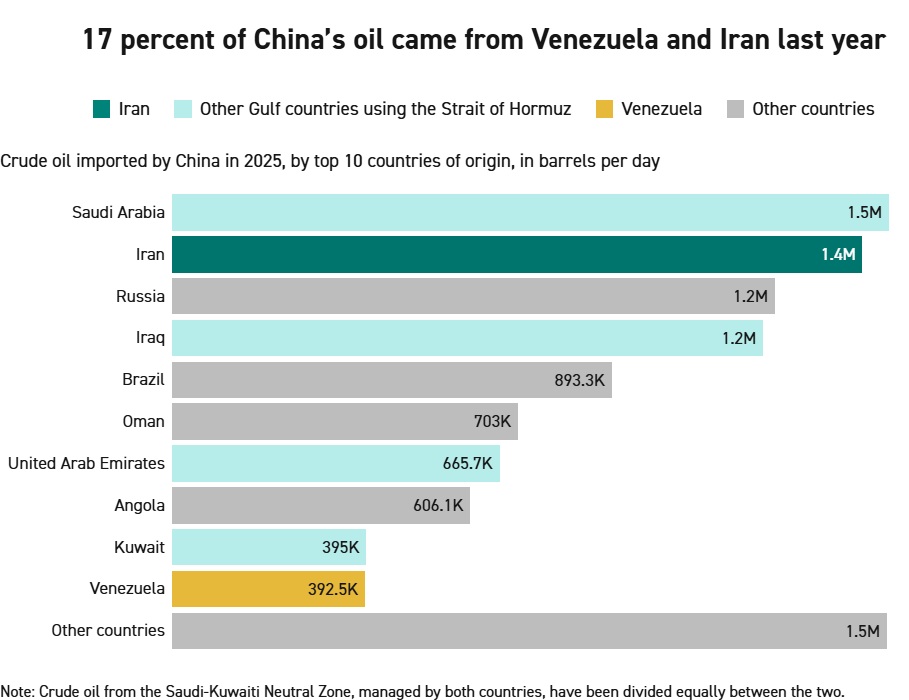
♦ First blow, the Trump tariffs hit Beijing hardest. ♦ Second blow, the Beijing tentacle on the Panama Canal is severed. ♦ Third blow, global tariff threats changed the risk dynamic for southeast Asia countries who acted as transnational shippers for China. ♦ Fourth blow, cheap sanctioned oil from Venezuela was cut-off. ♦ Now, the fifth blow; cheap, sanctioned Iranian oil is disrupted.
It’s not just a factor of oil flow, but also the price that China will ultimately end up having to pay. Beijing was buying oil from Venezuela, Iran and Russia at steep discounts because their purchases were skirting western sanctions.
With Iranian oil production now no longer a market option, China will seek to replace their needs with more Russian alternative. However, that diversion means the oil India was purchasing from Russia will come at a higher price, and the refined final product that was exported by India will arrive to the European Union carrying an additional cost.
Simultaneously, Vladimir Putin was asked about Russia’s lack of military support to Iran in response to the U.S. military action, to wit the Russian president noted the technical terms of their joint military agreements did not include Russia’s immediate involvement. In shorthand, Russia is busy and is not getting involved.
Russia was/is partially dependent on receiving military supplies from Iran in exchange for oil transfers. The military component is reported to include drones from Iran for use in the Ukraine conflict. Now that exchange profile is shuttered.
Taking Iran’s malign influence off the geopolitical chessboard is beginning to surface in major challenges to the BRICS assembly (Brazil, Russia, India, China, South Africa). Russia, China and India are impacted directly.
The BRICS nations were skirting western oil sanctions by trading the commodity outside the petrodollar structure. However, President Trump now controls the flow of oil from Venezuela, and his administration controls the currency in which it is sold.
With Iranian oil removed from the non-petro supply chain, the only remaining non-petro oil producer is Russia – who is simultaneously hit with a loss in military hardware support. China may end up as a larger oil customer to Russia, but at what price and in what payment structure.
With global oil supplies in a state of flux, and with the USA in control of the oil flow from Venezuela, North America is certainly in the best position for minimal energy disruption.
Asia is heavily dependent on oil flows through the Strait of Hormuz, and the majority of Europe has already shut themselves off from Russian oil production, putting themselves in a position of dependency to the global markets. The short-term ramifications of this oil disruption hit China, Southeast Asia, Japan and Europe particularly hard.
Gulf states facing an Iranian drone blitz may only have enough anti-drone defence missiles to last four days.
In a tactic that has surprised the US and its allies, Iran has responded to attempts to force regime change by raining down missiles and drones on its neighbours.
By spreading strikes across more than five countries at once and sustaining over 2,500 drones per day, Tehran is forcing its adversaries to divide their defences.
A source told the Daily Mail: ‘At the current rates the supplies could run out within four days.
‘The interceptors are being used at an unprecedented speed.’
The vast majority of Iranian projectiles have been blocked, but only a few need to breach the defences of Gulf nations to change the perception of the conflict.
That was brought home last night as footage of a thunderous explosion outside the US consulate in Dubai was shared online.
Shahed drones favoured by Iran can be produced more cheaply than the state-of-the-art defensive systems purchased by the UAE, Bahrain and other states from US manufacturers.
A single Iranian drone can cost as little as £26,000 to produce, researchers say, while intercepting it can cost anywhere up to £3million.
Iran’s strategy of ‘flooding the zone’ with drones and missiles seems beyond obvious. Moreover, there are articles from years ago on their underground missile storage sites scattered across the country. So, USA and Israel had to know about this. Then they must have prepared for it. If so, these stories about insufficient anti-drone and anti-missile ordnance must be a ruse. If USA and Israel knew and did not prepare for this, that is too stupid for words. I do not know what the story is, but weapons supplies are major strategic factors, so this cannot be attributed to confusion or the fog of war. If the purported lack of anti-drones is a strategic ruse on the part of USA and Israel, I wonder what purpose it serves. It may be that, USA and Israel want Iran to cause massive destruction throughout the region, thus setting up Israel, and maybe USA, to use nukes against Iran. That is probably what they are doing. It’s a sort of contrived or concealed false-flag against themselves to win public approval for nuking Iran. Using nukes against Iran will send a strong warning to Russia, China and the world. ABN
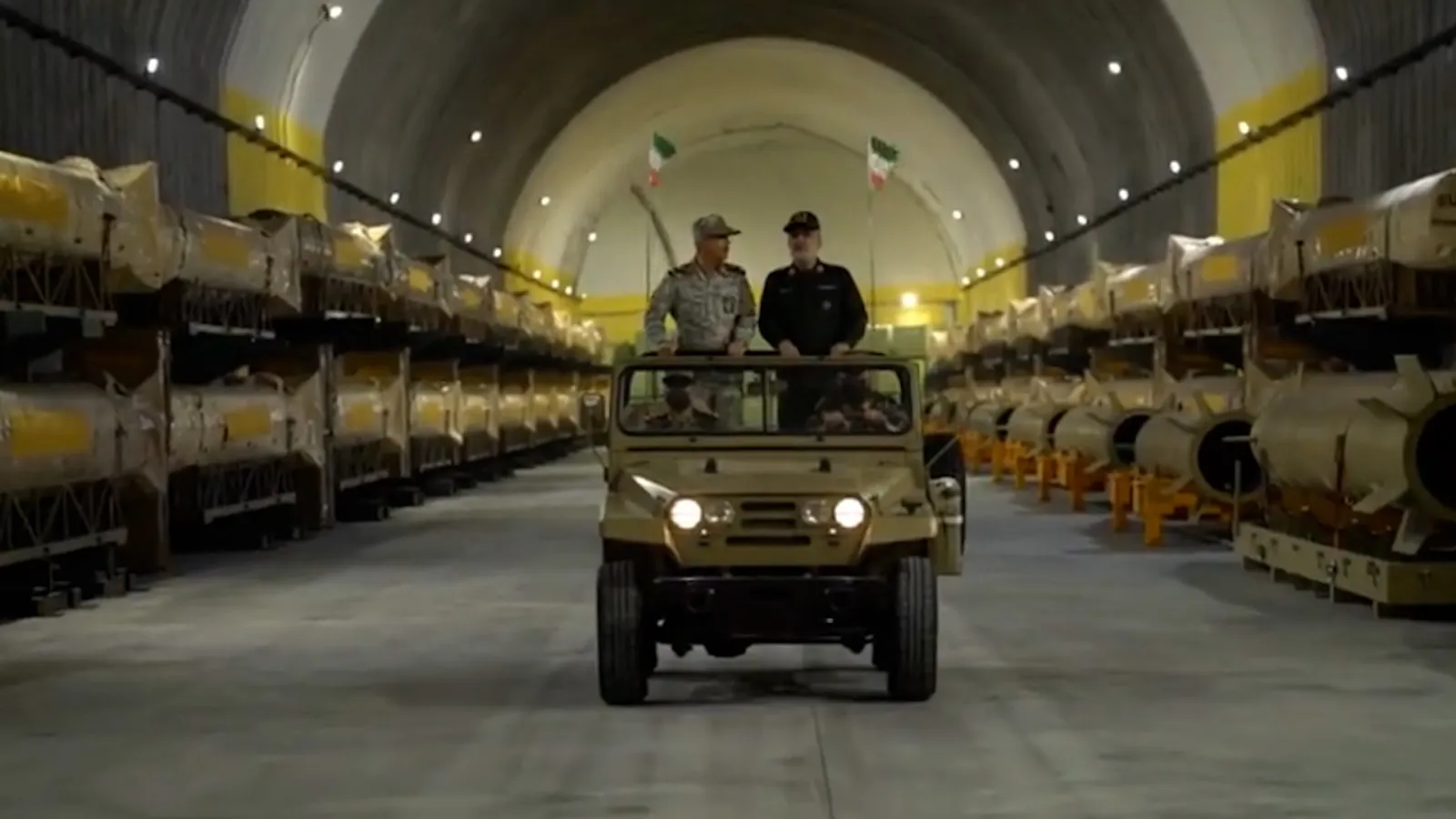
Iran’s underground and hidden missile reserves are a cornerstone of its military strategy, designed to survive and retaliate against large-scale attacks. The country has developed extensive “missile cities”—vast underground complexes excavated deep into mountains, some reaching 500 meters below ground—to store and launch ballistic missiles and drones. These facilities, scattered across provinces like Lorestan, East Azerbaijan, Isfahan, and Kermanshah, house long-range missiles such as the Shahab-3, Sejil, and Khorramshahr, with ranges up to 2,000 km (1,242 miles).
Iran's Revolutionary Guard Corps (IRGC) unveiled one of its largest underground missile cities on Tuesday, March 25. | IRNA/IRNA
Key sites include:
Khorramabad (Lorestan): A major storage and launch site for surface-to-surface and cruise missiles.
Tabriz (East Azerbaijan): Iran’s second-largest missile silo complex, capable of launching missiles toward Eastern Europe.
Isfahan: Home to the largest missile assembly and production site, producing components and missiles like the Shahab-3.
Kermanshah: Hosts the Bakhtaran and Panj Pelleh bases, strategically positioned to target Israel and Gulf states.
Iran has also constructed underground naval missile bases in southern Iran and the Gulf, with one unveiled in 2025. These facilities are often accessed through concealed entrances and protected by multiple layers of bunkers and berms. Despite their resilience, analysts highlight a critical vulnerability: many of these tunnels store munitions in open caverns without blast doors or separated revetments, making them susceptible to catastrophic chain reactions if breached.
While Israel and the U.S. have targeted these sites in recent airstrikes—damaging facilities like the Tabriz base—Iran continues to maintain a large stockpile of over 3,000 ballistic missiles, with about 2,000 capable of reaching neighboring countries. The Islamic Revolutionary Guard Corps Aerospace Force (IRGC-AF) uses these hidden reserves as part of a “war of salvos” strategy, aiming to overwhelm enemy missile defenses and increase the cost of military operations.
Donald Trump‘s commanders have been accused of telling troops that the war with Iran is part of God’s plan for Armageddon.
The Military Religious Freedom Foundation (MRFF), a non-profit civil rights watchdog, said it has received 110 complaints from troops since the war broke out on Saturday.
The complaints span more than 40 different units across 30 military sites, first reported on veteran journalist Jonathan Larsen’s Substack.
A non-commissioned officer (NCO) wrote to the MRFF Monday that his combat-unit commander had claimed Trump was ‘anointed by Jesus to light the signal fire in Iran to cause Armageddon and mark his return to Earth.’
‘He urged us to tell our troops that this was “all part of God’s divine plan” and he specifically referenced numerous citations out of the Book of Revelation referring to Armageddon and the imminent return of Jesus Christ,’ the NCO said.
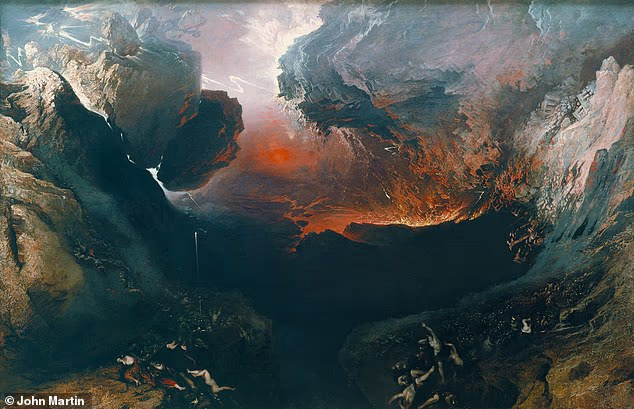
The Great Day of His Wrath (1853), oil painting on canvas by the English painter John Martin
The video shows footage of an Iranian ballistic missile attack on Israel on March 1, 2026, where cluster warheads reportedly split into up to 80 submunitions, a capability IDF officials described as unprecedented for maximizing civilian area coverage.
Iran’s missile program, originating in the 1980s, has advanced indigenously, bolstered by over 233,000 annual engineering graduates—third globally—enabling self-reliant innovations despite sanctions and assassinations.
The attacks involving these advanced cluster-capable missiles have primarily targeted central Israel, with confirmed impacts and damage in:
Petah Tikva (a major city east of Tel Aviv, hit by a missile with fragmentation/cluster elements, causing shrapnel damage across residential areas but no direct fatalities reported in that specific strike).
Tel Aviv area and suburbs (multiple barrages triggered sirens nationwide, with penetrations and damage to buildings/apartments).
Beit Shemesh (west of Jerusalem; one of the worst incidents involved a direct or near-direct hit killing around 9 people and injuring dozens, with cluster submunitions noted in some waves).
Broader central Israel regions, including areas near Jerusalem suburbs, Ramat Gan (near Tel Aviv), and scattered impacts from shrapnel/submunitions.
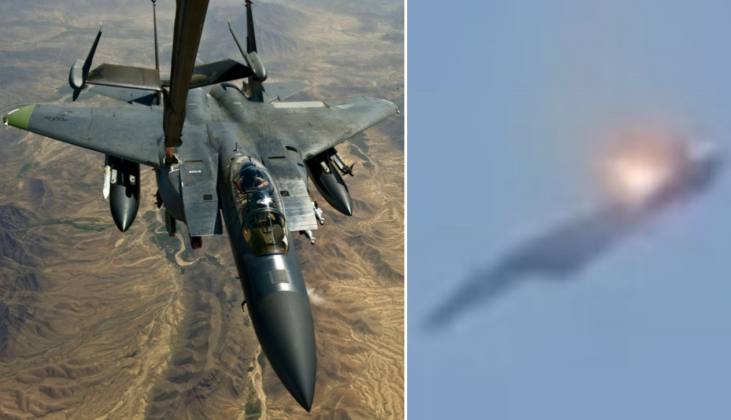
The United States Central Command has confirmed that three U.S. Air Force F-15E long range fighters were shot down over Kuwait on March 1, following multiple unconfirmed repots of shootdowns, and the subsequent release of footage showing one of the aircraft falling in flames in an uncontrolled spiral over Kuwaiti skies.
“At 11:03 p.m. ET, March 1, three U.S. F-15E Strike Eagles flying in support of Operation Epic Fury went down over Kuwait due to an apparent friendly fire incident… During active combat—that included attacks from Iranian aircraft, ballistic missiles, and drones — the U.S. Air Force fighter jets were mistakenly shot down by Kuwaiti air defences,” the Command reported.
Claims that the aircraft were shot down by Kuwaiti forces, rather than by hostile air defences in Iran or Iraq, having been bought to serious question.
F-15E and F-15E Crashing Over Kuwait
With Kuwait employing exclusively NATO standard air defence systems and fighter aircraft, modern identification friend or foe systems leave only a minimal possibility of shooting down friendly fighter aircraft, fuelling speculation that claims that the aircraft were shot down by friendly forces may be an attempt to deny Iran credit for what would be one of the most signifiant air defence operations in recent decades
While it is still early in the conflict, Iran appears to have maintained military momentum despite high-profile assassinations of senior Iranian military officials and Supreme Leader Ali Khamenei. Claims that regime change objectives have stalled reflect the absence, thus far, of visible elite fragmentation inside Iran.
Moreover, Iran has targeted regional energy and infrastructure, plus threatened maritime traffic through the Strait of Hormuz. Any sustained closure of the strait would represent a major escalation; at present, the waterway is all but closed — with ships avoiding it due to insurance risk and increasingly threatening statements from Iranian officials.
Iran appears prepared for a conflict that could extend for months. By contrast, US and Israeli planning assumptions appeared to expect to be able to wrap up operations in days or weeks. The legality of the initial strikes also remains contested, and this issue is likely to shape international diplomatic pressure as economic consequences mount.
The question is whether Gulf Arab states may reassess aspects of their security relationships depending on perceptions of US deterrence credibility; Washington may confront force posture and sustainability challenges if the conflict becomes protracted.
The international community is likely to press for de-escalation, but the Iranian government sees this conflict as an existential threat, so any termination terms would need to reflect that calculation, or the war will not end.
Trump said that it was his assessment that ‘the way the negotiation was going’ with Iran, he believed they would attack first, ‘and I didn’t want that to happen.’
‘You see we were having negotiations with these lunatics and it was my opinion that they were going to attack first,’ the president explained. ‘They were going to attack first, I felt strongly about that.’
‘So if anything I might have forced Israel’s hand.’
I used to be a Protestant and think all I needed was my Bible.
But… then I started asking the question no one wanted to answer: Who actually has the authority to interpret Scripture?
That question came from my study of the theological heresy of dispensationalism.
What I found shocked me. I learned, it isn’t ancient Christianity. It didn’t come from the Apostles. It didn’t come from the Church Fathers. It began in the 1800s with John Nelson Darby. A brand new theological system; a heresy which has created confusion among Christian’s.
It divided Israel and the Church into two separate peoples of God. It created two covenants. It pushed fulfillment into the future. It taught that prophecy still depends on a geopolitical nation-state called “Israel” which was founded by atheists in 1948.
I looked deeper and asked…what does that ultimately lead to? I was shocked to discover their belief of a rebuilt temple in Jerusalem. The one the Lord predicted would be destroyed in Matthew and it was in 70AD.
“Jesus left the temple area and was going away, when his disciples approached him to point out the temple buildings. He said to them in reply, ‘You see all these things, do you not? Amen, I say to you, there will not be left here a stone upon another stone that will not be thrown down.'” Matthew 24:1-2
This all happened. Jesus predicted it and it was fulfilled.
In 70 AD the Temple was destroyed. The altar was gone. The Levitical priesthood stopped functioning. The animal sacrifices ended.
That is not a minor detail.
The Mosaic covenant was inseparable from Temple sacrifice. Without the Temple, the sacrificial system of the Old Covenant could not continue.
In its place, rabbinic Judaism emerged. No longer centered on Temple sacrifice, but on Torah study and synagogue life.
The sacrificial order did not continue. It was finished.




 American Buddhist Net