In Thailand, Cambodia and Sri Lanka, Buddhists see strong links between their religion and country, as do Muslims in Malaysia and Indonesia
As some practices and philosophies related to Buddhism have become more commonplace in the United States and other Western countries, many Americans may associate Buddhism with mindfulness or meditation. In other parts of the world, however, Buddhism is not just a philosophy about mind and body – it is a central part of national identity.
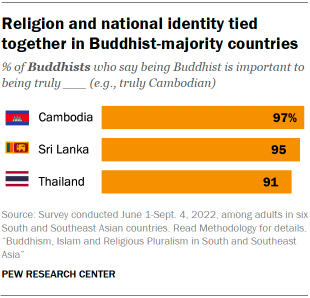
In Cambodia, Sri Lanka and Thailand – countries where at least 70% of adults are Buddhist – upward of nine-in-ten Buddhists say being Buddhist is important to being truly part of their nation, according to a 2022 Pew Research Center survey of six countries in South and Southeast Asia.
For instance, 95% of Sri Lankan Buddhists say being Buddhist is important to be truly Sri Lankan – including 87% who say Buddhism is very important to be a true Sri Lankan.
Although most people in these countries identify as Buddhist religiously, there is widespread agreement that Buddhism is more than a religion.1 The vast majority of Buddhists in Cambodia, Sri Lanka and Thailand not only describe Buddhism as “a religion one chooses to follow” but also say Buddhism is “a culture one is part of” and “a family tradition one must follow.”
Most Buddhists in these countries additionally see Buddhism as “an ethnicity one is born into” – 76% of Cambodian Buddhists hold this view, for example.
Whether you like her or not, from a Buddhist point of view this is a good apology. She takes full responsibility, briefly explains why she thinks she did what she did but does not turn that into an excuse. She disciplines herself and in essence vows never to do it again (an important part of a Buddhist apology). She deserves forgiveness from the public for this incident and, while she should reflect on it fully for a year or so, she should also gradually put it out of her mind and move on after that. I do not know anything else about Doorley and am just commenting on her apology. ABN
Central Asian scholars also developed an Islamic system of higher education modeled on the Central Asian system of the Buddhist vihâra, or monastic college. The vihâra was supported by a tax-exempt pious foundation that paid the expenses of the students and also of the teacher or teachers, who lived in the vihâra with the students. The primary method of teaching was oral lecture and debate, and the main subject of study was the Dharma, or Buddhist law and theology. These fundamental elements were taken over wholesale by the Arabs, who adopted even the distinctively Central Asian form of the vihâra architectural plan—a square structure with a large courtyard, each side of which contained chambers for the students and teachers plus four îwâns, large half-open halls in the form of gateways. The vihâra seems to have been Islamicized as the madrasa in Central Asia in the eighth and ninth centuries, though it is only noted in historical sources somewhat later.
Beckwith, Christopher I.. Empires of the Silk Road: A History of Central Eurasia from the Bronze Age to the Present (p. 154). Princeton University Press. Kindle Edition.
Medieval Western European culture grew intellectually as a direct result of contact with Muslim Spain and Palestine. The translation into Latin of Arabic books introduced new, exciting, and often controversial ideas. The work of al-Khwârizmî54 (Algorithmus) translated as the Book of Algorithmus introduced Arabic numerals, including the zero and “algorithmic” calculation along with them, while the Algebra introduced advanced algebraic mathematics. They were revolutionary to the scientifically oriented minds of Western Europe. The translation of previously unknown philosophical and logical works of Aristotle, along with the works of the great Islamic Aristotelian philosophers, also caused fundamental restructuring of Western European thought. The ideas accompanied at least one important institution. The first European college,55 the Collège des Dix-huit or ‘College of the Eighteen Scholars’, was established in Paris in 1180 by Jocius of London (Jocius de Londiniis) after his return from the Holy Land.56 It was the oldest of the colleges that formed the original University of Paris. The college retained most of the essential characteristics of its direct ancestors, the madrasa and vihâra, including the pious foundation that supported the student residents and a professor,57 and perhaps the architectural form as well.58 The transmission of Islamic knowledge, techniques, and institutions to the West thus fueled the intellectual revolution of the High Middle Ages.
Beckwith, Christopher I.. Empires of the Silk Road: A History of Central Eurasia from the Bronze Age to the Present (pp. 179-180). Princeton University Press. Kindle Edition.
The core comitatus consisted of a small number of warriors, who are called or referred to as friends. Chinggis Khan himself had four: Khubilai, Jelme, Jebe, and Sübedei, whom Jamukha characterizes as the four fierce wolves or dogs of Chinggis. The characterization of the comitatus warriors as wolves or other fierce animals goes all the way back to Proto-Indo-European times. The core group—usually a small number of men—committed ritual suicide (or was executed) to accompany the lord if he predeceased the group, and each man was buried “armed to the teeth” for battle in the next world. The comitatus warriors took their oath freely and, in doing so, broke their original connections to their clan or nation. They became as close or closer than family to their lord, they lived in their lord’s house with him, and they were rewarded lavishly by him in return for their oath. The comitatus is attested archaeologically in burials, historically in descriptions of cultures from all parts of Central Eurasia, and in early literary texts. The most famous are perhaps the Rig Veda hymns to the deified comitatus of Indra, the Marut chariot warriors. A vivid example is found in a dialogue between the lord and his warrior friends where Ahi is the snake-demon enemy, the dragon of many Central Eurasian heroic epics.
Beckwith, Christopher I.. Empires of the Silk Road: A History of Central Eurasia from the Bronze Age to the Present (pp. 13-14). Princeton University Press. Kindle Edition.
The lord and his comitatus formed the heart of every newborn Central Eurasian nation. In Central Asia the warriors of a typical ruler’s full comitatus, even that of a mere governor, numbered in the thousands and was extremely expensive to maintain. In the Middle Ages, the comitatus and ideas of rulership gradually changed with the adoption of world religions, which frown on suicide or ritual murder, but they otherwise continued down to the conquest of Central Eurasia by peripheral powers.
Beckwith, Christopher I.. Empires of the Silk Road: A History of Central Eurasia from the Bronze Age to the Present (p. 15). Princeton University Press. Kindle Edition.
On one occasion the Blessed One was living in the Deer Park at Isipatana (the Resort of Seers) near Varanasi (Benares). Then he addressed the group of five monks (bhikkhus):
“Monks, these two extremes ought not to be practiced by one who has gone forth from the household life. (What are the two?) There is addiction to indulgence of sense-pleasures, which is low, coarse, the way of ordinary people, unworthy, and unprofitable; and there is addiction to self-mortification, which is painful, unworthy, and unprofitable.
“Avoiding both these extremes, the Tathagata has realized the Middle Path; it gives vision, gives knowledge, and leads to calm, to insight, to enlightenment and to Nibbana. And what is that Middle Path realized by the Tathagata? It is the Noble Eightfold path, and nothing else, namely: right view, right intention, right speech, right action, right livelihood, right effort, right mindfulness and right samadhi. This is the Middle Path realized by the Tathagata which gives vision, which gives knowledge, and leads to calm, to insight, to enlightenment, and to Nibbana.
“The Noble Truth of Suffering (dukkha), monks, is this: Birth is suffering, aging is suffering, sickness is suffering, death is suffering, association with the unpleasant is suffering, dissociation from the pleasant is suffering, not to receive what one desires is suffering — in brief the five aggregates subject to grasping are suffering.
“The Noble Truth of the Origin (cause) of Suffering is this: It is this craving (thirst) which produces re-becoming (rebirth) accompanied by passionate greed, and finding fresh delight now here, and now there, namely craving for sense pleasure, craving for existence and craving for non-existence (self-annihilation).
“The Noble Truth of the Cessation of Suffering is this: It is the complete cessation of that very craving, giving it up, relinquishing it, liberating oneself from it, and detaching oneself from it.
“The Noble Truth of the Path Leading to the Cessation of Suffering is this: It is the Noble Eightfold Path, and nothing else, namely: right understanding, right thought, right speech, right action, right livelihood, right effort, right mindfulness and right concentration.
(I have taken the liberty of changing the translation of three of the elements of the Noble Eightfold Path. Of those three, I believe right samadhi is the most important. When samadhi is translated as concentration, it communicates poorly. Samadhi is the profound subjective experience of ‘ultimate reality’ or ‘Buddha nature’ or ‘cosmic consciousness’. Right samadhi is the subjective meditative experience that ties all of the Buddha’s teachings together. ABN)
Theise provides a good description of Right Samadhi at 6:02 min, prompted.
Buddhist philosophy and practice is founded on samadhi states, which might be described as the doors which open to the temple of Deepest Reality. Samadhi states are available to all people. They are the experiential part of Buddhism. They have to be experienced to make sense, and once experienced all of Buddhism will make sense.
Western civilization has almost no traditional awareness of samadhi. We have scores of philosophers and religious thinkers, but no samadhi. It is a glaring omission, one that has led us astray in many ways. Fortunately, today more people are beginning to see what samadhi states are, as Theise illustrates. Be sure to watch the whole clip as it will provide context to what he says about samadhi.
Buddhism is sort of implicitly ‘panpsychist’ or based on consciousness as a primary aspect of reality. Mind Only or Yogacara Buddhism makes this claim more explicitly. Samadhi is beautiful, joyful, wonderful. It will change you very deeply for the better or make you realize you don’t need to be changed at all. ABN
Pa_ ticca samuppa¯da (dependent arising) is the central philosophical principle of Buddhism, and is most commonly exemplified in the suttas in terms of the twelve nida¯nas. The ubiquitous interpretation of the twelve nida¯nas of pa_ ticca samuppa¯da as taking place over three lives, a religious doctrine explaining the rebirth process, is a commentarial development, not found in the suttas. Recent Therava¯din exegetes Bhikkhu Buddhada¯sa and N˜a¯_ navı¯ra Thera argue for an interpretation of the twelve nida¯nas of pa_ ticca samuppa¯da as taking place in the present moment, but Bhikkhu Bodhi disputes the claim that their interpretation is the Buddha’s original meaning. Recent work by Vedic scholar Joanna Jurewicz, however, suggests that originally the twelve nida¯nas were a parody of Vedic cosmogony. This scholarship opens the way for renewed exegesis of pa_ ticca samuppa¯da liberated from Indian Buddhist metaphysics.
Introduction
The Buddha is recorded as telling Ananda that it was through not understanding and not penetrating pa_ ticca samuppa¯da (dependent arising) that humanity ‘has become like a tangle of string covered in mould and matted like grass’, and so does not go beyond the miseries of conditioned existence (D 15 PTS ii 55, S 12:60 PTS ii 92). It is said that just before his enlightenment the bodhisatta reflected on how dukkha (unhappiness) arose dependent on conditions—how ageing and death ( jara¯mara_ na) arose on condition of birth ( ja¯ti), birth on existence (bhava), existence on clinging (upa¯da¯na), clinging on craving (ta_ nha¯), craving on feeling (vedana¯), feeling on contact ( phassa), contact on the six sensebases (sa_ la¯yatana), the sense-bases on name and form (na¯maru¯pa), name and form on consciousness (vin˜n˜a¯na), consciousness on formations (san˙kha¯ra¯), and formations on ignorance (avijja¯). It was just through the ceasing of these twelve nida¯nas that the Buddha, like Buddhas before him, attained the path to awakening, that overgrown road to the ancient city of enlightenment (S 12:65 PTS ii 104). To investigate these twelve linked conditions of sa _ msa¯ra is to understand the ‘noble method’ of the Dharma (A 10:92 PTS v 182); and the cessation of just these twelve nida¯nas is the end of dukkha.
From the paramount importance given to the teaching of the twelve nida¯nas in the Pali canon, one might expect the formula to be clearly explained. But not so. Although each nida¯na or link is expounded to some extent, ‘the earliest texts give very little explanation of how the formula is to be understood’ (Gethin 1998, 149). Later Buddhist tradition interpreted the twelve-fold formula as an explanation of the rebirth process over three lives, but it there is no evidence that this is what the Buddha originally meant.
In this article I will explore the interpretations of the twelve nida¯nas of pa_ ticca samuppa¯da offered by two recent Therava¯din thinkers, Bhikkhu Buddhada¯sa and Bhikkhu N˜ a¯ _ navı¯ra, who in different ways criticise the three-life interpretation and, reading the suttas afresh, offer accounts of how the links of pa_ ticca samuppa¯da can be understood as working in the present moment. I will also indicate the criticism of this present moment interpretation by Bhikkhu Bodhi, a defender of Buddhist tradition. I will then present a completely different approach to the problem, starting from the idea that the arrangement of the nida¯nas begins to make sense when one takes into account the brahminical religious context in which the Buddha was teaching. In this context, the various links in different ways turn upside down the assumptions about Self (atta¯), reality (brahman) and the supposed purpose of brahminical rituals current in the Buddha’s time. This suggests that the arrangement of the twelve nida¯nas was originally intended as a parody of brahminical beliefs as well as a statement of what the Buddha taught.
Below is an important excerpt, which very clearly sheds new light on the Twelve Nidanas. I highly recommend reading the entire essay as it is very informative. ABN
In N˜ a¯ _ navı¯ra’s view, the twelve nida¯nas are not a causally related sequence of temporally successive phenomena. Instead, they are the structurally related phenomena that make up the lived experience of being an ordinary human being, meaning, the experience of being a self, a ‘someone’, an ‘I’. This experience, characterised as dukkha, is ultimately a mistake since it finds a self, a sense of ‘me’ and ‘mine’ where, according to the Buddha, no such self can really be found. Direct seeing of pa_ ticca samuppa¯da means seeing that experience is thus structured, thereby enabling the process of cessation, by which there is liberation from dukkha. An analogy for what N˜ a¯ _ navı¯ra means by the twelve nida¯nas as the structure of experience is that of a building. Just as a house cannot have a roof without walls, so there can be no subjective existence as a self (bhava) without craving (tan˙ha¯) and grasping (upa¯da¯na); similarly, just as there can be no lower walls without foundations, there can be no consciousness of being a self (vin˜n˜a¯na) and the name and form of that experience (na¯ma-ru¯pa) without ignorant unawareness (avijja¯). The roof does not arise after the walls but depends on those walls for its existence; conversely, without a foundation, the whole building ceases to stand. However, whereas a building is a static entity, human experience is dynamic. The sense of self, of being a ‘someone’, is constantly attempted and renewed through the processes of feeling, craving and appropriation by which personal life is sustained.
The Buddha’s explanation of the five skandhas is intended to help us understand the emptiness of the self. It is a short explanation aimed at his most intelligent students.
The Sanskrit word skandha means “heap” or “aggregate” in English. Sometimes the Buddha compared the skandhas to heaps of rice. They are the “heaps” of psycho-perceptual data that comprise the “contents” of our minds. The five skandhas are conditioned dharmas (literally, “conditioned things”), which is to say that they are impermanent and empty, and when improperly understood lead to delusive attachments characterized by greed, anger, and ignorance. The purpose of the Buddha’s five skandha explanation is to help us see through the skandhas, or disentangle ourselves from them. In some Buddhist texts the five skandhas are called the “five covers” because they cover our minds and prevent us from seeing deep levels of reality. In others they are called the “five yin (versus yang)” because they cloud the mind and hide the truth from us. I will discuss each of the five skandhas in the sections below.
1) The first skandha is form. Form, in this case, means anything that leads to, or is capable of leading to, the next skandha. Forms can be visual, auditory, or sensory. They can be dreams, memories, feelings, or moods. Forms are often described as being “obstructions” because, though they may lead to complex thought and activity, they are also hindrances to mental clarity since the activity they lead to is essentially delusive. It is important to remember that the five skandha explanation is an explanation of the deluded mind and its thought processes.
The Abhidharma-mahavibhasa Shastra categorizes the skandha of form into three types:
a) Visible forms with a referent in the outer world such as color, size, length, position, shape, and so on.
b) Invisible forms with a referent in the outer world that are associated with the other sensory organs such as sounds, smells, tastes, and the sensations arising from physical contact.
c) Invisible forms with no referent in the outer world such as dreams, memories, thoughts, feelings, and so on. Though a dream may be “visible” to the dreamer, it is called “invisible” here because no one else can see it. This last category of forms is associated with what the Buddha called “mental dharmas.”
2) The second skandha is sensation. Following the appearance of a form, the mind reacts to it with a sensation that is either positive, negative, or neutral. We either like it, don’t like it, or are neutral about it. Though it is possible to become conscious of this skandha, most of us most of the time are not.
Sensations are generally categorized into two types:
a) Sensations of the body coming from the outside world through any of the sensory organs, such as sights, sounds, smells, tastes, and so on.
b) Sensations of the mind which may or may not come from the outside world. These include moods, feelings, memories, dreams, thoughts, ideas, and so on.
Both kinds of sensation are, of course, based on the prior appearance of a form. Greed and anger have their roots in the skandha of sensation, for if we enjoy a positive sensation we are liable to become greedy about it, while if we do not enjoy it, we are liable to become “angry” or irritable concerning it. The deep meaning of greed is “excessive attraction” to a sensation that we deem to be agreeable or positive, while the deep meaning of anger (or hatred) is “excessive aversion” to a sensation that we deem disagreeable or negative. Neutral sensations often are the result of our ignorance or lack of understanding, though as we progress in Buddhist practice they may be the result of wisdom.
Positive and negative sensations associated with the body are generally considered to be weaker than those associated with the mind, though both types of sensations often are interrelated. An example of this mixture and distinction might be a light slap in the face. While the physical sensation is only mildly unpleasant, the mental sensation will be quite strong in most cases. And yet both are interrelated.
3) The third skandha is perception. This skandha refers to the deepening of a sensation. It is the point where the mind begins to latch onto its sensations. At this point conscious recognition of form and sensation normally begins. It is possible to become conscious of the first and second skandhas as they are occurring, but most of us generally are not. During the skandha of perception we begin making conscious distinctions among things.
4) The fourth skandha is mental activity. This skandha refers to the complex mental activity that often follows upon the skandha of perception. Once we have identified (perceived) something, long trains of mental associations become active. Our bodies may also begin to move and behave during this skandha. For example, the simple perception of a travel poster may set in motion a great deal of mental activity. We may begin recalling an old trip or begin fantasizing about a new one. If we are photographers, we may admire the composition of the photo, step closer to it, make an effort to remember it, and so on. All of these behaviors belong to the skandha of mental activity.
5) The fifth skandha is individual consciousness. It is a product of the first four skandhas and is completely conditioned by them. This is what we normally, more or less, think of as being our “self.” The Buddha taught the five skandhas primarily to help us understand that this “self” or consciousness is empty since it is entirely based on the conditions found in the first four skandhas.
The Ekkotarika-agama explains this point very well. It says, “The Buddha said that the skandha of form is like foam, the skandha of sensation is like a bubble, the skandha of perception is like a wild horse, the skandha of mental activity is like a banana tree, and thus the skandha of individual consciousness is nothing more than an illusion.” The trunk of a banana tree is made of leaves curled together. From the outside, it may look substantial, but if we examine it closely we will find that one leaf pulls away from the next, leaving ultimately nothing behind. The trunk looks substantial, but in truth it is “empty.” In just this way, our individual consciousness may look substantial to us, but if we peel it apart, we find that there is no self within—it is empty.
How to Understand the Five Skandhas
Though most of us are not normally aware of the first two skandhas it is possible to become aware of them through meditation and mindfulness practices. Though it is easier to begin understanding the five skandhas by thinking of them as being separate and distinct, it is important to realize that any of the last four skandhas can give rise to the skandha of form. Mental activity itself, for example, can generate whole new trains of forms, sensations, and perceptions.
Another important thing to understand about the five skandhas is that our minds move very quickly from one to the next. The five skandhas produce a snow storm of impressions and mentation, upon which rests our unstable conscious world. When we become overly attached to this snow storm or to the consciousness built upon it, we generate the karma that ultimately fuels the five skandhas in the first place.
The Explanation of Mahayana Terms (en 1212) says that the skandhas can be understood as being either good, bad, or neutral. The goodness mentioned in this explanation should be understood as being a relative goodness that arises within the phenomenal world—though it is “good,” it is not the same as an enlightened vision that completely sees through the five skandhas. For this reason, we will use the word “positive” in place of “goodness” in this discussion. The Explanation says that positive activation of the five skandhas can be of three types: activation by a positive form, such as a Buddhist image; activation by skillful means, such as a desire to help someone; and activation within a pure-minded person. The Explanation says that the three bad or negative types of activation of the five skandhas result from: simple badness within them, as may have derived from low motives or moodiness; contaminations within them, such as selfishness during an act of kindness; and negativity that is simply the result of bad karma. The Explanation says that the three neutral types of activation are: formal activations that result from the performance of rituals; activations resulting from the practice of a skill; and neutral changes among the skandhas themselves.
How to Contemplate the Five Skandhas
The second noble truth of Buddhism is the cause of suffering. Generally, this cause is explained as clinging to a false self. By contemplating the five skandhas, we learn to understand both that the self is empty and why it is empty. This contemplation appeals to the rational mind for it allows us to use reason to convince ourselves that the “self” we call our own is, in truth, an illusion.
In contemplating the five skandhas we should be mindful that we begin to generate karma during the skandha of perception. At the same time, it is important to realize that the very forms we see and the sensations that result from them are heavily conditioned by our past actions, by the accumulation of karmic “seeds” or influences that are already stored in our minds. Two people may see exactly the same form, but have very different responses to it because their karma is not the same. Since their karma is different, their sensations and perceptions, and especially their mental activity and consciousness will be very different.
The Numerical Teachings of Great Ming Dynasty Tripitaka says (en 1213) that the most important way to understand the five skandhas is to realize that each of them is empty. As we become familiar with the five skandhas, we will find it easier to identify each one and contemplate its emptiness. We can think about them from first to last or from last to first.
If we choose to think of them from last to first, our contemplation will consist of a series of questions, whose answers should be considered deeply. We begin by asking ourselves what the skandha of individual consciousness is based upon. The answer is the roiling mentation of the skandha of mental activity. The skandha of mental activity becomes apparent as soon as we sit down to meditate. Having identified this skandha and appreciated its fundamental emptiness, we can ask ourselves what it is based upon. The answer is the skandha of perception. First the mind seizes one of its impressions (the skandha of perception), then a long train of thought and emotion follows (the skandha of mental activity). Having appreciated this process, we then ask ourselves what the skandha of perception is based upon. The answer is sensation—of the many forms and feelings passing through our minds, one of them gave rise to either a positive or negative sensation (neutral sensations are usually ignored by the mind). It is this sensation that led to the skandha of perception. If we can appreciate this, then we can ask what the skandha of sensation is based upon. The answer is form—either an outer or inner form. Were it not for this form, none of the other skandhas would have arisen.
If we choose to contemplate from the first skandha to the last, we may choose a form and then carefully watch how our minds process it. We will see that form leads to sensation, then to perception, then to mental activity, and lastly to individual consciousness—a state of mind deeply colored by the skandhas below it. Bear in mind that when the five skandhas are simply happening of themselves and no one is watching them, we are normally unconscious of the activity of the first two skandhas. Before most of us are even aware of what we are perceiving, we have begun to react to it. It requires some skill to see that forms give rise to positive, negative, or neutral sensations before they give rise to the skandha of perception, but this is the case in a normally active mind.
The quotation cited previously from the Ekkotarika-agama can also be used as a very fine contemplation. The agama said, “The Buddha said that the skandha of form is like foam, the skandha of sensation is like a bubble, the skandha of perception is like a wild horse, the skandha of mental activity is like a banana tree, and thus the skandha of individual consciousness is nothing more than an illusion.” The skandha of form is like foam in a stream—at any moment scores of forms contend for our attention. The skandha of sensation is like a bubble—suddenly we react to a single bubble within the foam. The skandha of perception is like a wild horse—we can never be sure which way our mind will turn at this point. The skandha of mental activity is like a banana tree—it consists of many things wrapped together. And thus, the skandha individual consciousness is empty, an illusion.
ABN
UPDATE: FIML practice can be understood in terms of the five skandhas in this way: A FIML query begins at or interrupts the skandha of mental activity. Through training and prior agreement, partners learn to identify a fraught psychological response at the third skandha–perception–and thereby shift away from habitual mental activity to FIML mental activity. The FIML query at this points implicitly asks is my habitual perception based on fact? The FIML query should be made in as neutral a tone as possible to avoid influencing your partner. Your partner’s reply will either confirm or refute your habitual perception. FIML is a dynamic and very powerful form of mindfulness that allows partners to be much more objective about the granular workings of their minds. After hundreds of FIML queries, partners will establish a database of objective insight into their own (and each other’s) psychology that is much more accurate than what can be done alone or through general discussion with anyone. ABN
Congress members may have unwittingly legalized marijuana, unbeknownst to themselves or customers. This does not include derivatives such as delta-8 THC or hexahydrocannabinol (HHC), which are made from CBD oil taken from federally authorized hemp plants and subsequently converted into psychotropic substances. Despite many states prohibiting hemp-derived THC, these cannabinoids remain federally legal due to a 2018 U.S. Farm Bill loophole.
However, the focus here is on licensed, state-compliant intoxicating cannabis transformed into consumer goods and marketed under the guise of THCA. THCA, a naturally occurring cannabinoid, is nonintoxicating but converts to psychoactive THC when heated, serving as a precursor. Marketed as THCA flower, these products supposedly adhere to the Farm Bill’s 0.3% delta-9 THC limit, thus meeting federal hemp standards.
I do not want to encourage the use of intoxicants but also realize CBD and probably other components of cannabis can be very helpful for pain, inflammation, poor sleep and other ailments. Another point worth making is intoxicating cannabis can be responsibly used as ‘harm reduction’ in place of worse drugs like alcohol or fentanyl. In this vein, I should add that the Fifth Precept of Buddhist lay ethics only mentions alcohol and only advises avoiding irresponsible use of it, which may lead to ‘heedlessness’. For more on this topic, including a discussion of psychedelics, please see: Are We Misunderstanding the Fifth Precept?ABN

 American Buddhist Net