
Nirvāṇa (/nɪərˈvɑːnə/ neer-VAH-nə, /-ˈvænə/ -VAN-ə, /nɜːr-/ nur-;[1] Sanskrit: निर्वाण nirvāṇa [nɪrʋaːɳɐ]; Pali: nibbāna; Prakrit: ṇivvāṇa; literally, “blown out”, as in an oil lamp[2]) is a concept in Indian religions (Buddhism, Hinduism, Jainism, and Sikhism) that represents the ultimate state of soteriological release, the liberation from duḥkha, suffering, and saṃsāra, the cycle of birth and rebirth.[3][web 1][4]
In Indian religions, nirvana is synonymous with moksha and mukti.[note 1] All Indian religions assert it to be a state of perfect quietude, freedom, highest happiness as well as the liberation from attachment and worldly suffering and the ending of samsara, the round of existence.[6][7] However, non-Buddhist and Buddhist traditions describe these terms for liberation differently.[8] In Hindu philosophy, it is the union of or the realization of the identity of Atman with Brahman, depending on the Hindu tradition.[9][10][11] In Jainism, nirvana is also the soteriological goal, representing the release of a soul from karmic bondage and samsara.[12] In the Buddhist context, nirvana refers to the abandonment of the 10 fetters, marking the end of rebirth by stilling the fires that keep the process of rebirth going.[8][13][14]
link
Category: Buddhism
What is that ancient path traveled by the Rightly Self-awakened Ones of former times?
And what is that ancient path, that ancient road, traveled by the Rightly Self-awakened Ones of former times? Just this noble eightfold path: right view, right aspiration, right speech, right action, right livelihood, right effort, right mindfulness, right concentration. That is the ancient path, the ancient road, traveled by the Rightly Self-awakened Ones of former times. I followed that path. Following it, I came to direct knowledge of aging & death, direct knowledge of the origination of aging & death, direct knowledge of the cessation of aging & death, direct knowledge of the path leading to the cessation of aging & death. I followed that path. Following it, I came to direct knowledge of birth… becoming… clinging… craving… feeling… contact… the six sense media… name-&-form… consciousness, direct knowledge of the origination of consciousness, direct knowledge of the cessation of consciousness, direct knowledge of the path leading to the cessation of consciousness. I followed that path.
— The Buddha, Nagara Sutta, Samyutta Nikaya ii.124, Translated by Thanissaro Bhikkhu [104][105]
In this section, the Buddha references the antiquity of the Noble Eightfold Path ‘travelled by the Rightly Self-awakened Ones of former times’. Even in his day it was an ‘ancient road’. This is a bona fide historical statement indicating that core Buddhist practices, still practiced today, predate all of the world’s major religions. This is worth contemplating, reflecting on. The eighth stage of this ancient road can also be translated as samadhi. ABN
A Buddhist heuristic for thought & action
- Information arrives
- Analyze it; seek help & opinions of others
- Decide how to proceed based on what is ethically/morally right or best
The above helps us decide where and how to enter the Noble Eightfold Path:
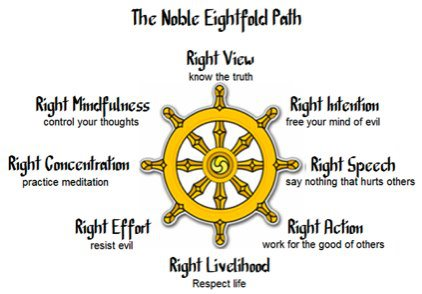
I noticed this morning that virtually everything I talk about with my wife and friends follows the heuristic stated above and all of that flows into the Noble Eightfold Path.
An example: The vaxxes. When they first appeared as information, I discussed them at length with anyone I reasonably could do that with. We all saw roughly the same thing—they were experimental, dubious, probably harmful, and not necessary: ergo, best to wait. Later on, after a couple of months, we were all certain that we should not take the vaxxes. Some of us also felt that we should speak about this conclusion and share it with others when opportune.
There was and still is a telling divide in the people I know. Many of my friends and family members willingly and very naturally engaged in analyses of the vaxxes and continue doing so to this day. The ones who did not want to engage in any analysis in the beginning, still will not do so to this day; all of the ones in this group took the vax.
Only one of the people who analyzed them early on took the vax, twice. Both he and his wife have vax injuries. His appear to be minor, hers are very serious. He openly regrets having taken the shot, continues analyzing vaxxes, and now also actively tries to explain to others in our circle why they should stop getting them.
Notice that propaganda and mind-control work most of all with getting people to skip analyzing information themselves and accept conclusions first being offered, then demanded. With only cursory analysis of the people making those offers and demands, it is not hard to see that their analyses are hidden, poorly done, or not done at all and that obvious objections to their demands are not answered reasonably.
I think this simple heuristic cuts to the heart of many matters, many kinds of information that arrive in our lives, both personal and public. It seems to highlight that when reason, thought, and analysis are skipped or skimped on, morality and good sense are harmed. We not only vax ourselves, we also vax our children and council others to make the same mistake. ABN
first posted MARCH 14, 2023
Noble Eightfold Path
The Noble Eightfold Path (Sanskrit: आर्याष्टाङ्गमार्ग, romanized: āryāṣṭāṅgamārga)[1][2] or Eight Right Paths (Sanskrit: अष्टसम्यङ्मार्ग, romanized: aṣṭasamyaṅmārga)[3] is an early summary of the path of Buddhist practices leading to liberation from samsara, the painful cycle of rebirth,[4][5] in the form of nirvana.[6][7]
The Eightfold Path consists of eight practices: right view, right resolve, right speech, right conduct, right livelihood, right effort, right mindfulness, and right samadhi (‘meditative absorption or union’; alternatively, equanimous meditative awareness).[8]
In early Buddhism, these practices started with understanding that the body-mind works in a corrupted way (right view), followed by entering the Buddhist path of self-observance, self-restraint, and cultivating kindness and compassion; and culminating in dhyana or samadhi, which reinforces these practices for the development of the body-mind.[9] In later Buddhism, insight (prajñā) became the central soteriological instrument, leading to a different concept and structure of the path,[9][10] in which the “goal” of the Buddhist path came to be specified as ending ignorance and rebirth.[11][12][13][5][14]
The Noble Eightfold Path is one of the principal summaries of the Buddhist teachings, taught to lead to Arhatship.[15] In the Theravada tradition, this path is also summarized as sila (morality), samadhi (meditation) and prajna (insight). In Mahayana Buddhism, this path is contrasted with the Bodhisattva path, which is believed to go beyond Arhatship to full Buddhahood.[15]
In Buddhist symbolism, the Noble Eightfold Path is often represented by means of the dharma wheel (dharmachakra), in which its eight spokes represent the eight elements of the path.
link
Error correction from Bret Weinstein
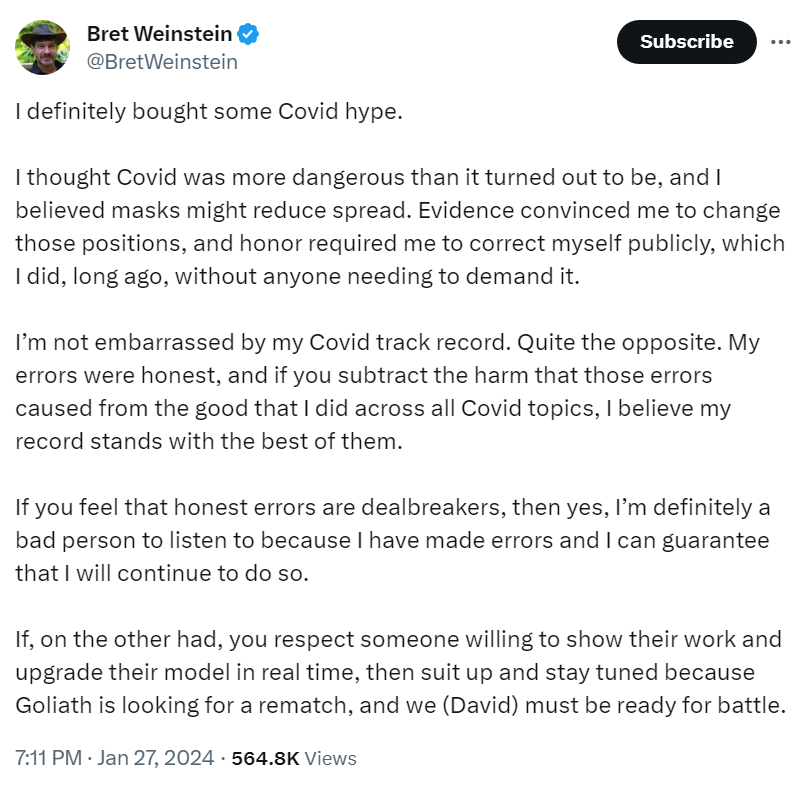
Sort of good enough but weakened by tones of self-promotion. In a time when information is widely scattered claiming ‘honor’ and that you already did something most seem not to have noticed takes back with one hand what you gave with the other. I am willing to put that behind us and will continue paying attention to Bret but not without a measure of skepticism. ABN
Proof That Reality Is An ILLUSION: The Mystery Beyond Space-Time — Donald Hoffman
This is a good video for Buddhists since much of it comports well with Buddhist teachings. Good for other religions and philosophies that have roots in the deep past as well. The ancients did not have our tools, sciences or mathematics, but they were easily as smart as us and did have more time to meditate, contemplate, and ponder the nature of reality. It’s a wonderful thing that a good deal of modern thinking corroborates many of their findings. Psychology has benefitted greatly from Buddhist techniques and ways of thinking. Now, even physics and cognitive science seem to be touching deeply on Buddhist teachings. ABN
Non-FIML sociology and Buddhism
Non-FIML sociology cannot but be based on and imbued with vagueness and uncertainty. Individuals make their ways in this foggy social environment according to their upbringing, experiences, and the different ways they have learned to negotiate ambiguity. Each non-FIML individual cannot but conform to or accept a position somewhere on the spectrum of private neurosis-public semiotics.
This is so because non-FIML individuals cannot attain interpersonal certainty; they can only attain a semblance of interpersonal certainty that is necessarily made up of many erroneous interpretations of the world around them, their loved ones, and themselves. Their understanding of themselves and of others will necessarily be made up of either private interpretations (that are sure to be largely false and thus neurotic) or public/cultural interpretations that are similarly just as false and/or too narrow or generalized (science, mainstream psychology, professional societies, religious or ethnic allegiances, etc.) to be fully satisfying to the profound needs of the individual. This is not to say that many individuals living in conditions like that are not happy, but rather that their sense of who they are and what they are doing is false, utilitarian, exploitative, slavish, or otherwise limited in one way or another. Individuals in conditions like that cannot but offend their deep-seated needs for interpersonal honesty/certainty by compromising their individual understanding of what the world around them means by accepting either prepackaged public explanations (public semiotics) or making up their own (private neurosis).
Most individuals in the world are, thus, contorted in some way. Some are deeply unhappy because they can sense something is wrong but have no way to grapple with it. Others decide to make their way in the world as it is, fully accepting, even enjoying, their perceived “need” to deceive themselves and others, to manipulate others, to take advantage of them, etc.
I think the above roughly describes a big part of what is meant by delusion and suffering in Buddhism. Delusion and suffering constitute the first two of the Four Noble Truths. The First Noble Truth says unenlightened life is characterized by suffering or dissatisfaction. The second explains the first by saying, briefly, that people suffer because they become attached to delusions. Delusions can be egocentric, sociocentric, or both. They can be a private neuroses or the very public madness of a whole society, or both. However you look at it, individual human beings will suffer and experience discontent under these conditions because their core sense of what is true is almost constantly being violated.
In the Buddha’s day, you fixed this problem by becoming a monk. You can still do that today, or you can practice Buddhism as a lay person. My feeling is that if you only practice Buddhism and do not do FIML practice, you will make a lot of progress but remain unsatisfied. Societies today are so large and complex, it is nearly impossible not to be influenced constantly by them. If you can join a monastery or build a cabin in the woods, lucky for you. Most of us, though, will continue to live among unenlightened people and will continue to have deep needs for highly satisfying interpersonal communication with our loved ones and close friends. FIML practice fits in right there. Since so many monasteries today are burdened with the weight of their own semiotics, FIML practice probably would be a very good practice even for monks, if it can be arranged.
In the Chinese Buddhist tradition, there is a story about heaven and hell. In hell people sit at a dinner table to eat but are forced to use chopsticks that are so long they cannot put any food in their mouths, and so they go hungry and feel miserable. In heaven, conditions are exactly the same, but people there use their long chopsticks to feed each other, so everyone if well-fed and very happy.
FIML practice is like heaven. By doing it we feed each other and grow more satisfied as we come to understand what the real conditions of this world are.
Incidentally, I am of the opinion, and many share this opinion, that Buddhists can and should work with the basics of the tradition to make it speak to them. I am fully convinced that FIML practice will open a very large door for almost anyone who tries it. Non-Buddhists can do FIML, but so can Buddhists. I do not see any contradictions between FIML and Buddhist practices. And I do see many advantages to augmenting Buddhist practice with FIML.
first posted FEBRUARY 18, 2012
Meaningfulness or emotional valence of semiotic cues
A new study on post traumatic stress disorder shows that PTSD sufferers actually perceive meaning or emotional valence within fractions of a second.
This study bolsters the FIML claim that “psychological morphemes” (the smallest psychological unit) arise at discrete moments and that they affect whatever is perceived or thought about afterward.
The study has profound implications for all people (and I am sure animals, too) because all of us to some degree have experienced many small and some large traumas. These traumas induce a wide variety idiosyncratic “meaning and emotional valence” that affects how we perceive events happening around us, how we react to them, and how we think about them.
The study in question—Soldiers with Posttraumatic Stress Disorder See a World Full of Threat: Magnetoencephalography Reveals Enhanced Tuning to Combat-Related Cues—is especially interesting because it compares combat veterans without PTSD to combat veterans with PTSD.
It is thus based on a clearly defined pool of people with “similar” extreme experiences and finds that:
…attentional biases in PTSD are [suggestively] linked to deficits in very rapid regulatory activation observed in healthy control subjects. Thus, sufferers with PTSD may literally see a world more populated by traumatic cues, contributing to a positive feedback loop that perpetuates the effects of trauma.
Of course all people are “traumatized” to some degree. And thus all people see “a world populated by traumatic cues, contributing to a positive feedback loop that perpetuates the effects of trauma.”
If we expand the word trauma to include “conditioned responses,” “learned responses,” “idiosyncratic responses,” or simply “training” or “experience” and then consider the aggregate all of those responses in any particular individual, we will have a fairly good picture of what an idiosyncratic individual (all of us are that) looks like, and how an idiosyncratic individual actually functions and responds to the world.
FIML theory claims that idiosyncratic responses happen very quickly (less than a second) and that these responses can be observed, analyzed, and extirpated (if they are detrimental) by doing FIML practice. Observing and analyzing idiosyncratic responses whether they are detrimental or not serves to optimize communication between partners by greatly enhancing partners’ ranges of emotion and understanding.
In an article about the linked study (whose main author is Rebecca Todd), Alva Noë says:
…Todd’s work shows that soldiers with PTSD “process” cues associated with their combat experience differently even than other combat veterans. But what seems to be driving the process that Todd and team uncovered is the meaningfulness or emotional valence of the cues themselves. Whether they are presented in very rapid serial display or in some other way, what matters is that those who have been badly traumatized think and feel. And surely we can modify how we think and feel through conversation?
Indeed, what makes this work so significant is the way it shows that we can only really make sense of the neural phenomena by setting them in the context of the perceptual-cognitive situation of the animal and, vice-versa, that the full-import of what perceivers say and do depends on what is going on in their heads. (Source)
I fully agree with the general sense of Noë’s words, but want to ask what is your technique for “modifying how we think and feel through conversation?” And does your technique comport well with your claim, which I also agree with, that “we can only really make sense of the neural phenomena by setting them in the context of the perceptual-cognitive situation of the animal”?
I would contend that you cannot make very good “sense of neural phenomena” by just talking about them in general ways or analyzing them based on general formulas. Some progress can be made, but it is slow and not so reliable because general ways of talking always fail to capture the idiosyncrasy of the “neural phenomenon” as it is actually functioning in real-time during a real “perceptual-cognitive situation of the animal.”
The FIML technique can capture “neural phenomena” in real-time and it can capture them during real “perceptual-cognitive situations.” It is precisely this that allows FIML practice to quickly extirpate unwholesome responses, both small and large, if desired.
Since all of us are complex individuals with a multitude of interconnected sensibilities, perceptions, and responses, FIML practice does not seek to “just” remove a single post traumatic response but rather to extirpate all unwholesome responses.
Since our complex responses and perceptions can be observed most clearly as they manifest in semiotics, the FIML “conversational” technique focuses on the signs and symbols of communication, the semiotics that comprise psychological morphemes.
FIML practice is not suited for everyone and a good partner must be found for it to work. But I would expect that combat veterans with PTSD who are able to do FIML and who do it regularly with a good partner will experience a gradual reduction in PTSD symptoms leading to eventual extirpation.
The same can be said for the rest of us with our myriad and various traumas and experiences. FIML done with a good partner will find and extirpate what you don’t want knocking around in your head anymore.
first posted JULY 9, 2015
UPDATE: This essay is very important for anyone who wants to better understand human communication. I hope readers of this site will avail themselves of the opportunity to learn FIML. FIML is a major discovery in interpersonal psychology and communication. If you try it and have difficulties, feel free to email me and/or post a comment addressing your issues. If you think you already do FIML and understand it, you don’t. There is nothing like it in any literature I have seen.
For readers today who have become aware of the great extent of government and media sponsored mind-control, the linked study as well as FIML can help explain how mind-control works at very basic levels. In this context, I highly recommend: The Rape of the Mind: The Psychology of Thought Control, Menticide, and Brainwashing. The Kindle version is just $.99 today. This book explains how humans are controlled by totalitarian regimes, a phenomenon we are surely experiencing today.
I bring the book up today because Meerloo delves deeply into how mind control techniques work at the individual level. In some ways, what he describes is 180 degrees opposite of FIML practice. FIML frees us from all forms of bad training and conditioned psychological responding, both idiosyncratic and totalitarian. Additionally, FIML helps us identify bad training at the most granular level of real-time, real-world activity. This is the opposite of mind-control. ABN

Dissociation and Confabulation in Narcissistic Disorders
Abstract
Narcissists and psychopaths dissociate (erase memories) a lot (are amnesiac) because their contact with the world and with others is via a fictitious construct: The false self. Narcissists never experience reality directly but through a distorting lens darkly. They get rid of any information that challenges their grandiose self-perception and the narrative they had constructed to explicate, excuse and legitimize their antisocial, self-centred and exploitative behaviors, choices and idiosyncrasies.
In an attempt to compensate for the yawning gaps in memory, narcissists and psychopaths confabulate: They invent plausible “plug ins” and scenarios of how things might, could, or should have plausibly occurred. To outsiders, these fictional stopgaps appear as lies. But the narcissist fervently believes in their reality: He may not actually remember what had happened-but surely it could not have happened any other way!
These tenuous concocted fillers are subject to frequent revision as the narcissist’s inner world and external circumstances evolve. This is why narcissists and psychopaths often contradict themselves. Tomorrow’s confabulation often negates yesterday’s. The narcissist and psychopath do not remember their previous tales because they are not invested with the emotions and cognitions that are integral parts of real memories.
link
Narcissism is well-described and largely understood in Western psychology. It is a major ‘station of the mind’, a stage in the development of any civilization. It seems probable that most if not all ancient and/or traditional cultures are narcissistic and that those that have retained ancient features today are narcissistic. Virtually all religions, including Buddhism, were established at the state-level by an autocrat and forced upon the population as a means of control. Confucianism, all the Abrahamics, Hinduism and so on, all share this general background. Ashoka tailored early Buddhism to be what he wanted it to be. The cabal that controls the West today is similarly hell-bent on controlling everyone and everything. The rulers who do this are cluster B narcissists and they demand a kind of ‘retail narcissism’ of their populations—enamorment with the ruler and the ruler’s rule book and intolerance of deviation from it. We can see this all around us today as cabal repeatedly lashes out against wrong-think while constantly ‘reimagining’ what that is. ABN
‘The heart may be a sentient, thinking, feeling, remembering organ’ — Dr Paul Pearsall
This video says a lot that connects to kundalini, chakras, Yogacara, samadhi, and dhyana states. It also provides insight into the body’s electromagnetic fields and the field that is consciousness itself. Deep yogic awareness draws on memory and intuition from many sources and fields. Restricting our understanding of consciousness to brain (or heart) activity alone is a mistake. To be clear, the video only talks about the heart, brain and physical electromagnetism; nothing about yoga, etc. ABN
STOICISM: The Connection Between Physics and Ethics
A.A. Long summarizes the Stoic philosophical system and highlights the connection between its physics and ethics in Hellenistic Philosophy; Stoics, Epicureans, Sceptics. An outline of his thought follows:[2]
• The Stoics “prided themselves” on the coherence of their philosophical system
• They believe the universe is “amenable to rational explanation” because it is “rationally organized.”
• Mankind derives their rationality from the same logos embodied in the universe.
• Cosmic and human events are consequences of the same logos.
• Mankind is related to cosmic Nature or God through the rationality of the logos.
• Full recognition of the implications of our relationship to cosmic Nature will inspire us to live up to the excellence of our human potential by living in agreement with cosmic Nature.
• Natural philosophy (science) and logic are tools that enable mankind to know what facts are true.
• “The coherence of Stoicism is based upon the belief that natural events are so causally related to one another that on them a set of propositions can be supported which will enable a man to plan a life wholly at one with Nature or God.”
link
Nurse Gail Macrae describes the moral debacle of covid hospital care
Were hospitals actually ‘full and overwhelmed’ in 2020 and 2021, as the media wanted us to believe? According to this nurse whistleblower, “they weren’t.” Nurse Gail Macrae began questioning the COVID protocols when she began having to refuse entry to family members of dying patients. The administration of remdesivir and thwarting of alternative treatments further contributed to her skepticism. Ultimately, her pushback against the establishment lost Gail her job. She explains the details during her CHD Bus appearance.
UPDATE 2: Posted this a couple weeks ago. Well-worth viewing if you missed it. ABN
UPDATE: Macrae is a very credible speaker. I am taking her at her word due to her extensive experience and also because what she describes happening in hospitals fits what we can see has happened nationwide.
She describes a hospital community wherein immoral practices were mandated protocols. She says only some 30% of her colleagues saw what was going on and how bad it was.
She describes the rest of her colleagues as wanting to be in ‘the in-crowd’ and not wanting to ‘rock the boat’. Since medical professionals are among our most highly trained workers, a picture emerges from Macrae’s words and what we know happened elsewhere that the vast majority of humans are functional non-thinkers, non-observers, virtual intellectual slaves. This is how the covid debacle happened and why stuff like this is bound to happen again.
From this very large example provided by covid we can also see that humans in general, though trainable, are not very smart and often behave like psychopathic morons in large groups and crowds.
And this is what mind-control professionals (and they are professionals) work with—malleable, easily frightened and coerced human herds.
And this corroborates the First & Second Noble Truths of Buddhism: People cause suffering by clinging to delusion and only some of them even glimpse what is happening and only a few of those do anything about it.
Macrae describes the majority of her colleagues as having ‘sold their souls… They chose to do what was easy and go along’. She appropriately describes herself as ‘free’ and says that is the ‘most powerful thing that has happened to her in the past two years’.
This is precisely what Buddhist enlightenment, Buddhist joy is. Her beatific smile and metal state as she speaks of her freedom from the collective delusion of her colleagues is testimony to the value of compassionate wisdom and her attainment of it. Doesn’t matter whether she is Buddhist or not. The truth she figured out is real and is a key insight into the nature of the human realm and what liberation from it entails. ABN
Mindfulness and error recognition
Mindfulness practices improve our ability to recognize error.
A recent study shows this by monitoring brain activity with an EEG.
The EEG can measure brain activity at the millisecond level, so we got precise measures of neural activity right after mistakes compared to correct responses. A certain neural signal occurs about half a second after an error called the error positivity, which is linked to conscious error recognition. We found that the strength of this signal is increased in the meditators relative to controls,” said Jeff Lin, co-author of the study linked just below. [emphasis mine](link to quote: How meditation can help you make fewer mistakes)
The study is here: On Variation in Mindfulness Training: A Multimodal Study of Brief Open Monitoring Meditation on Error Monitoring.
Few Buddhists will be surprised at the general findings of this study.
Error recognition is what first got me to read about this study.
The findings became even more interesting to me when I saw the statement about the one-half-second error positivity response in the quote above.
Error recognition or the recognition that one might be making an error is key to successful FIML practice.
The second key is to act on our recognition quickly, within a few seconds if possible.
I have always figured it takes about a half second more or less to feel a slight disturbance that tells us we might be forming a wrong impression about what someone is saying or doing. That we might be making an error.
It is this disturbance that tells us it is time to do a FIML query. Virtually every time I do a proper FIML query I find I am either flat out wrong or wrong enough to want to revise my original impression.
In the past, I have called the slight disturbance mentioned above a “jangle,” a term I don’t really like because it makes the response sound stronger than what it is. I suppose I could refer to it as the “error positivity response,” but that would require an explanation every time I used it.
[Edit: I have decided to solve this problem this way: A jangle is basically a trigger. The word jangle is used rather than trigger because the word trigger normally places too much responsibility on the speaker. A jangle should be understood as an internal emotional or psychological trigger that the listener 100% owns until it has been queried about. In most cases, partners will find that their jangles largely or entirely belong to their own psychologies and not their partner’s.]
In Buddhism, a jangle is probably the second of the five skandhas—sensation.
Buddhist practice will definitely make you more aware of the second skadha or “error positivity response.”
By being aware of this response in conversation with a trusted partner, FIML practice helps us take our mindfulness to a new level by providing us with the opportunity to ask our partner about their intentions. That is, the check our mental work for error.
If this is done quickly enough to preserve clear memories of 1) your “error positivity response” and 2) your partner’s memory of what was in their working memory at that moment THEN you both have one of the few psychological facts you can both be sure of.
Facts of this sort are not just psychologically of great significance, they are also of philosophical significance because they really are one of the very few fact-types you can truly know about your own idiosyncratic existence; your own very weird being.
I believe this is why the Buddha emphasized the importance of the moment.
FIML practice explodes the moment or expands it to include more reliable information (your partner’s input). And this allows both of you to do a really good analysis of what just happened, what that moment entailed.
And doing that many times, will help both of you see how you really are. It will help you break fee from erroneous psychological frames or theoretical misinterpretations of any type.
Hypermodern Buddhist take on interpersonal relations
Sketchy on the Fifth Precept, but, artistic license granted, otherwise excellent Buddhism and delightful. ABN
 American Buddhist Net