Experienced FIML practitioners enjoy levels of metacognitive control ordinary humans cannot even dream of.
This control comes after years of diligent FIML practice. It happens because the skills acquired through FIML combined with its metacognitive results allow practitioners to practice FIML on themselves.
FIML practice gradually removes virtually all communication error between partners. This error-removal process is ongoing because all living systems must continually remove waste and error to function optimally.
Successful FIML results in two major achievements:
very clear, optimally functioning cognition and metacognition
the skill-set needed to attain the above
When these achievements have been realized, FIML practitioners will find they are able to rather easily apply them to their own introspection, their own subjective states while alone.
Ordinary people cannot do this because they have not experienced the metacognitive states brought about by FIML nor have they acquired the skills to quickly remove error from their thoughts.
The FIML skills of quickly removing error from our thoughts cannot be acquired overnight. It must be built upon diligent practice and experience. You cannot imagine it into being.
Once these skills and experiences have become established in the mind as reliable functions, they can be applied to mental states while alone.
In this post I am going to argue that strong metacognitive awareness of one’s own intentionality in real-time translates into better and more accurate memory retrieval.
More specifically, I mean that the strong metacognitive awareness of one’s own intentionality that results from FIML practice is a skill that transfers to memory retrieval.
FIML partners spend a good deal of time asking and answering questions about each others’ intentionality in real-time.
The metacognitive skills that develop out of that practice streamline communication between partners, while also streamlining communication within the brains of each partner.
Each partner benefits psychologically as a standalone individual from the practice of FIML because FIML skills can also be applied to individual, subjective brain functions.
One of the psychological benefits of FIML practice is greatly enhanced awareness of the difference between truth and lies during interpersonal communication with the FIML partner.
This awareness beneficially affects memory retrieval.
It does so by increasing the individual’s capacity to better know when memories are reliable and when they are dubious if not outright false.
Advanced FIML practitioners will have less need for egotistical interpretations of their pasts (or anything else), and thus have minds and memories that are more streamlined and efficient.
This happens because FIML practice gradually shifts brain organization away from the heuristics of a static ego to operations that can be described as “metacognitive.”
Metacognitive operations of this caliber are a great improvement on static beliefs in a self or an egocentric narrative.
Additionally, since psychology is based on memory, fine metacognitive awareness of memory retrieval will also improve psychological functioning in other areas.
For example, emotions based on memory (all of them really) will be less likely to negatively influence intentionality if fine metacognitive awareness of memory retrieval is functioning in the individual.
The same can be said of psychological schemas, framing, values, beliefs, instinct and its interpretations, and so on. All aspects of human psychology can enjoy improvements (more truthful, less stupid) through the metacognitive skills that result from FIML practice.
A primary question about consciousness is “conscious of what?”
What if your consciousness is based on an error?
If you become conscious of the error, you will most likely correct it and thus change your consciousness.
Metacognition is a word that is sometimes used in place of “consciousness.”
Metacognition implies awareness of how our consciousness is functioning.
Buddhist mindfulness can be defined as “active metacognition.” This implies awareness of what is in our consciousness, what the elements of its functioning are in the moment.
Buddhist practice assume that if while being mindful we perceive error in our consciousness, we will correct the error.
Metacognition requires “self-awareness” or “awareness of the functioning of consciousness.” It seems that most people do this better than most animals in most situations.
Metacognition or mindfulness requires training or practice. But training and practice can also be wrong, based on wrong views.
Many forms of selfhood are based on wrong views.
Right mindfulness is used to perceive these mistakes and correct them.
For example, a person can be trained to have an identity. They can practice having this identity and learn the emotions that go along with it.
With wrong training and practice an identity can become explosive, violent, crazy.
This is a major part of what is meant by delusion in Buddhism, having a wrong view about your identity.
Notice, that a person can have a very wrong identity and be fully conscious of it and the world around them without realizing their identity is wrong.
The West has failed to analyze and understand metalevels of interpersonal communication. Our philosophies employ metalevel concepts and vocabularies but have never delved into or properly understood metalevels of interpersonal communication.
This failure to properly understand metalevels of interpersonal communication has very large downstream effects. It has retarded our religious understanding and psychologies, our group formation, our understanding of other groups, and our ability to form profound interpersonal relationships.
The basis of this claim is that when interpersonal language is deeply restricted—as ours is by this massive hole in Western philosophy—all other forms of language use are negatively affected. When metalevels of interpersonal communication are limited, so is almost everything else.
I believe our philosophers never went there for the same reason no one elsewhere has either—analysis of interpersonal metacognitive language and thought goes against a primitive human instinct to not question others too closely, especially in real-time and about usage and meaning.
The few areas of Western endeavor that have not been hobbled in this way are science, technology, and to some extent economics and politics. This is because these areas by definition must deal with metalevel concepts and thus are very capable of understanding and manipulating them, but only in their own self-described contexts. They are successful because they are practically engaged with the real-world.
In contrast, Western religions, psychologies, group formations, and intergroup communication are so severely hobbled by limited metacognitive understanding, they are all but forced to use rigid definitions of what their metacognitive levels are. Thus Western psychologies are theoretical, religions are dogmatic, group formations are formal at best or ideologically tribal, indicating the need to enforce metacognitive language and concepts rather than analyze or discuss them.
Wittgenstein came close to understanding the problem but did not provide a solution or seem to see that there is one. I hope readers of this site understand that FIML is both the solution to this problem and the best way to personally experience and come to grips with how very serious it is. ABN
The minds of social species are strikingly resonant
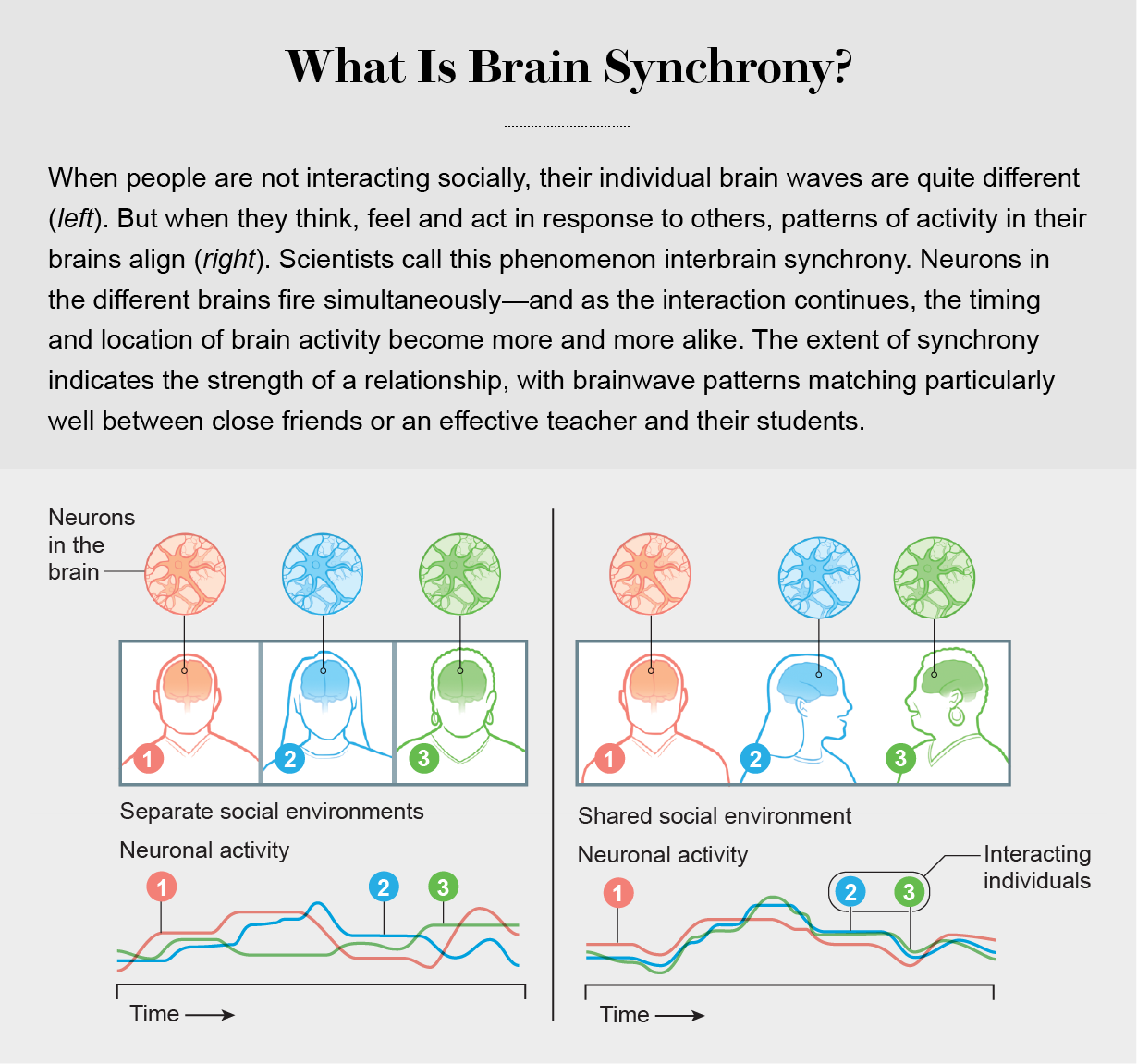
Collective neuroscience, as some practitioners call it, is a rapidly growing field of research. An early, consistent finding is that when people converse or share an experience, their brain waves synchronize. Neurons in corresponding locations of the different brains fire at the same time, creating matching patterns, like dancers moving together. Auditory and visual areas respond to shape, sound and movement in similar ways, whereas higher-order brain areas seem to behave similarly during more challenging tasks such as making meaning out of something seen or heard. The experience of “being on the same wavelength” as another person is real, and it is visible in the activity of the brain.
Researchers are discovering synchrony in humans and other species, and they are mapping its choreography—its rhythm, timing and undulations—to better understand what benefits it may give us. They are finding evidence that interbrain synchrony prepares people for interaction and beginning to understand it as a marker of relationships. Given that synchronized experiences are often enjoyable, researchers suspect this phenomenon is beneficial: it helps us interact and may have facilitated the evolution of sociality. This new kind of brain research might also illuminate why we don’t always “click” with someone or why social isolation is so harmful to physical and mental health.
In the beginning of learning it, FIML may also disrupt or alter brain synchrony.
Altered synchrony is probably the reason FIML is difficult to learn and understand at first.
When FIML practice is accepted as a natural form of speech—and partners have trained themselves in it—a more accurateand powerful synchrony will emerge. ABN
from article linked above
When we interact socially, what we fundamentally do is display and receive semiotics. We share them to greater or lesser extents.
What we do not do nearly enough is investigate this sharing at the level of real-time micro and meso semiotics.
FIML does precisely this and you do not need fMRI to do it.
From a Buddhist point of view, FIML is the dynamic sharing and analysis of subtle and very subtle states of mind.
The synchronies you share with your FIML partner will be deeper and richer than any others because you have worked and trained at fully understanding them. ABN
(1) Upon reelection President Trump told all U.S. energy providers to “drill baby drill” and maximize energy production. Trump then deregulated the industry for maximum efficiency: Secretaries Burgum (Interior), Wright (Energy) and Zeldin (EPA).
(2) Trump then meets with Putin in Alaska Aug 15, 2025. Three days later, Aug 18, 2025, Putin restarts Russia’s flagship Arctic project, the LNG export facility via the Northern Route to Asia.
(3) President Trump then signs contracts with Finland for the urgent start of Arctic icebreaking ship manufacturing in the USA and emphasizes the prior conversation about taking over Greenland which infuriates the Dutch and EU.
(4) President Trump then triggers the Venezuela operation, captures Nicholas Maduro and -in addition to other benefits- forms a new strategic oil development relationship with the interim Venezuela government. Russia stays silent.
(5) President Trump then triggers Operation Epic Fury against Iran; completely changing the geopolitical landscape that surrounds energy partnerships. Energy flows through the Gulf of Oman are impacted.
(6) President Trump then removes specific sanctions against Russia permitting Russian oil and LNG to be sold (in petrodollars) into the Asian market. Meanwhile, the European Union is forced to increase LNG purchases from the United States.
Sure, it could all be just coincidence… or not. One thing is certain, the FIVE-EYES opposition do not think all of this downstream benefit that flows to Russia and the USA is coincidental. The FIVE-EYES opposition see all of this as a strategic realignment between the USA and Russia, and they are going to do everything in their power to stop it.
The author of the above appears to be in favor of USA/Israel attacking Iran, which I am not, but he otherwise makes a good point. From a pragmatic POV, his insight should be taken in; he’s probably largely right. From what I can see, good relations with Russia are of paramount importance for all northern—Top of the World—nations, including Europe, Japan, Korea, as much of Central Asia as wants in, Canada and the Western-derived nations NZ and OZ. Good can usually be found in all situations and this may be a good side of what is happening in Iran, something I personally find revolting and grossly laden with pseudo-Christian nonsense along with Jewish Supremacist madness. It’s basic Buddhism to recognize the human realm is characterized by craziness and delusion. Politically, we always have to work with what we have and no one ever gets everything they want or need. ABN
After years of clearing up my mind, I noticed that my inner voice sometimes uses short phrases to bring negative trains of thought to an end. It was a habit I was aware of but had never given any thought to.
The phrases are not pretty; e.g. “I hate them all,” “fuck them,” “who cares about assholes like that,” etc.
My guess is this kind of inner speech is not uncommon. I was using it to end various lines of thought that had wandered into painful territory.
Having a clearer mind today or at least believing I did, I decided that when phrases or words like that came up again, I would not let them shut off my thoughts as I had been doing. Rather I would let the thoughts continue, explore what was there.
What I found is a bunch of old memories and emotions that were fairly easy to clean up. They were not so much repressed as not having been visited for many years. The nasty phrases were like labels in an old, unused filing cabinet.
About half the material was out of date and easy to toss. Another one-quarter was pertinent but was stuff I had dealt with in other ways and was thus redundant.
Only about a quarter of the material lying behind those nasty phrases deserved more thought.
In some of the most interesting cases, I realized that I was letting someone off too easy by hiding their behavior inside a neutral memory. They actually had been horrible but I had been too young to understand (narcissists, for example). Analyzing that stuff over again in a more mature mind was a bit of a chore, but the results have been good, even refreshing.
The process is ongoing. It does resemble cleaning an attic or an old filing cabinet. The stuff I found behind those nasty phrases was not all the stuff from my past. It was just stuff where I was blaming someone or feeling angry about something or had been harmed by someone. The bad stuff I’ve done is elsewhere in my mind.
I am struck by several things concerning those phrases and what lay behind them. One is a lot of that material dates back to childhood and early adulthood. It was not so much unconscious as not having been visited for a long time. Though most of it does not have strong emotional valence, some of it is very revealing because it brings together memories that had been disconnected, leading me to understand dramas or aspects of experience I had not understood before even though I had lived them. I also notice that it was just a few words that closed off those “files.”
The power of words to command silence in the mind is enormous.
I had been dismissing all that material with just a few words whenever I didn’t feel like going there, which was every time. After not going there for many years, it was refreshing to poke around and rearrange those parts of my mind. I am quite sure I freed up some memory space and removed some snags in my thinking by dealing with that stuff. I also see new patterns within my general sense of my past, patterns with better explanatory power, both truer and more concise.
I see our minds as having a structure sort of similar to language or a forest. Trees of ideas, memories, and feelings grow and change. It’s good to remove some of them sometimes, put the space to better use. Buddhist practice is very helpful in endeavors like this. Rather than get all worked up with Freudian passions and delusions, we can simply observe, dismiss, refile, erase, upgrade, or reimagine as needed based on our capacities and understanding of what’s best.
Our bhavanga or “storehouse consciousness” contains memories, pictures, ideas, words., explanations They flow along with us, in many ways are us. When the mind is clear, a lot of that material can be rearranged for the better. There aren’t many rules for that. Just do your best.
Personally, I see all of the Abrahamic religious variations as being unwise and potentially dangerous.
All religions and extremist politics, such as communism and woke, occupy the top cognitive levels of the mind; and for that reason lend themselves to fanaticism and consensus bias.
Christian-Zionists and many evangelical sects have been infiltrated by Jewish Supremists, who even dare to change the Bible and its Christian interpretations.
Buddhism has its problems, but three features of Buddhism are very wise and largely protect the tradition: 1) Buddhism does not take any written words to be God’s words, and thus subject to fanatical misinterpretations. 2) The Buddha always said he was just a man and not a god. 3) It is considered very bad conduct for Buddhists to claim to be enlightened when they are not.
As for Buddhism being ‘Godless’, that’s not true. Buddhism holds the position of ‘having no belief’ about the nature of Ultimate Reality because to do so is to retreat from it. Humans are not smart enough to say what it is but can experience it.
Buddhism is a rich and ancient philosophy. It is the foundation of Greek skepticism, but not limited to skepticism’s intellectual paradigm. Pyrrho took what he could understand from Buddhist monks in Bactria about 100 years after the Buddha’s passing.
Buddhism: No scriptures claiming to be the Word of God. No proselytizing, only welcoming those who come on their own. Strong focus on individual responsibility, which prevents the weakness Buddhists perceive in Christians or the craziness we see in religious fanatics of all stripes.
I’m just one person. What I have written is an extemporaneous response to the videos above and how they capture a slice of the terrifying nonsense in the world today.
I know a good deal about Jewish Supremacy, so I write about it often. Gaza and the public assassination of Charlie Kirk, and now the Epstein files and war with Iran, have shown millions how our world really works, how evil has burrowed so deeply into all of our institutions. ABN
While reading David Deutsch’s The Beginning of Infinity, I came across the following sentence:
What is needed is a system that takes for granted that errors will occur, but corrects them once they do—a case of ‘problems are inevitable, but they are soluble’ at the lowest level of information-processing emergence. (p. 141)
This statement comes from the chapter “The Jump to Universality,” in which Deutsch argues that “error correction is essential in processes of potentially unlimited length.”
Error correction is fundamental to FIML practice. In fact, the nuts-and-bolts of FIML practice could be described as being little more than a method for correcting errors “at the lowest level of information-processing” during interpersonal communication. This level is “the lowest” because FIML deals primarily with very short segments of speech/communication. In many posts, we have called these segments “psychological morphemes” or the “smallest speech/communication error” we can reliably identify and agree upon with our partner.
If you try to tackle bigger errors—though this can be done sometimes—you frequently run into the problem of your subject becoming too vague or ill-defined to be rationally discussable.
I haven’t read enough of Deutsch’s book to be sure of what he means by “universality,” but I do think (at this point) that FIML is universal in the sense that it will clear up interpersonal communication errors between any two qualified partners. “Qualified” here means that partners care about each other, want to optimize their relationship, and have enough time to do FIML practice.
We all demand that our computers be error-free, that buildings and bridges be constructed without error, that science work with error-free data as much as possible. But when it comes to communication with the person we care about most, do we even talk about wanting a method of error correction, let alone actually using one?
You can’t correct big errors if you have no method for correcting errors that occur “at the lowest level of information-processing,” to use Deutsch’s phrase. Once you can correct errors at this level, you will find that you and your partner are much better able to tackle bigger questions/errors/complexes. This happens because having the ability to reliably do small error-correcting gives you the capacity to discuss bigger issues without getting lost in a thicket of small mistakes.
Your ability to talk to each other becomes “universal” in the sense that you can tackle any subject together and are not tethered to static ideas and assumptions about what either of you really “means.”
FIML does not tell you how to think or what to believe. In this sense, it is a universal system that allows you and your partner to explore existence in any way you choose.
To use Deutsch’s words again, “error correction is essential in processes of potentially unlimited length.” Your relationship with your partner can and should be a “processes of potentially unlimited” growth, and error correction is essential to that process.
I used to be a Protestant and think all I needed was my Bible.
But… then I started asking the question no one wanted to answer: Who actually has the authority to interpret Scripture?
That question came from my study of the theological heresy of dispensationalism.
What I found shocked me. I learned, it isn’t ancient Christianity. It didn’t come from the Apostles. It didn’t come from the Church Fathers. It began in the 1800s with John Nelson Darby. A brand new theological system; a heresy which has created confusion among Christian’s.
It divided Israel and the Church into two separate peoples of God. It created two covenants. It pushed fulfillment into the future. It taught that prophecy still depends on a geopolitical nation-state called “Israel” which was founded by atheists in 1948.
I looked deeper and asked…what does that ultimately lead to? I was shocked to discover their belief of a rebuilt temple in Jerusalem. The one the Lord predicted would be destroyed in Matthew and it was in 70AD.
“Jesus left the temple area and was going away, when his disciples approached him to point out the temple buildings. He said to them in reply, ‘You see all these things, do you not? Amen, I say to you, there will not be left here a stone upon another stone that will not be thrown down.'” Matthew 24:1-2
This all happened. Jesus predicted it and it was fulfilled.
In 70 AD the Temple was destroyed. The altar was gone. The Levitical priesthood stopped functioning. The animal sacrifices ended.
That is not a minor detail.
The Mosaic covenant was inseparable from Temple sacrifice. Without the Temple, the sacrificial system of the Old Covenant could not continue.
In its place, rabbinic Judaism emerged. No longer centered on Temple sacrifice, but on Torah study and synagogue life.
The sacrificial order did not continue. It was finished.
And distorted motives warp human interactions, which in turn degrade individual psychology.
There is no way around it—the ways almost all people communicate are much cruder than their brains are capable of.
And that is the cause of most of what we now call (non-biological) “mental health” problems.
Here is an example: I want to say something very complex to my primary care doctor. I can give her the gist in a minute or two but I do not want to have that go on my medical record.
So I ask her if I can start a discussion that she will promise to keep off my record.
She says, “I’ll think about it.”
A week later I get a letter from her nurse saying she is not willing to do what I asked.
No reason why was given. Do rules prevent her from doing that? I have heard of doctors allowing patients to keep some concerns off the record, but who knows what the reality is? Do you?
If I insist, will that go on my record? Did what I asked in the first place go on my record? My doctor is trapped within or is voluntarily following some guideline that is most decidedly not in my best interests.
This same sort of thing can happen interpersonally. If I raise a topic that is psychologically important to me with even a close friend, I have to wonder will they understand? Will they allow me to expand the subject over a few weeks or months or longer? Will my initial statements change our friendship?
The basic problem is how do you discuss complex psychological subjects with others?
One of my friends works in alternative health care. She knows what I want to bring up with my doctor and admits that even in her professional setting where patients have an hour to open up, there is not enough time.
Back to my primary care doctor. I saw her again a year later and she asked if I remembered her. I said, “Of course I remember you.” She said no more and neither of us raised the off-the-record topic. An intern was with her.
I wonder what she thinks of me. Did she interpret my slightly nervous behavior when I first asked as a “sign” of something? Does she think I am volatile or bipolar or just nuts? (I am not.)
I am 100% sure that she cannot possibly know what I wanted to bring up with her. In this case, I have all of the information and I want to give it to her but she cannot or will not allow that unless my initial fumblings toward a complex subject are made public.
Even a close friend could find themselves in a similar position. And I wonder if I have done that myself to someone. Most people most of the time are not able to scale those walls that divide us.
On either side of the wall is a complex person capable of complex understanding, but one or both persons cannot scale the wall. My doctor is smart enough to have become an MD and yet I cannot tell her about a complex medical condition that is of great importance to me.
I know that I do not want to open the subject and risk a shallow public label (a common hindrance to many potential communications). I honestly do not know what my doctor is thinking. Maybe I will try again the next time I see her.
One year later: I didn’t try again. After much thought, I decided to switch doctors. And I will not bring this subject up with my new doctor. It’s a sad reality that trying at all ruined (in my mind) my relationship with my first doctor and convinced me that the topic is not one I can discuss with any medical professional in a professional setting and maybe in any setting.
__________
UPDATE: I first posted the above a few years ago. The world has changed. What I wanted to discuss with my doctor is the attacks I have suffered at the hands of Jewish Supremists. ABN.
Former Norwegian Prime Minister Thorbjørn Jagland, who also chaired the Norwegian Nobel Committee and served as Secretary General of the Council of Europe, was reportedly hospitalised following an alleged suicide attempt amid corruption charges linked to his connections with the late financier Jeffrey Epstein.
The development came days after Jagland was formally charged with aggravated corruption, which carries a potential 10-year prison term.
He has denied wrongdoing, describing his ties to Epstein as “unwise” or “poor judgement” and pledging full cooperation with the investigation.
Thorbjørn Jagland, former Norwegian Prime Minister and chair of the Norwegian Nobel Committee from 2009 to 2015, was directly involved in awarding Barack Obama the Nobel Peace Prize in 2009. As the committee’s chairman at the time, he oversaw the decision to grant the prize to Obama, a move that drew significant international attention and criticism due to Obama being less than nine months into his presidency and during ongoing wars in Afghanistan and Iraq.
_________
The West is dying because our general sense of right and wrong is far too abstract and out of touch with the extremely vast majority of human cultures in the world today and throughout history. I can respect people who kill themselves over personal moral issues. But it appears Jagland was remiss on the morality of global and national politics as well. He is emblematic of of the deep failure of Westerners to live up to their own ideals while also failing to protect their own people. Notice, Epstein trafficked and sexually abused zero Jewish victims. He was as low as they come, but still. First Noble Truth — the human realm is characterized by suffering which arises out of clinging to delusion. ABN
Our perception is continuously biased toward the past to help stabilize the chaotic world we live in.
Watch the video below (1 min, 32 sec) to see this illusion in real-time:
This video illustrates how our brains ignore change or incorporate it into our perceptions somewhat slowly through a “continuity field,” as described below:
Our brains are constantly uploading rich, visual stimuli. But instead of seeing the latest image in real time, we actually see earlier versions because our brain’s refresh time is about 15 seconds, according to new UC Berkeley research.
The findings, appearing in the journal Science Advances, add to a growing body of research about the mechanism behind the “continuity field,” a function of perception in which our brain merges what we see on a constant basis to give us a sense of visual stability.
“If our brains were always updating in real time, the world would be a jittery place with constant fluctuations in shadow, light and movement, and we’d feel like we were hallucinating all the time,” said study senior author David Whitney, a UC Berkeley professor of psychology, neuroscience and vision science.
Despite a noisy and ever-changing visual world, our perceptual experience seems stable over time. How does our visual system achieve this apparent stability? Here, we introduce a previously unknown visual illusion that shows direct evidence for a mechanism continuously smoothing our percepts over time.
As a result, a continuously seen physically changing object can be misperceived as unchanging.
In the video above, you can notice two things: 1) the slowness and blurriness of our perceptual change as we watch the video, and 2) that we can and do accept that change the moment it is shown to us in comparative stills.
If vision behaves this way, it is fair to assume our psychologies or, more precisely, our psychological memories do something similar on both points.
I was intrigued to see that the authors of the study calculated a time-span of 15 seconds:
We find that online object appearance is captured by past visual experience up to 15 seconds ago.
This is roughly the ‘speed’ or duration of our working memories.
FIML works most of all with the working memory because when we correct a mistake in our working memory or upgrade the data in our working memory while it is still present, we are able to make large changes in our psychologies almost effortlessly.
FIML leverages the working memory to make large changes in our whole brain memories.
It works well because changing your working memory to fit the obvious reality staring you in the face is easy.
In contrast changing whole brain memories and psychologies through rumination and recollection typically only entrenches them further and deeper.
While it is easy to see how this happens visually as in the video above, it may be difficult to see how to do this with our complex psychologies as they are functioning in real-time.
FIML completely solves this problem and yet it may be hard to see how and why.
It works like this:
The how is done by pausing real-life in real-time so you can compare your own mind’s percept with your partner’s percept of the same thing and make corrections as warranted.
The why is psychologically analogous to correcting the illusions produced by our brains “continuously smoothing our percepts over time.” This “continuously smoothing over time” prevents wholesome, realistic change. It lies at the heart of many psychological problems.
By this I mean our deepest levels of meaning, emotion, and intention are either implied or more often concealed from the person(s) we are speaking with.
In professional and formal settings (school, clubs, church, etc.) this is pretty much how it has to be since there is not enough time to delve more deeply and no good reason to do so in most cases.
Problems arise, however, when the arm’s length habits of formal settings are imported into intimate private settings such as close friendships, marriages, families.
Arm’s length communication is effective in formal settings, but its use of reduced messaging techniques in private settings invariably enters gray areas followed by conscious lying.
I think people do this in their private communications mainly because they don’t know how to communicate in any other way. Humans are basically somewhat smart apes who have a fairly complex (for us) communication/language system grafted onto the instincts of a wild animal.
When the inevitable ambiguities and lies of arm’s length communications build up within the intimate communications of couples or close friends, the result will be explosive emotions or alienation and apathy.
The simple arm’s length system is a primitive, basic system for communicating obvious things. To be honest, if you enjoy your communications at work or the clubhouse more than at home, you are basically showing how primitive you are.
In formal settings communication is entirely based on predetermined mutual agreement concerning values, beliefs, etc.
Private settings require much more nuance and thus a much more nuanced communication technique.
FIML is designed for private, intimate communication. It allows partners to open their minds to much richer and much healthier interactions.
You cannot achieve optimum psychological health if you engage only in arm’s length communication. You can only do so by using a technique like FIML that allows you and your partner to consciously share the profound world of interpersonal subjectivity.
FIML takes some time and practice but it is no harder than learning how to ski or cook or play a musical instrument moderately well.
The Buddha bucket had a figure making the joint of the bucket handle. That figure was practising the meditation position. He sat on the lotus position (“Padmāsana”). His head flat. Eyes closed and facial expression sank. The decorations on the chests were in the yellow, red, and blue colours. It was the swastika illustrating the front of the Buddha’s cloak. The swastika in Buddism meant luck, good fortune, and blessing.
The Vikings must have met the Buddhists from other regions during their voyages or the newcomers came to Scandinavian countries to trade.



 American Buddhist Net