The intransigent European Union is hitting a dead end with immovable Trump on the issue of tariffs. The resulting dynamic is what we would expect given 75 years of the Marshall Plan (European Recovery Plan) as part of the EU’s only point of reference.
In order for the EU to maintain its socialistic form of government, it needs to continue the economic benefits from one-way tariffs that exploits the American consumer market. President Trump’s plan to force reciprocity is against its entire economic foundation. The EU simply cannot fathom life without the status quo.
In many ways the EU is in the same position as Canada. From its perspective, economic reciprocity is not sustainable; it would have to change its social compacts. This is the core of the conflict.
The EU trade delegation hit a brick wall in Washington DC, as the U.S. trade team reiterated the baseline tariffs are not something within the negotiation dynamic.
As we highlighted in term-1, these ongoing negotiations with the EU on the issues of trade are extremely challenging. However, in term-2 President Trump’s position is much simpler; why keep arguing about the same problem only to end up in negotiations of intransigence?
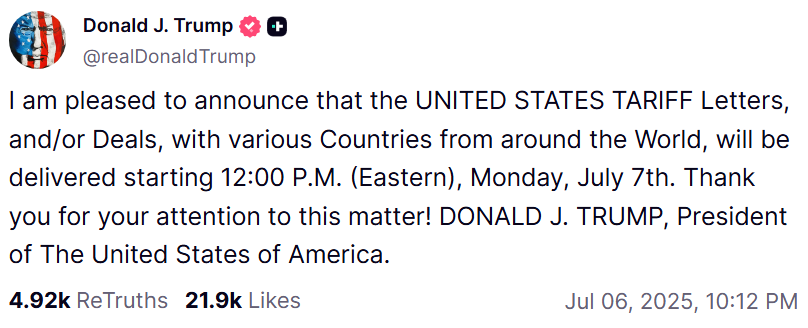
Instead, if the EU is going to continue negotiations as a collective, President Trump is now favoring just sending the EU a letter informing them of the tariff rates applied to each of their industrial sectors. This is the most direct and impactful way to end the stalemate.
The EU cannot fathom the new level of ambivalence carried by President Trump, and by extension his trade team, toward the conversation. There is no level of countervailing tariffs the EU can announce that impacts the position of Trump. Even if the EU were to end all trade with the USA, that only feeds into the goals and objectives of the Trump administration.
The EU has no power in this dynamic beyond its purchasing power, and if the EU doesn’t want to level the purchasing – thereby maintaining a trade deficit, then Trump will equalize the financial imbalance with tariffs.
Canada is in the same position, hence its alignment with the EU.
Transportation Secretary Sean P. Duffy has had enough of America’s highways being treated like social-justice canvases.
According to the directive issued this week to every governor in the nation, the Trump-appointed cabinet official ordered states to scrub their roads, intersections, and crosswalks of “political messages or artwork,” singling out rainbow-themed crosswalks as prime offenders.
“Roads are for safety, not political messages or artwork. Today I am calling on governors in every state to ensure that roadways, intersections, and crosswalks are kept free of distractions,” said U.S. Transportation Secretary Sean P. Duffy.
“Far too many Americans die each year to traffic fatalities to take our eye off the ball. USDOT stands ready to help communities across the country make their roads safer and easier to navigate.”
Safety communication is always better when it is unambiguous, straight to the point, universally understood and is not distracting. Based on this reasoning alone, it is right to go back to standard crosswalks everyone understands. More pedestrians are hit by motor vehicles than most people realize. If even one person’s leg is saved by this directive, it’s worth it. And, you can be sure lives will be saved. ABN
Very strong indication Iran has accepted a new position in the Middle East. This is a good sign and shows serious fighting is probably over across the region.
The GCC and others will become the collective regional hegemon, with some sort of US presence on the sidelines.
Israel has also accepted a new position and appears to have entirely abandoned their zany Jewish Supremist fantasy of a ‘Greater Israel’ ruling over everyone else.
Trump appears to have brokered the deal of the Century.
Now, onto the Russia-Europe-USA alliance that will cement control of the Northern Hemisphere. If Trump accomplishes that, it will be of even greater importance than what is happening in the ME.
Top of the World nations have much more in common than not and all of them are fully capable of complex cooperation.
I am talking about Japan, Korea, Mongolia, Canada and others joining a solid cultural and economic alliance with USA, Russia and Europe. ABN
Following the cessation of Iranian-Israeli hostilities in a ceasefire June 24, 11 days after they had been initiated, speculation has continued to grow regarding how Iran may respond to a possible new wave of attacks on its territory.
Prior Iranian strikes on Israeli targets made use of a wide range of missiles, from the lower end Shahab-3 which began to enter service in the late 1990s, to the solid fueled Fattah which uses a hypersonic glide vehicle for guidance.
While Iran’s ballistic missile development has for decades relied heavily on components and technology transfers from North Korea, the country has also procured a small number of North Korean missiles ‘off the shelf’.
Although the vast majority of these procurements were short ranged Hwasong-5 and Hwasong-6 models sold during the 1980s and 1990s, a small number of Hwasong-10 missiles were also reportedly transferred. When acquired in the mid-2000s, they were by far the most capable in the Iranian arsenal.
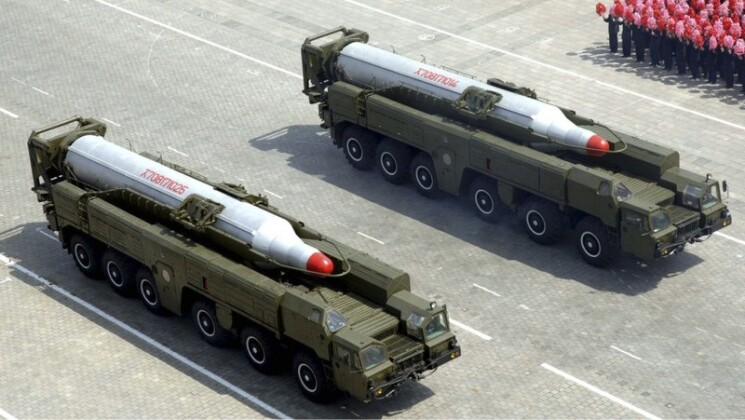
Hwasong-10 Ballistic Missile on Parade
U.S. and South Korean intelligence reported the Hwasong-10’s entry into service in 2006, after reports in January that year indicated that it had been flight tested in Iran under North Korean supervision. These exports were a particularly sensitive issue at a time when a Western attack on Iran was under consideration.



 American Buddhist Net