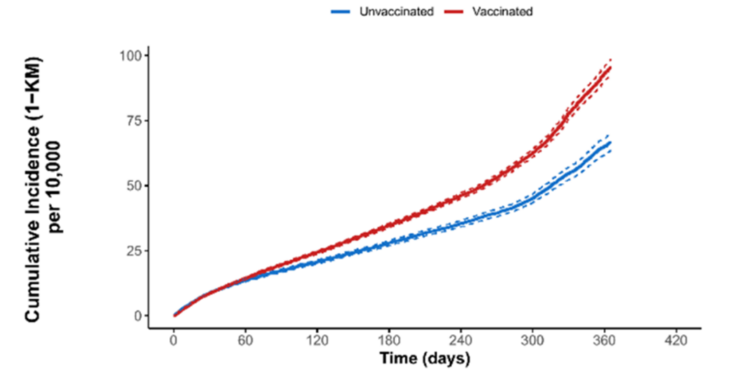
I told you here about Pfizer’s abstract of its Interim Report 5, showing at least 23-40% higher risk of some heart-related conditions in the vaccinated, but that the MHRA, the U.K. medicines regulator, was withholding publication of the full report. As I said at the time : “In summary, if, as I suspect, MHRA is worried by the results in Pfizer’s ‘Interim Report 5’ then no wonder it is sitting on it.”
Well, MHRA is still sitting on the report but I’ve managed to obtain a copy. It looks like I was right – the detailed results in the full report are even more worrying than the Hazard Ratios in the abstract which I reported last time (below).
Jacinda, you and your kind decisively lost the argument on internet free speech during covid. You and your kind were wrong about everything–lockdowns, banning early treatment, masks, school closing, mandating vaccines, and more. All wrong. What’s worse is during the pandemic you had free-reign to do what you wanted without being questioned. As a consequence, you and your kind caused a worldwide policy disaster which is still plaguing us today. Its effects will be felt for many generations to come. In contrast, those of us who disagreed with almost everything you forced on your country and the world were polite, reasonable, logical, and far more science- and data-oriented. This contrast between us and you proves decisively that you and your kind lost the argument for controlling internet speech. If our side had been allowed uncurated free speech without censorship and deplatforming, the pandemic would have ended much sooner, early treatment would have ended any need for vaccines, lockdowns would have been stopped or never started, our economies would be fine, and you would not be talking dangerous nonsense at the UN as you are doing above. ABN
The method consists of a combination of deep breathing and visualisations in an attempt to ‘shut the body down’, one bit at a time.
You begin by lying in any comfortable position on the bed.
Next come a series of visualisations about relaxing the muscles in each and every part of the body — starting with your forehead.
‘Relax your eyes, your cheeks, your jaw and focus on your breathing,’ Agustin instructed in the clip.
‘Now go down to your neck and shoulders. Make sure your shoulders are not tensed up. Drop them as low as you can and keep your arms loose by your side, including your hands and fingers.’
…Prolonged exhalations are known to rapidly slow down the heart rate, activating the parasympathetic nervous system — a network of nerves that relaxes your body after periods of stress or danger.
The act of intentionally relaxing each part of your body is a type of meditation known as ‘body scanning’, which has long been proven to trigger hormones association with feelings of calm.
The recent loophole-free verification of Bell’s inequalities [Hensen et al., 2015] has shown that no theory based on the joint assumptions of realism and locality is tenable. This already restricts the viability of realism — the view that there is an objective physical world; that is, a world (a) ontologically distinct from mentation that (b) exists independently of being observed — to nonlocal hidden-variables theories. More specifically, other recent experiments have shown that the physical world is contextual: its measurable physical properties do not exist before being observed [Grö blacher et al., 2007; Lapkiewicz et al., 2011; Manning et al., 2015]. Contextuality is a formidable challenge to the viability of realism.
These developments seem to corroborate Richard Conn Henry’s assertion in his 2005 Nature essay that “The Universe is entirely mental” [Henry, 2005: 29]. After all, in a mental universe (a) observation necessarily boils down to perceptual experience — what else? — and (b) the physical properties of the world exist only insofar as they are perceptually experienced. There is no ontological ground outside mind where these properties could otherwise reside before being represented in mind. Indeed, in a mental universe observation is the physical world — not merely a representation of the world — which not only echoes but makes sense of contextuality.
The Visual Word Form Area (VWFA) is a brain region that helps us recognize written words and letters. Without it, reading requires much more effort. When a man suffered an accidental lesion to his VWFA during brain surgery, he lost much of his ability to read while losing none of his general language abilities. After six months, he had partially recovered, but reading still took twice as long as it had before (Gaillard et al, 2006).
The VWFA is composed of neurons that were once used for face recognition:
Thus, learning to read must involve a ‘neuronal recycling’ process whereby pre-existing cortical systems are harnessed for the novel task of recognizing written words. … [Such areas of the cortex] possess the appropriate receptive fields to recognize the small contrasted shapes that are used as characters, and the appropriate connections to send this information to temporal lobe language areas (Dehaene & Cohen, 2011)
This neuronal recycling seems to have become hardwired, at least in some people. After Swiss preschoolers played a grapheme/phoneme correspondence game for a total of 3.6 hours over 8 weeks, an MRI scan showed their VWFAs preferentially responding to images of strings of letters. Yet only a few of the children could actually read, and only at a rudimentary level (Brem et al., 2010).
Humans may have initially identified words by using face-recognition neurons. As reading became more important, natural selection favored those humans who could free up more of their face-recognition neurons for reading. This selection eventually created a large neuronal population dedicated solely to word recognition, i.e., the VWFA.
This article discusses how our ability to recognize faces evolved to also recognize the written word, especially in alphabetic languages. The face recognition areas in the brain can also be partially commandeered by the development of word-recognition skills through learning to read. As someone with poor face-recognition, I wonder what happened to me. I also learned to read Chinese, so who knows what was going on? Apparently, recognizing Chinese characters requires yet another region of the brain. Some information about that can be found in this paper: The Visual Word Form Area: Evidence from an fMRI study of implicit processing of Chinese characters. ABN




 American Buddhist Net