Pam Bondi and Kash Patel just blew the lid off the biggest cover-up in American politics.
A hidden cache of Clinton Foundation files — long buried — has finally surfaced. Inside: proof of pay-to-play deals, blocked investigations, and foreign “donations” that bought Washington access while the DOJ and FBI looked the other way.
Congress has the evidence now. This isn’t rumor — it’s receipts.
Obstruction. Bribery. Treason wrapped in charity. For decades they said “no one is above the law.” Time to find out if they were lying.
“The first step in liquidating a people is to erase its memory. Destroy its books, its culture, its history. Then have somebody write new books, manufacture a new culture, invent a new history. Before long, that nation will begin to forget what it is and what it was. The world around it will forget even faster.” — Milan Kundera
Medieval England had laws dictating who could eat what based on social class.
Nobility: Venison, beef, mutton, game birds. The fattiest cuts. Roasted whole.
Peasants: Barley, oats, peas, beans. Meat maybe twice a year at festivals.
This wasn’t preference. This was LAW. You could be punished for eating above your station.
The aristocracy understood that diet determines class more than birth. Feed someone like a peasant long enough, they become one. Weak bones, poor teeth, stunted growth, no energy for rebellion.
Feed someone like a lord and suddenly they start acting like one. Strong, aggressive, capable of demanding more.
Now we don’t need sumptuary laws. We just price meat out of reach, run fear campaigns about cholesterol, and convince people that quinoa is premium nutrition.
Different century. Same suppression. Better branding.
This is where the insulting phrase, the little people, comes from.
Weakening the people through diet, culling their herd by killing or maiming their strongest; poisoning their wells, the King’s Spies… these were all methods of total control, among many others.
The little people were (and still are) punished harshly for speech and behavior that threatens to liberate them from slavery.
Elites today oppose free speech because it will undermine their evil control of the human population.
They support mass immigration invasion because it dilutes their herds of little people, weakens them, forces them to succumb.
Today’s little people are now diabetic and obese from bad diets and this was not by accident. ABN
BBC lied and manipulated footage from Jan 6. That alone is horrifying, being guilty of the very thing you accuse others of. But Norway’s state broadcaster, NRK, went even further: they used the same techniques in a program for children! Shaping minds, lying and stripping critical thought before it can even form.
A few years earlier, NRK openly declared they wouldn’t report bias when it came to Donald Trump, just as they forbid criticism of the so-called “climate crisis.” Yes, they said that too. People watch NRK. They believe it’s truthful and neutral. That belief, that blind trust, is our biggest problem.
That’s how a migrant who faked a “Nazi attack” in Bergen walks free due to claims of “false memories”, while Norwegians attacked by immigrants are branded racist for daring to be angry.
The National Governors’ Association drafted a joint statement on Nov. 11 to counteract the nationwide spread of xenophobia and social media misinformation that includes the sentiment “As foreigners increase, so does crime.”
Headed by Shizuoka Governor Yasutomo Suzuki, the project team behind the draft hopes it will ease anxieties regarding international residents.
It is scheduled to be approved at a meeting between all 47 of Japan’s governors who represent the 46 prefectures and Tokyo on Nov. 26.
The association has so far requested the central government to compile a basic plan for accepting non-Japanese nationals, enact a fundamental law on multicultural coexistence measures and establish an organization dedicated to overseeing the issue.
DENOUNCEMENT OF XENOPHOBIA
Three pillars make up the document titled the “Joint declaration by governors nationwide aiming to realize a multicultural society (tentative).”
The first seeks the “promotion of multicultural coexistence” by advocating measures that will support community building between Japanese citizens and foreign residents.
It vows to “strongly reject exclusivism and xenophobia based on information not grounded in facts or data.” It also calls for “calm discussions based on realistic evidence and concrete measures, without relying on impressions.”
The second is a tenant of “coexistence based on rules and ensuring peace of mind.” This declares that multiculturalism “does not mean the disorderly acceptance or preferential treatment for foreigners.”
It emphasizes efforts to provide information and consultation, including matters such as garbage disposal and noise, to ensure international residents can properly understand rules; also included is the intent to promote Japanese-language learning opportunities.
The third point zeroes in on “accurate and proactive information dissemination” and points out that foreigners have become “indispensable members of the community” in terms of manpower to offset population decline.
This is the trick where when you lose on the national level, you undermine on the local level.
Culturally, this is gaslighting and mind-control Japanese style—‘ensuring peace of mind’—while politically, it’s the invariable second line of attack used in USA and throughout the West.
I want to see Japanese civilization preserved as much as I want to see the West’s preserved.
Rapidly oncoming robotics eliminate the need for mass immigration, while examples across the West prove the devastating outcomes which result from an invasion of immigrants, many of whom will hate you and work to destroy you. ABN
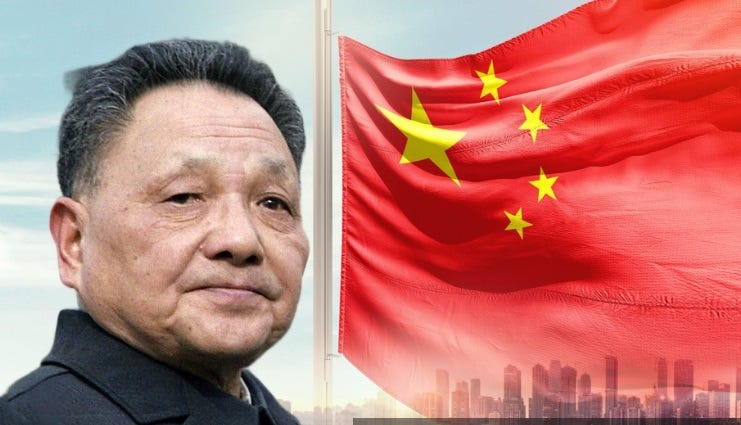
When China got a break: Deng Xiaoping imported the Japanese high growth formula
After nearly three decades of ideological campaigns on the people of China, and likely more than 60 million people killed in the process, even the died-in-the-wool communists had after the death of strongman Mao become tired of party-political programmes (see Part I for more on those). Consequently, it was an uphill battle for Mao’s chosen heir, Hua, to generate any enthusiasm and support. Instead, a growing majority in the upper echelons of the Chinese Communist Party felt keenly that continuity was not attractive, as things had not panned out that well. Instead, the decision-makers ordained that it was time for a change in direction, namely by allowing a reality-oriented pragmatist to take the helm who would focus on delivering results – such as economic development, strengthening the nation and making the Chinese people better off.
Every so often there are moments in world history when the senior decision-makers over nations are neither incompetent agents serving foreign agendas, nor evil, genocidal psychopaths.
The time was ripe for Deng Xiaoping, who had joined the early Communist Party of China in the 1920s and had been on Mao’s Long March in1934. Moreover, he had already been in positions of influence before, but had been unceremoniously deposed several times, sent to labour camps or had otherwise been suppressed. Known as a calm, able and even-handed administrator who had not been involved directly in the cynical anti-human policies of the previous decades, Deng was rehabilitated in 1977 and appointed Vice Chairman of the CCP. He was also appointed Vice Premier of the State Council and member of the Politburo.
Deng picked up the pieces and restored economic order. He was now generally supported, especially as Hua’s unsuccessful attempt to pin the blame for the biggest policy disasters on particular people, such as the “Gang of Four”, had merely driven home the realisation that China had lost many years, even decades in terms of prosperity.
The remainder of 1977 and much of 1978 were a time of preparation for Deng Xiaoping. Then, in December 1978, he gave a key speech, which has since been interpreted as Deng officially taking over the leadership in China.
According to Israeli officials, the planned US base along the Gaza border would house several thousand troops tasked with maintaining the cease-fire; the move signals Washington’s determination to deepen its involvement in the Israeli-Palestinian conflict
The removal of Blued and Finka marks another setback for China’s LGBTQ+ community.
Apple has removed two of the most popular gay dating apps in China from the App Store after receiving an order from China’s main internet regulator and censorship authority, WIRED has learned. The move comes as reports of Blued and Finka disappearing from the iOS App Store and several Android app stores circulated on Chinese social media over the weekend. The apps appear to still be functional for users in the country who already have them downloaded.
“We follow the laws in the countries where we operate. Based on an order from the Cyberspace Administration of China, we have removed these two apps from the China storefront only,” an Apple spokesperson said in an email. Apple clarified that the apps have not been available in other countries for some time. “Earlier this year, the developer of Finka elected to remove the app from storefronts outside of China, and Blued was available only in China.”
Fuentes does a good job with his cultural analyses and calling out a**holes. From what I have seen, though, is he has only scratched the surface of Jewish Supremacy.
The really big demonic fish he needs to catch is JS covert warfare inside USA and the West.
It has been very violent, but hidden, at interpersonal levels and is a major cause of Western decline.
It’s never been about just ideas or nepotism or money.
It’s mostly been about covert violence against talented young people and the ruination this brings the West, year after year. ABN
A Trump-appointed federal prosecutor in Miami has launched a probe into a ‘grand conspiracy’ by Democrats led by Barack Obama to destroy Trump’s political ambitions.
Jason Reding Quinones, US Attorney for the Southern District of Florida, has subpoenaed at least 30 Obama officials involved with an investigation into Trump’s 2016 presidential campaign, The New York Times reported.
The Miami probe follows up on a far right theory that Obama officials used the ‘hoax’ investigation in an in attempt to jail Trump after the 2016 election.
Quinones has now issued more than two dozen subpoenas, some to officials who took part in the Russia inquiry. So far, they include ex-Director of National Intelligence James Clapper, former FBI agent Peter Strzok and ex-FBI lawyer Lisa Page.
A Chinese diplomat has sparked a diplomatic firestorm in Japan over a statement widely seen as threatening toward Prime Minister Sanae Takaichi, following her recent remarks on Taiwan.
The controversy erupted after Takaichi, who was sworn into office last month, told a parliamentary committee on Friday that a Chinese military blockade of Taiwan, which Beijing claims as its own, would likely create a “survival-threatening situation” for Japan—one that could force Tokyo to respond by deploying its Self-Defense Forces.
Xue Jian, the Chinese consul general in Osaka, fired back on social media platform X in a now-deleted post, which read: “That filthy neck that barged in on its own—I’ve got no choice to cut it off without a moment’s hesitation. Are you prepared for that?”




 American Buddhist Net