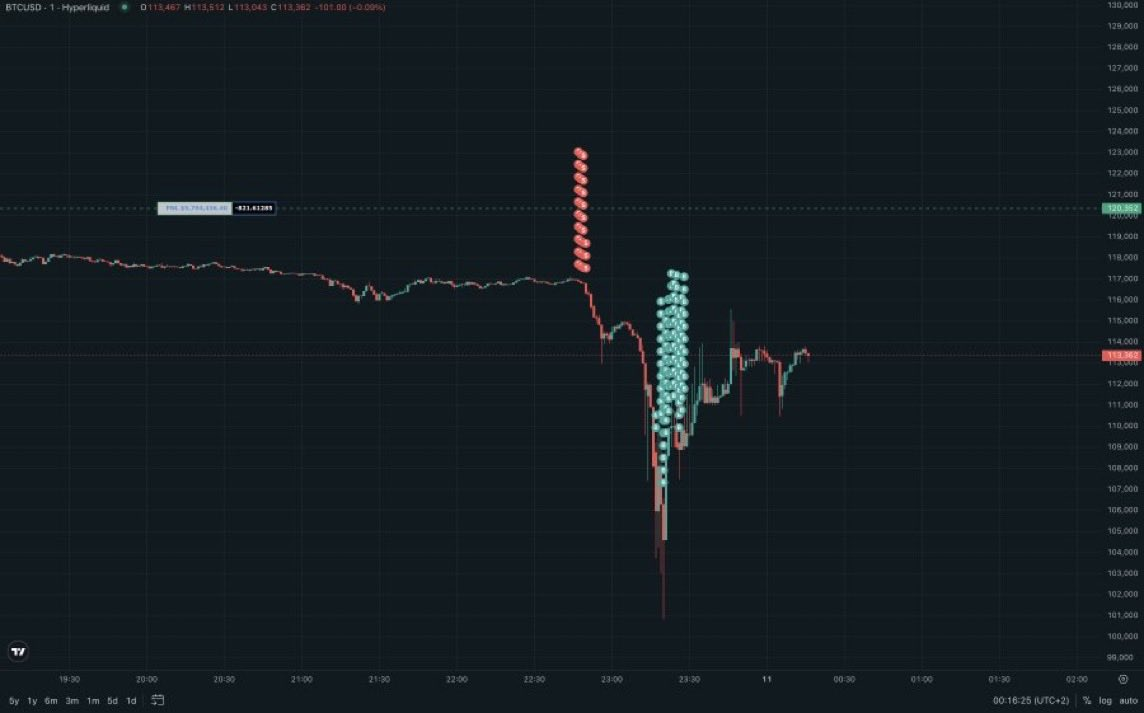
A single colossal BTC whale shorted at the peak, then, just minutes before the market-shattering crash, piled on millions more in shorts. At the very bottom of the drop, he closed 90% of his Bitcoin short and completely exited his Ethereum short, pocketing roughly $190–$200 million in a single day.
That’s the only instance we can trace, but speculation is rampant that the scale was far larger and extended across other exchanges.
Don’t be naive, this wasn’t luck. Someone was either manipulating the market or front-running it. Either way, the collapse was engineered, and investors have every reason to be alarmed.
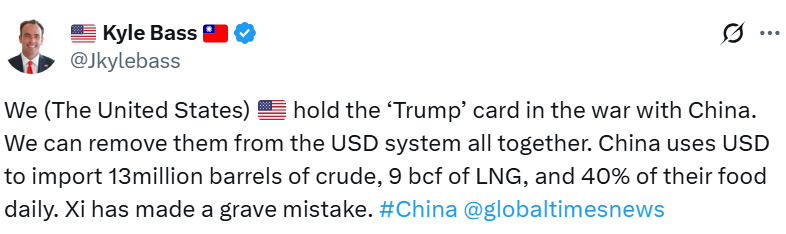
Also Kyle Bass: ‘The path forward certainly feels like an inevitability of war.’
Bass is fairly reliable and does not have stars in his eyes vis-a-vis China, which is a very good thing.
I would hope USA has other ways to get rare earth minerals.
This move by China has been brewing for a long time and it has been a well-known option all along.
As for BRICS becoming stronger if USA responds vigorously, Bass has this to say:
‘The BRICS are akin to 5 garbage trucks backing into each other. Reserve managers won’t go there and China will collapse in the meantime.’
For decades I have watched Westerners being overly intimidated and/or impressed by China. This is a natural form of what might be called ‘culture shock’.
Everyone who studies Chinese starts out this way, super-enamored. It takes years of study to see their weaknesses and faults; their real humanity.
The best thing China has going for them is ethnic/ racial cohesion.
Sun Yat-sen taught this over one hundred years ago and it has become gospel in all Chinese communities everywhere.
It is a foundational part of Chinese education everywhere.
In the West, we have mistakenly gone the other way and are fast destroying ourselves with endless self-criticism and resignation.
The ‘culture shock’ aspect of this is societies affected by it typically feel despondent, even hopeless because the confronting culture is new and seems indominable.
Japan and China both reacted this way when first confronted by the West.
Japan figured things out more quickly than any other society in the world and succeeded in modernizing without losing their Japanese identity.
China today is still reeling from its self-perceived ‘Century of Humiliation’.
The West today is akin to Japan in, maybe, 1885 in our understanding of the ‘culture shocks’ we are experiencing.
Another big factor in the West is we are infested with powerful and hostile parasitic subcultures, literally high-end gangs, who are actively seeking to destroy us as they feed on us. ABN
While Chris Martenson has, I believe, conducted a conclusive scientific ballistic analysis to prove that the sniper who killed Charlie Kirk was on a different building than the alleged shooting position of Tyler Robinson, other researchers continue to accumulate circumstantial evidence that, in the weeks preceding Kirk’s death, his pro-Israel backers were trying to blackmail and threaten him into abandoning his recent criticism of Israel.
They feared that Kirk would follow the path of Tucker Carlson and Candace Owens and draw millions of his Gen Z followers behind him.
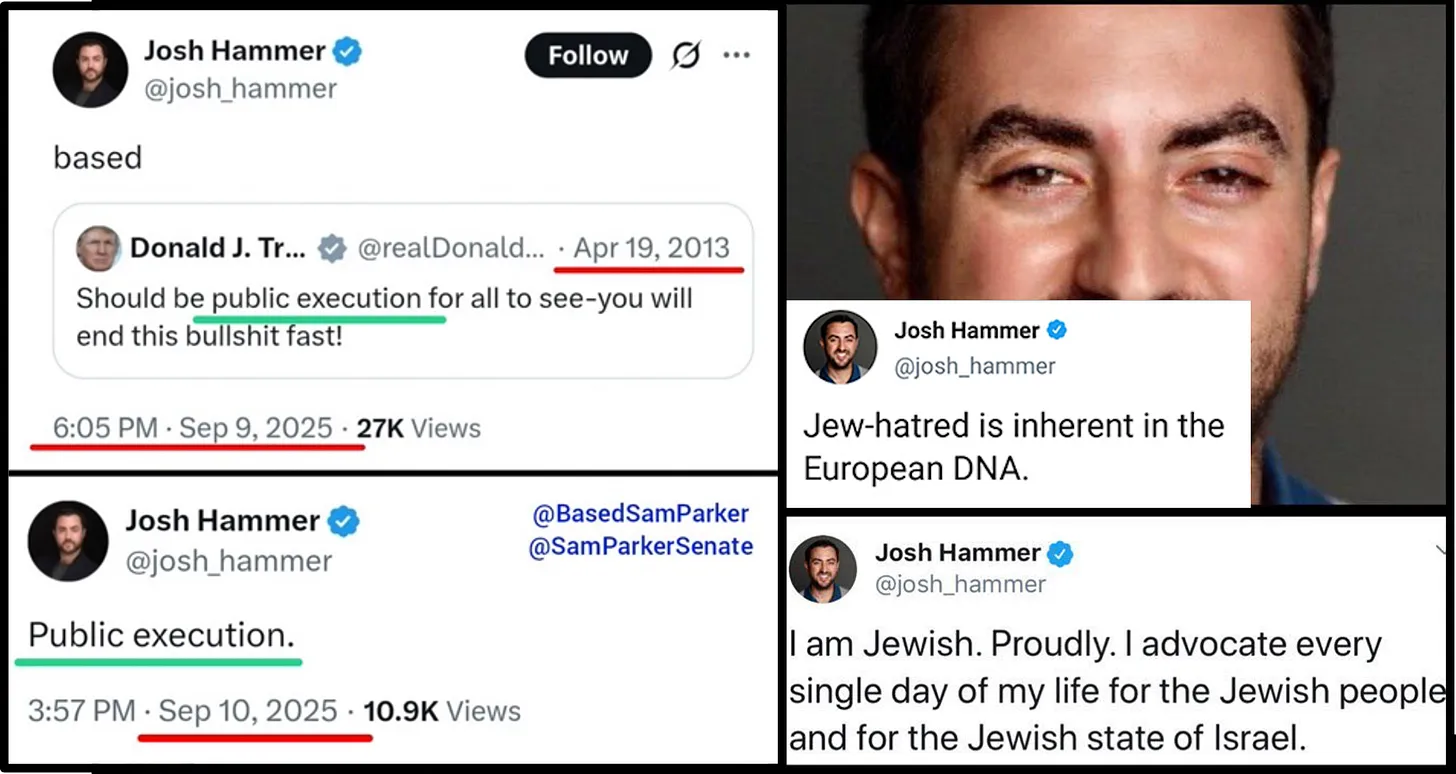
After inviting Carlson on Turning Point in mid-July, Kirk was thinking of inviting Owens, who is now on the frontline in the battle for the truth about her friend’s “public execution”.
Meanwhile, il is becoming public knowledge that, in the words of “someone well situated in conservative circles who personally knew Kirk” and spoke to Ron Unz, “everyone in Kirk’s circle, even including important Trump Administration officials, suspected that Israel had probably killed the young conservative leader.”
Here, I recap what I think are the most important established facts. I have borrowed much from Sam Parker’s long investigative tweets on the subject (here, here and here), and I strongly recommend following him on X.
• Alzheimer’s disease is commonly thought to result from abnormal plaque buildup in the brain that gradually destroys brain tissue. As a result, almost all Alzheimer’s research has been directed toward eliminating amyloid, even after the basis for much of this work was shown to stem from fraudulent research.
•As such, despite decades of research and billions of dollars spent, this model has completely failed to produce useful results. The costly “groundbreaking” Alzheimer’s drugs only slightly slow dementia progression—at the expense of causing brain bleeding and swelling in over a quarter of those treated.
•In contrast, numerous affordable treatments have been developed for Alzheimer’s disease that target the root causes of the disorder, producing significant benefits at a fraction of the cost and without any toxicity.
•One neurologist, for example, proposed that amyloid serves a protective function in the brain and treats Alzheimer’s by identifying the underlying process causing dementia (which can often be diagnosed through symptoms). Remarkably, despite the method being proven in clinical research, awareness of it or the fact there are completely different types of “Alzheimer’s disease” which require different treatments remains almost nonexistent.
•Likewise, a strong case can be made that impaired cerebral circulation, along with impaired venous and lymphatic drainage, plays a pivotal role in Alzheimer’s disease.
•This article will review the common causes of cognitive impairment and dementia (e.g., cells becoming trapped in a shocked state where they no longer function) along with the forgotten treatments for neurodegenerative disorders—some of which, like DMSO, have extensive evidence supporting their use.
Sad this needs to be said. It needs to be said more often. 3.5% of world population are White women. If you guys keep fighting White men, neither of us is going to survive :) ABN
A recent study (Emoticons in mind: An event-related potential study) convincingly demonstrates that our responses to emoticons as simple as a colon next to a parenthesis :) are similar to our responses to real human faces.
Clearly, this response has been learned. No infant is born with that response and no one anywhere had it just a few decades ago.
Our tendency to respond to :) as a face arose with its use in email and texting. This response is now a well-established “public” response to a “public” semiotic. In this context, public means “understood and shared by many people.”
A public semiotic is a sign with wide currency. It is a unit of culture and often of language itself. We can see in the case of the emoticon :) that a new sign can arise due to unique circumstances and that that sign can come to have a deep meaning for many people.
The sign :) seems quite beautiful to me because it is very simple, very easily produced, and very telling about how our minds work. If the elements of the sign are reversed (: people no longer respond to it as a face, though of course we could learn to do that if the reversed sign were used that way more frequently.
I remember the first time I saw a derivative sign ;) and wondered briefly what it meant. If you had a similar experience, you may be able to remember how such a simple sign can bloom in your mind and go from something that is unknown to something of considerable significance in just a few seconds.
That is an example of the birth of a sign, the birth of a semiotic in your mind.
When the semiotic is public, we strive to learn what other people mean by it. When it is private—that is, with a meaning known only to us—there will be other, often very significant, implications.
What would a “private sign” be like? A straightforward example might be a code we use in a diary. Such a code would have at least one visual sign whose meaning is known only to us.
Another kind of private visual sign might be a facial expression that we have come to interpret differently from other people. My guess is everyone has a good many of these. That is to say, the “idiolect” of facial expressions we each use to understand other people is at least as various as different idiolects within a spoken language.
Now add tone of voice, posture, accent, word choice, topic choice, and so on to this mix. Each of those areas of communication uses signs that can and always will be interpreted in a wide variety of ways, including private ones.
Now, consider how an individual may get lost in all this. If someone ever smiled at you as they hurt you, you may have learned to be suspicious in your interpretation of human smiles. Or you may employ your own smile in ambiguous ways.
Now consider all the signs of communication and how many possible interpretations there are. Then consider the study linked above which shows how deep our responses can be to something as trivial as the sign :).
One way we form delusions occurs when our interpretations of communicative signs become too private and/or do not correspond well with the interpretations employed by other people. The other way we form delusions occurs when our interpretations of signs does correspond well with the interpretations employed by other people, but those other people are wrong.
In “public” situations—professional, commercial, business, school, etc.—it is fairly easy to communicate well enough based on established norms. But in interpersonal communication, you can only take “established norms” so far. At some point, you will have to understand your partner and be understood by them in much greater detail than “established norms,” or public semiotics.
It has just been learned that China has taken an extraordinarily aggressive position on Trade in sending an extremely hostile letter to the World, stating that they were going to, effective November 1st, 2025, impose large scale Export Controls on virtually every product they make, and some not even made by them. This affects ALL Countries, without exception, and was obviously a plan devised by them years ago. It is absolutely unheard of in International Trade, and a moral disgrace in dealing with other Nations.
Based on the fact that China has taken this unprecedented position, and speaking only for the U.S.A., and not other Nations who were similarly threatened, starting November 1st, 2025 (or sooner, depending on any further actions or changes taken by China), the United States of America will impose a Tariff of 100% on China, over and above any Tariff that they are currently paying. Also on November 1st, we will impose Export Controls on any and all critical software.
It is impossible to believe that China would have taken such an action, but they have, and the rest is History. Thank you for your attention to this matter!
DONALD J. TRUMP PRESIDENT OF THE UNITED STATES OF AMERICA
The researcher, Anthony McCaffrey, says of his theory: “I detected a pattern suggesting that something everyone else had overlooked often became the basis of an inventive solution.”
This is exactly what FIML does. Normally, we all overlook the indisputable fact that we simply do not understand one another a good deal of the time. We get impressions, we get the general idea, we trust, we love. But we don’t have good, clear understanding of the small units of communication, out of which our impressions of others are built. With most people in professional or formal settings, this does not matter greatly (or maybe it does but it is hard to fix in those contexts), but with close friends, and especially loved ones, not having a clear idea of what they are saying can and often does have very serious consequences.
What FIML practice does is show us how to notice what we are overlooking in our communications with our partners. Since both partners are equal participants and both are active in the practice, it doesn’t take very long to get good results.




 American Buddhist Net