The Army is experimenting with arming small, soldier-operated drones with guns to shoot enemy targets with either a 9mm pistol or tiny ink-pen-like gun barrel mounted on.
“We are looking right now at a remotely operated single-shot weapon which looks like a pen,” Col. Sam Edwards, Director of Robotics Requirements, Capability Development Integration Directorate, Ft. Benning, Ga., told The National Interest in an interview.
First and foremost, a small drone armed with a pistol controlled remotely by a human operator can attack an enemy soldier on the other side of a ridge, behind a rock, or even inside a building. It can enable point-to-point small arms fire while protecting the shooter. Such a possibility could clearly bring new possibilities to close quarter battle by offering new angles of attack. The presence of an armed drone might force enemies to reposition and move, potentially exposing themselves to targeting opportunities.
Armed drone aerial small arms attack would be very difficult to defend against, particularly if there were numerous mini-gun tubes loaded onto the drone as is the case with the ink-pen-like drone.
Unlike drones that are themselves engineered to become explosives, mini-armed drones could be recoverable and, for example, return to an operator for reloading and retasking. The system will need to have the right kinds of hardware configuration, software, and camera systems enabled by some kind of data link transmission sufficient to send targeting information.
This article is from 2020. If this weapon was made public at that time, you can be sure it was operable even sooner, let alone today.
A reasonable hypothesis today is Charlie Kirk was shot from a drone like this carrying a small caliber round fired through a ‘pen-like barrel’.
This would explain the super-fast drones observed on that day and the anomalous neck wound on Kirk; and, so far, the absence of an exit wound or a spent bullet.
The projectile could have been designed to home in on a signal coming from Kirk’s earpiece or it could have been aimed by a remote operator or AI program.
Only a nation or powerful private organization would have the means to obtain and use a weapon like this.
Kirk’s autopsy will reveal what happened if it is credible, which is highly unlikely. ABN
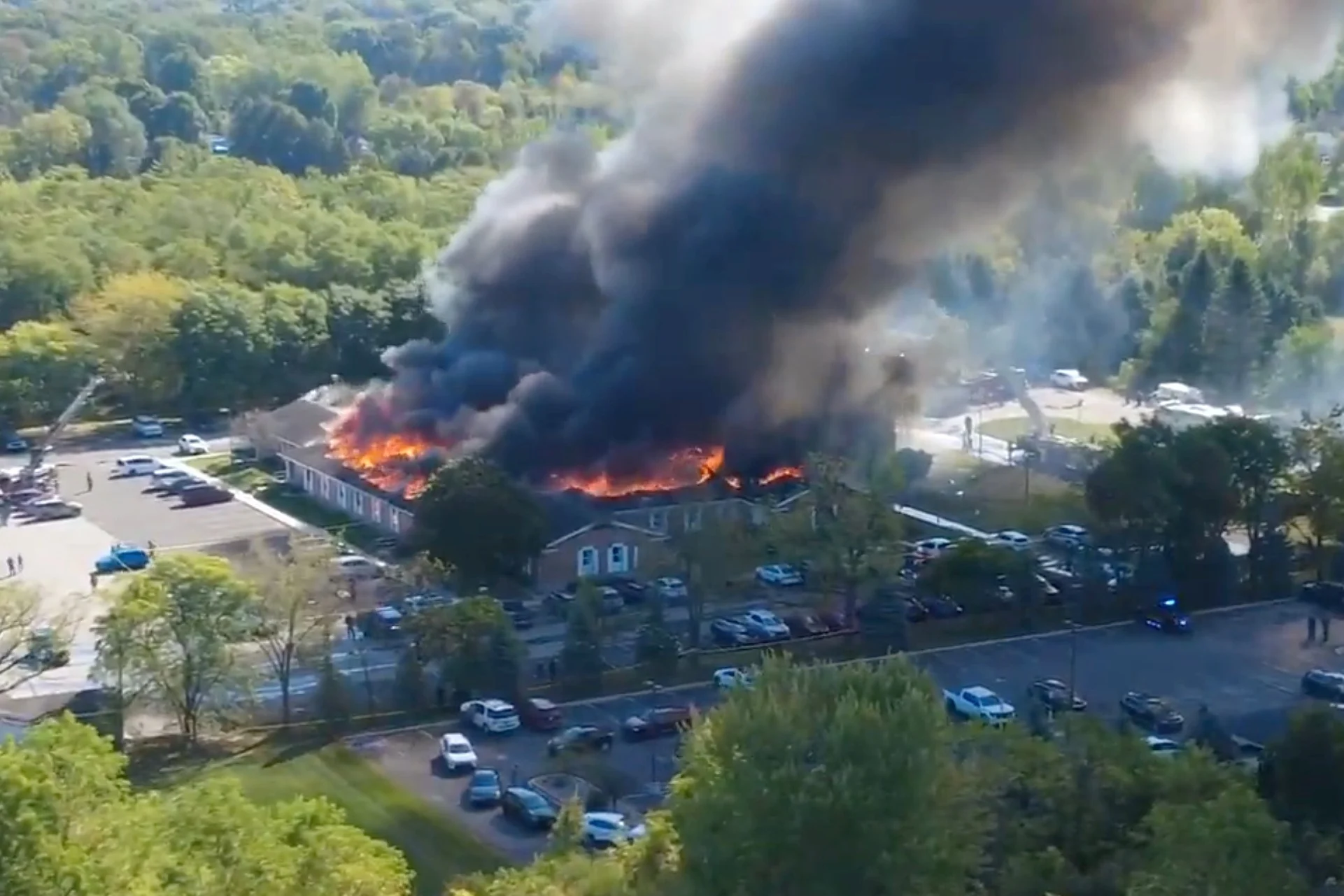
GRAND BLANC, Mich. (AP) — Police say one person was killed and nine injured in a shooting at a Mormon church in Michigan, and the suspect is also dead.
The shooting happened Sunday at The Church of Jesus Christ of Latter-day Saints in Grand Blanc, about 50 miles north of Detroit, Grand Blanc Township Police Chief William Renye told reporters. The church was also set ablaze.
Police said there is no ongoing threat to the public. Authorities have not released details on the surviving victims’ conditions.
In this image taken from video released by Julie J, @Malkowski6April, Massive flames and smoke rise from The Church of Jesus Christ of Latter-day Saints in Grand Blanc, about 50 miles north of Detroit, Sunday, Sept. 28, 2025. (Julie J, @Malkowski6April via AP)
A respected congressman has claimed that advanced alien beings could be hiding out in ‘five or six’ underwater UFO bases right off the US coast.
Tennessee congressman Tim Burchett, a member of the House Oversight Committee overseeing UFO reports, drew massive attention on social media after saying that he believed there were alien ‘entities’ currently living in deep-water areas on Earth.
The September 17 clip posted on X has already been viewed more than 1.9 million times.
During the sidewalk interview with a UFO researcher and documentary filmmaker who goes by the pseudonym Red Panda Koala, Burchett suggested that advanced alien beings or civilizations may have been hiding in Earth’s oceans for generations.
He added that there have been frequent sightings of unidentified craft around five or six specific deep-sea areas, which he found significant given how little is known about the ocean compared to the moon’s surface.
Mortality is an indisputable outcome and thus a reliable statistical marker of the danger of the covid vaxxes.
But where there is mortality there is sure to be many times more instances of morbidity.
Factor this morbidity into the rise in colon cancers, strokes, other cancers, and more.
Whether they were designed as bioweapons or not, the covid mRNA vaxxes have worked like bioweapons, including probable insertion into the human genome of deleterious genetic traits. ABN
Besides being totally crazy, this vid shows the power of semiotics. It’s a glaring example of what semiology is all about. The girl, the uniform, his gait, the flag, the voices. ABN
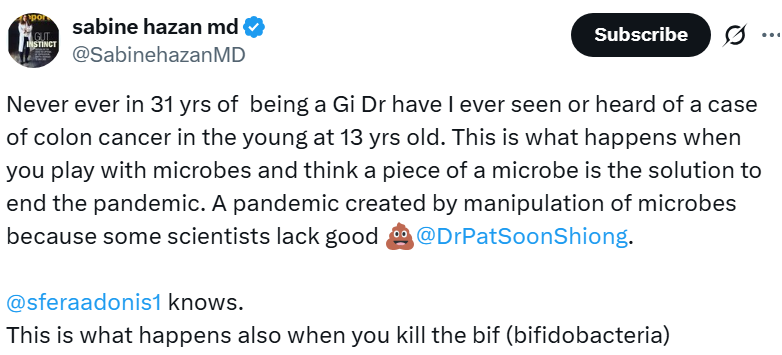
Bowel preparation for colonoscopy significantly affects Bifidobacterium, a beneficial genus of gut bacteria. Studies have shown a decrease in Bifidobacterium abundance following bowel preparation, with one study noting its reduction in fecal samples one month after the procedure
This change is part of broader alterations in the gut microbiota, including a significant decrease in Firmicutes and an increase in Proteobacteria immediately after cleansing, with Bifidobacterium identified as one of the bacterial members involved in long-term changes
The disruption to Bifidobacterium and other beneficial microbes can persist for days to weeks, potentially contributing to post-procedural symptoms like bloating and pain
However, research suggests that probiotic supplementation, including strains of Bifidobacterium, may help restore microbial balance and reduce these adverse effects For instance, a probiotic formulation containing Bifidobacterium species was found to restore intestinal dysbacteriosis and reduce pathogen abundance
While some studies indicate that the gut microbiota, including Bifidobacterium, may return to baseline levels within 14 days after the procedure , others report persistent changes in microbial composition, including reduced Lactobacillaceae (a family closely related to Bifidobacterium) and altered diversity, suggesting a more prolonged impact in certain individuals
The extent and duration of these changes may depend on the specific bowel preparation agent used and individual factors
I like the way she speaks directly and definitely without resorting to weak rhetorical questions with obvious answers which often sound feeble or supplicating.
A strong tone can be spoken gently and convey meaning and purpose with great clarity while leaving zero doubt about what the issue is or what the speaker wants.
This is the way we should all speak about the decline of Western civilization and its peoples. ABN
The U.S. Air Force 461st Flight Test Squadron based at Edwards Air Force Base has received a unique specially instrumented F-35A fighter designed to enhance the much delayed testing of new software.
The new aircraft is expected to help accelerate efforts to bring the F-35’s software fully up to the Technology Refresh 3 (TR-3) standard, which is critical to keeping up with the latest advances in Chinese fifth generation fighter programs, and eventually facilitating bringing the F-35 up to the Block 4 capability standard in the early-mid 2030.
The issue of delays has been serious enough that in July 2023 the Joint Program Office placed F-35 procurements on hold, with the Pentagon refusing to approve deliveries specifically because TR-3 software had not been fully tested.
Commenting on the importance of the new to accelerating development world, the director of the F-35 Integrated Test Force Lieutenant Colonel Daniel Prudhomme observed: “As the world’s only F-35A capable of evaluating both mission systems and flight sciences, this new asset is key for rapidly fielding advanced capabilities to the warfighter.” “This new aircraft arrives at a crucial time, supporting intensive testing of TR-3 software upgrades and next-generation weapons integration,” he added.
An ex-educator claiming the de Blasio administration knowingly permitted “racial harassment” against white staffers in the public school system — during anti-bias training sessions and in the workplace — can sue NYC, a federal appellate court ruled this week.
The bombshell decision on Thursday overturned a lower-court’s dismissal of a 2019 lawsuit by Leslie Chislett, a veteran administrator who led the Advanced Placement for All initiative in the city Department of Education. It paves the way for a trial or financial settlement with the city.
“She presented evidence that would allow a reasonable juror to find that the DOE consistently ignored racial harassment of Caucasian employees during ‘implicit bias’ trainings and workplace interactions,” the three-judge panel of the US 2nd Circuit Court of Appeals found.
It was just revealed that the FBI had secretly placed, against all Rules, Regulations, Protocols, and Standards, 274 FBI Agents into the Crowd just prior to, and during, the January 6th Hoax. This is different from what Director Christopher Wray stated, over and over again! That’s right, as it now turns out, FBI Agents were at, and in, the January 6th Protest, probably acting as Agitators and Insurrectionists, but certainly not as “Law Enforcement Officials.” I want to know who each and every one of these so-called “Agents” are, and what they were up to on that now “Historic” Day. Many Great American Patriots were made to pay a very big price only for the love their Country. I owe this investigation of “Dirty Cops and Crooked Politicians” to them! Christopher Wray, the then Director of the FBI, has some major explaining to do. That’s two in a row, Comey and Wray, who got caught LYING, with our Great Country at stake. WE CAN NEVER LET THIS HAPPEN TO AMERICA AGAIN!
The FBI has fired agents who were photographed kneeling during a racial justice protest in Washington that followed the 2020 death of George Floyd at the hands of Minneapolis police officers, three people familiar with the matter said Friday
This is a good sign but it will take more than this to clean up the agency. The linked article contains info on other firings, but likewise, more is needed. ABN






 American Buddhist Net