North Korea’s defence sector has inaugurated a new factory for the production of tactical ballistic missiles, which makes use of fully automated assembly lines that can reportedly handle material preparation, precision processing, and component assembly.
According to state media, new production processes will not only increase output, but will also improve product quality, potentially allowing for the realisation of higher levels of precision and longer service lives for the missiles. KN-24 short range tactical ballistic missiles were seen on the factory floor, although it remains uncertain whether any other missile classes will be produced at the facility.
KN-24 Missiles at New North Korean Missile Factory
Although North Korea has made significant strides in the quality of its machine tools and CNC machines, images from the country have indicated that civilian machinery such as CNC machines have been procured from China which could further significantly improve the products of local industry.
FIML is both a practice and a theory. The practice is roughly described here and in other posts on this website.
The theory states (also roughly) that successful practice of FIML will:
Greatly improve communication between participating partners
Greatly reduce or eliminate mistaken interpretations (neuroses) between partners
Give partners insights into the dynamic structures of their personalities
Lead to much greater appreciation of the dynamic linguistic/communicative nature of the personality
These results are achieved because:
FIML practice is based on real data agreed upon by both partners
FIML practice stops neurotic responses before they get out of control
FIML practice allows both partners to understand each other’s neuroses while eliminating them
FIML practice establishes a shared objective standard between partners
This standard can be checked, confirmed, changed, or upgraded as often as is needed
FIML practice will also:
Show partners how their personalities function while alone and together
Lead to a much greater appreciation of how mistaken interpretations that occur at discreet times can and often do lead to (or reveal) ongoing mistaken interpretations (neuroses)
FIML practice eliminates neuroses because it shows individuals, through real data, that their (neurotic) interpretation(s) of their partner are mistaken. This reduction of neurosis between partners probably will be generalizable to other situations and people, thus resulting a less neurotic individual overall.
Neurosis is defined here to mean a mistaken interpretation or an ongoing mistaken interpretation.
The theory of FIML can be falsified or shown to be wrong by having a reasonably large number of suitable people learn FIML practice, do it and fail to gain the aforementioned results.
FIML practice will not be suitable for everyone. It requires that partners have a strong interest in each other; a strong sense of caring for each other; an interest in language and communication; the ability to see themselves objectively; the ability to view their use of language objectively; fairly good self-control; enough time to do the practice regularly.
In mathematics, a ‘computation’ is the process of performing mathematical operations on one or more inputs to produce a desired output. A problem in analyzing human psychology arises when we understand that human psychology cannot be reduced computationally. The ‘computational irreducibility’ of human psychology does not mean, however, that there is no way to probe it and understand it. In the following essay, I show how FIML practice can greatly enhance our understanding of our own psychologies and, by extension, the psychologies of others.
Rather than rely on tautological data extractions or vague theories about human psychology, FIML focuses on small interpersonal exchanges that can be objectively agreed upon by at least two people. These small exchanges correspond to what Wolfram calls ‘specific little pieces of computational reducibility’. When we repeatedly view our psychologies from the point of view of specific little pieces of computational reducibility, we begin amassing a profoundly telling collection of very good data that shows how we really think, speak, and act.
FIML is a method of inquiry that deals with the computational irreducibility of humans. It does this by isolating small incidents and asking questions about them. These small incidents are the “little pieces of computational reducibility” that Stephan Wolfram remarks on at 42.22 in this video. Here is the full quote:
One of the necessary consequences of computational irreducibility is within a computationally irreducible system there will always be an infinite number of specific little pieces of computational reducibility that you can find.
This is exactly what FIML practice does again and again—it finds “specific little pieces of computational reducibility” and learns all it can about them.
In FIML practice, two humans in real-time, real-world situations agree to isolate and focus on one “specific little piece of computational reducibility” and from that gain a deeper understanding of the whole “computationally irreducible system”, which is them.
When two humans do this hundreds of times, their grasp and appreciation of the “computationally irreducible system” which is them, both together and individually, increases dramatically. This growing grasp and understanding of their shared computationally irreducible system upgrades or replaces most previously learned cognitive categories about their lives, or psychologies, or how they think about themselves or other humans.
By focusing on many small bits of communicative information, FIML partners improve all aspects of their human minds.
I do not believe any computer will ever be able to do FIML. Robots and brain scans may help with it but they will not be able to replace it. In the not too distant future, FIML may be the only profound thing humans will both need to and be able to do on their own without the use of AI. To understand ourselves deeply and enjoy being human, we will have to do FIML. In this sense, FIML may be our most important human answer to the AI civilization growing around us. ABN
Shireen was an American citizen and a Christian working as a journalist for Al Jezeera. In May 2022., she was covering a story about IDF raids in the West Bank when she was shot in the head by the IDF. She was wearing her press vest.
If even one European country sends troops to Ukraine, we’ll declare war on them immediately. No other way about it. It won’t be easy, but this time we’ll end the Patriotic War in London.
While we’re at it, we’ll clear out all illegal migrants from our mandated territory—grooming gangs? Shot on sight, no fuss. Every last one. And British girls will flock to greet our moral, slightly grumpy Russian soldiers. You’re free, Brits. Do whatever you want now.
Show your true colors!
Also with the French, but Cossacks on Montmartre is already déjà vu. Pick out a couple of lampposts for Macron and that wrinkled Neanderthal.
Important update from the families of Lola, Ruby and Mayah. This will be part 3 of my reporting on this incident. Finally we have concrete answers and definitive proof of what happened on Aug 23rd.
If you’ve followed my reporting on this incident you’ve gotten a very different story than what was originally told by the Scotland Police, by the migrants in question and by the media.
The claim by the Scotland Police was that CCTV footage which conveniently has now “gone missing”, proved that there were no crimes committed other than the “possession of offensive weapons” charge against Lola Moir.
We now have definitive proof that this is a lie and that the Scotland Police have been engaging in a cover up to protect the migrant and his sister from the crime of assaulting a minor. Attached is a screenshot of the hospital record proving that Ruby Moir sustained a serious head injury (concussion) as a result of the assault by “The Gypsy Gangster” Fatos Ali Dumana and his sister.
If you recall from my previous reporting, we described the vicious assault where the sister of the migrant violently attacked Ruby unprovoked, yanked her to the ground by her hair, then her and her brother “The Gypsy Gangster” proceeded to kick her head in while she lay defenceless on the ground. You’ll also recall that this is what motivated Lola to pull out the Knife and Hatchet to scare off the violent migrants and save her sister’s life.
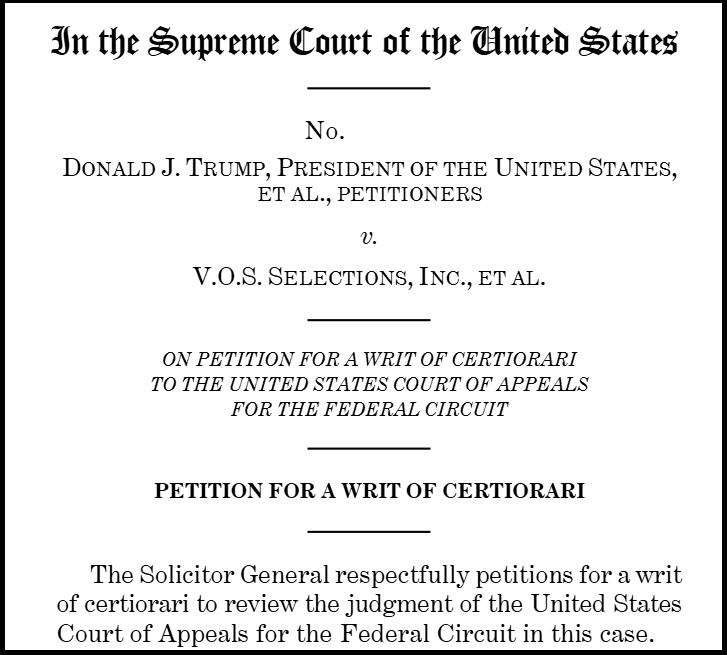
U.S. Solicitor General D. John Sauer has asked the Supreme Court to accept the case by next week, hear arguments in early November and “expedite” its ultimate ruling “to the maximum extent feasible.” [Appeal Here] with [Expedited Review Request Here]
At issue is the president’s authority under the International Economic Emergency Powers Act (IEEPA), a 1977 law Trump used to impose baseline tariffs between 10 and 50 percent on goods from countries who do not have Free Trade Agreements with the U.S.
President Trump also declared fentanyl drug shipments a national emergency, providing the administration’s justification for imposing tariffs on Canada, China and Mexico.
From the request for expedited consideration, “The en banc Federal Circuit’s erroneous decision has disrupted highly impactful, sensitive, ongoing diplomatic trade negotiations, and cast a pall of legal uncertainty over the President’s efforts to protect our country by preventing an unprecedented economic and foreign-policy crisis,” Sauer notes.
Adding comments from Treasury Secretary Scott Bessent, “The recent decision by the Federal Circuit is already adversely affecting ongoing negotiations. World leaders are questioning the Presi-dent’s authority to impose tariffs, walking away from or delaying negotiations, and/or imposing a different calculus on their negotiating positions.”
Moreover, “[t]he frameworks for trade agreements already in place contain additional provisions whereby the trade partners agree to significant purchases from and/or in-vestments in the United States.” … “If these agreed upon frameworks were unwound and the investments and purchases had to be repaid, the economic consequences would be catastrophic.” (more)






 American Buddhist Net