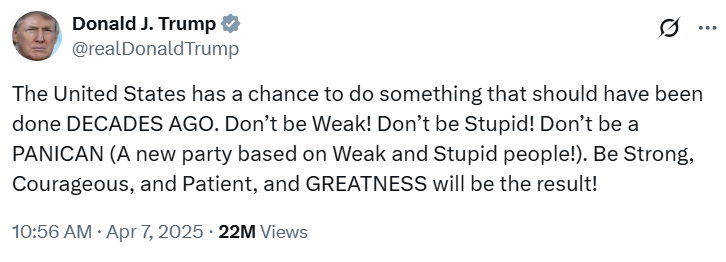
Paul surely understands Trump MUST move as quickly as possible to accomplish urgent goals. I have come to despise Paul for his constant talking and never doing anything or his constant chirping against Trump. In a moment of national crisis, a small window of deep change has opened and Paul dithers over abstractions. All law and all moral principles are pragmatic at the national level. This is always and especially true in time of crisis. Gangs of ruthless illegals must go; USA has a debt crisis which must be fixed now; world trade has been imbalanced against USA since WW2 and now is the time to balance it. From a Buddhist POV, seize the day, use the real-world conditions we have to make real progress repairing and improving our country. ABN
FIML is both a practice and a theory. The practice is roughly described here and in other posts on this website.
The theory states (also roughly) that successful practice of FIML will:
Greatly improve communication between participating partners
Greatly reduce or eliminate mistaken interpretations (neuroses) between partners
Give partners insights into the dynamic structures of their personalities
Lead to much greater appreciation of the dynamic linguistic/communicative nature of the personality
These results are achieved because:
FIML practice is based on real data agreed upon by both partners
FIML practice stops neurotic responses before they get out of control
FIML practice allows both partners to understand each other’s neuroses while eliminating them
FIML practice establishes a shared objective standard between partners
This standard can be checked, confirmed, changed, or upgraded as often as is needed
FIML practice will also:
Show partners how their personalities function while alone and together
Lead to a much greater appreciation of how mistaken interpretations that occur at discreet times can and often do lead to (or reveal) ongoing mistaken interpretations (neuroses)
FIML practice eliminates neuroses because it shows individuals, through real data, that their (neurotic) interpretation(s) of their partner are mistaken. This reduction of neurosis between partners probably will be generalizable to other situations and people, thus resulting a less neurotic individual overall.
Neurosis is defined here to mean a mistaken interpretation or an ongoing mistaken interpretation.
The theory of FIML can be falsified or shown to be wrong by having a reasonably large number of suitable people learn FIML practice, do it and fail to gain the aforementioned results.
FIML practice will not be suitable for everyone. It requires that partners have a strong interest in each other; a strong sense of caring for each other; an interest in language and communication; the ability to see themselves objectively; the ability to view their use of language objectively; fairly good self-control; enough time to do the practice regularly.
In mathematics, a ‘computation’ is the process of performing mathematical operations on one or more inputs to produce a desired output. A problem in analyzing human psychology arises when we understand that human psychology cannot be reduced computationally. The ‘computational irreducibility’ of human psychology does not mean, however, that there is no way to probe it and understand it. In the following essay, I show how FIML practice can greatly enhance our understanding of our own psychologies and, by extension, the psychologies of others.
Rather than rely on tautological data extractions or vague theories about human psychology, FIML focuses on small interpersonal exchanges that can be objectively agreed upon by at least two people. These small exchanges correspond to what Wolfram calls ‘specific little pieces of computational reducibility’. When we repeatedly view our psychologies from the point of view of specific little pieces of computational reducibility, we begin amassing a profoundly telling collection of very good data that shows how we really think, speak, and act.
FIML is a method of inquiry that deals with the computational irreducibility of humans. It does this by isolating small incidents and asking questions about them. These small incidents are the “little pieces of computational reducibility” that Stephan Wolfram remarks on at 42.22 in this video. Here is the full quote:
One of the necessary consequences of computational irreducibility is within a computationally irreducible system there will always be an infinite number of specific little pieces of computational reducibility that you can find.
This is exactly what FIML practice does again and again—it finds “specific little pieces of computational reducibility” and learns all it can about them.
In FIML practice, two humans in real-time, real-world situations agree to isolate and focus on one “specific little piece of computational reducibility” and from that gain a deeper understanding of the whole “computationally irreducible system”, which is them.
When two humans do this hundreds of times, their grasp and appreciation of the “computationally irreducible system” which is them, both together and individually, increases dramatically. This growing grasp and understanding of their shared computationally irreducible system upgrades or replaces most previously learned cognitive categories about their lives, or psychologies, or how they think about themselves or other humans.
By focusing on many small bits of communicative information, FIML partners improve all aspects of their human minds.
I do not believe any computer will ever be able to do FIML. Robots and brain scans may help with it but they will not be able to replace it. In the not too distant future, FIML may be the only profound thing humans will both need to and be able to do on their own without the use of AI. To understand ourselves deeply and enjoy being human, we will have to do FIML. In this sense, FIML may be our most important human answer to the AI civilization growing around us. ABN
Ben Lamm is a serial entrepreneur and the founder and CEO of Colossal Biosciences, a company dedicated to genetic engineering and de-extinction projects. Colossal’s mission includes bringing back extinct species like the woolly mammoth and advancing conservation efforts through cutting-edge biotechnology. https://www.colossal.com
President Donald J Trump announcing the end of the 80-year-old Marshall Plan (aka The European Recovery Program) of one-way tariffs against American imports has triggered a very predictable response from the European Union.
While saying the EU is prepared to enter negations toward a zero-tariff trade reciprocity, Comrade Ursula von der Leyen simultaneously announced that Brussels is prepared to launch countermeasures against The United States, in an effort to retain economic control and access to a U.S. consumer market they must exploit for their economic survival.
Speaking in very deliberate terms, the EU Komisar states the U.S. decision to demand reciprocity, and fairness will deliver “immense” and “dire consequences” for the New World Order and “global trading system.” von der Leyen proclaims that global citizens will be impacted with higher grocery bills, shortages of medication and increased costs for transportation.
The leader of the world’s largest bureaucracy stunningly proclaims President Trump’s tariffs will increase the “burdens of bureaucracy.” The one-sided benefits and “interests of the European Union” will be protected at all costs. WATCH:
.
Regarding “countermeasures.” Again, we repeat the predicable response. Together with their unelected ally in Canada controlling the North American response, watch for the EU to target Big USA Tech companies and financial service sectors.
The goal of the EU will be to assemble a tariff countermeasure response that will deliver political pain, not economic consequences. That’s just how they roll. The EU will leverage disgruntled Wall Street, banking and Technocracy sectors in order to put political pressure on Donald Trump to back down.
Optically this is the worst possible type of pontificating EU spokesperson to generate internal American opposition. Frankly comrade Ursula, MAGA don’t give a damn. [Pinky Finger Salute]
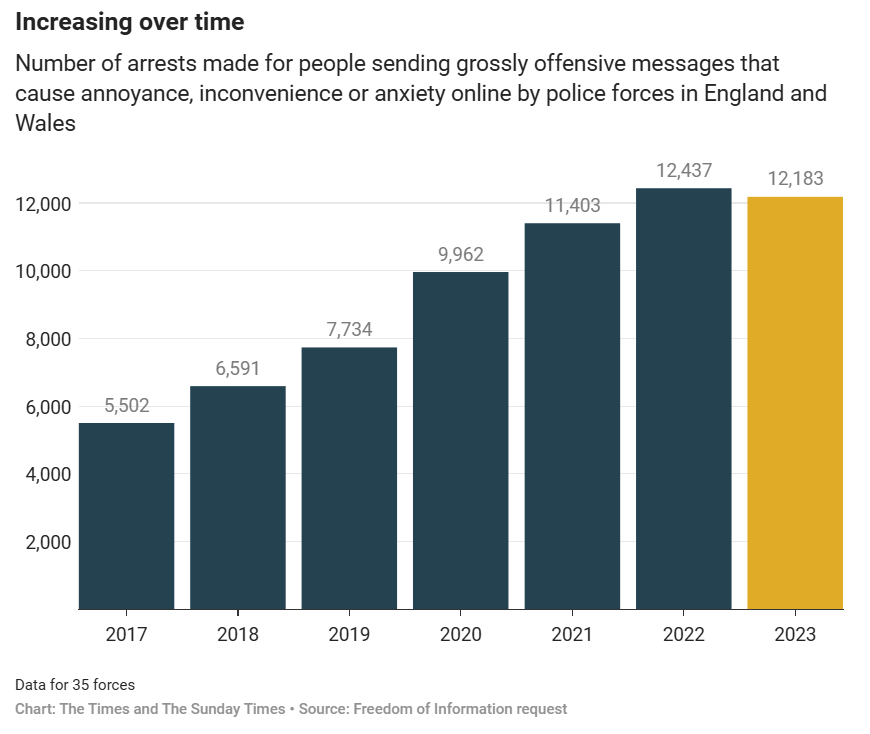
The police are making more than 30 arrests a day over offensive posts on social media and other platforms.
Thousands of people are being detained and questioned for sending messages that cause “annoyance”, “inconvenience” or “anxiety” to others via the internet, telephone or mail.
Custody data obtained by The Times shows that officers are making about 12,000 arrests a year under section 127 of the Communications Act 2003 and section 1 of the Malicious Communications Act 1988.









 American Buddhist Net