
President Trump directed US Attorney General Pam Bond to pursue penalties against law firms and lawyers that lodge “frivolous” litigation against the government.
Trump pointed to civil procedure rules barring lawyers from lodging legal filings to “harass” or “cause unnecessary delay” and asked Bondi, 59, to recommend additional steps he could take to fight back.
“Far too many attorneys and law firms have long ignored these requirements when litigating against the Federal Government or in pursuing baseless partisan attacks,” Trump said in a presidential memorandum the White House released Saturday.
“I hereby direct the Attorney General to seek sanctions against attorneys and law firms who engage in frivolous, unreasonable, and vexatious litigation against the United States.”
The Trump administration has weathered well over 100 lawsuits since late January.
The existential beauty (and chemistry) of updating beliefs
A new study shows that updating beliefs about the world requires and stimulates dopamine release in the brain.
Lead author of the study, Matthew Nour, from University College London and Kings College London has this to say about the findings:
“We found that two key brain areas of the dopamine system (the midbrain and striatum) appear to be more active when a person updates their beliefs about the world, and this activity is related to measures of dopamine function in these regions.” (Source)
Healthy people update beliefs when new evidence is presented. The study may also show that abnormal dopamine functionality is implicated in schizophrenia and paranoid ideation by interfering with normal updating.
The study can be found here: Dopaminergic basis for signaling belief updates, but not surprise, and the link to paranoia.
I like this study because participants were measured while changing minor, short-term beliefs.
Small changes in beliefs manifested in short-term memory lies at the heart of FIML practice.
FIML relies heavily on changing inaccuracies in the short-term memory bank because this data can be isolated and objectively agreed upon by both partners and because this data is by definition fairly small and thus easily changed.
A year of FIML practice may entail a thousand or more small updates in perception, belief, and self-knowledge. Each individual update is typically small, but the aggregate of many updates over longer periods of time creates the basis for very large psychological transformations.
And since these transformations are based on more accurate data, they lead to a more realistic view of the world and the self.
Moreover, by regularly making many small updates in their perceptions of each other and themselves, FIML partners are constantly exercising their dopamine “updating system,” thus strengthening their abilities to function well in any environment.
FIML changes can come quickly, but it is long-term practice that brings the best results.
The above study shows that something very real happens when we update our perceptions. I would maintain that making this happen often with meaningful psychological information through FIML practice leads to very significant and beneficial changes in psychological functioning across many domains.
first posted October 16, 2018
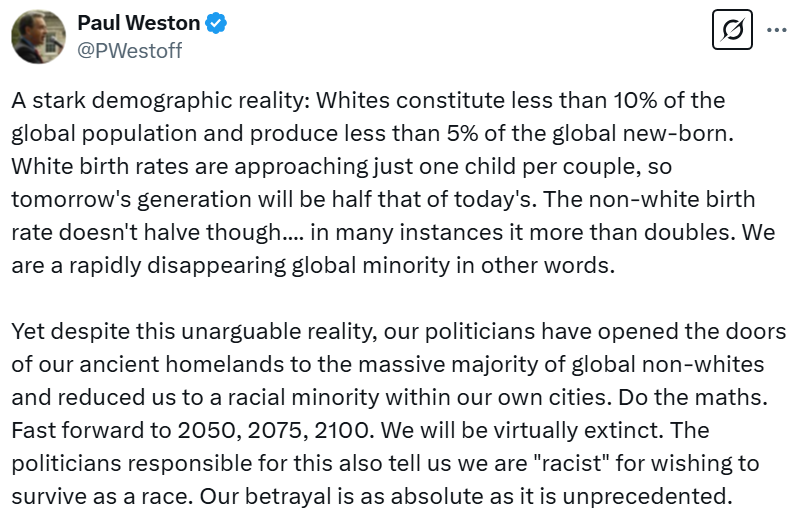
Whites are a rapidly disappearing global minority

US to revoke legal status of more than a half-million migrants, urges them to self deport
The Trump administration will be revoking the legal status of hundreds of thousands of Latin American and Haitian migrants welcomed into the U.S. under a Biden-era sponsorship process, urging them to self-deport or face arrest and removal by deportation agents.
The termination of their work permits and deportation protections under an immigration authority known as parole will take effect in late April, 30 days after March 25, according to a notice posted by the federal government.
The move will affect immigrants from Cuba, Haiti, Nicaragua and Venezuela who flew to the U.S. under a Biden administration program, known as CHNV, that was designed to reduce illegal immigration at the U.S.-Mexico border by giving would-be migrants legal migration avenues.
A total of 532,000 migrants entered the U.S. under that policy, which was paused soon after President Trump took office, though it’s unclear how many have been able to secure another status that will allow them to stay in the country legally.
Trump speaks with reporters, discusses Ukraine and deportation flights

So… The “Conspiracy Theorists” Were Right About JFK | Candace Ep 164
Our current geological period has lowest CO2 levels

White House Envoy Witkoff on Trump-Putin Call, Likely Meeting
This interview highlights the importance of Russia-USA relations to both parties and to the world and how Trump makes deals. Witkoff: ‘The president is all about clearing up misconceptions, clearing up miscommunication, figuring out how to get a good deal for all stakeholders… and then deciding beforehand what the outcome he wants is.’ ABN

Macgregor on why Trump ‘has no choice’ but to follow Israeli orders
Candace Owens on early Zionist mind-control
Virtually all public culture is like this — staged, manipulated, and deeply untrue. ABN
Trump blasts Boasberg for trying to ‘usurp’ his presidency and demands Supreme Court take action
Donald Trump accused District Court Judge James Boasberg of trying to ‘usurp the power of the presidency’ while demanding the Supreme Court take action amid a high-stakes legal standoff.
Trump called Boasberg a ‘publicity hound’ in his latest attack on the judiciary after the judge halted his massive deportation of migrants with a temporary restraining order.
‘Judge James Boasberg is doing everything in his power to usurp the Power of the Presidency,’ he warned.
‘The danger is unparalleled!’
Boasberg had issued the temporary order after the administration flew more than 200 alleged gangsters to El Salvador.
Trump mocked Boasberg as ‘a local, unknown Judge’ and added that he’s a ‘grandstander, looking for publicity.’
Boasberg on Thursday deemed a court filing from the administration ‘woefully insufficient’ because it was filed by a low-level staffer.
One day earlier, he hosted a contentious hearing with DOJ lawyers and said he wants to find out whether the government ‘deliberately flouted’ his order.
Roberts is up to his eyeballs in this as he is the one who appointed Boasberg to be the top FISA court judge and both knew the reason was to hide FBI spying on Trump’s first campaign and presidency. Much good may come of this because, ironically, neither judge has a shred of legal or moral standing. Their entire careers are irreparably stained by their malfeasance. ABN
 American Buddhist Net