Humans all need to feel certain about at least some things. We also need to have basic mental and emotional coherence. FIML practice gives partners a very reliable level of mutual certainty and coherence.
Since FIML practice is a process—something you do with your partner—partners will be able to check and recheck their mutual understandings as often as they like. The interpersonal certitude and coherence that result from this process is amazing. It is amazing in and of itself but also because having reliable interpersonal coherence with your partner will have a deep influence on you. It will affect how you understand yourself and how you feel about yourself. It will also affect how you understand and feel about your place in the world, your place in society.
People who do not practice FIML ordinarily get certitude and coherence from outside of themselves — from TV, movies, newspapers, schools, churches, clubs, and so on. The external semiotics of cultures and subcultures created by other people give most individuals the certitude and coherence they need for psychological well-being. Insofar as external semiotics are not sufficient for the individual (and they rarely are), most people fill in whatever is missing with personal interpretations. In many other posts, we have discussed how these personal interpretations are usually fraught with mistaken impressions. They are usually neurotic, or constitute the kleshas (wrong views, toxic fixations, mistaken interpretations, etc.) described in Buddhist literature.
FIML practice allows partners to correct their neuroses by disconfirming them with their partner. If you disconfirm a neurosis, you effectively confirm that it is/was not true and can therefore be discarded.
FIML practice also helps partners free themselves from the need to find certitude and coherence outside of themselves. As you become more secure in your communication with your partner, both of you will begin to notice that you are becoming less dependent on external semiotics.
FIML emphasizes the certitude and coherence of truth between two caring people above certitude and coherence based on conformance to social norms. FIML helps partners co-form their own subculture rather than conform to a culture created by someone else.
The American taxpayer just gave this organization a $10 million grant so it could fund messaging and goals like
“defending Jerusalem as the moral capital of the West”
And
“…the answer to this challenge is to believe again that being Jewish is the most important thing in the world… and that defending Jewish civilization is the only way to advance the cause of human liberty and human dignity…”
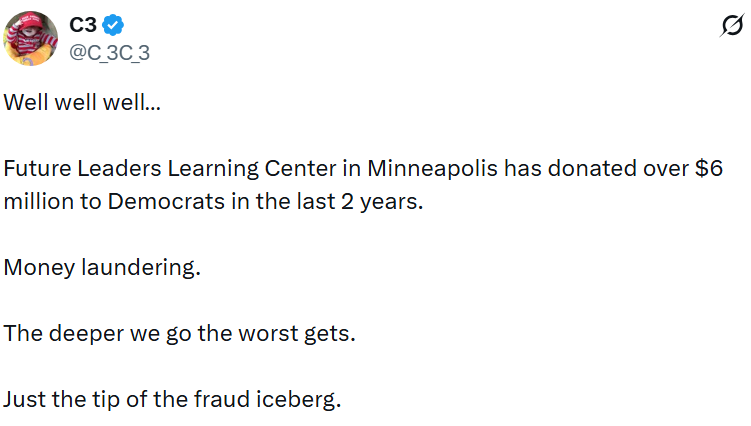
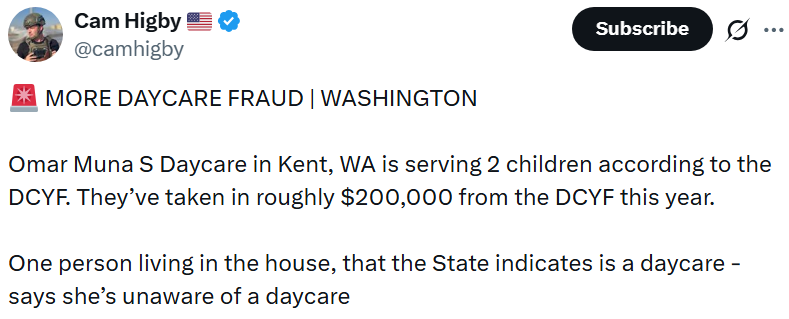
He is expressing clan and tribal values, much like the Somali clan & tribal values we are witnessing in the Minnesota scams.
USA and the West were built on a civilization that had ended clans, stopped them from perpetuating themselves through strict marriage laws against marrying near kin.
This fostered the high-trust (of strangers) that characterizes Western civilization.
This is also the reason Westerners have so much trouble understanding how and why clans and tribes work and why they almost always become parasitic in a high-trust society.
In a generous society such as USA and Europe, a parasitic clan will tend to hate the host and thus feel blissfully justified in scamming as much as they can while also destroying everything they touch.
A conspicuous exception to this rule are the Amish, who live by a moral and ethical code which prohibits parasitism and is highly respected by almost everyone who lives near them or knows anything about them.
Jews could easily earn immense respect from the entire world if they would kneel at the feet of the Amish and learn to behave more like them. ABN
The regulation of consanguineous marriages within the Catholic Church evolved over time, with early foundations rooted in classical Roman law, which already prohibited certain degrees of kinship for social and inheritance reasons. The Christianization of the West introduced theological dimensions to these laws, but the Church did not initially enforce strict prohibitions on cousin marriage. By the early 9th century, the Western Church had expanded the prohibited degrees of consanguinity from four to seven, adopting a new method of calculation that counted generations back to a common ancestor. This expansion marked a significant development in canon law, though it was not a single legislative act but a gradual process. The formal codification of these rules was further refined at the Fourth Lateran Council in 1215, which reduced the prohibited degrees from seven to four and established the method of calculating consanguinity still used today.
Imagine a world where your thoughts no longer live silently inside your head—where machines can decode what you see, feel, or even intend to say. Mind reading technology, once the stuff of science fiction, is now edging into reality through the rapid evolution of neuroscience and artificial intelligence. From brain-computer interfaces that allow paralyzed patients to move robotic limbs, to neural decoding systems that can reconstruct images directly from brain signals, the line between imagination and reality is fading fast.
So, what is mind reading technology? It’s not mystical telepathy, but a scientific field focused on interpreting brain activity patterns using sensors, algorithms, and AI. Modern research uses techniques like fMRI (functional magnetic resonance imaging) and EEG (electroencephalography) to translate neural signals into recognizable outputs—such as speech, visual images, or emotional states. In simple terms, when we ask, how does mind reading technology work, the answer lies in reading the brain’s electrical and chemical language and turning it into digital data that computers can understand.
But as this frontier opens, it brings both hope and fear. The promise lies in helping those with paralysis, ALS, or speech impairments to communicate freely. The fear lies in losing mind privacy—the last untouched layer of human autonomy. Who owns your thoughts if machines can read them? Can mind privacy still exist in a world where neural data becomes as valuable as personal data?
As scientists push forward, mind reading technology stands at a moral crossroads—one that could redefine freedom, identity, and the very concept of what it means to have a private mind.
To save yourself from embarrassment and confusion, prepare now by doing FIML with your partner in life. It’s possible, but I doubt a mind-reading machine will be capable of providing the depth and deeply human sharing FIML provides. It seems likely to me that FIML will prove to be the last human thing that only humans can do and no machine can, ever. That said, a mind-reading machine will be an excellent non-human ‘partner’ to practice with and learn FIML. In a deep sense, FIML is an artform and partners doing it are artists probing and recreating themselves. ABN
Ascorbate synthesis was lost in the evolution of several species, turning this molecule into an essential micronutrient, vitamin C. Are there any benefits to losing ascorbate synthesis and becoming prone to ascorbate deficiency? We show that loss of ascorbate synthesis and consequent transient ascorbate deficiency protects mice infected with schistosomes, parasites which cause the major parasitic disease schistosomiasis. This is because schistosomes require ascorbate from the host to lay eggs and cause pathology. Our work shows that a vitamin deficiency can have physiological benefits by protecting animals from the pathology of a major parasitic disease. We propose that resistance against the pathology of a parasitic infection may explain why some animals lost the ability to synthesize vitamin C.
A listener’s state of mind is different from a speaker’s.
It is more dreamy, often more visual, and has a wider range of associations in play.
For this reason, listeners often react more to their own minds than to what the speaker meant.
An example of this occurred recently.
While my partner was speaking, she referred to someone as a “douche bag.” She meant to distinguish that person from someone else with the same name (who is not a douche bag).
As she said “douche bag,” a strong image rose in my mind of the person in question being pushed into a region of darkness.
In response to that image, I protested “he is not a douche bag”; not so much to recover his honor or reputation as to keep him from being pushed further into the darkness.
She changed her wording and the conversation went on. I completely forgot the incident and the image that had arisen in my mind.
The next morning my partner brought the subject up again and explained in FIML detail why she had used “douche bag” and that it had been meant as a minor distinction between the two people and not as a deep statement.
The memory came back to me of struggling to pull my friend out of the mistaken darkness I had imagined.
It’s a good example of how a speaker’s mind differs from a listener’s.
This is an interactive version of the Exposure Based Face Memory Test.
Introduction: The human brain has a special module that is used to recognize faces. People with prosopagnosia, also known as “face blindness”, have difficulty remembering faces. Every time they see a face it looks to them like a face they have never seen before and such people have to use other information such as hair, voice, and body to recognize others. The Exposure Based Face Memory Test was developed as an open source measure of face memory and was designed with a procedure that is both closer to the demands on face memory experienced in every day life, and minimizes administration time.
Procedure: In this test you will be shown a long series of faces. For each face you must say if you have been shown that person before, or if this is a new face you have not been shown yet. It should take 2-5 minutes to complete. This test can only be taken once. It is spoiled if you have seen any of the faces before. So if want accurate results, make sure to take it seriously the first time.
Participation: You use of this assessment should be for educational or entertainment purposes only. This is not psychological advice of any kind. Additionally, your responses to this questionnaire will be anonymously saved and possibly used for research or otherwise distributed.
This is a quick test which will give you some sense of whether you have or do not have face-blindness. I scored better than just 16.5% of people who have taken the test, which does not qualify as prosopagnosia, though I do have moderate-significant face-blindness. One aspect of this condition not yet studied, far as I know, is I sometimes see the faces of people I should recognize as distorted, sometimes rather weirdly so, sometimes just a bit weirdly; this happens just before I fully recognize them by voice or some other prompt. If you have face-blindness it is probably a good idea to tell people you meet about it. Some people react with surprise and confusion but many have heard of prosopagnosia and appreciate getting the information. Human faces form a semiotic ‘language’ which people with excellent face-recognition probably greatly enjoy. Easily recognizing/ remembering faces facilitates building social relationships. Not easily recognizing faces causes a delay in fully receiving into your mind the social presence of another person, thus making it more difficult to build social relationships. I have probably spent more time thinking about language and interpersonal communications than most people because I largely remember people initially or click with them through their speech idiosyncrasies more than by remembering their faces. ABN





 American Buddhist Net