Small lies matter

A new study shows that even small lies can weaken our self control, causing us to tell bigger lies and more of them.

Lead author of the study, Neil Garrett, says of it:

“It is likely the brain’s blunted response to repeated acts of dishonesty reflects a reduced emotional response to these acts. This is in line with suggestions that our signals aversion to acts that we consider wrong or immoral. We only tested dishonesty in this experiment, but the same principle may also apply to escalations in other actions such as risk taking or violent behaviour.” [emphasis added] (How lying takes our brains down a ‘slippery slope’)

The study itself can be found here: The brain adapts to dishonesty.

Here is the abstract:

Dishonesty is an integral part of our social world, influencing domains ranging from finance and politics to personal relationships. Anecdotally, digressions from a moral code are often described as a series of small breaches that grow over time. Here we provide empirical evidence for a gradual escalation of self-serving dishonesty and reveal a neural mechanism supporting it. Behaviorally, we show that the extent to which participants engage in self-serving dishonesty increases with repetition. Using functional MRI, we show that signal reduction in the amygdala is sensitive to the history of dishonest behavior, consistent with adaptation. Critically, the extent of reduced amygdala sensitivity to dishonesty on a present decision relative to the previous one predicts the magnitude of escalation of self-serving dishonesty on the next decision. The findings uncover a biological mechanism that supports a ‘slippery slope’: what begins as small acts of dishonesty can escalate into larger transgressions. [emphasis added]

Though this is only one study based on results from only 80 people, I find it very credible.

In Buddhism we learn that even the smallest of thoughts can have enormous consequences.

An important aspect of Buddhist mindfulness is watching how our thoughts develop and how they affect us and others. FIML practice is based on sharing the fruits of real-time mindfulness with a partner.

Done correctly, FIML allows us to observe small transitions in our minds and correct them in real-time if they are wrong.

FIML does not deal all that much with lies per se because partners are expected to be beyond that and FIML won’t work if partners lie.

Nonetheless, FIML does deal with small misunderstandings that can lead to slippery slopes similar to what is described in the study.

For example, if you think your partner’s tone is dismissive and it isn’t and you don’t do a FIML query, the next time you hear that tone you will experience confirmation bias and be on your way down the slope. It’s very hard to trace that sort of thing back to its origin after a few occasions. Your misunderstanding of your partner’s tone could be construed as an unconscious lie that you are telling yourself.

This is why FIML is so important and why it is very helpful to start doing it early in your relationship when all is well and there are no misunderstandings.

FIML can be described as detailed, shared, real-time moral and existential awareness. It demands integrity and mindfulness from both partners and rewards them with greatly enhance shared integrity and mindfulness.

A major purpose of FIML is to prevent the sort of thing that happened in the study. To prevent partners from sliding down a slippery slope that sometimes cannot be regained.

first posted October 24, 2016
Is morality a fundamental part of nature?

Viewing nature as a signaling network shows its advantage with this question.

Instead of asking where our moral sense comes from, we ask instead what makes for a good signaling network?

The answer is “good organization.”

By “good,” I mean efficient, well-made, good use of resources, easy to maintain, rational, etc.

You are a signaling network.

A well-organized you will probably tend to be morally pretty good and wanting to get better at it, depending on your conditions.

Of course some people view “morality” as whatever is in their best interests. And that is a type of moral thinking. When it is found out, though, most other people, very reasonably, do not like it.

If we view nature as the evolution of signals and signaling networks rather than as the evolution of matter, we will see that changes in signal organization are fundamental to the evolutionary process.

In this sense, it is the most ordinary thing in the world that you, a complex signaling system that is conscious, would consciously seek good organization and/or want to adapt your organizing principles, both objective and subjective, to conditions that impact you.

Conditions that impact you are signals being perceived by the signaling network you think of as yourself.

Your adaptations, both small and large, will encompass many moral considerations and choices.

Morality can be viewed as a kind of organization. The networks that make up your being must organize their relations with the world around them and other sentient beings. We make many moral decisions when we do this. These decisions are an integral part of how we are organized.

Last night I heard a drunk swearing at his friend from the street. “You fucking bastard…” etc. Not well-organized, but still he was yelling a local version of morality and this was fundamental to his networks and behavior.

first posted MARCH 4, 2017

UPDATE 11/09/22: The above shows that what we scientifically think of today as evolution does not contradict what might be called spiritual evolution, or Buddhist evolution that happens in three ways combined: through 1) morality/ethics; 2) concentration/mindfulness; and 3) wisdom/understanding. Karma is the path of our mind as it wends through its various and numerous realities, sometimes tending toward goodness or the Tathagata, sometimes tending away. By consciously contemplating our signaling networks and describing them to ourselves and close friends we can make our signals clearer and more ethical and thus become wiser, have better understanding. The act of doing this is a kind of concentration or mindfulness. It really doesn’t matter what your religion is, including atheism or even oblivionism, honestly analyzing your signaling will change you probably for the better. ABN

KTM may be sold

KTM has been in trouble for a while now. But in its most recent financial statements, it seemed as if with a little restructuring, more layoffs, and a few changes to its lineup, things would likely even out in the next year or so. Sure, it’d be rocky ahead, but the brand’s parent company, Pierer Mobility AG, would be on firmer footing soonish. 

That’s, apparently, absolutely not the case. 

Just a few weeks after Pieirer released its Q3 financials, ones that denoted a serious drop in revenue and an increase in acquired debt (welcome to the family, MV Agusta!), the brand released another statement essentially saying, “We’re truly and properly screwed if we don’t find a substantial cash infusion.” So yeah, I think KTM, as well as GasGas, Husqvarna, and the newly acquired MV Agusta, might get sold in the coming months if not weeks…

link

The plandemic boosted motorcycle and bicycle sales, but the trend has not continued. Motorcycles are technologically better by far than years ago but they also cost more and new riders may not understand the value of the added tech or know how to use it. ABN

How Christianity rebooted cognitive evolution

…Christianity did more than end the cognitive decline of Imperial Rome. It reversed that decline and launched an upward trajectory that would last throughout the Christian Era from Late Antiquity to post-medieval times. Thus, with each generation, the average person became more and more intelligent.

The new faith restarted cognitive evolution by banning polygyny, which had usually involved elite men and lowborn women. Elite women thus gained in reproductive importance. The Church thereby changed the culture not so much by making radically new rules but rather by reviving old rules and enforcing them more effectively.

Keep in mind that Christianity was much more rules-based than the old faith, particularly the watered-down paganism of the Imperial Era. Pagan Romans were more interested in developing a transactional relationship with their favorite god: “do this for me, and I’ll do that in exchange.”

link

Navigating the Fiscal Storm: A New Course for U.S. National Defense — Douglas Macgregor

This paper argues for: leverage change to build new, better forces for the 21st century, allowing for deep spending cuts of \$400-500 billion. This approach enhances the U.S. military’s competitive advantage in future warfare and improves American national security by ending open-ended interventions without attainable political-military objectives. Assuming Congress acts wisely, the resulting annualized savings can both pay down the national debt and reorient U.S. military power to new forms of warfare.

Grand Strategy and New Thinking

Grand strategy, if it exists at all, consists of avoiding conflict, not starting wars. New thinking in defense and foreign policy prioritizes diplomacy and peaceful cooperation over military power. None of America’s potential opponents, except those with nuclear weapons, pose a direct threat to the American homeland. If international terrorism and criminality remain threats, then border security and tightly controlled immigration should be the top priority in national security.

Senior military leaders and their services cannot be expected to reform themselves and fundamentally change the military status quo—a World War II/Cold War structure that is expensive, single-service focused, and vulnerable to weapons of mass destruction. Peter Drucker, when asked how to change a large business enterprise, answered, “If you want something new, you must stop doing something old. People in any organization are always attached to the obsolete.”

In line with Drucker’s guidance, the incoming President must implement a new national military strategy that diverges sharply from the last 30 years. This strategy must scale back America’s forward presence, mandate adaptation to new forms of warfare, and address the requirement to retain and develop America’s best human capital in uniform.

link

Douglas Macgregor: Looking at Trump’s Cabinet Picks – Not Sure about his Foreign Policy Vision

UPDATE: Macgregor describes Trump’s cabinet nominees as: ‘Elite capture. There is nothing more reliable than a man who can be bought for cold, hard cash. All of these people have been bought and paid for. There have been investments for twenty years, ranging into 100s of millions maybe billions of dollars by Israel and its agents in the United States to drive us into war against Iran. Now, they are positioned to finally get what they want’. ABN

UPDATE: Maybe I am clutching at straws, but it could also be that Trump’s many pro-Israel nominees are also the best people to say no to Netanyahu, no to war with Iran. ABN

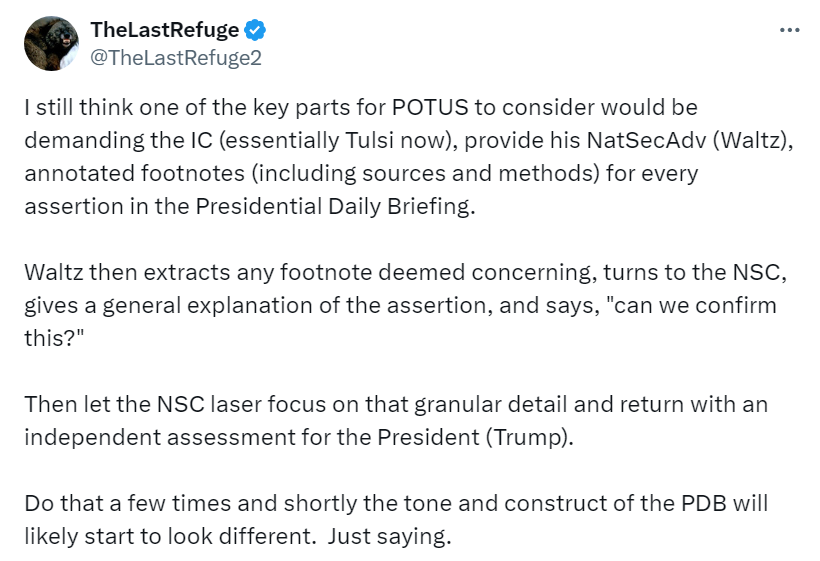
The strategy behind the nomination of Matt Gaetz for US Attorney General

In what can only reasonably be described as a MOAB targeted directly to Main Justice, President Trump has nominated Republican Congressman Matt Gaetz to be United States Attorney General.

Making the nomination strategy that much more interesting, Matt Gaetz resigned his position within congress, “effective immediately.”

In combination with the nomination of Senator Marco Rubio to the State Dept., this sets the stage for a Senate situation where the upper chamber may attempt to derail the Gaetz nomination, yet Florida Governor Ron DeSantis could then appoint him to be the replacement U.S. Senator from Florida; thus, returning an angry MOAB back into the silo that derailed him.

To say the Lawfare leftists are having a meltdown would be an understatement.

link