I have verified the shocking findings of Peter Schweizer regarding Chinese childbirth tourism and its future impact to US democracy, it is absolutely true! Even in Houston there are at least TEN Chinese birth centers (月子中心), and they are all in operation. How many are in NYC, LA and SF? In America there are hundreds! I have been involved in some WeChat discussions about this topic, some members in CA provided their firsthand experiences. It’s shocking!
The CCP backed Chinese childbirth tourism started in 1990s . Each birth center serves anywhere between 20-300 pregnant Chinese women annually, and takes full responsibility for new borns, including birth certificates, Chinese entry paperwork, etc. Depending upon where the pregnant Chinese women came to the U.S., they may or may not even need visas (such as Guam).
When those babies grow up and reach 18, they come back to America not only enjoy social benefits, like Peter said, they will vote! It is not exaggerated that by 2030 there will be ONE MILLION American-born and China-educated voters who will vote on behalf of CCP!
The CCP is invading America and changing American democracy without using guns, fighter jets or aircraft carriers. So what should American society do? Letting America become a colony ruled by CCP?
Translation from Latin: In this sign you will win. As a semiotician I like the use of Latin and the word sign. As a Buddhist I can support this ethos if it is reasonable and wholesomely unites the traditional West against those who are destroying it. As an American of Baltic extraction, gotta admit I cringe at knights in armor bearing crosses. Even still, I support Christian unity and wise resistance against the enemies of the West, many of whom are recent invaders and many of whom are ancient infiltrators. I believe a good many Eastern Europeans think the way I do. Both recent and ancient experience has taught us you have to be practical and work every angle to defeat a powerful pathocracy. ABN
This level of incompetence mixed with deliberate corruption is rife throughout USA. Most of it appears to be in Dem states which have drifted into woke emotionalism and concomitant corruption. The buck should have stopped at the governor’s office. At the national level, corruption is much the same, though much worse and more entrenched. All large organizations are susceptible to corruption and weak employees who dare not do the right thing. Many organizations can live a long time while burdened with parasites, but in the end, entire civilizations fall for these reasons. ABN
FIML is the quintessence of interpersonal social behavior. FIML is the quintessence of interpersonal cooperation. As such, it transforms what we call “personality” by altering the basis of experience.
If social behavior is understood quantitatively, then “more social” means more social contacts.
If social behavior is understood qualitatively, then “more social” becomes “better social”; i.e. more honest, true, profound, fulfilling.
It is not possible to have high-quality interpersonal interactions without a precise way to manage and correct errors in communication as they occur.
Personality is based on interpersonal experiences. Change the experiences and you change the personality.
Improve the experience and you improve everything.
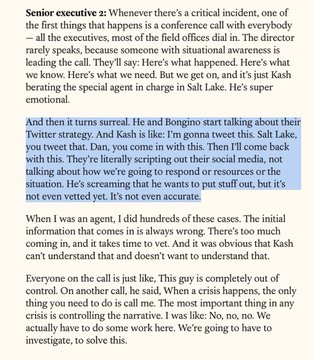
What is going on at Turning Point right now should be termed the Scottsdale Witch Trials.
I have now gathered first-person accounts that executives are dragging people into offices asking about their allegiance to Erika. Specifically, one person was told that an uber driver told their CMO that his daughter was friends with an employee who didn’t like Erika.
Andrew Kolvet then hauled the uber-mentioned employee into an office and questioned her about the driver’s account, regarding which, she was totally mystified.
Another person had the Turning Point in-house counsel show up at her personal home, tell her she was fired “hi, I’m outside, you are fired” and then demanded she not delete anything and hand over her company laptop.
Another young woman thought she was going in for a bonus because they had worked so hard on Amfest and have not stopped since Charlie’s assassination. Despite 250 million dollars raised since Charlie’s assassination, she was fired. No reason given. She believes Turning Point may have installed some sort of spyware on their company laptops because the previous evening, she had communicated to another Turning Point employee that she wasn’t fond of Erika’s leadership style.
We have a recording of her firing and will be releasing it later today.
What is especially incredible is that NONE of my actual sources were terminated but these people were.
As Israel’s image has suffered from its genocidal campaign in Gaza, ADL CEO Jonathan Greenblatt and broader Jewry are targeting Hispanic evangelical communities in the United States and Central America to cultivate a fresh base of golems who will back Zionist causes.
Greenblatt recently announced a formal partnership with the National Hispanic Christian Leadership Conference during a speaking engagement at Sinai Temple in Los Angeles, revealing an extensive outreach initiative targeting Hispanic evangelical communities. “We have roughly 2,000 active synagogues in America. There are 42,000 active Hispanic evangelical churches,” Greenblatt told the audience. “Right now, the ADL is co-writing Sunday school curriculum with them. Right now, the ADL is working on joint lobby days with them.”
The ADL announced the partnership on October 16, 2025, creating educational materials for distribution across Hispanic evangelical churches in the United States. The collaboration encompasses a 12-month antisemitism awareness curriculum distributed to pastors, youth leaders, and congregants, with specific modules designed for K-12 private schools. Faith-based resources include sermon guides and prayer materials promoting solidarity with Jewish communities.






 American Buddhist Net