
Autism and ADHD are linked to disturbed gut flora very early in life
…The study is part of the ABIS (All Babies in Southeast Sweden) study led by Johnny Ludvigsson at Linköping University. More than 16,000 children born in 1997–1999, representing the general population, have been followed from birth into their twenties. Of these, 1,197 children, corresponding to 7.3 percent, have been diagnosed with autism spectrum disorder, ADHD, communication disorder or intellectual disability. A large number of lifestyle and environmental factors have been identified through surveys conducted on several occasions during the children’s upbringing. For some of the children, the researchers have analysed substances in umbilical cord blood and bacteria in their stool at the age of one.
“We can see in the study that there are clear differences in the intestinal flora already during the first year of life between those who develop autism or ADHD and those who don’t. We’ve found associations with some factors that affect gut bacteria, such as antibiotic treatment during the child’s first year, which is linked to an increased risk of these diseases,” says Johnny Ludvigsson, senior professor at the Department of Biomedical and Clinical Sciences at Linköping University, who led the study together with Eric W. Triplett.
Children who had repeated ear infections during their first year of life had an increased risk of being diagnosed with a developmental neurological disorder later in life. It is probably not the infection itself that is the culprit, but the researchers suspect a link to antibiotic treatment. They found that the presence of Citrobacter bacteria or the absence of Coprococcus bacteria increased the risk of future diagnosis. One possible explanation may be that antibiotic treatment has disturbed the composition of the gut flora in a way that contributes to neurodevelopmental disorders. The risk of antibiotic treatment damaging the gut flora and increasing the risk of diseases linked to the immune system, such as type 1 diabetes and childhood rheumatism, has been shown in previous studies.
link
DARPA made the virus, DOD ran the response


Which is why it’s called a plandemic. ABN
Google and FIML
Google has helped all of us upgrade our info about the world around us, whatever we are interested in, etc.
In the past, people had brains as complex as ours and a love of good information as great as ours, but they had to make do with less.
Somewhat resembling Google, FIML practice upgrades interpersonal information shared by (usually) two people.
Rather than guess and fill our minds with superstitions about the people we care about most, FIML allows us to “look up” the info we need when we need it.
This has a dramatic and beneficial effect on both the self and other(s). The foundations of human psychology are exposed in FIML practice.
Once you see how FIML works and what it does, you will be doing it as often as you jump on the computer to look up something you want to know.
FIML is advanced interpersonal technology that makes first-rate psychological information as readily available as a computer search. It does take some practice, but is emotionally even more valuable than Google.
first posted SEPTEMBER 9, 2016
Eight years ago when this was first posted, I was still naive about Google, which is a beast at both gathering and curating information. The analogy posed above belongs to a different time. Properly done, FIML practice does not curate information or selfishly gather information and hide it as Google now does. ABN
NEW LIGHT ON THE TWELVE NIDANAS — Dhivan Thomas Jones
Pa_ ticca samuppa¯da (dependent arising) is the central philosophical principle of Buddhism, and is most commonly exemplified in the suttas in terms of the twelve nida¯nas. The ubiquitous interpretation of the twelve nida¯nas of pa_ ticca samuppa¯da as taking place over three lives, a religious doctrine explaining the rebirth process, is a commentarial development, not found in the suttas. Recent Therava¯din exegetes Bhikkhu Buddhada¯sa and N˜a¯_ navı¯ra Thera argue for an interpretation of the twelve nida¯nas of pa_ ticca samuppa¯da as taking place in the present moment, but Bhikkhu Bodhi disputes the claim that their interpretation is the Buddha’s original meaning. Recent work by Vedic scholar Joanna Jurewicz, however, suggests that originally the twelve nida¯nas were a parody of Vedic cosmogony. This scholarship opens the way for renewed exegesis of pa_ ticca samuppa¯da liberated from Indian Buddhist metaphysics.
Introduction
The Buddha is recorded as telling Ananda that it was through not understanding and not penetrating pa_ ticca samuppa¯da (dependent arising) that humanity ‘has become like a tangle of string covered in mould and matted like grass’, and so does not go beyond the miseries of conditioned existence (D 15 PTS ii 55, S 12:60 PTS ii 92). It is said that just before his enlightenment the bodhisatta reflected on how dukkha (unhappiness) arose dependent on conditions—how ageing and death ( jara¯mara_ na) arose on condition of birth ( ja¯ti), birth on existence (bhava), existence on clinging (upa¯da¯na), clinging on craving (ta_ nha¯), craving on feeling (vedana¯), feeling on contact ( phassa), contact on the six sensebases (sa_ la¯yatana), the sense-bases on name and form (na¯maru¯pa), name and form on consciousness (vin˜n˜a¯na), consciousness on formations (san˙kha¯ra¯), and formations on ignorance (avijja¯). It was just through the ceasing of these twelve nida¯nas that the Buddha, like Buddhas before him, attained the path to awakening, that overgrown road to the ancient city of enlightenment (S 12:65 PTS ii 104). To investigate these twelve linked conditions of sa _ msa¯ra is to understand the ‘noble method’ of the Dharma (A 10:92 PTS v 182); and the cessation of just these twelve nida¯nas is the end of dukkha.
From the paramount importance given to the teaching of the twelve nida¯nas in the Pali canon, one might expect the formula to be clearly explained. But not so. Although each nida¯na or link is expounded to some extent, ‘the earliest texts give very little explanation of how the formula is to be understood’ (Gethin 1998, 149). Later Buddhist tradition interpreted the twelve-fold formula as an explanation of the rebirth process over three lives, but it there is no evidence that this is what the Buddha originally meant.
In this article I will explore the interpretations of the twelve nida¯nas of pa_ ticca samuppa¯da offered by two recent Therava¯din thinkers, Bhikkhu Buddhada¯sa and Bhikkhu N˜ a¯ _ navı¯ra, who in different ways criticise the three-life interpretation and, reading the suttas afresh, offer accounts of how the links of pa_ ticca samuppa¯da can be understood as working in the present moment. I will also indicate the criticism of this present moment interpretation by Bhikkhu Bodhi, a defender of Buddhist tradition. I will then present a completely different approach to the problem, starting from the idea that the arrangement of the nida¯nas begins to make sense when one takes into account the brahminical religious context in which the Buddha was teaching. In this context, the various links in different ways turn upside down the assumptions about Self (atta¯), reality (brahman) and the supposed purpose of brahminical rituals current in the Buddha’s time. This suggests that the arrangement of the twelve nida¯nas was originally intended as a parody of brahminical beliefs as well as a statement of what the Buddha taught.
Below is an important excerpt, which very clearly sheds new light on the Twelve Nidanas. I highly recommend reading the entire essay as it is very informative. ABN
In N˜ a¯ _ navı¯ra’s view, the twelve nida¯nas are not a causally related sequence of temporally successive phenomena. Instead, they are the structurally related phenomena that make up the lived experience of being an ordinary human being, meaning, the experience of being a self, a ‘someone’, an ‘I’. This experience, characterised as dukkha, is ultimately a mistake since it finds a self, a sense of ‘me’ and ‘mine’ where, according to the Buddha, no such self can really be found. Direct seeing of pa_ ticca samuppa¯da means seeing that experience is thus structured, thereby enabling the process of cessation, by which there is liberation from dukkha. An analogy for what N˜ a¯ _ navı¯ra means by the twelve nida¯nas as the structure of experience is that of a building. Just as a house cannot have a roof without walls, so there can be no subjective existence as a self (bhava) without craving (tan˙ha¯) and grasping (upa¯da¯na); similarly, just as there can be no lower walls without foundations, there can be no consciousness of being a self (vin˜n˜a¯na) and the name and form of that experience (na¯ma-ru¯pa) without ignorant unawareness (avijja¯). The roof does not arise after the walls but depends on those walls for its existence; conversely, without a foundation, the whole building ceases to stand. However, whereas a building is a static entity, human experience is dynamic. The sense of self, of being a ‘someone’, is constantly attempted and renewed through the processes of feeling, craving and appropriation by which personal life is sustained.

Japan to Embark on an Era of ‘Mass Foreign Migration’
It’s set to be a massive change for a country that was still up until recently 97.5% ethnic Japanese, according to the CIA World Factbook.
A Bloomberg report details how rapidly declining native birth rates, an aging society and a chronic labor shortage is fueling the importation of millions of foreigners who “are changing the face of Japan.”
The number of foreign workers in Japan has now exceeded 2 million, a 12.4% increase on 2022. The East Asian country needs at least 647,000 working-age immigrants per year to meet its 11 million worker shortage by 2040.
A BBC News report about Japan’s previous refusal to adopt mass migration highlighted how the country was “stuck in the past,” with that past being characterized as “a peaceful, prosperous country with the longest life expectancy in the world, the lowest murder rate, little political conflict.”
link

Week 12, 2024: The State of Things Pandemic – The Ethical Skeptic
A summary of excess mortality in the United States: A comprehensive analysis for Week 12 of 2024 – marking the 212th week of the SARS-CoV-2 Pandemic. This article provides an in-depth examination of various factors contributing to increased mortality rates, including an assessment of the primary causes. Despite facing challenges in visibility due to varying degrees of allowance and dissemination across platforms like Apple, LinkedIn, YouTube, and Facebook, this analysis strives to present an unbiased, evidence-based perspective on this excess mortality.
Week 12 2024 Highlights:
link
- Cancer is now the third largest excess death category, behind ‘unknown’ and ‘uncommon’ death causes
- Covid is down to 576 deaths per week, even with over-attribution
- We are in what I call the ‘Spring Lull’ where pull forward effect does a little whipsaw each year and makes everything look peachy, when it is not.
- True US Excess Mortality = 5.6% for Week 12 2024
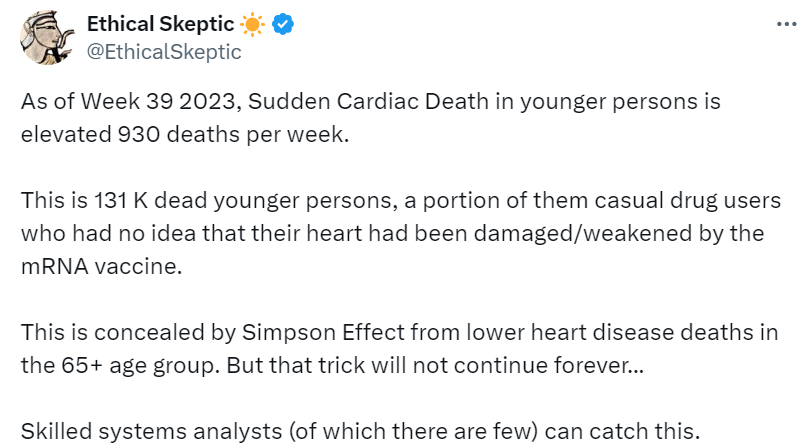
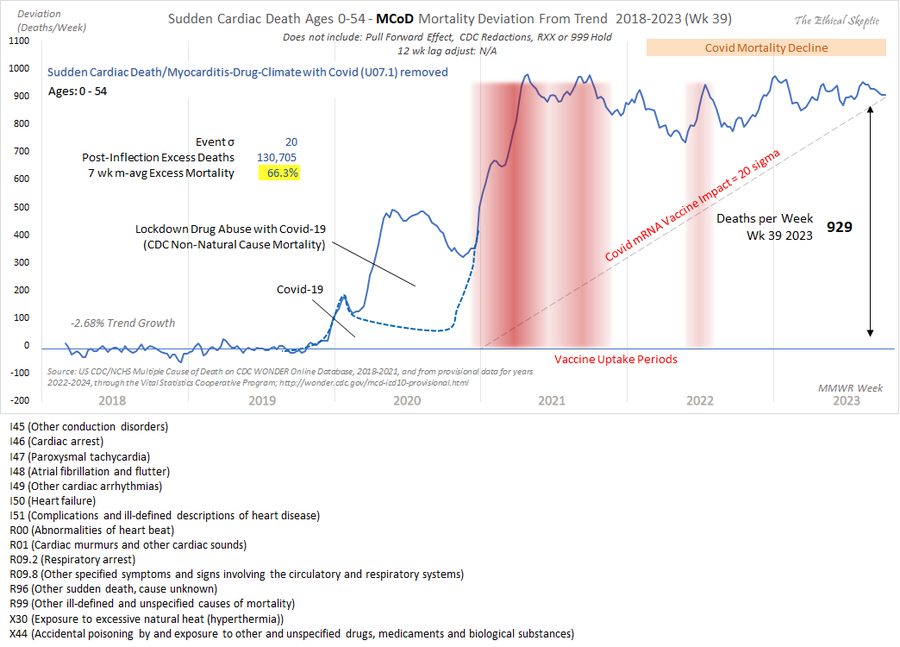
- Chart of the Week: Sudden Cardiac Death Ages 0-54 = 66.3% or 21-sigma excess, which began 12 days after the rollout of the shots 14 Dec 2020 and has not abated in the least. 125,000 dead younger persons – and the government/media are silent.
What Makes All Vaccines So Dangerous?
Story at a Glance:
•Since vaccines frequently cause a wide range of side effects this makes it challenging to identify what the common thread between those injuries. One of the best candidates that has been put forward is vaccination triggering microstrokes throughout the body—a process which I believe also underlies many other chronic diseases.•In the in 1960s (and earlier) a large volume of forgotten research was produced showing that blood cells clumping together was the root cause of a variety of diseases. In parallel, Chinese medicine came to an identical conclusion which has recently been validated by modern scientific instrumentation.
•The science of colloidal chemistry and zeta potential has shown that the primary factor which causes blood cells to clump together are the electrical charges present around them. Many of the most harmful agents in existence (e.g., aluminum or the COVID spike protein) coincidentally also happen to contain a positive charge which is remarkably effective at clumping fluids together.•I believe impaired zeta potential (especially in the modern era) is the root cause of a wide range of diseases and that treating zeta potential is one of the most effective means to address both acute and chronic illness. Likewise, a strong case can be made that many effective conventional and holistic therapies ultimately work by improving the physiologic zeta potential.
link

Security Removed!! The People help Derby family get back into their home

Sudden Cardiac Death elevated among young people
LITHUANIAN MYTHOLOGY — GINTARAS BERESNEVICIUS
Continue reading “LITHUANIAN MYTHOLOGY — GINTARAS BERESNEVICIUS”Lithuanian mythology underwent its formation at the time when the active and belligerent tribes who were the ancestors of modern Lithuanians were distinguishing themselves from the bulk of the Baltic protonation, circa 500 AD. At this time the Lithuanian tradition acquired its specific character. The mythologies of Lithuanians and other Balts are versions of the common Indo-European field of mythological images, but the Lithuanian and Baltic traditions preserved archaic Indo-European images, which disappeared from other European regions before the early Middle Ages. Since the most important characters of the Lithuanian pantheon were common to all Balts, we will begin by describing their common elements.
GODS AND HEROES
The highest figure in the Baltic pantheon is Dievas, in Prussian Deywis or Deyws, and in Latvian Dievs. This god is of Indo-European origin, and his name, as in some religions of the Near East, has been expanded to embrace all gods (God — the name of the highest of gods, god — the name applied to all gods). Earlier Dievas or Deivas simply denoted the shining dome of the sky, cf. ancient Indian deva ‘god’ and dyazts ‘sky’, Latin deus and dies, originating from the Indo-European root deiuo-s, which means both God and sky. Dievas, Dievs, Deivs is also related to the Greek Zeus. In Lithuanian dialects his name is sometimes Pondzejis, Avestian Daeva, Luvian Tiwat, Lidian Tiyaz, as the German Tiwaz. The Finns took the name of Dievas from the Balts, cf. Finnish taivas and Estonian taevas ‘sky’ .
In the mythology of the Balts, Dangaus Dievas (God of the Sky) retains quite a few original Indo-European characteristics — he lives in heaven, is related to shining celestial bodies and is imagined as a light, radiant person deciding fates. For Prussians and Lithuanians, however, Dangaus Dievas becomes an inactive god, deus otiosus. In some lists of Prussian gods he does not figure at all, while in Lithuanian tales he takes part in the creation of the world and its aftermath. In Latvian songs Dievas is much more active — he goes down the hill on which he lives and walks around a field of rye carrying bliss and fertility to the earth. And although traditionally it was possible to rely upon him when striking a contract, making a vow, or in times of crises, his cult among the Balts was doubtful. In any case, sacred places devoted to Dangaus Dievas are not even mentioned in Baltic mythology.
If Dievas was the highest character in the pantheon, then Perkunas, Latvian Perkons, Prussian Perkuns, Perkztno, the god of storm and thunder, master of the atmosphere and all celestial matters, and evidently Dievas’ son, was the most important and prominent. The name of this god is believed to have originated either from words denoting oak, cf. Latin quercus (from perkwus), Celtic herc, or a related root meaning a mountain, like in Hittite parunas ‘a rock’ or Sanskrit parvatas ‘The top of a hill’. In Baltic mythology Perkunas is linked both to a mountain — in Lithuanian mythology Perkunas lives on the top of a hill reaching the sky — and to oaks, growing in sacral places, or to sacred oak woods. Related to Perkunas are such Indo-European gods as Slavonic Perun, Parjanya who is mentioned in the Rigveda, the Germanic goddess Fjorgyn, the gods Donar, Thor, etc. Perkunas’s functions coincide with thunder gods of the Near East; with Baal, for instance, he is related by his care of fertility.
Perkunas is pictured as middle-aged, armed with an axe and arrows, riding a two-wheeled chariot harnessed with goats, like Thor. As is obvious, Perkunas enters the common field of Indo-European and Near Eastern thunder gods, just like Dievas, corresponding to deities of these religions — from An, or Anu, of the Sumerians and Babylonians, to Germanic Tiwaz.
link
 American Buddhist Net