It has been hailed as ‘the most significant archaeological discovery in a decade.’
Archaeologists in Mexico have uncovered a 1,400-year-old tomb in the Central Valleys of Oaxaca that had been lost to history.
The stone structure, built by the Zapotec culture, known as Be’ena’a, or ‘The Cloud People’, is adorned with sculptures, murals and carved symbols that suggest ritual significance.
The Zapotec believed their ancestors descended from the clouds and that, in death, their souls returned to the heavens as spirits.
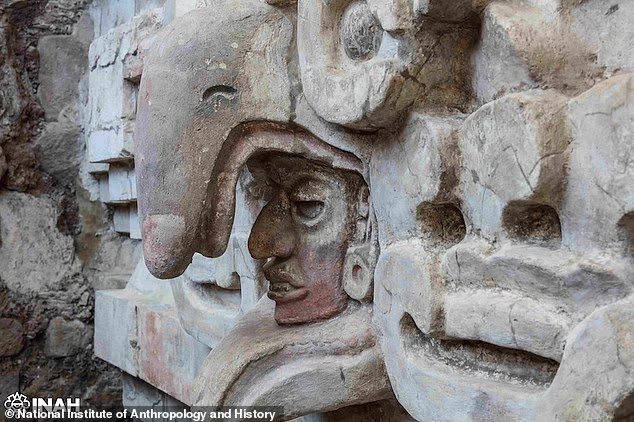
At the entrance sits a massive carved owl, its open beak revealing the face of a Zapotec lord, a symbol the National Institute of Anthropology and History said represented death and power.
Pictured is the face of the Zapotec god inside the owl’s mouth
FIML practice can be seen as a dynamic work of art engaged in by two (or more) people. FIML practice works very well in the moment and it builds on itself by providing many moments of clarity and understanding.
FIML practice creates and defines a history of self-discovery that practitioners can share and enjoy. Since this history is based on good, clear data and since input into it is entirely up to the practitioners themselves, FIML liberates the mind from conformance to received ideas, semiotics, styles, symbols, behaviors, and so forth. FIML gives us the tool we need to freely create the relationships we want to have without illusions and without social and neurotic constraints.
FIML practice can be thought of as a sort of interpersonal performance art. By doing it, we create insights and understandings in each other’s minds. FIML liberates us from the conventional and/or habitual behaviors and interpretations that have dominated and clouded our thoughts.
FIML can only be done with another person. The person you choose to do it with is already special to you. Ideally, you already love them. Do FIML with love and understanding. FIML is a tool to make art within and between your minds.
The artist previously known as Kanye West blamed his behavior on bipolar disorder, saying he “lost touch with reality.”
Ye, the US rapper and record producer known as Kanye West, has taken out a full-page advertisement in the Wall Street Journal, expressing regret for years of antisemitic behavior.
In the ad, he wrote that he “lost touch with reality” and blamed his actions on an undiagnosed brain injury from a 2002 car crash and untreated bipolar disorder.
“I regret and am deeply mortified by my actions in that state, and am committed to accountability, treatment and meaningful change. It does not excuse what I did, though. I am not a Nazi or an antisemite. I love Jewish people,” he added.
Speech proscriptions can be overt with legal ramifications.
Or they can be sort of covert, couched in ideas like good manners, respect, make no waves, maintain friendly relations, follow group norms, etc.
I believe the covert ones happen most basically because almost all people are terrible at speaking their own subjective truths. And this leads to being terrible at hearing others’ subjective truths, even if they are well-expressed which is rare.
This problem arises from the pervasive, inherent ambiguity of language in general but especially spoken language.
Speech flies by and we are required to extract coherent meaning from bits of it. We make stories out of it and judge people, including ourselves, based on bad evidence.
Ambiguity in speech also requires us to maintain the same personas and most of the same beliefs for decades. We travel in herds of ideological banality due to it.
Staying the same, conforming to the group, is a way of displaying a profoundly diminished species of unambiguous meaning, even though we may sense that deep down the whole thing is a bad game.
I used to be bothered by this, but stopped after I figured out FIML and practiced it with my partner for a few years.
After maybe five years, our speech started to become so much clearer it didn’t even feel like the same medium anymore. After ten years, it got so good it seems we may have transcended psychology as it is normally conceived.
This happened because psychology as normally conceived is massively based on speech ambiguity and the ways people react to it. Fact is, you probably should feel a bit crazy in most interpersonal situations because speech proscriptions mixed with compounding ambiguities cannot possibly allow the psychological freedom needed to be cognitively healthy.
Boltzmann Brain hypothesis is a thought experiment in cosmology and statistical mechanics suggesting that, in an infinitely long-lived universe approaching thermodynamic equilibrium, self-aware brains could spontaneously form from random quantum or thermal fluctuations—complete with false memories of a past that never existed.
These hypothetical brains would be indistinguishable from ordinary human brains in their thoughts, memories, and perceptions, but they would arise not through evolution or a structured universe, but as fleeting, isolated events in an otherwise empty, featureless cosmos.
The core paradox arises from statistical reasoning: it is vastly more probable for a single brain to fluctuate into existence than for the entire universe to have formed in the low-entropy state we observe. This leads to the unsettling conclusion that we are far more likely to be Boltzmann brains than evolved humans, which undermines the reliability of our memories and observations.
This idea was originally proposed as a reductio ad absurdum to challenge Ludwig Boltzmann’s explanation for the low-entropy state of our universe. Today, it remains a key concern in cosmology, especially in theories involving eternal inflation, multiverses, and de Sitter space, where the “measure problem”—how to assign probabilities in infinite universes—has no consensus solution.
Despite its theoretical appeal, most physicists consider the Boltzmann Brain hypothesis untenable as a description of reality, because it leads to cognitive instability: if you were a Boltzmann brain, your beliefs—including the belief in the hypothesis—would be unreliable. As physicist Sean Carroll puts it: “We’re not arguing that Boltzmann brains exist — we’re trying to avoid them.”
Recent research, including work by David Wolpert and Carlo Rovelli, suggests that the paradox stems from subtle circular reasoning in how we define the past and interpret entropy, implying that the hypothesis may rely on assumptions about time and observation that are not physically justified.
Lab–grown life has taken a major leap forward as scientists use AI to create a new virus that has never been seen before.
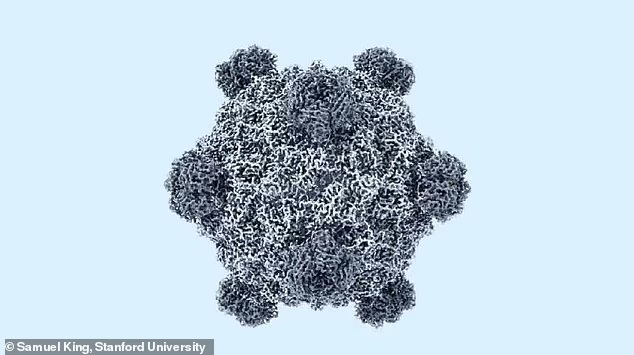
The virus, dubbed Evo–Φ2147, was created by scientists from scratch using new technologies that could revolutionise the course of evolution.
With just 11 genes, compared to the 200,000 in the human genome, this virus is among the simplest forms of life.
However, scientists believe that the same tools could one day create entire living organisms or resurrect long–extinct species.
This artificial virus was specifically created to kill infectious and potentially deadly E. Coli bacteria.
While only 16 were able to attack the E. Coli, the most successful were 25 per cent quicker at killing bacteria than the wild variants.
Scientists have made a major breakthrough towards creating artificial life, as they use AI to create a new virus that never existed in nature (pictured)
I am sending Tom Homan to Minnesota tonight. He has not been involved in that area, but knows and likes many of the people there. Tom is tough but fair, and will report directly to me. Separately, a major investigation is going on with respect to the massive 20 Billion Dollar, Plus, Welfare Fraud that has taken place in Minnesota, and is at least partially responsible for the violent organized protests going on in the streets. Additionally, the DOJ and Congress are looking at “Congresswoman” Illhan Omar, who left Somalia with NOTHING, and is now reportedly worth more than 44 Million Dollars. Time will tell all. Thank you for your attention to this matter! President DJT
Since 2000, women and minorities, who make up less than 10% of all pilots, were factors in 66% of crashes caused by pilot error.
Despite the disparity, major airlines are continuing to hire on the basis of identity rather than merit.
In January 2025, Delta CLO Peter Carter said the airline is “steadfast” in its DEI commitments and called them “critical to our business,” while United’s training academy maintains a goal that 50% of its graduates be women or minorities. Southwest likewise continues to pledge that it will “recruit, hire, and retain a diverse and inclusive workforce.”




 American Buddhist Net