“Health freedom is the largest, strongest single issue voting bloc in America today.”
“We are America’s new majority.”
“We are independent from any party.”
“And we are stronger than ever.”
She declared that Bayer-Monsanto’s push for a pesticide liability shield is “exactly what happened in 1986 when Congress gave a liability shield to vaccine makers.”
“It was a bad use of tort reform then, and it’s a bad use with pesticides today.”
“So let the record show, just like we did in 2024, we’re gonna show up and decide the elections in 2026.”
“Your voice matters more than you can imagine.”
“And it’s about to matter even more in the 2026 midterm elections.”
CRIMINAL PROSECUTION of top COVID officials has officially begun.
Fauci’s top advisor was the first domino.
Criminal referral requests have already been filed against Anthony Fauci and other officials in SEVEN states — Accused of MURDER, TERRORISM, RACKETEERING, FRAUD, & more.
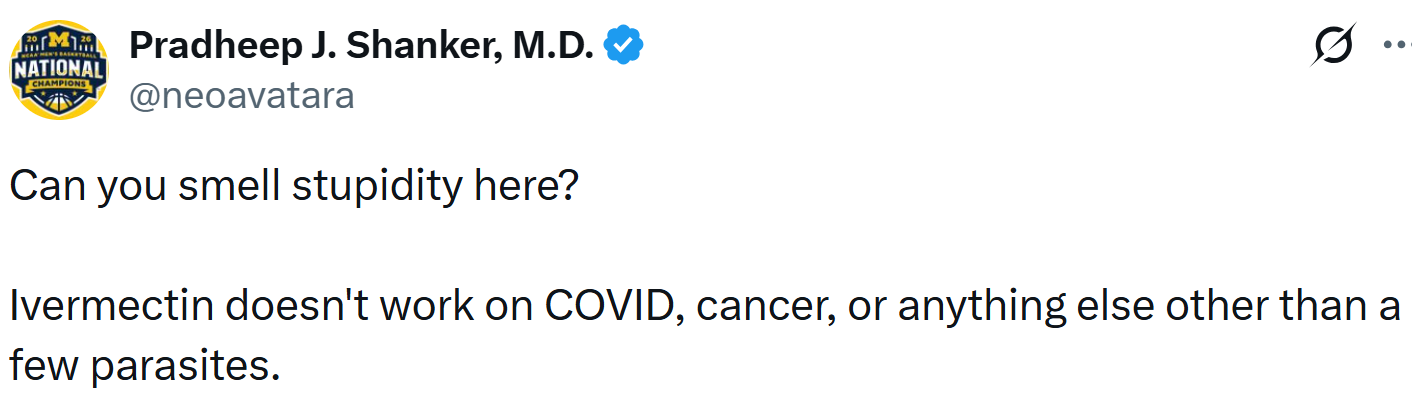
Another parasitic MD who can’t spell “1st do no harm.”
IVM has a far better safety profile than the mRNA vaccines which also don’t work yet have a log scale higher adverse event rate.
Regardless if you think IVM works or doesn’t work, it should be prioritized on safety 1st then efficacy..
That’s why Safe and effective has Safe 1st.
And yes… IVM does work for C19. It’s pharma bitches like this one that like to overdose patients to suggest it doesn’t.
Then there is the economics of generic drugs vs $100B boondoggles using injected vaccines for respiratory viruses where the antigens don’t provide mucosal immunity.
A drug so good you have to mandate it with liability protection so the entire world learns to hate your profession for lap dogging such a violation of informed consent.
Sit the f$ck down you unethical beast. You lost all credibility when you didn’t defend patients rights.
The text presents a controversial perspective on historical narratives surrounding colonialism and slavery, positing that contemporary discussions around these topics are often manipulated to induce guilt among White people. The author claims that this guilt is exploited by various groups, including self-hating Whites, racial minorities, and international financiers, to foster a narrative that undermines the racial identity and survival instinct of the White race. The argument hinges upon the idea that the portrayal of history has been distorted to promote a sense of moral obligation among Whites while dismissing the complexities of historical events, such as slavery and colonialism, which the author claims were not exclusively the result of European actions but involved various actors, including Black Africans themselves.
The text argues that the European slave trade was not a unique or novel development, as it was built upon pre-existing practices wherein African tribes captured and sold one another. The author references historical specialists to support the claim that the demographic impact of the slave trade on Africa was minimal and that contrary to popular belief, the industrial revolutions in Europe were not significantly financed by profits from slavery. Furthermore, it is asserted that many Black individuals were themselves slave owners, and the text points out that a considerable number of White individuals also suffered from forms of slavery, which complicates the narrative of racial oppression. The author suggests that the prevailing discourse surrounding reparations and racial guilt is fundamentally flawed, arguing that contemporary generations should not be held accountable for the sins of their ancestors.
…the forgers of history forget to mention that, like the inter-European trade of White Christians, the European slave trade was a Jewish specialty. The vast majority of slave traders who were not Arabs or Blacks were in fact Jews. They owned the slave ships; the crews and auction brokers were predominantly Jewish, as were a disproportionate number of slave owners, especially in the West Indies, Brazil, and South America. The headquarters of this very lucrative trade were in New Port Rhode Island, which is also the site of the first synagogue in the Western hemisphere. Trading in this human misery was halted on Saturdays to observe the sabbath.
This is not a new topic and readers of this site are probably aware of the basics of it. I have only lightly skimmed the linked article, but is appears to be a good overview of slavery and who did it and why. ABN
Harrowing news details have emerged of the extreme punishments meted out in North Korea, including prisoners beaten to death with a hammer, a pregnant woman executed, and a farm manager shot after angering Kim Jong Un.
In some of the most shocking cases, inmates were killed in secret ‘indoor executions’ using blunt weapons, while defectors said they witnessed the shooting of minors despite official claims such punishments are banned.
A manager was also executed after all the baby terrapins at a state-run farm died, with sources saying he was shot dead shortly after Kim berated officials during a visit.
The disturbing accounts are laid bare in a new report by Transitional Justice Working Group, which maps executions across the secretive state and reveals how killings surged during the Covid pandemic.
Images included in the report reveal the scale of the killings, showing suspected execution sites across North Korea including firing ranges near airports, football pitches and also in remote fields.

 American Buddhist Net