
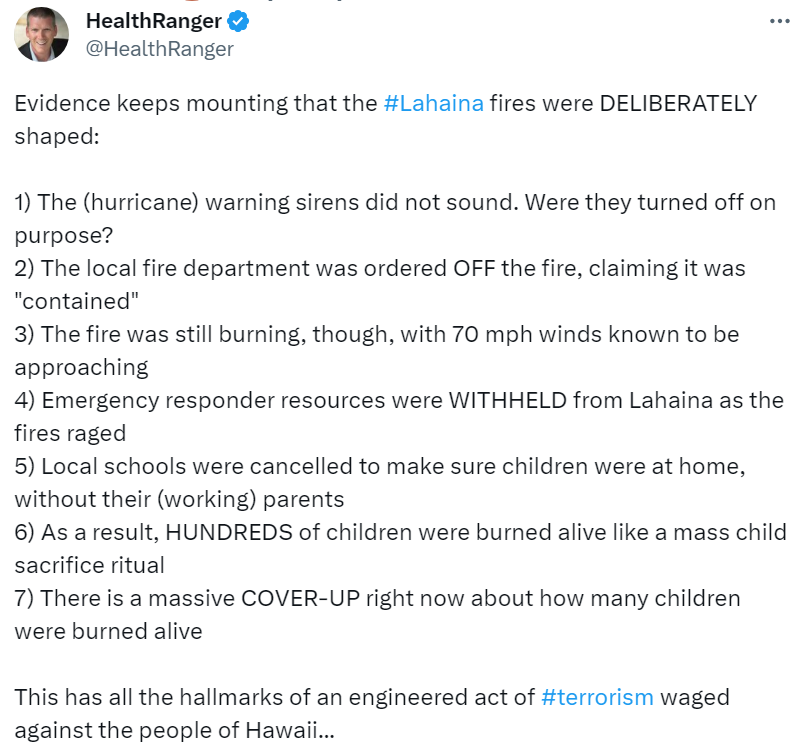
This would constitute a major motive for arson. ABN
Evidence mounting that Lahaina fires were deliberate
RFK Jr explains Ukraine, bio-labs, and who killed his uncle — Tucker Carlson Interview
Kennedy on US bioweapons and overseas labs
Most readers probably know what Kennedy is talking about, but it is well-worth repeating and emphasizing. I will add that this is a very difficult area because there is the deep logic that if we don’t do it others will. There is no single moral act or opinion that can be a bottom line on this. And this is especially true of bioweapons since labs are so easy to conceal. ABN
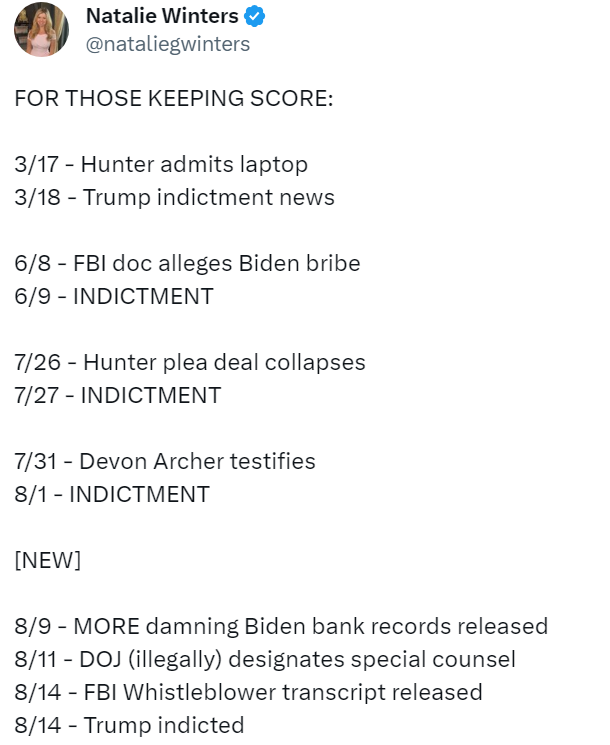

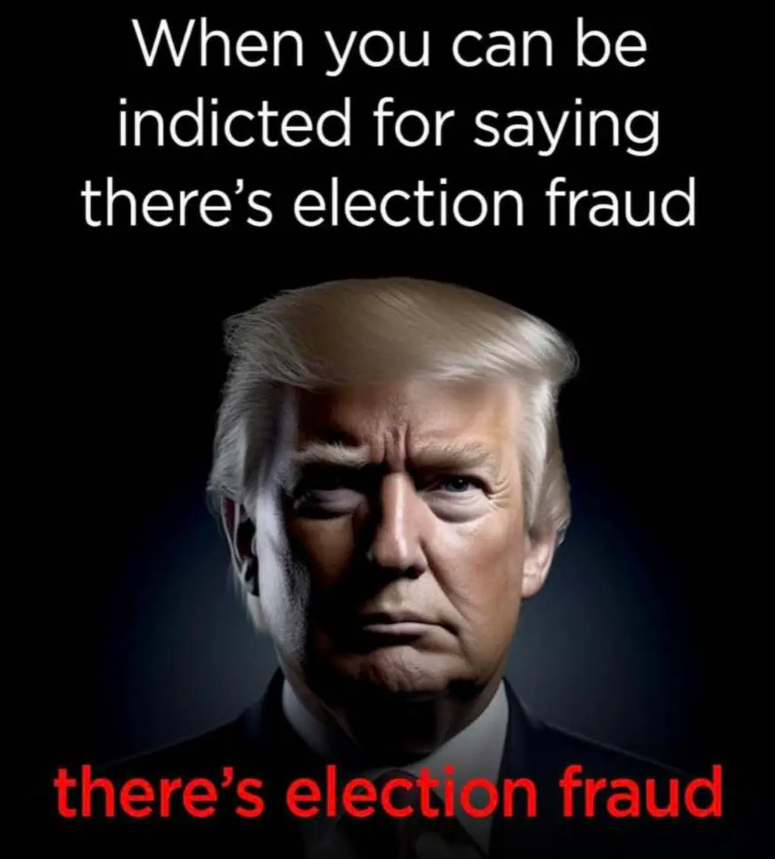
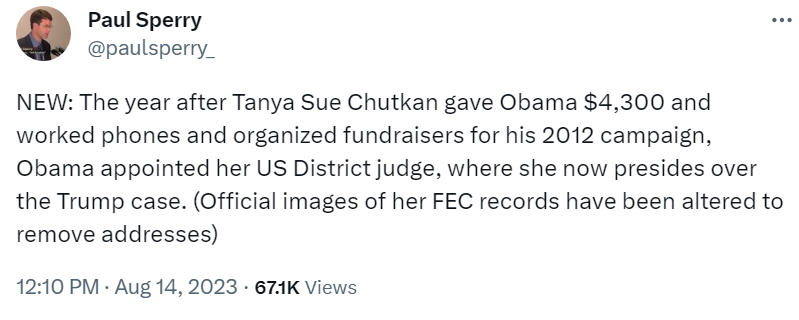
Criminal Indictment Released Against President Trump and 18 Coconspirators
The Fulton County clerk of courts has uploaded a 98-page criminal indictment against President Trump and 18 alleged coconspirators. [PDF HERE]
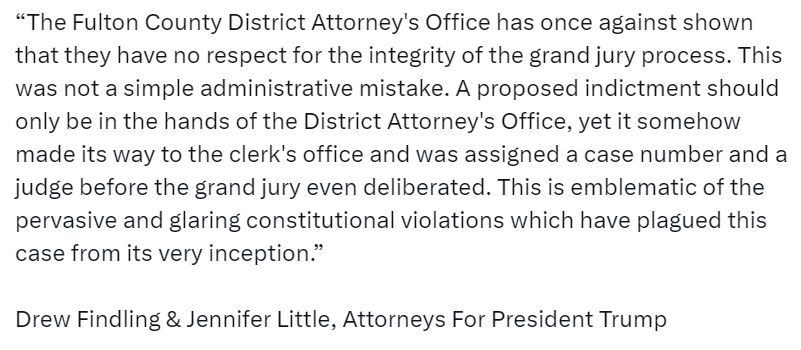
First thing to notice, the released indictment is identical to the one the clerk said was not accurate earlier today. Meaning, two things: (1) the indictment was generated before the “special grand jury” voted; and (2) the Fulton County clerk of courts lied. 👀 Nice way to start the review, huh?
Defendants include, Donald Trump, Rudy Guiliani, John Eastman, Mark Meadows, Jeffrey Clark, Jenna Ellis, Sidney Powell and a host of villainous villains who did allegedly perpetrated villainy in the Peachtree state.
Fulton County is the place where the bogus plumbing leak led to election overseers being ushered out after which bogus ballots were scanned. This indictment is an obvious travesty of justice but it will probably make Trump even stronger. At the same time, this shows how far we have fallen as a nation. ABN
What limits speech? In a word: Fear
If we consider speech with only one listener and look firstly at the micro level, we find it is fear of wrong word choice, wrong gesture, expression, demeanor, or tone of voice that limits our speech because a misstep with any one of these may transgress interpersonal limits.
At the meso level, it is either fear of offending or embarrassing (our understanding of) the “personality” of our listener or the fear of an actual flareup from our listener.
At the macro level, it is the fear of introducing a largish idea with sociological or career implications that might disturb, embarrass, or anger our one listener.
With two or more listeners, the analysis is much the same though the numbers of people make it more complex, until we get to so many people we are speaking to an audience. Then it becomes simpler in some ways because the micro and meso levels will be less prominent due to distance between speaker and audience and there being no clear single target of our tone of voice or phraseology.
On the other hand, an audience’s response can be more complex and problematic because more than one person can become angry at us.
Human beings thus are stuck in a game that is controlled by how most of us listen most of the time.
Stated differently, human beings have magnificent speech and communicative capabilities, but rarely get to use them to their full, best effect because one or more of the many speech limits outlined above will cause us either to hold our tongues or else risk creating a disruption in the mind(s) of our listeners.
This seems like a Big Problem to me. I do not want to spend my life constrained by those rules. FIML can help us overcome this problem but even FIML cannot do it all.
We must also recognize that our very comprehension of meaning itself is grounded in fear.
first posted SEPTEMBER 23, 2019
UPDATE: This is a main area where I have some disagreement with traditional Buddhist practice which tends to put the onus of right speech entirely on the speaker. This makes sense in many contexts but in many other contexts it can cause speakers to withhold or be timid when they should not. Or it can cause listeners to believe that speakers must always keep in mind their weaknesses and that they (listeners) are being entirely proper when they misinterpret or mis-react to someone’s speech. This kind of thinking too often leads to overly emotional responses, a greatly reduced scope of discussable topics, and an overall pettiness that constrains everyone. Placing the onus for right speech always on the speaker and never requiring right mindfulness of the listener leads to a kind of hierarchy of speech or a totalitarian view of what is right and wrong to say. In the world today, we can clearly see how speech is constrained in this way through censorship, shadow-banning, muting, shaming, deplatforming, cancelling and more with almost no good purpose ever being served except elitist control of the masses. At interpersonal levels, our speech is too often limited by the narcissistic sensibilities of listeners or what we fear those sensibilities might be. None of this is optimal good speech. In Buddhism we want to optimize speech, thought, mindfulness, and listening. It is good to be mindful of what we say, when we say it, and to whom. But it is not good to always tread in fear every time you open your mouth. ABN
Federal Court rules chronic pot use doesn’t cancel gun rights
The court, in an appeal in the case of Patrick Darnell Daniels of Gulfport, Mississippi, found unconstitutional the 1968 law that bars an individual from lawful firearm possession if they are an “unlawful user of or addicted to any controlled substance.”
Daniels, who was arrested by local police and a DEA agent in April 2022 after a traffic stop for a missing license plate found marijuana cigarette butts in the ashtray and two loaded firearms, was charged in a federal district court on the “unlawful user” statute and given nearly four years in prison in addition to having his Second Amendment rights stripped away for life. While Daniels had admitted to smoking marijuana since high school and consumed the “Devil’s Lettuce” about 14 times a month, he was not otherwise a lawbreaker.
The thing is, held the appeals court panel, the 1968 law, as viewed through the lens of the Bruen ruling from the U.S. Supreme Court, doesn’t square with the historical right to bear arms and tossed the conviction.
“In short, our history and tradition may support some limits on an intoxicated person’s right to carry a weapon, but it does not justify disarming a sober citizen based exclusively on his past drug usage,” said U.S. Chief Judge Jerry Edwin Smith, a 1987 Reagan appointee, in the court’s opinion. “Nor do more generalized traditions of disarming dangerous persons support this restriction on nonviolent drug users. As applied to Daniels, then, § 922(g)(3) violates the Second Amendment. We reverse the judgment of conviction and render a dismissal of the indictment.”
‘Pervasive and glaring constitutional violations’
Lahaina downed electric wires are a possible cause of the fires
The downed wires could also have been deliberately staged to provide a plausible excuse for the fires which were started by DEW or something else and amplified by arsonists on the ground. It’s mostly speculation right now. ABN
 American Buddhist Net