Proprioception means “one’s own” or “ones’ individual” (Latin proprius) “perception.”
We normally use this word to refer to our physical position in the world—whether we are standing or sitting, how we are moving, and how much energy we are using.
When we dream, our capacity for physical movement, with rare exceptions, is paralyzed. But we still do a sort of proprioception in dreams—a semiotic proprioception, or proprioception within the semiology of the dream.
In dreams, we grope through semiotic associations and respond, gropingly, to them. People and things often look smaller in dreams, or distorted, because we do not have either the need or the capacity to calibrate our physical proprioception as we do in waking life.
Dreams move from one semiotic proprioception to another via our individual four-dimensional (3D plus time) groping/associative function. In one short segment of a dream we are at home, then we go through a door only to find ourselves on a boat in the ocean. Our 4D semiotic proprioception within dreams readily accepts groping, associative shifts like this.
Much of what we perceive when we are awake is memory. We glance at a room we know well and call up our memory of it rather than actually look closely at the room.
I am fairly sure that the memories we call up to aid perception while we are awake are much the same as the groping proprioception we experience in dreams. A major difference is when we are awake we can and do check our waking proprioception with the people and objects around us, while in dreams the associative function has a much freer range.
Notice how dreams move from scene to scene rather slowly. Things can go quickly, but normally dreams grope somewhat slowly along the 4D path of semiotic proprioception.
In waking life, our dreamy use of memory and association to aid perception of the world happens constantly.
When we speak with another person, we use this function to make groping associations concerning what we think they are saying. We grope and respond to them as in a dream while at the same time searching for clues that indicate we are both in the same dream.
These clues that two people may sort of “agree on” while speaking are normally standard public semiotics that belong to whatever culture(s) they share. By “agreeing” on them, we form a sort of agreeable camaraderie with whomever we are speaking, and this can be satisfying, but if we only get this, it can also become deeply unsatisfying.
The four dimensional groping/dreamy function of our mind is far richer than any standard collection of public semiotics. In our public lives—professional, commercial, based on organizations, etc.—we have, at present, little recourse but to accept normal public semiotics, to agree with them and manifest agreement.
We can express some deviation from them and sometimes make jokes about them, but we are generally fairly bound to the semiotics of the culture or organization that generates the context of our speaking. Consider how people in the same church or school are bound by the semiotics of those institutions.
In our intimate relations, however, we do have recourse to investigate and understand how our groping, 4D semiotic proprioception works. This is what FIML does. It allows partners to observe, analyze, and understand the semiotic proprioceptions of their minds as they are actually functioning during interpersonal communication.
If you constantly avoid FIML types of investigations, you will be stuck with a mix of dimly shared public/private semiotics that will tend to become highly ambiguous, even volatile, or very shallow.
Modern surface temperatures are an echo from the past. The Earth is an ocean planet, driven by a pulsating 1,000-year conveyor belt known as Thermohaline Circulation. We are witnessing a planetary memory in the oceans operating on a scale humans struggle to imagine — where deep currents are only now responding to thermal signals set in motion during the Roman Warm Period (250 BC–400 AD).
Indeed, a landmark study by Jake Gebbie (Woods Hole) and Peter Huybers (Harvard) found that the deep Pacific lags so far behind the atmosphere that it is still actively cooling from the later Medieval Warm Period, and only just beginning to digest the climate shift of the Little Ice Age.
The top 3.5 meters of the oceans hold the same heat capacity as the entire global atmosphere. The 3,700 meters below, is the Earth’s thermal vault of all retained heat energy. Oceanic inertia – or momentum – smooths out atmospheric hot and cold spikes.
The oceans absorb and retain 90% of the system’s excess heat while the atmosphere is simply a gaseous envelope, thin and reactive, largely a passenger on the back of the massive oceanic flywheel.
Carlson actually says the quote in the headline but Bowden fully agrees. She has been very good all along and deserves our respect and support. At great cost to herself, she spoke and still speaks the truth about covid, covid masks, and most of all, the covid vax. People like her have innate bravery and love of truth. From a Buddhist POV, that’s morally and spiritually exemplary. That’s what life is all about. ABN
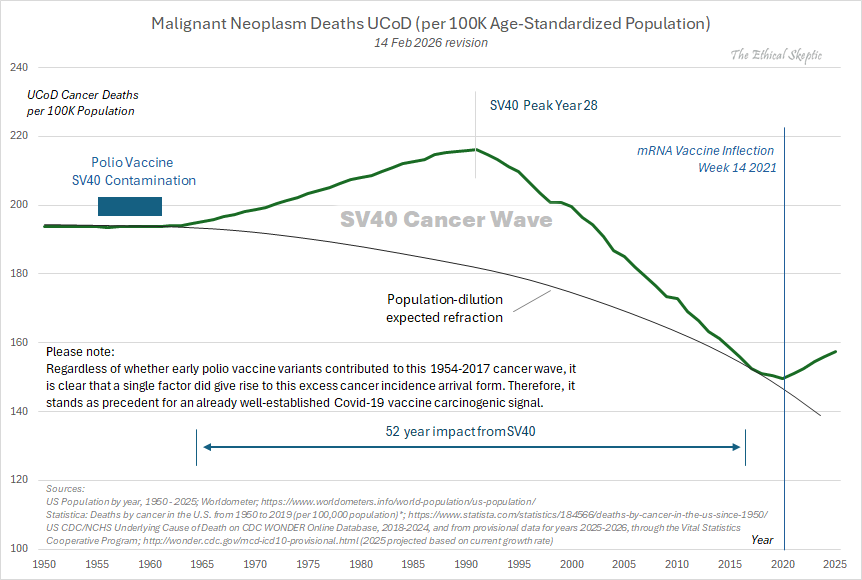
The polio vaccine ‘horror curve’ can serve as a reasonable precedent to the cancer curve which is showing up following mass covid-19 mRNA injections. With the polio vaccine, we can probably believe the claim that the SV40 (Simian Virus 40) accidentally contaminated the product. I do not see how repeating that same contamination in the covid-19 vaxxes can be considered ‘accidental’. This is yet another reason to suspect the covid mRNA injections were and still are bioweapons. ABN
The ongoing conflict in Ukraine has raised significant questions about Russia’s military effectiveness, particularly given its apparent supply superiority. A friend in the defense sector queried why Russian forces have struggled to achieve decisive territorial gains despite having a considerable advantage in resources. The initial objectives of the Russian invasion, as articulated by President Putin, were primarily to “demilitarize” Ukraine rather than to occupy its territories. This divergence from a full-scale invasion strategy has shaped Russia’s military operations, which have often been limited and focused on specific regions rather than a comprehensive assault on Ukrainian sovereignty.
Following the initial invasion, Russia did achieve some military successes, notably in capturing Mariupol and significant portions of Luhansk and Donetsk. However, these achievements were not indicative of an overall strategy to conquer Ukraine but rather aimed at creating enough pressure to bring Ukraine to the negotiation table. The situation escalated when negotiations faltered due to external influences from Western nations, leading to a shift in Russia’s military focus towards a more aggressive campaign in the eastern regions of Ukraine. Despite controlling a vast majority of Luhansk by September 2022, Russian forces faced challenges in maintaining momentum and faced significant setbacks during Ukraine’s counteroffensive in the Kharkiv region.
As the conflict progressed into 2023 and beyond, Russian operations became characterized by a high attrition strategy, focusing on maximizing damage to Ukrainian forces while minimizing Russian casualties. The Battle of Bakhmut emerged as a critical point in the war, symbolizing Russia’s attempt to regain lost ground while still adhering to its limited operational framework. Despite mobilization efforts, including the call-up of reservists, Russia maintained a strategic posture that avoided full national mobilization, which would entail a broader wartime commitment. This choice reflects a continued reliance on a professional military force rather than a mass mobilization.
Entering 2026, the dynamics of the conflict shifted once more, with Russia reportedly deploying around 700,000 soldiers in Ukraine. While this represents a significant increase in military commitment compared to the early stages of the conflict, Russia continues to operate under the guise of a Special Military Operation (SMO). The focus remains on capturing remaining Ukrainian strongholds in Donetsk, with analysts predicting that Russia could achieve these objectives soon. The strategic differences between the Russian and Ukrainian forces are stark; Russia possesses ample reserves and a vast artillery advantage, while Ukraine struggles with limited resources and a lack of strategic depth. Ultimately, the discussion pivots on the inevitability of Russian advances and the extent of territorial control it will exert over Ukraine, raising profound implications for the future of the region.
Whether you fell for this bs or not, the video is worth viewing as a reminder of how powerful propaganda and censorship can be. And also how mindlessly stupid, wrong, dangerous, blatantly deliberate and evil they are. Mind-control constitutes over 90% of all Big Media, and much of the rest due to bots, psyop agents and the gullible. ABN



 American Buddhist Net