FIMLis fundamentally a communication technique with wide-ranging implications for many other aspects of being human.
FIML removes mistakes from communications between partners. FIML reduces or eliminates neurotic feelings. FIML encourages honesty, integrity, responsibility, and many other virtues. It greatly improves communication. It transforms beliefs in a static self, a personality, an ego, or a set autobiography to a more realistic understanding of the dynamic nature of being, speaking, listening, remembering, functioning. FIML skills are useful when dealing with people other than the FIML partner. FIML greatly reduces the need to rely on external standards (public semiotics) for self-definition and/or communication. FIML elevates consciousness in the sense that FIML practice is done consciously and improvements are made in partners’ consciousnesses. FIML works directly with partners’ experiences and thus is a deeply experiential practice that generates experiential understanding.
FIML greatly supports Buddhist practice and though FIML is not specifically a traditional Buddhist teaching, it does not contradict any core Buddhist teaching. For many people, FIML may be a very good tool to use with the Dharma. This is so because FIML allows each partner to identify kleshas (mistaken interpretations) the moment they arise and to correct them with input from their partner. FIML also helps partners experience the reality of no-self, impermanence, emptiness, and dependent origination. When these truths are experienced together with a partner, both partners are able to deeply confirm the validity of their insights as both share in this confirmation. Both partners will notice kleshas being eliminated and both will be able to confirm this to each other, through explicit statements to each other and also through observations of each other.
FIML practice also helps partners understand and experience how the First and Second Noble Truths actually operate in their lives. When one partner discovers a klesha through a FIML query, they will see very clearly how their mistaken interpretation, if not corrected, could be the source of suffering. When they correct their mistake, they will see how eliminating a klesha is liberating and how it produces a bit of “enlightenment” (Third and Fourth Noble Truths).
FIML practice encourages honesty between partners and many other virtues. FIML partners will directly experience the importance of being honest with their partner and treating them with the utmost respect and integrity. This strengthens partners’ understanding of the Buddha’s teachings on morality (sila).
FIML’s emphasis on fully understanding the roles of language and semiotics supports the Buddha’s teachings on Right Speech (for language) and wisdom (for semiotics). In the Prajna Sutras, “dharmas of the mind” (laksana) very closely correspond to the modern English word semiotics as that word is used in FIML practice. By focusing on this word and concept and experiencing with a partner how semiotics affect everything we think and do, partners will gain great insight into the kind of consciousness described in the Diamond Sutra—a consciousness without the “marks” or “characteristics” (laksana, semiotics, signs) of a self, a human being, a sentient being, or a being that takes rebirth.
FIML accomplishes most of what it does by being a technique that is called up quickly, the moment it is needed. FIML queries almost always lead to long and interesting discussions, but the basic technique must be done quickly. The moment either partner feels a klesha arising, they should stop and query their partner about what is/was in their mind. After hearing your partner’s honest answer, compare it to what you had thought. The better data from your partner should eliminate that particular klesha after a small number of its appearances. Remember, your partner’s data is better because you asked them quickly enough for them to be able to recall with great accuracy what really was in their mind during the moments you were asking them about. If you wait too long or get into long stories or theories, or become emotional, you will miss the chance to catch that klesha. When you do catch a klesha, feel good about it. That means there is one less hindrance in your mind.
Non-Buddhists will experience the same results from FIML practice as Buddhists, though their understanding of these results will be framed differently. We have discussed FIML from a non-Buddhist point of view in many other posts. Interested readers are encouraged to browse some of those posts for more on that angle.
UPDATE: I’m not a big fan of Candace’s interviews, of which I have only watched two. She is a monologue genius but not well suited to the interview format, imo. This one is OK for about 30-40 minutes but did not promise any new information so it felt like just watching two people talk about stuff we already know. Youssef did some general analysis on USA starting at the ~35 min mark; what I saw of it was trite, so I stopped watching. Just my opinions. ABN
George Zinn received a harsher prison sentence after police found child sex abuse materials on his phone after arresting him at UVU
In the chaotic moments after Charlie Kirk was shot at Utah Valley University, a man approached a detective who was searching for the killer and yelled, “I shot him! Now shoot me.”
But that man, George Zinn, had nothing to do with Kirk’s death.
Now, the 71-year-old is going to prison for making the false claim, which authorities say diverted law enforcement’s attention when they were trying to find the actual shooter.
Zinn pleaded no contest on Thursday to a third-degree felony charge of obstruction of justice. He also pleaded guilty to two counts of sexual exploitation of a minor, admitting that police found child sex abuse materials on his phone when they questioned him on Sept. 10 after he claimed he had killed Kirk.
Fourth District Court Judge Thomas Low sentenced Zinn to spend up to 15 years in prison for the crimes: Two one-to-15 year terms for the second-degree felony exploitation charges, and a zero-to-five year sentence for obstruction. He will serve the terms concurrently.
I got hearing aids a few years ago, and this is kind of how it feels, especially if you play a musical instrument. For adults, acclimation takes much longer because adult brains reprogram more slowly than kids. Everybody should have their hearing tested periodically or before taking on something that depends on good hearing, like learning a language, music, bird watching, conversation and much more. My audiologist told me it takes the average adult seven years to get hearing aids after they have been diagnosed with hearing loss, which typically declines slowly. For years, I thought my computer was bad because I could not hear videos clearly even at top volume (it wasn’t). Not hearing well has significant behavioral ramifications, which you will discover if you get HAs. Personally, I don’t feel embarrassed about wearing them in the least. They are basically eyeglasses for your ears. I love the tech and even think they are kind of cool. Plus I can actually hear quite well again. ABN
“Monks, a friend endowed with seven qualities is worth associating with. Which seven? He gives what is hard to give. He does what is hard to do. He endures what is hard to endure. He reveals his secrets to you. He keeps your secrets. When misfortunes strike, he doesn’t abandon you. When you’re down & out, he doesn’t look down on you. A friend endowed with these seven qualities is worth associating with.”
This is reportedly from a few years ago in Taiwan before Jensen became super-rich and famous. Nothing very special about it except it shows a dimension of Taiwan culture and Jensen’s personality. They eventually sing a song in English. It’s a good ‘slice of life’ video. ABN
Jensen Huang speaks Taiwanese Hokkien and Mandarin Chinese, though his Mandarin is described as “rusty” and learned later in life. He was born in Taipei, Taiwan, and grew up speaking Taiwanese Hokkien with his parents, who were native speakers. He began learning Mandarin in the 1980s while working at AMD to communicate with Chinese photomask workers. He has since spoken Mandarin in public, including a notable speech at the 2025 China International Supply Chain Expo, where he said, “I am very happy to be here in China,” in Mandarin. He also frequently uses Taiwanese Hokkien when in Taiwan and has been seen speaking it in public events and interviews.
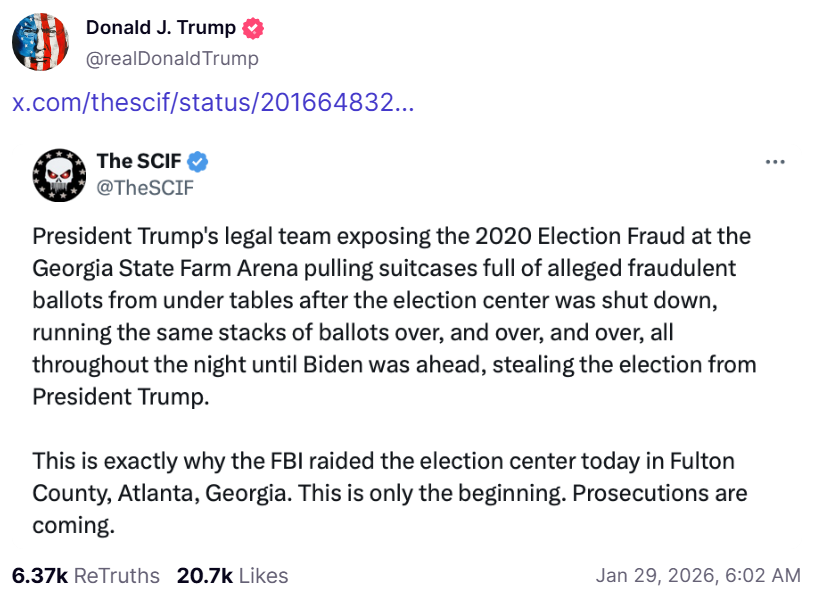
“REPORT: DOMINION DELETED 2.7 MILLION TRUMP VOTES NATIONWIDE. DATA ANALYSIS FINDS 221,000 PENNSYLVANIA VOTES SWITCHED FROM PRESIDENT TRUMP TO BIDEN. 941,000 TRUMP VOTES DELETED. STATES USING DOMINION VOTING SYSTEMS SWITCHED 435,000 VOTES FROM TRUMP TO BIDEN.”
This is infuriating, and entirely due to something else in the background {GO DEEP}. Former National Security Council member (Russia/EurAsia desk) Alexander Vindman is running for a Florida senate seat against Republican Ashley Moody.
First, Alexander Vindman doesn’t stand a chance at winning; however, that’s not his objective with this announcement. Here is where it becomes important to understand the game.
Vindman is directly tied to the background issue of the fraudulent impeachment effort, which I have been working to bring to the forefront. Progress is agonizingly slow but moving forward.
Alexander Vindman has two primary objectives in announcing this effort: (#1) to give himself the political defense against any accountability for his involvement in the IC coup against President Trump in 2019. By running for the Florida Senate seat, Vindman will claim evidence is only coming to light as an outcome of his seeking elected office, i.e. it is a political attack. And (#2) running for office allows Vindman to accept campaign donations that will ultimately be used in his defense against #1. This is how they roll.






 American Buddhist Net