The mission of this website is to call attention to possible foreign and domestic malign influences on voting systems across our country with evidence obtained from open sources. This evidence raises significant concerns about whether our democratic system is under attack due to the use of foreign-owned electronic voting systems to run our elections and count our votes.
Are unauthorized and malicious foreign software engineers and administrators in hostile countries accessing our voting records and manipulating our elections? Is some of the work funded by one or more South American cartels? Is the personal voting information from past elections stored on Chinese servers in an eastern European country? Are actors able to control and alter the outcomes of our elections? Have they been doing so?
The timelines below trace the evolution of the coding and software that form the electronic DNA of America’s electronic voting and tabulation systems as they have developed over the years. The summary timeline provides the chronological history in brief. Just follow the yellow line. It connects pieces of evidence and raises important questions.
The full timeline includes more than 200 events between 1997 and 2024. Everything is linked to the original sources.
This evidence should concern all Americans. If we have lost control of our votes, we have lost control of our democratic process and our constitutional republic.
This claim fits well with information many of us have been seeing for years. It connects China, Serbia and Venezuela, as well as the makers of electronic voting machines used in USA. The story has always been shadowy and lacking essential details or recognition by law enforcement. Emerald claims Trump is preparing to take down Maduro in Venezuela primarily over their election fraud in USA. ABN
The newest fighter type in the Russian Armed Forces inventory, the Su-30SM2, has been intensively combat tested since it began to enter service in early 2022, with the outbreak of full scale hostilities between Russia and Ukraine just weeks after it became operational providing significant opportunities to further refine operational tactics.
New details on the fighter’s performance in the theatre have been provided by the Russian state arms export conglomerate Rostec, which reported: “Aircraft of this type have confirmed their effectiveness in the special military operation.
They have a record of hundreds of destroyed aerial and ground targets, including Patriot systems.” “Thanks to its powerful radar, the Su-30SM2 can ‘see’ farther and more accurately, which facilitates the crew’s operation.
In turn, its advanced electronic warfare system allows the fighter to effectively counter enemy air-launched weapons,” the report added.
Russian Navy Su-30SM2 Fighter
The Su-30SM first entered service in the Russian Air Force in 2012, following the termination of the ambitious Soviet MiG 1.42 fifth generation fighter program in 2001, and major delays to the more conservative Su-57 fifth generation program. The aircraft was developed as an enhanced derivative of the USSR’s most capable fighter type the Su-27 air superiority fighter, and directly replaced Soviet built Su-27s in frontline roles.
Swedish entrepreneur and freedom fighter Henrik Jönsson just launched 100% – a brand new fully independent media platform that’s here to crush Sweden’s state-funded, left-wing media monopoly.
He’s going all-in. Zero government zero subsidies – just pure truth funded directly by the people.
Here’s Henrik himself explaining why Sweden needs this NOW. (ai translated clips)
Mainstream media has become propaganda. Henrik is building the alternative – 100% independent.
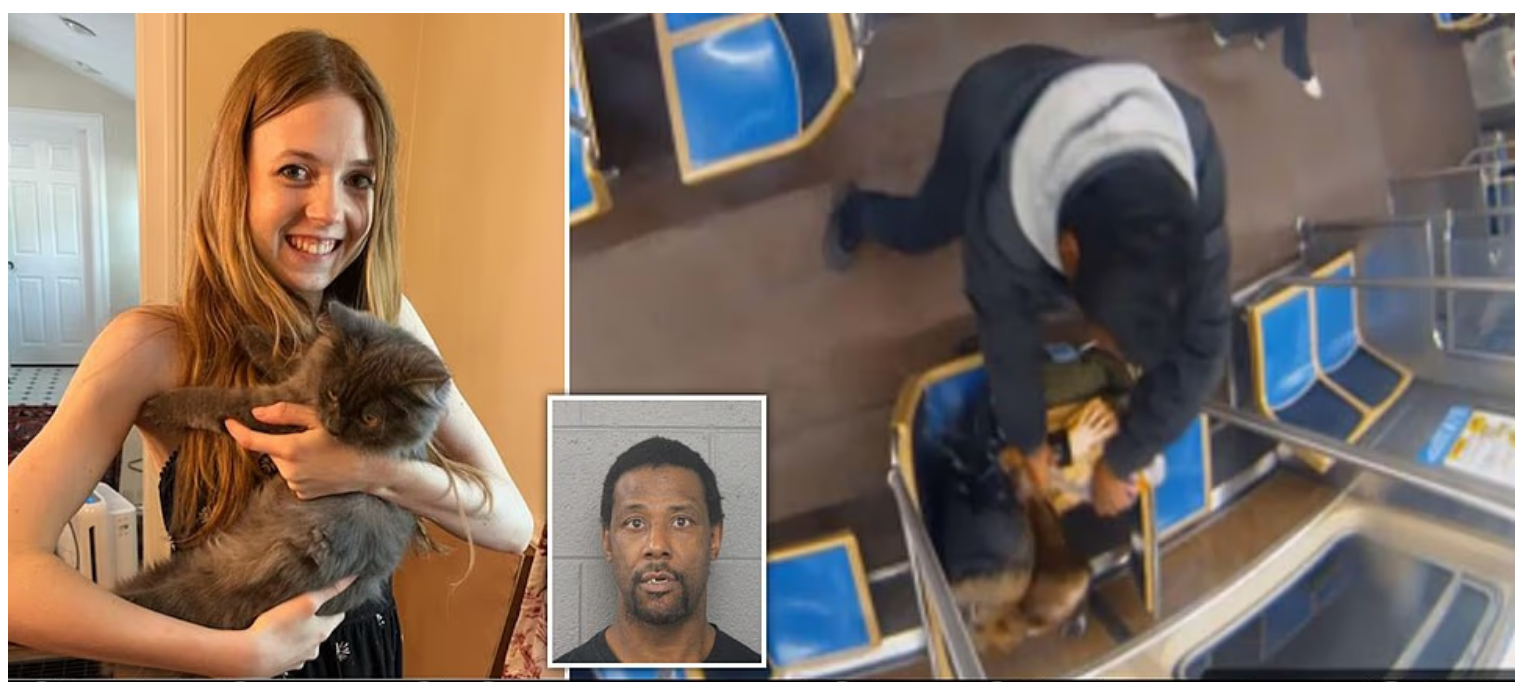
The woman set alight by a lunatic on a Chicago metro train is a 26-year-old analyst for Caterpillar who suffered burns to 60 percent of her body.
Bethany MaGee, 26, was doused in gasoline and set alight on the city’s Blue Line on Monday night, but managed to flee the train and survive.
MaGee, from Upland in Indiana, works as a business research analyst at Caterpillar after graduating with a bachelors of science at Purdue’s Polytechnic Institute.
Her Facebook profile photos revealed that she is an animal lover and churchgoer, who is close to her parents Emily and Gregory, and two brothers Mark and John.
MaGee’s father Dr Gregory MaGee is a professor of Biblical studies at Taylor University, a Christian college in Indiana.
The man police named as her attacker, 50-year-old Lawrence Reed, is a serial criminal with 72 prior arrests freed months earlier by a judge after he allegedly attacked a social worker.
The FBI had multiple “missed opportunities” to stop Thomas Crooks before he tried to assassinate President Trump, a former assistant director at the Bureau has told The Post.
Last week, The Post reported on multiple extremist social media posts believed to be tied to Crooks, including numerous threats of political violence and a dramatic shift against Trump, after previously expressing his admiration for the Republican.
If even “half” of Trump’s would-be assassin’s extremist digital footprint turns out to be true, he should have been on the FBI’s radar long before the 20-year-old opened fired on the then-presumptive GOP presidential nominee during a rally in Butler, Pennsylvania, said Chris Swecker, a retired FBI assistant director.
“It’s clear that he was popping off on the social media sites and saying things that should have garnered attention,” Swecker, who served in the FBI for 24 years, said.
“That constitutes a miss on the part of the FBI,” he added, saying that the Bureau’s handling of the investigation earned a “a C- grade.”
“There was a bias in the FBI towards right-wing extremists. And if there was a right-wing extremist ideology, that got surfaced real quick in any of these shootings. But if there was a left-wing extremist ideology driving it, it was glossed over,” Swecker said
He said that view was “shared by a lot of my colleagues” in the FBI.
I have read that short naps or lapses in attention often occur because the brain is disposing of waste. FWIW, napping is very common in China, and the ‘right to nap’ used to be part of the Chinese constitution. Not sure about the legal status today. ABN
This has been a major conspiracy theory going back several years if not more, that Venezuela had been using these machines to rig their own elections and thus wasused to play a big role in election fraud in USA.
Trump knew enough to evade that system in 2024, so he must be well aware of the game.
Trump typically acts on several levels at once, which do not become fully apparent until later, often much later.
Bombing Iran’s nukes is an example of that.
The deep reason for the bombing is everyone in the ME wanted it done and so did Russia and China.
It was not just for Israel.
In fact, the attack lowered Israeli PR stock because destroying the nukes destroyed their most plausible reason for attacking Iran and Gaza. ABN
The Club des Cent (sometimes referred to in intelligence literature as the “Cercle des Cent” or simply “Le Cercle”) is a secretive, invitation-only foreign policy group that has operated since the early Cold War period. It is distinct from the gourmet dining club of the same name in Paris (the actual “Club des Cent” for food critics). The intelligence-related group is often called Le Cercle in French sources or The Pinay Circle in Anglo-American ones, named after its most influential early chairman, former French Prime Minister Antoine Pinay.
Origins and Structure
Founded in the early 1950s by Antoine Pinay and French Prime Minister Jean Violet (a lawyer with close ties to French intelligence, particularly the SDECE – the predecessor of DGSE).
Created as a private, anti-communist forum to coordinate Atlanticist (pro-NATO, pro-US–Europe alliance) foreign policy and intelligence efforts outside official channels.
Membership has always been small, elite, and transnational: senior politicians, intelligence officers, bankers, diplomats, industrialists, and occasionally royalty. Former members or attendees include:
Franz Josef Bach (German diplomat and CDU politician)
Alan Clark (British Conservative MP)
Giulio Andreotti (Italian PM)
Otto von Habsburg
Henry Kissinger (attended at least once)
David Rockefeller
Margaret Thatcher (met with the group)
Senior figures from MI6, CIA, French SDECE/DGSE, German BND, Belgian Sûreté, etc.
Involvement in Covert Operations
Le Cercle has never been an operational intelligence agency, but it functioned as a high-level private intelligence coordination and strategy group. Its documented or strongly alleged involvement includes:
Anti-communist propaganda and psychological warfare
Financed and coordinated anti-Soviet and anti-leftist operations in Europe through linked organizations such as the Interdoc network and the Institut de Politique Internationale.
Funded anti-communist trade union activities and media operations.
Africa and the “Françafrique” network
Jean Violet and other Cercle members were deeply involved in French neocolonial networks in Africa, especially through the Safari Club (a 1970s intelligence alliance between France, Iran, Saudi Arabia, Egypt, and Morocco designed to bypass CIA restrictions after the Church Committee).
Supported interventions in Congo/Zaïre, Chad, and elsewhere.
1980s anti-neutrality campaigns in Europe
Coordinated private funding and strategy against European neutralism and the peace movement (especially in West Germany and the Netherlands). Linked to the creation of front organizations that received covert CIA and MI6 funding.
The “Clockwork Orange”–style operations in the UK
British Cercle members (Julian Amery, Brian Crozier, Nicholas Elliott) were implicated in attempts to destabilize the Labour government of Harold Wilson in the 1970s via smear campaigns involving MI5 and private intelligence networks.
Support for the 1980s Reagan–Thatcher hardline policies
Acted as a back-channel between European conservative circles and the incoming Reagan administration, particularly on intermediate-range nuclear forces (INF) deployments in Europe.
Secrecy and Current Status
The group deliberately avoids publicity. Meetings are held twice a year in different countries, always under heavy security and with no minutes published.
After the end of the Cold War, its focus reportedly shifted toward the Middle East, Islamic terrorism, and later Russia/China.
As of the 2010s–2020s, it is believed to still exist in a much reduced form, sometimes under different informal names, with younger Atlanticist politicians and intelligence veterans.
In summary, the Club des Cent / Le Cercle was one of the most important private covert action networks of the Cold War era – not an official agency, but a place where senior Western intelligence officers, politicians, and financiers could plan and fund operations that official agencies could not or would not touch. Its influence peaked in the 1970s–1980s and has significantly declined since, but its model of private–public coordination continues to fascinate researchers of “deep politics.”
This video is self-described as speculative but presents a very notable, and probably telling, coincidence of ‘intelligence-grade activity’.
See the link above for comments on this video.
One possibility is the planes dropping very low were releasing and picking up drones, possibly used in Kirk’s murder.
Drones make sense to me as their technology is surely far beyond what we know publicly.
A shot from a super-fast mini-drone with a small projectile that explodes a micro-second after impact would account for Kirk’s neck wound not acting like an entry, but an exit, wound. ABN
Pope Leo XIV must state clearly and publicly – by name – that Nick Fuentes and Candace Owens do not represent Catholic teaching or Catholic values and that their antisemitism is sinful and dangerous.
Across the United States, antisemitism is not merely rising – it is metastasizing. It has taken on new forms, new platforms, and new proponents who weaponize modern media to amplify an ancient hatred.
Among the most toxic of these figures are Nick Fuentes and Candace Owens, two of the most influential and hostile anti-Jewish voices in America today. And there is an uncomfortable and undeniable fact that demands a response from the Vatican: both are fervent Catholics who routinely invoke their faith while also spewing bile and hate.
Fuentes, a self-styled “America First” agitator, has built a large online following by preaching rage, conspiracy theories, and unapologetic Jew-hatred. He has praised Adolf Hitler, admired Joseph Stalin, minimized the Holocaust, revived medieval slanders, and cast Jews as enemies of America and Christianity.
He calls for a “Christian nationalist” America that excludes Jews altogether. And Fuentes revels in extremist rhetoric while positioning himself as a defender of Catholic teachings and tradition.
Owens, meanwhile, peddles in the same toxins. Over the years, she has repeatedly used her social media platform to spread virulent antisemitic tropes about Jewish influence and power. According to the Anti-Defamation League, she has claimed that Judaism is a “pedophile-centric religion that believes in demons… and child sacrifice.”
Human beings are semiotic entities. We largely live in and react emotionally to semiotics. Virtually everything we think, feel, and believe is built on a foundation of signs and symbols—semiotics.
A recent German study elegantly shows that people with arachnophobia see spiders more quickly than people who do not fear spiders.
The authors of the study say that there probably is “an evolutionary advantage to preferentially process threatening stimuli, but these effects seem to have become dysfunctional in phobic patients.”
I would argue that “these effects” have also migrated into human semiotics and are similarly dysfunctional. That is, humans perceive some signs and symbols as more threatening than they are. For some of us these signs and symbols can seem so threatening we become “phobic” or neurotic about them.
For example, insecure people may become hypersensitive to signs of rejection. People who have been abused or tortured may perceive signs that seem ordinary to others as serious threats. If the person who tortures you also smiles, you will probably see human smiles as being dangerous when to others they indicate kindness.
Once a semiotic becomes associated with strong emotions, and this can happen in many ways, we will tend to see that semiotic as an emotionally charged sign from then on.
FIML practice is designed to interrupt our emotionally-charged responses to semiotics the moment those responses occur. By doing this repeatedly with the same sign, FIML practice can extirpates the neurotic response to that sign.
_________________
Edit: Extirpating semiotic “phobias” or neuroses should be easier to do in most cases than extirpating phobias based on visual perceptions of things, such as the spiders discussed in the linked study. This is likely due to the more direct connection between emotional or limbic responses and the visual cortex. Complex semiotics are signs and symbols built on top of other signs and symbols, and thus their “architecture” is more fragile than direct visual perception and probably simpler to change in most cases. Human facial expressions probably fall somewhere between complex signs and direct visual perception. A good deal of what we call “psychology” are networks of complex semiotics. When a network becomes “neurotic” it is probably true that it contains erroneous interpretations of some or all of its semiotics. That said, a complex neurosis than involves many semiotic networks may be more difficult to extirpate than a straightforward phobia like arachnophobia.







 American Buddhist Net