The fifth tranche, released on Friday, includes chilling accounts of enormous triangular craft, mysterious high-speed orbs and even a metal sphere allegedly carrying a human body.
Among the most extraordinary reports is a military pilot’s account of a silent, 500-foot triangular object that swept over Bagram Airfield, a US-operated base, in 2002.
The witness told agents that he was stargazing with another pilot at approximately 4:30am when the stars suddenly began disappearing above them.
‘It appeared as if something huge went overhead,’ the FBI interview summary states.
The pilot described the object as an equilateral triangle that moved silently across the sky at a steady speed and altitude, despite displaying no visible lights.
An Italian translator who says he was ‘fired by the Vatican’ for his interpretation of the original Hebrew Bible has revealed a radical reinterpretation of what God in scripture really is.
Mauro Biglino pointed to the word ‘Elohim,’ found 2,570 times in the Holy Book, which translates to ‘God’ or, in his opinion, ‘Gods.’
Pointing out that Elohim is often treated as a singular name for God despite its plural form, he argued that the Bible describes multiple divine figures rather than one supreme being.
‘There are multiple divine figures, with different names of God,’ he said.
The word also appears throughout the Old Testament with both singular and plural verbs, which he says suggests it cannot always refer to a single deity.
One passage central to his theory is Psalm 82, where God appears to stand among other divine beings before declaring: ‘You are “gods”; you are all sons of the Most High.’ But you will die like mere mortals; you will fall like every other ruler.’
To Biglino, the passage describes an assembly of the Elohim rather than a lone, all-powerful God.
He argued it reflects a council of powerful beings, not a single divine ruler. Biblical scholar Michael S Heiser also interpreted Psalm 82 as describing a divine council, although he viewed its members as spiritual beings rather than extraterrestrials.
The materials were quietly uploaded to the Department of War’s website on Friday morning and include a series of cases that investigators were unable to definitively explain, leaving the nature of the phenomena unresolved.
Among the newly released records is a 2025 FBI report describing a video captured by a citizen in the northeastern US.
According to the witness, a bright object hovered over their backyard as a ‘brilliant red sphere’ roughly the size of a basketball.
Another never-before-seen video shows what officials described as a ‘plasma-like sphere’ hovering above a pond at an undisclosed location in the US, appearing to shift shape and brightness as it moved.
Friday’s release also includes dozens of long-hidden CIA files about mysterious sightings, revealing that the agency assembled a panel of top scientists to investigate ‘flying saucers’ amid fears the reports could clog military warning systems and spark mass hysteria.
The Catholic archbishop of Washington, D.C., Cardinal Robert McElroy, on Wednesday removed a well-known priest as an exorcist of the archdiocese after he made public comments suggesting that UFO sightings were the work of demons.
McElroy said the archdiocese also was cutting ties with the St. Michael Center for Spiritual Renewal, a Washington-based nonprofit headed by the priest, Monsignor Stephen Rossetti.
The archbishop said Rossetti’s statements “linking UFOs to demonic presence and the Center’s recent use of social media gravely undermine the Church’s very precise teaching on the devil, demons and exorcism.”
“There’s a danger here,” Rossetti said in a May 29 video posted on his Facebook page addressing UFO sightings and the existence of aliens. “As an exorcist I wanted to raise that danger. And that is that demons like to hide. … They don’t want us to know what they’re doing because they’re more effective when we don’t realize it.”
“They can kind of get into your head, you know, and manipulate things in the world to influence us to do evil.”
“It’s my personal belief that probably many if not most of these UFO sightings are in fact demons,” Rossetti added.
Specifically, because I follow the networks of the U.S. intelligence community and how they intersect with political objectives and interests of the U.S. government, I would be remiss if I did not point out that next month a Hollywood production by Stephen Spielberg is being released.
The Spielberg movie is called “Disclosure Day,” and the plot of the movie is the U.S. government informing the American people that alternative life systems, essentially alien entities, exist in our universe. Perhaps it is a coincidental data point, perhaps not. It is, however, a data point. You can decide if the two releases are related.
Today the Dept of War releases declassified files highlighting Unidentified Anomalous Phenomena (UAP). The FILES ARE HERE. The files contain videos, images and witness statements.
A universe teeming with other worlds, realms and dimensions is a significant part of Buddhism. No Buddhist should be alarmed by evidence of other forms of sentience. Most of us, I suspect, will enjoy learning the government possesses proof of alien life, or even interdimensional life functioning right now on planet earth. What they actually reveal and how believable or censored it is, is another story. ABN
Turns out, lots of quite well-known people, and several commenters on The Unz Review believe these UFOs are demons. I would like to take a stab at seriously looking at this possibility.
There is a version of the UAP problem that is safe to discuss in polite company. It involves military pilots seeing objects that outperform known aerospace technology, radar systems confirming what the pilots saw, and a government that has spent decades lying about its level of interest in the subject. This version has congressional hearings, credentialed witnesses, and the imprimatur of the New York Times. It is, in the vocabulary of the national security establishment, a technology problem — something unknown is operating in controlled airspace, and the responsible question is what it is and who built it. Being alarming without being embarrassing is a considerable advantage. Senators can engage with it. Defense contractors can orient toward it. Journalists can cover it without their editors pulling them aside for a quiet word.
What this does not engage with, and has structural reasons not to engage with, is the rest of the record. Not the cleaned-up remainder after the strange cases have been removed, but the strange cases themselves, which constitute a substantial portion of the total evidence and which have been documented by researchers whose credentials are not obviously inferior to those of the people testifying before Congress. The abduction literature alone represents decades of systematic investigation involving thousands of witnesses, conducted by a Harvard psychiatrist, a professional historian, and an artist turned investigator who between them produced a body of work that any honest accounting of the UAP record has to address. The cattle mutilation evidence involves law enforcement testimony, veterinary analysis, FBI investigations, and physical characteristics that remain unexplained after half a century of attempted explanations. The cluster phenomena — locations where multiple anomalous event types aggregate simultaneously and then apparently follow investigators home — have been documented by scientists with advanced degrees who did not begin their careers expecting to write those reports. None of this material sits comfortably in the technology problem category. All of it gets quietly moved to a different shelf.
The technology researchers set high strangeness aside because it makes their core argument harder to take seriously. The secrecy investigators set it aside because it makes their sources look unstable. The congressional witnesses set it aside because their lawyers told them to. Each is a rational decision given the relevant incentive structure, and the cumulative effect is a public conversation about UAP from which the most significant portion of the evidence has been systematically removed before the conversation begins. What remains is impressive enough. What was removed is the point.
The serious theological and metaphysical literature that addresses the nature and behavior of the phenomenon directly — rather than its propulsion systems — has not set the strange material aside. It has organized its entire analytical framework around it. This is not because theologians and Traditionalist philosophers are less rigorous than defense analysts. It is because they were asking a different question from the start, and the question they were asking turns out to fit the data considerably better. That is an uncomfortable conclusion for people who have spent careers on the technology problem. It is nonetheless the conclusion the evidence supports, or at minimum the conclusion that deserves to be tested rather than assumed away.
In a recent episode of the American Alchemy podcast, Jesse Michels facilitated a thought-provoking dialogue between mathematician Eric Weinstein and astrophysicist Dr. Eric W. Davis, focused on the complexities surrounding Unidentified Aerial Phenomena (UAP). Over a four-hour conversation, they delved into the conspicuous absence of theoretical physicists in UAP-related programs, despite the presence of engineers and material scientists with direct knowledge of alleged crash-retrieval efforts. Weinstein’s frustration with this absence highlights a critical gap in understanding the physics behind UAP capabilities, suggesting that the challenges posed by UAPs extend beyond engineering to fundamental physics. The discussion raises crucial questions about the structure of research and the compartmentalization of knowledge in defense-related projects.
Weinstein’s analogy regarding the lack of physicists in UAP retrieval programs likens the situation to an orchestra missing its essential musicians, arguing that without the input of theoretical physicists, significant scientific advancements cannot be realized. Davis corroborates this notion by contrasting the disjointed nature of current retrieval efforts with the collaborative framework of the Manhattan Project, where various scientific disciplines worked cohesively towards a common goal. This point underscores a potential failure in the organization of UAP research, suggesting that a more integrated approach involving theoretical physics could be necessary to address the profound challenges posed by UAP phenomena.
The conversation also touches on the historical context of the Manhattan Project, illustrating how compartmentalization was a deliberate design choice rather than a flaw. This historical analogy serves as a lens to examine contemporary UAP research, prompting speculation about whether a similar compartmentalization exists today—one that may exclude physicists by design. The Wilson-Davis memo suggests that access to sensitive programs is tightly controlled, hinting at layers of classification that might keep theoretical physics work hidden from the engineers working on the retrieval efforts. This raises concerns about the efficiency and effectiveness of current UAP research frameworks and whether the critical insights from theoretical physics are being deliberately isolated from practical engineering applications.
Moreover, the discussion introduces the role of notable figures like Jeffrey Epstein and Robert Maxwell, who, through their connections to various scientific and governmental institutions, have been implicated in potentially surveilling or influencing the scientific discourse around advanced physics. Weinstein posits that Epstein may have had motives beyond finance, positioning himself at the intersection of theoretical physics and intelligence operations. This assertion, coupled with the exploration of the Department of Energy’s classification system, suggests that significant research related to UAPs may be occurring outside of public and even military scrutiny. The implication is that if physicists are indeed located in hidden layers of government or private institutions, the broader understanding of UAP technology and its implications remains obscured by both secrecy and a lack of interdisciplinary collaboration.
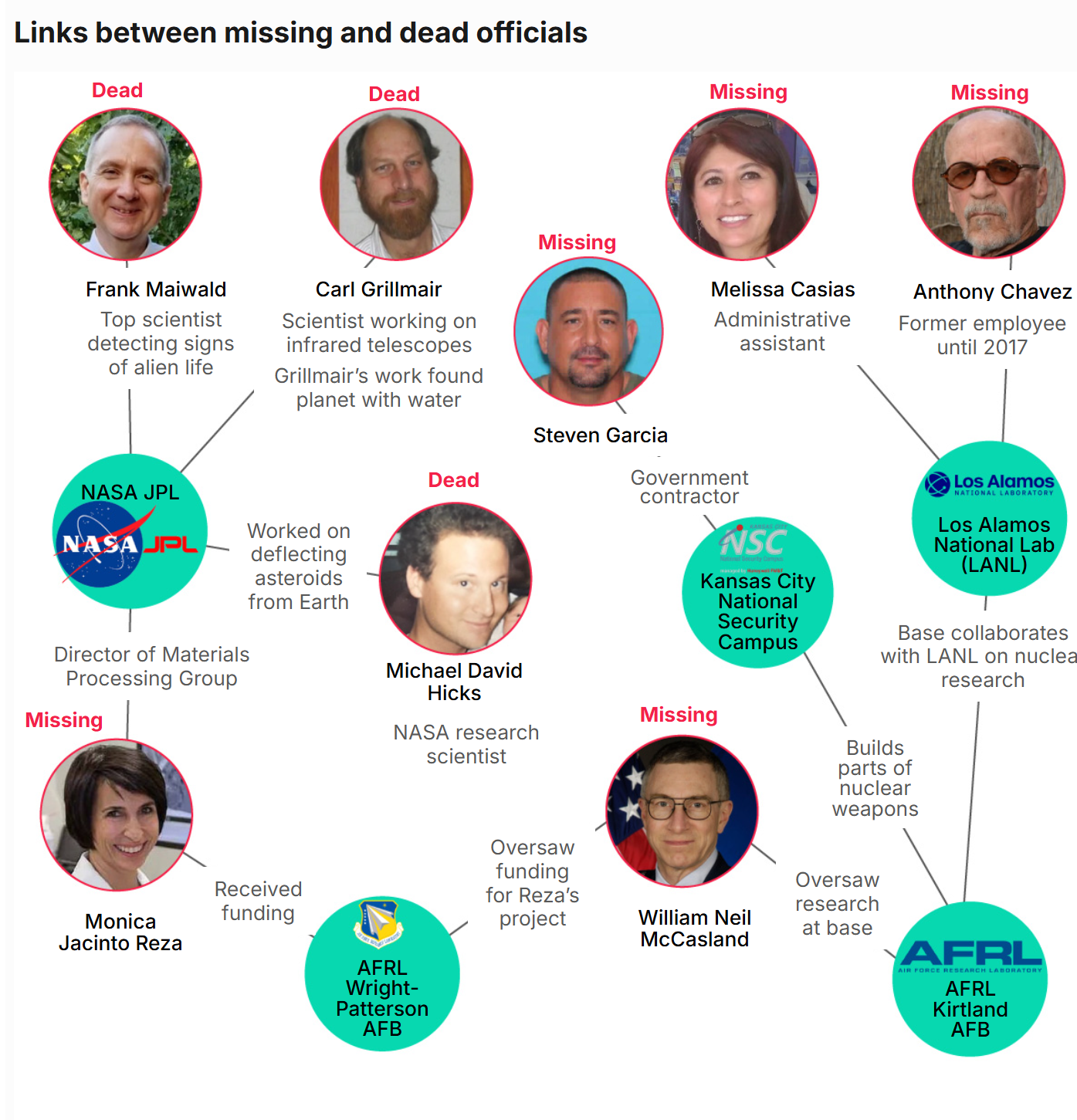
The White House has broken their silence on the disturbing string of deaths and disappearances involving scientists with knowledge of America’s biggest secrets.
During Wednesday’s briefing at the White House, Press Secretary Karoline Leavitt was asked for the first time about the ten people linked to space or nuclear secrets who have mysteriously died or vanished without a trace since 2023.
When asked if the Trump Administration was aware of the incidents and if the US intelligence community was already investigating whether they were connected, Leavitt did not have a definitive answer for reporters.
Among the most prominent voices dissatisfied with the government’s response to the alleged national security threat has been Tennessee Congressman Tim Burchett, who has claimed McCasland was deeply tied to the country’s secret UFO programs.
Burchett previously told the Daily Mail he had been demanding answers regarding the search for the retired general and others, but had received no answers from the US intelligence community – including the so-called ‘alphabet agencies’ such as the FBI.
‘I’ve been constantly ran down different rabbit holes with them, so I don’t have any need to talk to them at all,’ the congressman said in March.
‘The numbers seem very high in these certain areas of research. I think we’d better be paying attention, and I don’t think we should trust our government.’
For decades, we’ve been looking to the skies for any sign of aliens – but it turns out we may have been missing attempts at contact.
A new study has cast doubt on our radio signal detection methods, arguing that ‘space weather’ could be distorting incoming transmissions.
Until now, most experiments have focused on identifying spikes in radio frequency – signals unlikely to be produced by any other natural processes in space.
But experts have highlighted an overlooked complication.
Even if an extraterrestrial transmitter produces a perfectly narrow radio signal, it may not remain narrow by the time it leaves its home star’s atmosphere.
This distortion, which happens near the point of origin, can ‘smear’ the signal’s frequency, meaning it can be missed by our detectors that are primed to search for more focused radio waves.
‘Searches are often optimized for extremely narrow signals,’ Dr Vishal Gajjar, astronomer at the SETI Institute and lead author of the paper, said.
‘If a signal gets broadened by its own star’s environment, it can slip below our detection thresholds, even if it’s there, potentially helping explain some of the radio silence we’ve seen in technosignature searches.’
The interstellar object traveling through our solar system has just made its most startling move yet, appearing to reverse thrust as it disappeared behind our sun.
It’s the latest in a growing list of puzzling clues that some scientists have claimed prove that the object dubbed 3I/ATLAS is not just an ordinary comet from a distant solar system.
Harvard physicist Avi Loeb has been among the leading voices maintaining that there is enough evidence to say 3I/ATLAS has shown signs of being guided by an unknown intelligence.
The next clue could emerge on October 29, when the object is projected to reach its closest point to the sun.
Loeb told the Daily Mail that if 3I/ATLAS comes out of this blind spot in a completely different place than gravity was taking it, it would be a clear sign the object was artificial and likely powered by some kind of engine.
Most astronomers have been reluctant to consider the possibility of an extraterrestrial origin, noting that the space rock has shown the classic signs of being a comet, including having a tail and a coma, a large cloud of gas and dust surrounding it.
Previous studies throughout the summer have concluded that 3I/ATLAS’s strange chemical makeup, rich in carbon dioxide gas, is merely a result of forming in a solar system completely foreign to our own.
However, Loeb contends that those in the scientific community who have dismissed the more extraordinary possibilities are more concerned with being right and avoiding criticism than alerting the public to a potentially world-changing event.
‘Here we are talking about a potential for something that could affect humanity in the future in a dramatic way, and so you shouldn’t apply the same approach of being as conservative as possible,’ Loeb explained.
Transient star-like objects of unknown origin have been identified in the first Palomar Observatory Sky Survey (POSS-I) conducted prior to the first artificial satellite. We tested speculative hypotheses that some transients are related to nuclear weapons testing or unidentified anomalous phenomena (UAP) reports. A dataset comprising daily data (11/19/49—4/28/57) regarding identified transients, nuclear testing, and UAP reports was created (n = 2,718 days). Results revealed significant (p = .008) associations between nuclear testing and observed transients, with transients 45% more likely on dates within + /- 1 day of nuclear testing. For days on which at least one transient was identified, significant associations were noted between total number of transients and total number of independent UAP reports per date (p = 0.015). For every additional UAP reported on a given date, there was an 8.5% increase in number of transients identified. Small but significant (p = .008) associations between nuclear testing and number of UAP reports were also noted. Findings suggest associations beyond chance between occurrence of transients and both nuclear testing and UAP reports. These findings may help elucidate the nature of POSS-I transients and strengthen empirical support for the UAP phenomenon.
Evidence of non-human intelligence activity near US nuclear sites gains scientific validation
A groundbreaking study has just been published, providing verified evidence that something or someone was observing our nuclear sites from space long before the first human satellites were ever launched into orbit.
Dr Beatriz Villarroel from the Nordic Institute for Theoretical Physics in Sweden revealed a clear connection between nuclear tests between 1949 and 1957 and an increase in the number of mysterious bright spots called ‘transients’ appearing in the sky.
These transients are not believed to be a natural phenomenon, with Villarroel saying they showed signs of being highly reflective, like a mirror, and even spinning like a flying saucer.
The publication of these findings was a major milestone, as most papers discussing the existence of unidentified anomalous phenomena (UAPs) are rejected by the scientific community.
Having the work successfully peer-reviewed means other scientists have looked over the data and could not find anything to dismiss the team’s findings as just another unproven story about UFOs.
A respected congressman has claimed that advanced alien beings could be hiding out in ‘five or six’ underwater UFO bases right off the US coast.
Tennessee congressman Tim Burchett, a member of the House Oversight Committee overseeing UFO reports, drew massive attention on social media after saying that he believed there were alien ‘entities’ currently living in deep-water areas on Earth.
The September 17 clip posted on X has already been viewed more than 1.9 million times.
During the sidewalk interview with a UFO researcher and documentary filmmaker who goes by the pseudonym Red Panda Koala, Burchett suggested that advanced alien beings or civilizations may have been hiding in Earth’s oceans for generations.
He added that there have been frequent sightings of unidentified craft around five or six specific deep-sea areas, which he found significant given how little is known about the ocean compared to the moon’s surface.
Why do you think the Vatican keeps its underground libraries closed to the public? Why don’t they digitize the books and share them with the world? We know that they possess ancient knowledge, but why keep it for a select few?
Do you think it’s because they care about us or because they want an advantage?
The mainstream narrative is that they want to preserve the books because they are old, and are now slowly digitizing and publishing them online. But in reality, there are millions of books, transcripts, manuscripts, etc., and they have published only a few thousand. How can we know they are not being selective?
This is a Deep Rabbit Hole Thread (1/10)🧵
They say, ‘Knowledge is power,’ but also, ‘Ignorance is bliss.’ Do you really think that the masses are not ready for the truth? And do you really believe that only the select elite is able to handle the knowledge?
They renamed the library from the ‘Vatican Secret Archives’ to the ‘Vatican Apostolic Library,’ and the ‘Vatican Secret Archives’ to the ‘Vatican Apostolic Archives,’ to stop drawing attention to their secret! (2/10)🧵



 American Buddhist Net