The is a video clip of former Israeli President Reuven Rivlin, in a recent interview, expressing alarm over the IDF’s evolving leadership, describing younger officers as products of Netanyahu-era settler culture with a “messianic mission” to wield the military for biblical redemption, unlike predecessors shaped by Rabin and Peres.
Rabbi Yosef Mizrachi lectures on Kabbalistic/Zoharic prophecies about end-times events. He often discusses themes like nations (including America) facing divine judgment or humbling for historical treatment of Jews, the role of exile/redemption, and messianic-era shifts drawn from Zohar passages (e.g., on nations “squaring accounts” or bowing in recognition).
The Zohar (Hebrew: זֹהַר, “Splendor” or “Radiance”) is the central and most influential work of Kabbalistic literature, forming the cornerstone of Jewish mysticism. It is presented as a mystical commentary on the Torah, exploring the nature of God, the structure of the universe, the soul, redemption, and the relationship between the divine and the human.
Traditionally, the Zohar is attributed to the 2nd-century sage Rabbi Shimon bar Yochai, who is depicted as the central figure teaching his disciples in the text. According to tradition, he composed parts of it while hiding in a cave from Roman persecution.
However, modern scholarly consensus holds that the Zohar was primarily written in 13th-century Spain by Moses de León, a Jewish mystic. While de León claimed to be revealing an ancient text, most scholars believe he authored it himself between 1280 and 1286, possibly incorporating earlier mystical traditions. The Zohar is written mostly in a unique, artificial form of Aramaic, which supports the view of its medieval origin.
Despite debates over its authorship, the Zohar gained immense authority in Jewish thought by the 15th and 16th centuries and profoundly influenced Jewish spirituality, ethics, and ritual. It consists of multiple sections, including the main Zohar, Tiqqunei ha-Zohar, and Zohar Chadash.
Rabbi Yosef Mizrachi is a Haredi rabbi and public speaker born in 1968 in Israel. He served in the Israel Defense Forces (IDF) before moving to New York City in his 20s, where he worked in the financial sector. In 1997, he transitioned to full-time Torah study and teaching at the Ohr Yisrael Yeshiva in Monsey, New York, and began producing kiruv (outreach) videos online in 2004, revolutionizing Orthodox Jewish outreach through social media.
Mizrachi is the founder of the non-profit organization Divine Information, established in 1995, which aims to connect Jews to Judaism and Torah through lectures, videos, and educational resources. His website, DivineInformation.com, hosts over 700 lectures and has a global following across more than 50 countries, primarily in the U.S., Israel, Canada, and England. He has delivered over 8,000 lectures worldwide and maintains strong presences on Facebook (over 100,000 followers), YouTube, and Instagram.
In recent statements, Foreign Minister Baiba Braže has firmly rejected EU-mandated migrant redistribution, declaring Latvia “will not accept new migrants” and emphasizing that the country is already bearing a disproportionate burden in securing the EU’s external borders. She highlighted that over 12,000 attempts at illegal border crossings were prevented in recent years, primarily along the Latvian–Belarusian border, and stressed that Latvia would not pay for or host relocated migrants.
These positions reflect broader anxieties in Latvian society, amplified by extreme rhetoric from some Muslim community leaders. In 2015, Ahmed Robert Klimovičs, a spokesperson for the Islamic Cultural Centre in Riga, claimed that Latvia would become an Islamic state within 50 years, citing demographic trends and the high fertility rate among Muslim families. His comments—though later clarified as advocating democratic change rather than violence—sparked national debate and concern.
Meanwhile, Latvian security officials have reported that the country’s Muslim community has been affected by radicalization trends, with several individuals expressing intentions to join extremist groups like the Islamic State. The Latvian Security Police has also noted that young Latvians are being recruited by international criminal networks to smuggle migrants into the EU, further fueling fears about security and national integrity.
I used to be a Protestant and think all I needed was my Bible.
But… then I started asking the question no one wanted to answer: Who actually has the authority to interpret Scripture?
That question came from my study of the theological heresy of dispensationalism.
What I found shocked me. I learned, it isn’t ancient Christianity. It didn’t come from the Apostles. It didn’t come from the Church Fathers. It began in the 1800s with John Nelson Darby. A brand new theological system; a heresy which has created confusion among Christian’s.
It divided Israel and the Church into two separate peoples of God. It created two covenants. It pushed fulfillment into the future. It taught that prophecy still depends on a geopolitical nation-state called “Israel” which was founded by atheists in 1948.
I looked deeper and asked…what does that ultimately lead to? I was shocked to discover their belief of a rebuilt temple in Jerusalem. The one the Lord predicted would be destroyed in Matthew and it was in 70AD.
“Jesus left the temple area and was going away, when his disciples approached him to point out the temple buildings. He said to them in reply, ‘You see all these things, do you not? Amen, I say to you, there will not be left here a stone upon another stone that will not be thrown down.'” Matthew 24:1-2
This all happened. Jesus predicted it and it was fulfilled.
In 70 AD the Temple was destroyed. The altar was gone. The Levitical priesthood stopped functioning. The animal sacrifices ended.
That is not a minor detail.
The Mosaic covenant was inseparable from Temple sacrifice. Without the Temple, the sacrificial system of the Old Covenant could not continue.
In its place, rabbinic Judaism emerged. No longer centered on Temple sacrifice, but on Torah study and synagogue life.
The sacrificial order did not continue. It was finished.
“Trash / garbage, get out of Japan! Scram / get lost already!”
This anime reflects rising nationalist sentiments in Japan, where public discourse on immigration intensifies due to demographic pressures like an aging population (projected to shrink by 30% by 2070 per UN data), yet polls (e.g., 2023 Pew Research) show over 70% of Japanese favoring cultural homogeneity over increased inflows.
UPDATE: I lived in Japan for over four years. Generally speaking, educated Japanese I spoke with were well-aware of Jewish covert behavior and wary of it. Japanese so-called antisemitism is actually the awareness of their tribe of the danger of the Jewish tribe. The views expressed in the short video above strike me as reflecting what I heard personally from intelligent, wealthy and well-educated Japanese, including respect for warriors outside of Japan. I myself have experienced horrific violence at the hands of Jewish Supremists. I had a responsible job while in Japan. And that meant my past had been thoroughly investigated by Japanese IC. So, some of those same Japanese I spoke with knew what I had been through and were willing to be open with me. Social and political interpersonal boundaries of speech in USA and the West are far more restricted than in Japan, China and other places I have lived in East Asia. Notice, Japan is not falling for the benefits of replacement invasion. This is not new. They have seen the problem and have been discussing it among themselves for decades. The rise of Sanae Takaichi and Japan’s ‘sudden’ swing to the right is happening because Japan’s elite is making it happen. This position also reflects popular sentiments, but the elite are making it happen. Just what we need in the West; if only our elite were not infiltrated by a large tribe of Jewish Supremists and their disgusting toadies. ABN
When it comes to wealth, extravagance and notoriety, few compare to Thailand‘s playboy king, Maha Vajiralongkorn.
Known formally as Rama X, the 73-year-old monarch is the wealthiest ruler in the world, with an estimated net worth of £52billion.
He has lived an extraordinarily wild, and at times outright bizarre, life that would put even history’s most debauched monarchs to shame.
But in recent months, the flamboyant royal has all but retreated from public life.
Rarely seen since the October death of his mother Sirikit, the once-spirited monarch appears to still be in mourning.
In November, just a few weeks after his mother passed away, a glum-looking Vajiralongkorn became the first ever Thai monarch to visit China as part of a state visit.
And on February 1, the king was seen performing religious rites to commemorate the 100th day since his mother’s passing. Photos of the event showed uniformed soldiers obediently bowing down to the dour-looking king and queen in a gaudy room that held a large portrait of the late Sirikit.
Good talk and I agree. At one point Rubio warns Westerners not to be daunted by ‘…fear of climate change, fear of war, fear of technology’. I would respectfully add to this list ‘…fear of Jewish Supremacy’, which is one of the most corrosive and damaging intellectual, emotional and societal forces in the West today, and over the past 150 years. From the covert maiming and impoverishing of their perceived ‘enemies’ (anyone who disagrees with them) to their vast system of infiltration throughout the West, Jewish Supremists have been a persistent and ever-present bane of Western civilization. There is no harmful (to the West) policy or war they do not support. And no beneficial policy they do not oppose. Ofc, Rubio cannot say this, nor can any other hapless toady in an elite political position, but I do not believe that many of them are not aware of how bad it is and why, probably including Rubio. ABN
The video is a 5-minute dramatized excerpt from Adolf Hitler’s Mein Kampf (Volume 1, Chapter 2), narrating his claimed “awakening” to antisemitism via observations of Jewish involvement in Vienna’s prostitution and human trafficking around 1908–1913.
__________
I believe this is the first time I have ever posted anything about Hitler. Like most, I am allergic to his name, even though I deeply understand and have experienced the horror of Jewish Supremacism. I am posting this speech because it rings true today. Ofc, today there are many parasites feasting on the West but history shows JS is behind most of them. I believe the best, if not the only, way out of this terrible reality is for Jewish Supremists themselves to repent and reform. That seems impossible today, but noting is impossible, so maybe it will happen. The best revenge is not success but knowing your abusers have repented, reformed and apologized deeply and from the heart and will never do it again. This is all I want, what we all should want. ABN
I agree with this. Jewish Supremacy is very real and profoundly destructive. It is an arrogant, self-declared enemy of both American Whites and American Blacks, and thus a natural cause for both groups of to unite against it. ABN
for this and all images on this site, click the image for a larger and more legible version
__________
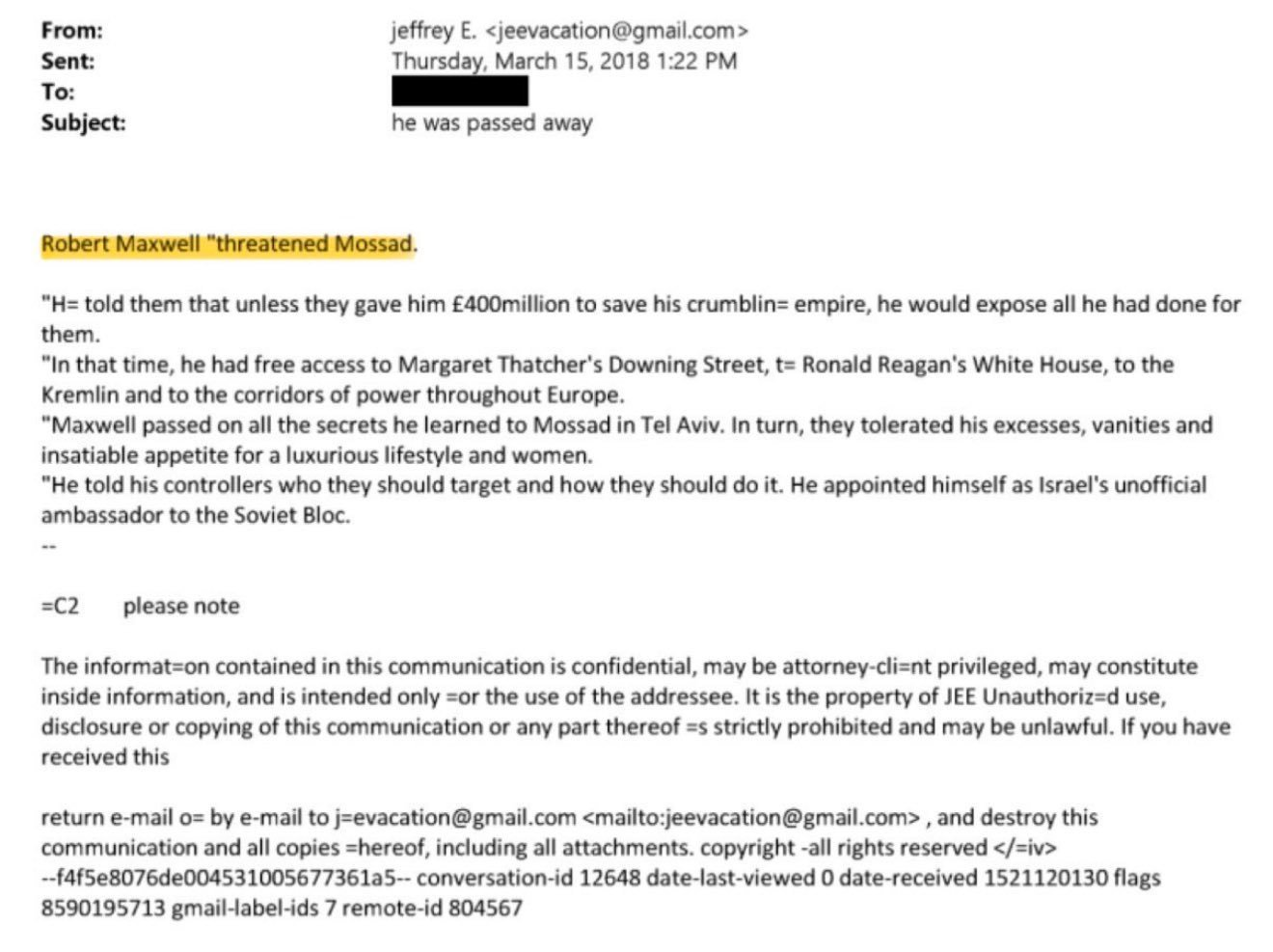
Robert Maxwell was Ghislaine Maxwell’s father. Epstein saying ‘he was passed away’ in the subject heading must mean Robert Maxwell was murdered for threatening Mossad, a fate which may have befallen Epstein himself. The recent release of Epstein files amply reveals the violence and depravity of the group of Jewish Supremists Epstein consorted with. USA Congress publicly and shamelessly bows and scrapes before Netanyahu whenever he visits. Christian Zionists (the majority of whom are victims of JS infiltration and mind-control) falsely believe the Bible says Jews are superior to them and must be worshipped. ‘Judeo-Christian values’ is and has always been a JS mind-control psyop. The Catholic Church has for centuries been infiltrated by JS. It is very plausible that Christianity itself was created by Jewish (and Roman Flavian) Supremists to control the Roman Empire. ABN
The Flavian Dynasty ruled the Roman Empire from 69 to 96 CE, marking the second imperial dynasty after the Julio-Claudians. It consisted of three emperors: Vespasian, who founded the dynasty; his son Titus; and his younger son Domitian. The dynasty rose to power during the Year of the Four Emperors (69 CE), a period of civil war following Nero’s death. After Galba and Otho died, Vitellius became emperor, but he was defeated by Vespasian’s forces at the Second Battle of Bedriacum. Vespasian entered Rome on December 20, 69 CE, and was declared emperor by the Senate the next day.
Flavius Josephus was a first-century Jewish historian and military leader born as Yosef ben Mattityahu in Jerusalem around AD 37. He became a prominent figure in Roman history after surrendering to the Roman forces during the First Jewish–Roman War, particularly after the siege of Yodfat in AD 67. His claim of a divine prophecy that Vespasian would become emperor—later fulfilled when Vespasian rose to power in AD 69—secured his release and marked his transition from a Jewish commander to a Roman ally. In AD 71, following Vespasian’s ascension, Josephus was granted Roman citizenship and adopted the Flavian family name, becoming Flavius Josephus—a common practice for freedmen and new citizens under Roman patronage.
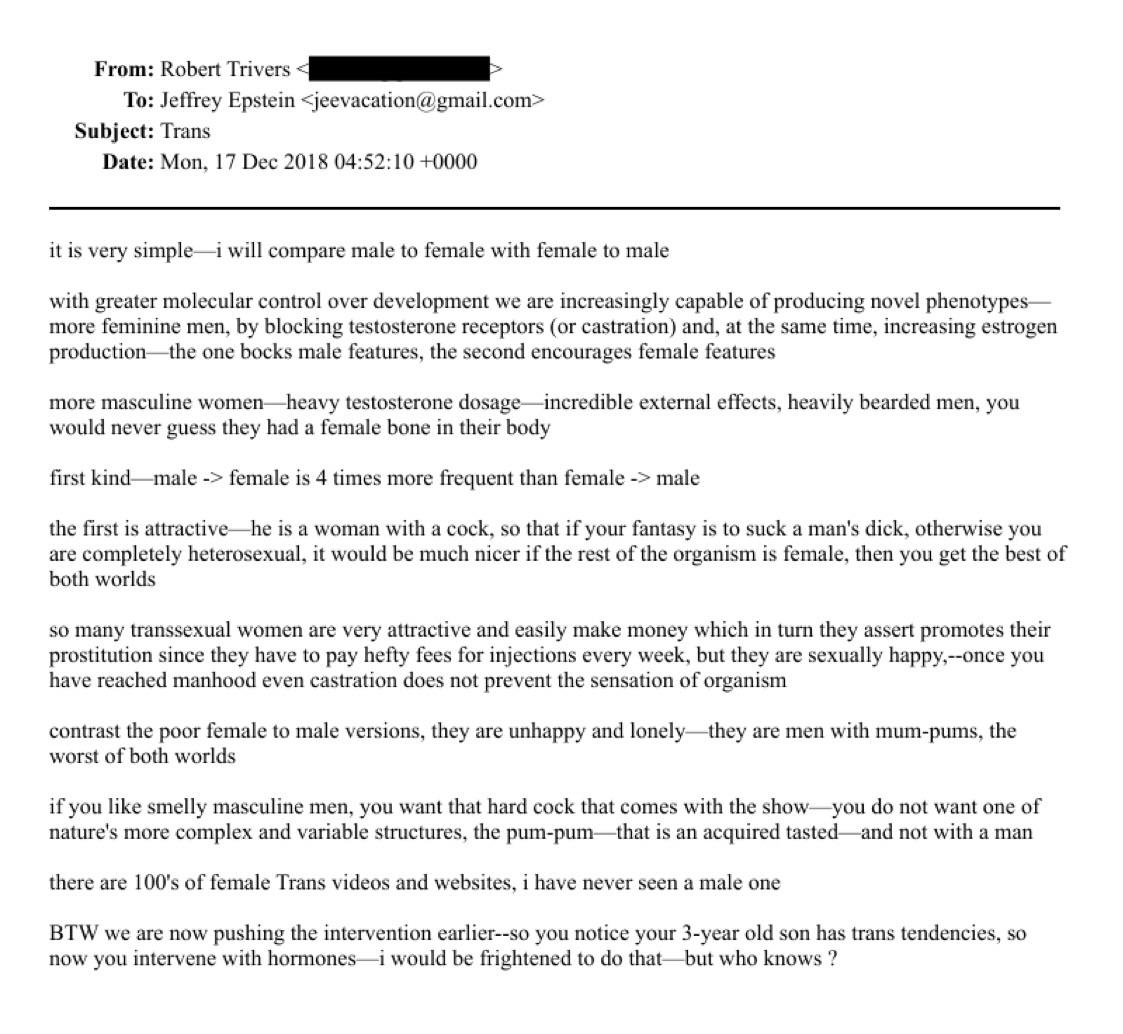
The letter below (click image for larger version):
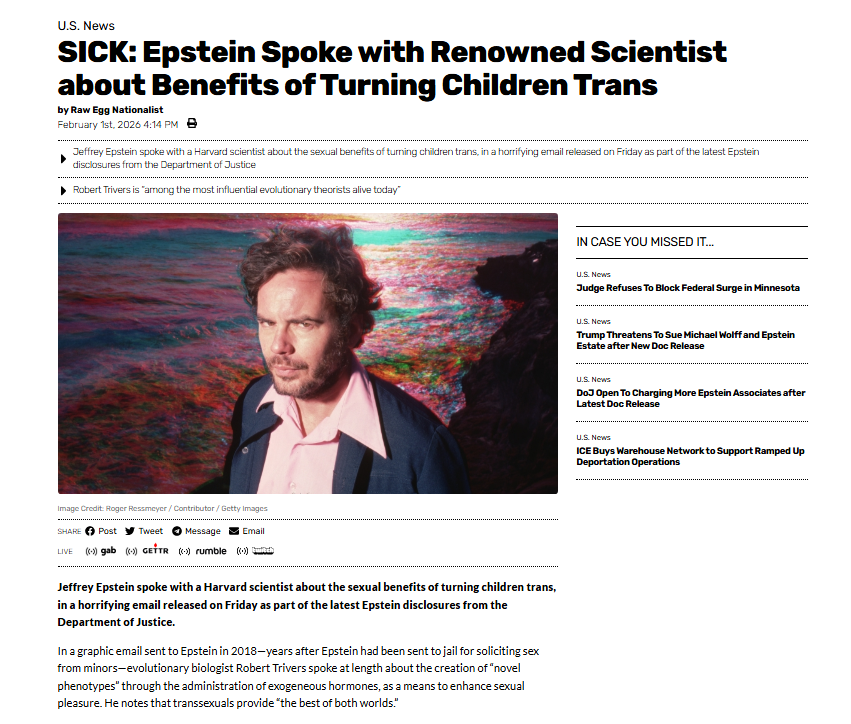
Robert Trivers was born in Washington DC, son of Howard Trivers, a Jewish-American academic and US State Department diplomat who played a key role in the denazification of post-war Germany
Trivers said of Epstein’s assaults on underage girls “by the time they’re 14 or 15 they’re like grown women were 60 years ago, so I don’t see the acts as so heinous.” Reuters reported that Trivers said Epstein “is a person of integrity who should be given credit for serving time in prison and for settling civil lawsuits brought by women who said they were abused”
Trivers, has been open about his diagnosis of bipolar disorder, which was first diagnosed when he had a manic episode at Harvard, requiring hospitalisation for several months and treatment with first generation antipsychotics. During his recovery he developed an interest in psychology and social biology
__________
Epstein’s main crime was the blackmail and bribery operation he ran, with little doubt, for a gang of Jewish Supremists. This is not to downplay the traumas suffered by Epstein’s victims but to emphasize that even in their abject degradation they were but tools, toys for Epstein’s larger design — total control of USA and the West. Epstein alone is not responsible for having turned USA into a captured nation, but he was a significant participant in that effort and should stand as a symbol for what was done and still is being done and by whom to USA and the West. ABN



 American Buddhist Net