
A Realistic View of Slavery & Slave Trading

White people commonly respond to demands for reparations for slavery and slave trading by pointing out that it was whites who abolished these things.[1] I don’t know whether they notice that this doesn’t get them the credit from their antagonists that they seem to expect; they certainly don’t appear to see why this is.

The reason they get no credit is that black people don’t see the abolition of slavery and slave trading as quite the boon for humanity that white people do. If Africans had wanted slavery and slave trading to be abolished, they could have abolished them themselves very easily, just by ceasing to indulge in them. Instead, they met white attempts at abolition with fierce resistance. This was quite natural. Slavery was their way. As for slave trading, it gave them a good profit, and they saw nothing wrong with it.

No, the reason black people go on about slavery and slave trading is not that they deplore them but that they see that white people deplore them, who might therefore be made to feel so guilty about their forefathers’ involvement as to give black people large amounts of money in restitution.

Indeed, if we set the white record on slavery and slave trading against the black record, it stands out as a shining example. The transatlantic slave trade lasted only a fraction of the time that Africans spent selling each other to Arabs, and the number of slaves bought by whites — perhaps ten or 12 million — was a fraction of the number bought by Arabs. As for the length of time Africans spent selling each other to other Africans, and the numbers involved, these were much greater still. The intra-African slave trade still predominated in the nineteenth century, when a European explorer reported that slave-hunting in Africa went on far more to supply the domestic than the foreign market.[2]

link

This is a strongly written piece. I am putting it up because it’s probably largely true and because white people get so much criticism, we need to hear other sides. I could say this about many of the essays I post. ABN
Rabbis explain what’s going on in France

source

I am fairly new to the idea that Christianity was founded by Jews as a ruse to trick the Roman Empire. Also new to the idea that Judaism is largely founded on the deceit of Jacob, who tricked his brother Esau out of his birthright as firstborn son. These two ideas seem to be at the root of a lot of widely-recognized difficult Jewish behavior—often having ulterior motives, chutzpah based on that, ethnic nepotism and great skill in crime. The Old Testament explains all you need to know about Jewish vengeance. Note that I am describing bad Jewish behavior, with which I have considerable experience, not all Jewish behavior. I am quite sure the sociopathic Arenda system in Eastern Europe is a fundamental part of the long history of Jewish-Christian conflict. The system was set up by so-called ‘Polish nobles’ but run mostly by Jews who held and enforced leases. From the Jewish point of view, this system was a ‘Golden Period’ of Jewish history, when Jews acquired great wealth and saw a population increase unprecedented in human history; clear indications of good diet and leisure. From the serfs’ point of view, these same markers were clear indications of who was reaping the benefits of their slavery. (Jewish History, Jewish Religion: The Weight of Three Thousand Years by Israel Shahak has some information on the Arenda system. Most Jewish authors completely gloss over it, another trick, imo.) Our POS elitists, whoever they happen to be, have created the dystopia of diversity the West has become. And also, they do all they can to prevent our understanding what is happening, a clear throwback to the age of serfdom when a wrong word could get you killed. As we continue our descent into raw tribalism, I present these ideas and the video above for readers’ consideration. Much more on this topic can be found in the work of Laurent Guyénot, who has written extensively on these subjects. ABN

SAILER SPEAKS: “Did Black Lives Matter Get All Those Black Lives Murdered? Yes. Yes, It Did.”

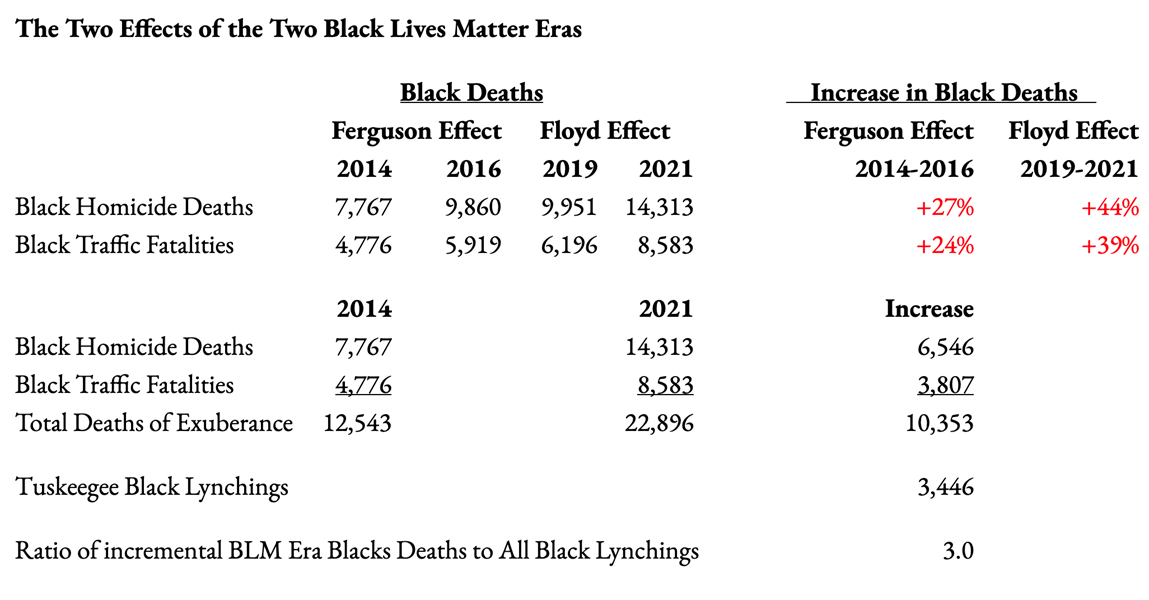
The Black Lives Matter movement, during its two eras of triumph (after Ferguson and after George Floyd), helped get huge numbers of extra blacks killed in two different ways: homicides and motor vehicle accidents.

(For the record, about 1,297 whites were also lynched in the same period).

During the Ferguson Effect, black homicide deaths increased 27% from 2014 to 2016 and black motor vehicle deaths were up 24%. During the Floyd Effect, black homicide victimizations surged 44% from 2019 to 2021 and car crash deaths were up 39%.

Overall, black Deaths of Exuberance were more than 10,000 lives more in 2021 than in 2014. Just in 2021 alone, the 10,353 incremental black homicide and auto accident deaths were three times than the vastly publicized 3,446 lynching deaths of all blacks in all American history.

But virtually nobody knows this. The media won’t publish the two graphs together. It simply doesn’t fit with our era’s naïve worship of Diversity.

link

Complex Systems Won’t Survive the Competence Crisis

…The core issue is that changing political mores have established the systematic promotion of the unqualified and sidelining of the competent. This has continually weakened our society’s ability to manage modern systems. At its inception, it represented a break from the trend of the 1920s to the 1960s, when the direct meritocratic evaluation of competence became the norm across vast swaths of American society. 

In the first decades of the twentieth century, the idea that individuals should be systematically evaluated and selected based on their ability rather than wealth, class, or political connections, led to significant changes in selection techniques at all levels of American society. The Scholastic Aptitude Test (SAT) revolutionized college admissions by allowing elite universities to find and recruit talented students from beyond the boarding schools of New England. Following the adoption of the SAT, aptitude tests such as Wonderlic (1936), Graduate Record Examination (1936), Army General Classification Test (1941), and Law School Admission Test (1948) swept the United States. Spurred on by the demands of two world wars, this system of institutional management electrified the Tennessee Valley, created the first atom bomb, invented the transistor, and put a man on the moon. 

By the 1960s, the systematic selection for competence came into direct conflict with the political imperatives of the civil rights movement. During the period from 1961 to 1972, a series of Supreme Court rulings, executive orders, and laws—most critically, the Civil Rights Act of 1964—put meritocracy and the new political imperative of protected-group diversity on a collision course. Administrative law judges have accepted statistically observable disparities in outcomes between groups as prima facie evidence of illegal discrimination. The result has been clear: any time meritocracy and diversity come into direct conflict, diversity must take priority. 

link

A society not based on truthful standards of excellence will crash. Almost all individuals accept their own limitations. Why don’t we just face these facts and also accept that some groups can be defined as better at some stuff than others and use those people and those groups where they can be most effective? ABN

The original meaning of skin color — Peter Frost

Skin color is perceived through the lens of a mental algorithm that initially arose for gender recognition. People can tell whether a face is male or female even if the image is blurred and provides no other useful information than its hue and luminosity.

Today, skin color has a strong ethnic meaning. It differs mostly between people of different geographic origins, at least in modern Western societies. But that has not always been the case. In earlier societies, where people were overwhelmingly of local origin, skin color had a gendered meaning: it differed primarily between men and women.

Women are universally the fair sex (Frost and van den Berghe 1986). They are paler than men, who conversely are ruddier and browner. That sex difference was noticed in earlier times. Wherever the visual arts developed—ancient Egypt, the Greco-Roman world, early South and East Asia, Mesoamerica—female figures were depicted with a lighter hue and male figures with a darker one.

link

Why FIML is a little bit hard to do (at first)

FIML is hard to do at first because it violates, or seems to violate, a basic language instinct to not interrupt another speaker or question them too closely.

FIML gets around this instinct by having partners make a prior agreement to interrupt (or break into) a conversation and question each other closely, specifically to ask their partner to divulge the contents of their working memory and then (often) divulge their own.

FIML establishes a new human skill. The ability to do the above quickly and easily, and without undue emotion.

It will feel a bit weird at first to learn and exercise this skill, but after a few dozens iterations it will become fairly easy and eventually become second nature.

I believe FIML has never been discovered and this region of interpersonal language and communication has never been properly explored due to the strong but superficial instinct against it mentioned above. I would also speculate that this instinct is a significant contributing factor to hierarchical social structures and the psychologies that derive from them. In this respect, the psychologies of virtually all people everywhere are deeply steeped in the mores, taboos, and sensibilities that attend to and revolve around the instinct to hold your tongue when you most need to use it.

As post-modern humans on the verge of an earth-shaking AI singularity, it is past time to overcome this part of our primitive nature. ABN

Scandinavians are the earliest Europeans

Scientists have sequenced a 37,000-year-old genome. The results show that present-day Scandinavians are the closest living relatives to the first people in Europe.

The study, which was recently published in Science, sheds entirely new light on who we are as Europeans.

“From a genetic point of view he’s an European,” says Professor Eske Willerslev, Director of the Centre for GeoGenetics at the University of Copenhagen, who was involved in the new study, and adds:

“Actually, he is closer to Danes, Swedes, Finns and Russians than to Frenchmen, Spaniards and Germans”.

Split happened within a 8.000 year gap

The new results reveal that the man is the oldest that we know of so far to genetically represent a separate line from the forebears of present-day Asians. This is decisive when it comes to dating one of the most important events in history.

“We can now date the separation time between Asians and Europeans,” says Professor Rasmus Nielsen from the University of Copenhagen and the University of California, Berkeley, who was also involved in the study.

He points out that the Kostenki genome sets a line 37,000 years ago. Here the lines must have split, while the 45,000-year-old genome from the recently discovered Ust’ Ishim in Siberia sets the limit in the other direction.

This gives the answer to one of the biggest questions in the history of mankind; scientists now know that it is within the 8000 year gap that Europeans and Asians went their separate ways. 

link

Early peopling of Europe – Eske Willerslev comments on the latest DNA research

Direct evidence of the use of multiple drugs in Bronze Age Menorca (Western Mediterranean) from human hair analysis

Abstract

Human hair dated to Late Prehistory is exceedingly rare in the Western Mediterranean. Archaeological excavations in the Bronze Age burial and cult cave of Es Càrritx, in Menorca (Balearic Islands) provided some human hair strands involved in a singular funerary rite. This finding offered the opportunity to explore the possible use of drug plants by Late Bronze Age people. Here we show the results of the chemical analyses of a sample of such hair using Ultra-High-Performance Liquid Chromatography-High Resolution Mass Spectrometry (UHPLC-HRMS). The alkaloids ephedrine, atropine and scopolamine were detected, and their concentrations estimated. These results confirm the use of different alkaloid-bearing plants by local communities of this Western Mediterranean island by the beginning of the first millennium cal BCE.

link

Touting ‘Ethnic Fusion,’ China’s New Top Official for Minority Affairs Envisions a Country Free of Cultural Difference

Last October, China’s top officials convened the once-every-five-year congress of the Chinese Communist Party (CCP) to determine the leadership and political trajectory of the country for the next half decade. Xi Jinping secured a precedent-breaking third term as paramount leader of the Party, confirming expectations that the congress would cement his authority and concentrate power in a single person to a degree not seen since the Mao era. Several high-profile promotions and demotions signaled that officials’ political survival depends on personal loyalty to Xi, and that aggressive implementation of his policies is key to career advancement. Among the officials garnering Xi’s support is Pan Yue, who was elected as a full member of the Central Committee of the CCP.

Since last June, Pan has been head of the State Council’s Ethnic Affairs Commission, which is responsible for policy concerning China’s “minority nationalities,” the 55 officially recognized ethnic groups who collectively represent around 8.9 percent of the total population. For decades, the CCP’s ethnic policies have oscillated between multiculturalism—recognizing and even celebrating distinct ethnic identities—and assimilationism—denying and destroying them—with significant variation at the local level. The Chinese term “minzu” (民族) captures this policy range: it refers both to individual “nationalities” or ethnic groups, like Han, Uyghurs, and Tibetans, and to the overarching “Chinese nation” (zhonghua minzu, 中华民族), which comprises all 56 (55 minorities plus the Han majority) groups.

Pan’s election to the Central Committee suggests that the Xi administration’s hard turn toward assimilationism will likely continue and perhaps intensify. Pan is the second Han official in a row to head the Ethnic Affairs Commission, which for nearly 70 years had been led by a Party member from a non-Han nationality. Since the beginning of Xi’s second term in 2017, measures related to “managing” ethnic minorities have run the gamut from destruction of what officials deem “foreign” architectural elements such as mosque domes and removal of Arabic signage on restaurant awnings and storefronts to the imposition of Mandarin as the sole language of instruction for certain subjects in some schools. Repression has been most severe in Tibet and Xinjiang, where the local populations have been subjected to extreme restrictions on movement, constant surveillance, mass internment, and as has been reported of Uyghur women, forced sterilization.

link

Jewish Corruption in Ukraine

With Russia now slowly escalating its ‘special military operation’ against Ukraine on the eve of its first anniversary, I find myself drawn once again to the complex but stark phenomenon of extreme Jewish corruption in the latter nation. While it’s become commonplace to note Volodymyr Zelensky’s Jewishness, and perhaps also that of Volodymyr Groysman, the first Prime Minister to serve under Zelensky, I have yet to read a detailed discussion of the major Jewish players in the ongoing saga of Ukrainian oligarchy and its political affiliates. If anything, the present conflict is a huge distraction from the fact that, for decades, the biggest threat to Ukraine hasn’t been Russia, but financiers and speculators operating with impunity within Ukraine’s borders to exploit ethnic Ukrainians and plunder their resources.

link

1.2-million-year-old obsidian axe factory found in Ethiopia

Forged in magma and capable of producing the sharpest blades on Earth, obsidian is without a doubt one of the most badass materials ever imagined. The jet-black volcanic glass is also extremely delicate and dangerous to work with, and was not mastered by humans until the latter part of the Stone Age… or so we thought.

Reporting on the latest findings from the Melka Kunture archaeological site in Ethiopia, a team of researchers has described the discovery of an obsidian handaxe workshop within a layer of sediment dated to 1.2 million years ago. This represents a staggeringly early example of obsidian shaping, and, according to the study authors, is the only handaxe factory ever dated to the Early Pleistocene.

“[Archaeological] sites described as ‘knapping workshops’ are only recorded in the second half of the Middle Pleistocene and only in Europe so far,” write the researchers. Located predominantly in France and the UK, the most notable Stone Age axe workshops were all associated with the creation of flint blades.

“Generally speaking, obsidian is extensively used only from the Middle Stone Age onwards,” write the study authors.

However, during the course of their excavations, the team came across an ancient layer of sediment containing a cache of 578 stone tools, all but three of which were sculpted from obsidian. “We show through statistical analysis that this was a focused activity, that very standardized handaxes were produced and that this was a stone-tool workshop,” they write.

Describing the axes, the researchers repeatedly marvel that “the morphological standardization is remarkable,” and while they don’t know which species of human crafted the tools, they say that whoever created them diligently applied “secondary retouches” and was highly “focused on the final regularization of the artifacts.”

link

link to study: A surge in obsidian exploitation more than 1.2 million years ago at Simbiro III (Melka Kunture, Upper Awash, Ethiopia)

The bloody death of a liberal dream: After throwing open its borders to 2million migrants, DAVID JONES investigates how Sweden has been left with an underclass of alienated teenagers, a murderous gang culture and gun crime that’s spiraling out of control

On a bitingly cold morning in Stockholm, two days ago, I stood among 200 mourners in a Muslim cemetery, set in a magnificent pine forest.

They had come to bury a 15-year-old Afghan boy who had been shot dead, allegedly by a gangster of the same age.

Yet as his coffin was lowered into the frozen ground, it seemed to me that we were also witnessing the death of Sweden’s great multi-cultural dream.

Brought to this famously hospitable country three years ago, to escape the impending return of the Taliban, it appears that Ali Shafaei is the latest victim of a vicious war being waged largely by child gangsters from Sweden’s migrant sink-estates.

Among Swedish politicians, the precise causes of this internecine conflict may be a matter for debate.

Yet even those on the liberal Left now grudgingly agree that they are rooted in the country’s disastrously failed immigration policy — which in recent years opened Sweden’s borders. Some 2 million immigrants (20 per cent of the entire population), now live in Sweden, often from the most troubled parts of Asia and Africa.

Many of the offspring of these migrants have morphed dangerously into a lost generation who are effectively stateless. Though they were born here, many don’t feel remotely Swedish, yet have no allegiance to their parents’ homelands, either.

link
Continue reading “The bloody death of a liberal dream: After throwing open its borders to 2million migrants, DAVID JONES investigates how Sweden has been left with an underclass of alienated teenagers, a murderous gang culture and gun crime that’s spiraling out of control”