In Poland, government protects citizens and Polish culture. In Sweden, government neglects citizens and invites invaders hostile to Swedish culture. Pathological altruism and psycholinguistic stupidity combined. ABN
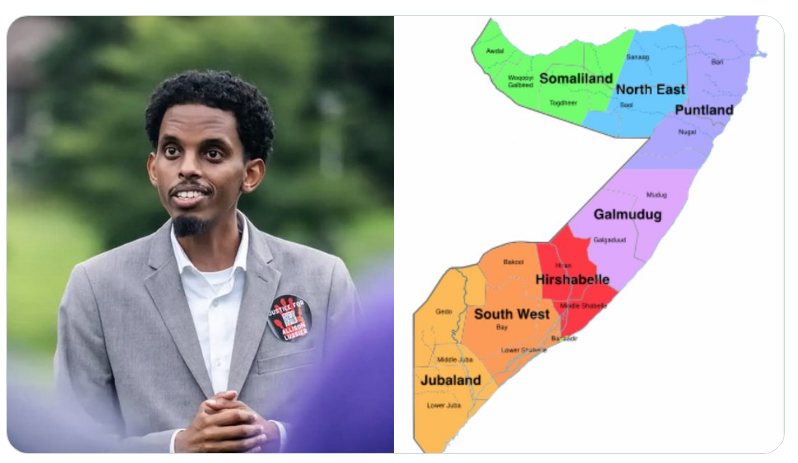
A Somali source in Maine offers this explainer on the clan dynamics unfolding in Maine/U.S. politics:
The Darood clan dominates Somali political representation in Maine but by population, other clans have massive presence but for some reasons the Darood LOVE power. People including figures like Ilhan Omar, Deqa Dhalac, Yusuf Yusuf, Omar Fateh, Safiya Khalid, Abdullahi Ali are from the same sub-clans of Darood (Ogaden and Majeeteen). In Somalia, however, the Darood are just one of the four major clans—alongside Hawiye, Rahanweyn, and Dir—without overall dominance.
Somali immigrants from these other clans, particularly in Minnesota’s large diaspora, have grown resentful of Darood’s rising influence in U.S. politics. For instance, when Nasri Warsame (non-Darood) ran for office in Minneapolis back in 2021, Darood-aligned groups reportedly blocked him and supported an Indian-born woman instead, preferring a non-Somali over someone from a rival clan.
This intra-clan rivalry has led Hawiye, Rahanweyn, and Dir members—including those from Somaliland (which flies its own flag and seeks independence from Somalia)—to back non-Somali candidates. They supported Jewish incumbent Jacob Frey for mayor over a Somali opponent from a different clan, prioritizing clan loyalty over ethnic or religious solidarity. So yeah haha many Somalis voted for the Jew over a Muslim Somali. Go figure
The most powerful clan in USA is Jewish Supremists. Their origin, emotions and clan structure have the same roots as every other clan that immigrates to USA and pursues its own interests to the detriment of others.
Western civilization is different from the entire rest of the world due to the Catholic church deliberately destroying European clans.
From that arose the most creative civilization in world history and a large community of peoples who were able to cooperate by trusting each other. ABN
Basic anthropology — tribal beliefs and behaviors migrate along with the tribes. Not difficult to discuss at all unless your tribe (Europeans) have been mind-controlled into not seeing the painfully obvious, which they have been. I highly respect the young speaker above, as saying what she is saying actually takes courage in Europe today. ABN
Eastern Europeans are deeply aware of what being conquered entails and still have living memories of it.
In today’s Europe and West, we should look up to Eastern Europeans in areas such as cultural preservation, the importance of ethnic cohesion, the importance of expanding ethnic cohesion to include all Whites and anyone else who truly supports the preservation and development of the West.
There hasn’t been a single positive aspect to mass immigration. Zero. None.
All it has brought Europe was cultural decay, impoverishment and insecurity. And if nothing changes, we will soon become a minority in our own homelands.
Jewish ‘morality’ is not Christian morality, nor is it a universal morality which treats all people with ethical compassion. It is a tribal ‘morality’ or code which applies only to Jews. Everyone else is inferior or worse, Amalek. ABN
This response is inevitable. The sooner it happens full-bore, the better. The longer you wait the more violent it will be. These are not far-rightists. They are normal human beings sensing their annihilation and reacting. ABN
In this post I am going to contend that: linguistic ambiguity tends to lead to or produce hierarchical social systems.
By linguistics, in this context, I just mean language and its uses, though expressions, gestures, roles, and so on can also be factors. Of course, many other things–genes, wars, historical precedents, etc.–also produce hierarchical societies, but today we will just deal with language.
Another way of stating the contention above is: humans have adapted to linguistic ambiguity by forming hierarchies. Or human hierarchical societies have evolved as adaptations to linguistic ambiguity. A stronger way of saying that would be human hierarchical societies have evolved as adaptations to linguistic ambiguity and they exploit ambiguity to maintain themselves.
Another way of saying all that might be to say that in hierarchical societies linguistic ambiguity is good for the top people because it maintains the status quo. This happens because if the ambiguity matters in any way, it is almost always the top people who will decide what it means.
I am going to present a microcosmic example of this point. Please notice as you read this example that this kind of ambiguity is very common. Something like this will occur in your life very often, maybe as often as a few times per hour of conversation, maybe more.
This morning I was cutting some (store-bought) potatoes for breakfast. As I was doing that I said to my partner: “The potatoes from our garden are so much better than these store-bought ones.” All I meant was that. I had no further implication in mind.
My partner (my FIML partner) did a FIML query and asked me: “Did you say that to make me feel good about our garden?” I replied: “No, I did not.” After which she said: “Because if you had I would have felt bad because I was very careful when I bought those potatoes so I would have felt that you were criticizing my shopping.”
This example shows very clearly that the only way to resolve the ambiguity inherent in my statement is to fully discuss the statement–why I said it, what I meant by it, and what I didn’t mean by it. Anything less would leave a puzzle in my partner’s mind.
This example also shows the value of trivial incidents for FIML practice, something we have emphasized many times. That this incident is trivial and small (just a single sentence) makes it perfect material for a FIML query. If the incident were larger, it would be harder to isolate and agree upon data points. As it was, my partner and I were able to clearly remember what I had said and how we both understood that statement very differently. As it was, we were able to clear up the ambiguity very quickly. No, I was not implying criticism. Yes, I do appreciate your careful shopping. Yes, these are excellent store-bought potatoes, but they aren’t as good as the ones we grow in our garden.
Everything was clear and we both experienced a resolution, my partner more than I because I had not initially noticed the ambiguity in my statement or the effect it had on my partner.
That’s a good example of a FIML query. And it is a good example of how a FIML query can lead to an extensive discussion. The extensive discussion in this case is how even very minor ambiguities like the potato incident can lead to or support hierarchical social structures.
In most non-FIML homes, I am pretty sure most people would not have inquired as my partner did. Most people would probably not say anything. Not saying anything would maintain whatever status quo had been established in that home.
If our home were a hierarchy and I were the top dog (and we did not do FIML), my partner would be forced to wonder silently about what I meant about my potato comment. Maybe she would suffer or feel confused or resentful. It is natural for humans to interpret language in a self-centric manner and it is natural (normal) for humans to be a little paranoid about what they hear. If my partner were the top dog and I had said that, she might question me in an aggressive manner or accuse me of being ungrateful. In that case, I would probably be forced to apologize and claim that I hadn’t meant it that way. Going forward, I might become more wary about what I said around her.
So, not inquiring, not resolving small linguistic ambiguities maintains the status quo. If the status quo is a hierarchy, it will be maintained.
If the status quo is not hierarchical, other problems will result from not resolving ambiguities even as small as the potato example. In the example of partners who live together, partners will feel a mounting sense of confusion and uncertainty as ambiguities like that accumulate. It will be harder for them to trust each other. Kind motives may be misinterpreted as being aggressive, and so on. In time, things may get so bad partners will separate or stay together but divide their lives into separate spheres of influence. If they separate, no status quo has been maintained (demonstrating my main point). If they divide their lives into separate spheres of influence, they will essentially be dividing their lives into small hierarchical spheres of influence (ditto). The garden is yours. The basement is mine. Et cetera.
Some hierarchy is inevitable and desirable between friends or in the home. But for close relationships, less hierarchy is better for most people because it is through egalitarian relationships that we learn the most about ourselves and each other, and it is in these sorts of relationships that we develop the most.
In hierarchical societies, generally speaking the person who is higher up decrees the resolution to all ambiguities. Do what the boss says. Just do what you’re told. She’s in charge. He is infallible, etc.
One reason hierarchies get away with decrees like that is it would simply take far too much time to resolve every ambiguity in a perfectly egalitarian way. Thus, almost all humans today are well-adapted to living in hierarchies. I am sort of OK with that in many professional and business contexts.
Where I am not OK with it is between close friends or couples, except for a little bit here and there depending on context (for example, one partner has special knowledge or experience the other doesn’t have). I suppose many people are very content living in a hierarchy in their own home, but that’s not for me. I don’t want my partner obeying me or being afraid of me and I don’t want to obey or be afraid of her either.
From this small potato example, I hope readers will be able to extrapolate to the formations of social groups. Surely social groups formed in many places at many different times. As history moved forward in time, less well-adapted groups were dominated by groups that were better adapted. And that is why the world is run by hierarchies almost everywhere.
One consequence of this is it affects the individual psychology of all of us who live in hierarchical societies. This may make us intolerant of ambiguity. It may make us view our private lives through hierarchical lenses. Without FIML, our massive training in hierarchical systems will lead to confusion and suffering in our private lives. The inevitable ambiguity will eat away at us if we have no way to fully deal with it.
Another consequence of living in hierarchical societies is people who for one reason or another don’t quite understand the rules will often be judged as mentally ill, dangerous, trouble-makers, outlaws, and so on. In very rigid societies you can be sent to a gulag or be burned at the stake for not conforming. In less rigid societies, you will be fired or ostracized.
Sad this needs to be said. It needs to be said more often. 3.5% of world population are White women. If you guys keep fighting White men, neither of us is going to survive :) ABN




 American Buddhist Net