During the Mesolithic, Western Europe was inhabited by a population known as Western Hunter-Gatherers/WHG. This genetic cluster first appears toward the end of the Upper Paleolithic, replacing earlier groups such as the Gravettians, Solutreans, and Magdalenians – populations with whom the WHG shared both close genetic affinity and likely descent.
One of the sites inhabited by WHG groups during the Mesolithic was Star Carr in North Yorkshire, England, dating to around 9300-8500 BC. It is one of Britain’s most important prehistoric sites, as exceptional preservation allowed organic materials – wood, bone, and antler – to survive. Excavations uncovered Britain’s oldest known structure, numerous antler tools, and the famous red deer stag-skull headpieces, which may have been used for ritual or hunting. Other finds include barbed bone points, wooden artifacts, and a decorated shale pendant – one of the earliest known examples of Mesolithic art in the UK.
WHGs were Protoeuropoid, with robust cranial structures and stocky builds, averaging about 165 cm in height for males. Many lacked the skin-lightening genes typical of modern Eurasian populations, yet they also lacked the skin-darkening variants common in equatorial groups. WHG almost universally carried alleles associated with blue eyes, reflecting their small and bottlenecked founder population. Modern Europeans can trace up to around 30% of their total autosomal ancestry to WHG groups.
I believe the out-of-Africa hypothesis has been thoroughly debunked by modern gene analyses.
Recreations like this one involve considerable talent and artistry.
They help us imagine the distant past, and are especially valuable today since there has been so much DEI-style lying about Europe’s past (and not just Europe’s). ABN
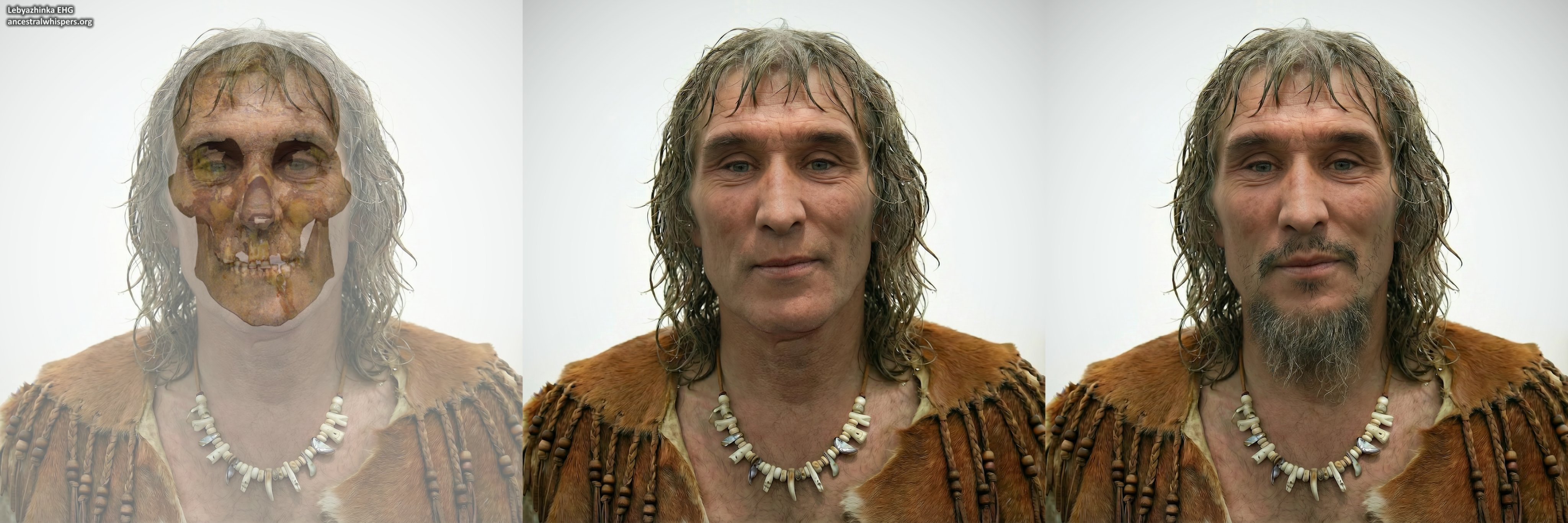
This Eastern Hunter-Gatherer individual was found in the Samara region. His Y-DNA was R1b-P297, and his mtDNA U5a1d. Pigmentation analysis indicates that he carried genes for light skin, light hair, and blue eyes. His cranial measurements include a medium-large cranial length of 181 mm, a medium-small cranial width of 135 mm, and a large cheek width of 137 mm.
The idea of a distinct Sub-Ural population stratum emerging in deep antiquity was developed on the basis of Early Neolithic skulls recovered from burials near the villages of Chekalino and Lebyazhinka in the Samara region. This population was classified as belonging to what is termed the Ancienturalic race. [Khokhlov, 2017]
The concept of the Ancienturalic race was introduced by anthropologist Viktor Bunak. He proposed that a unique anthropological formation arose in the Ural region during the Neolithic, possibly as early as the Paleolithic. This group possessed a set of traits intermediate between Caucasoids and Mоngolоids, yet developed independently of both, originating from a very ancient, autochthonous layer. The male skull from Lebyazhinka IV, associated with the Elshan culture, like many other individuals belonging to the EHG cluster, exhibits precisely this combination of features.
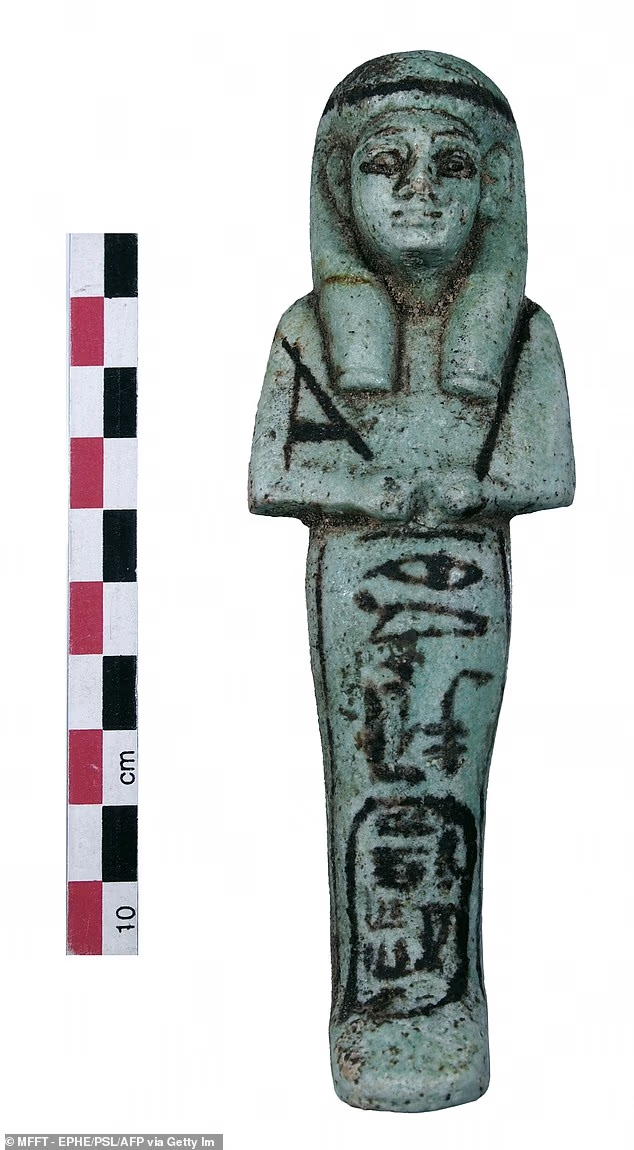
Archaeologists in Egypt have uncovered a stunning treasure trove hidden inside an ancient royal tomb, a discovery so rare it is rewriting history.
Buried deep beneath the sands of Tanis, researchers found 225 exquisitely crafted funerary figurines arranged in a mysterious ceremonial pattern, yet the tomb itself was empty of a body.
The find has electrified the archaeological world, not only for its scale but for its baffling implications.
More than half of the figurines are female, an almost unheard-of feature in royal burials, raising new questions about funerary customs during Egypt’s fractured Third Intermediate Period.
The figurines were laid out in a star-like formation and in perfect horizontal rows, suggesting an intentional ritual design untouched for nearly 3,000 years.
This is the first time in almost 80 years that figurines have been discovered undisturbed inside a royal tomb at Tanis, making it one of the most significant finds at the site since the 1940s.
Most astonishing of all, the royal symbols on the miniature servants confirm that the empty tomb belonged to Pharaoh Shoshenq III, a ruler whose final resting place has puzzled Egyptologists for decades. He reigned from 830 to 791 BC.
Out of 8 billion humans on Earth, only around 0.33% are women with Nordic features, blonde hair and blue or green eyes.
That makes these features rare, it makes us a minority and an endangered type on this planet.
Now, women with Nordic features are being openly targeted by the radical woke left’s self-hating ideologues who want to erase us because we’re apparently not “diverse” enough for their agenda.
Only 0.33% of humankind. Make that make sense.
If this were any other race, ethnicity, or group of people, there would be outrage.
“Equality & diversity” was never about true inclusion, it was always about the exclusion of white people and their replacement.
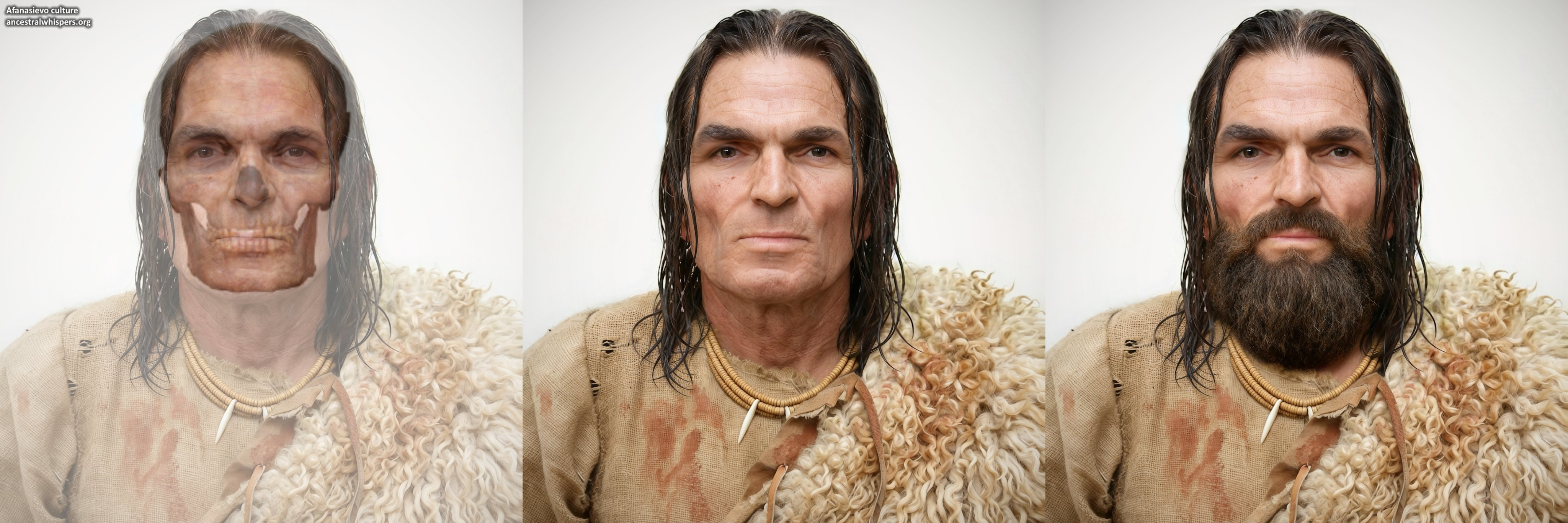
Facial reconstruction of a 5,100-year-old Afanasievan from Mongolia with Yamnaya-like auDNA
He carried Y-DNA haplogroup J1a2b and mtDNA U5a1. His maternal lineage, associated with European hunter-gatherers, was widespread among Indo-Europeans. His paternal lineage, J1a2b, has been previously detected in the Khvalynsk culture; a downstream of this haplogroup also dominates the Y-DNA of the Kura-Araxes culture, possibly suggesting a dispersal of J1a2b from the Caucasus into the Steppe, where a related branch persisted and became the main haplogroup of the Kura-Araxes culture.
The man, belonging to the Paleoeuropoid/Protoeuropoid type, stood roughly 180 cm tall (498mm femur length) and possessed a notably massive and robust skull, with a very long cranial length of 193 mm, massive cranial width of 151 mm, and a very broad cheekbone width of 147 mm.
In Inner Asia, the Bronze Age begins with the emergence of the Afanasievo culture, which spread across vast regions of southern Siberia and Central Asia. Its sites are known from western and central Mongolia, eastern Kazakhstan, the Dzungarian Basin, and even the Middle Zarafshan, though the highest concentration lies in the Altai and the Minusinsk Basin. AMS radiocarbon dates place the Afanasievo horizon between 3300–2500 BCE. Both anthropological and ancient DNA evidence indicate that the Afanasievo culture arose from a migration of populations from Eastern Europe, specifically from the Yamnaya cultural sphere (Solodovnikov et al. 2023).
The Altai Afanasievo individuals rank among the tallest ancient populations of Eurasia (Solodovnikov et al. 2018). A similarly tall stature is seen among Afanasievo individuals from central Mongolia, based on limited material from the Shatar-Chuluu cemetery (where the reconstructed individual was found) near the Khangai range (Tumen 1978; Solodovnikov, Erdene 2022).
Two published Afanasievo individuals have been identified as fifth-degree relatives. One was buried at Inskaya Dol in the northwestern Altai (I11752, BARN-039) [Narasimhan et al. 2019], and the other at the Shatar-Chuluu cemetery in central Mongolia (SHT002, AT-25 (I6221, the reconstructed individual)) [Jeong et al. 2020; Ringbauer et al. 2023]. Although these sites lie 1,410 km apart, both individuals share the characteristic Afanasievo/Yamnaya genetic profile and cluster closely with other Afanasievo samples. Their biological relationship implies that at least one ancestor in their family line must have traveled several hundred kilometers within their lifetime.










 American Buddhist Net