Archaeologists in Egypt have uncovered a stunning treasure trove hidden inside an ancient royal tomb, a discovery so rare it is rewriting history.
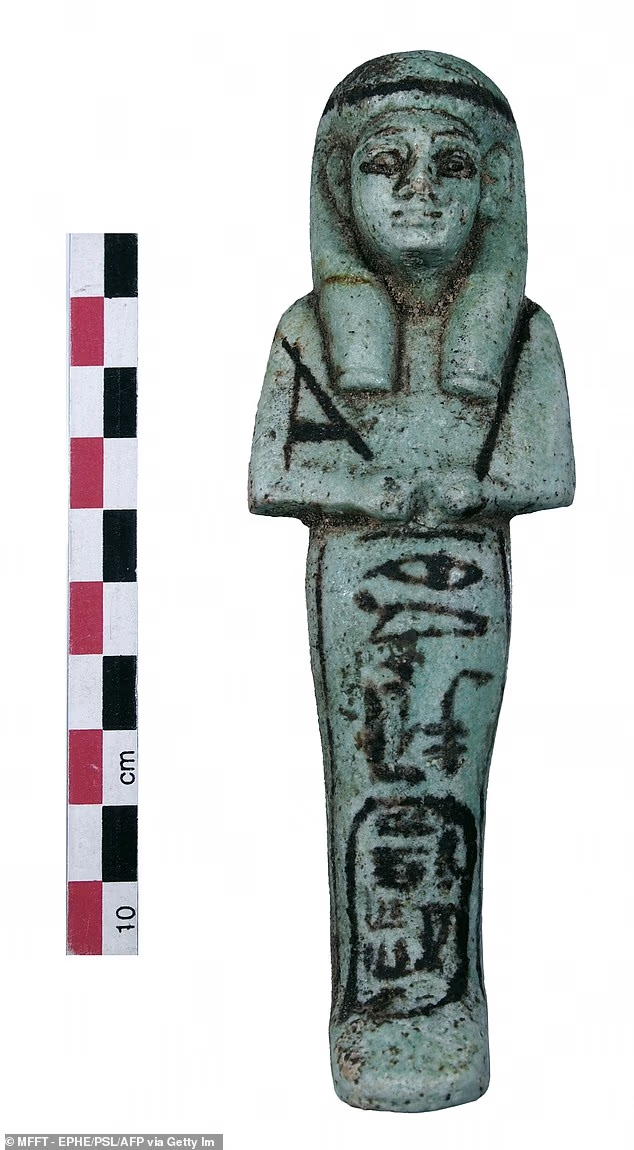
Buried deep beneath the sands of Tanis, researchers found 225 exquisitely crafted funerary figurines arranged in a mysterious ceremonial pattern, yet the tomb itself was empty of a body.
The find has electrified the archaeological world, not only for its scale but for its baffling implications.
More than half of the figurines are female, an almost unheard-of feature in royal burials, raising new questions about funerary customs during Egypt’s fractured Third Intermediate Period.
The figurines were laid out in a star-like formation and in perfect horizontal rows, suggesting an intentional ritual design untouched for nearly 3,000 years.
This is the first time in almost 80 years that figurines have been discovered undisturbed inside a royal tomb at Tanis, making it one of the most significant finds at the site since the 1940s.
Most astonishing of all, the royal symbols on the miniature servants confirm that the empty tomb belonged to Pharaoh Shoshenq III, a ruler whose final resting place has puzzled Egyptologists for decades. He reigned from 830 to 791 BC.
Out of 8 billion humans on Earth, only around 0.33% are women with Nordic features, blonde hair and blue or green eyes.
That makes these features rare, it makes us a minority and an endangered type on this planet.
Now, women with Nordic features are being openly targeted by the radical woke left’s self-hating ideologues who want to erase us because we’re apparently not “diverse” enough for their agenda.
Only 0.33% of humankind. Make that make sense.
If this were any other race, ethnicity, or group of people, there would be outrage.
“Equality & diversity” was never about true inclusion, it was always about the exclusion of white people and their replacement.
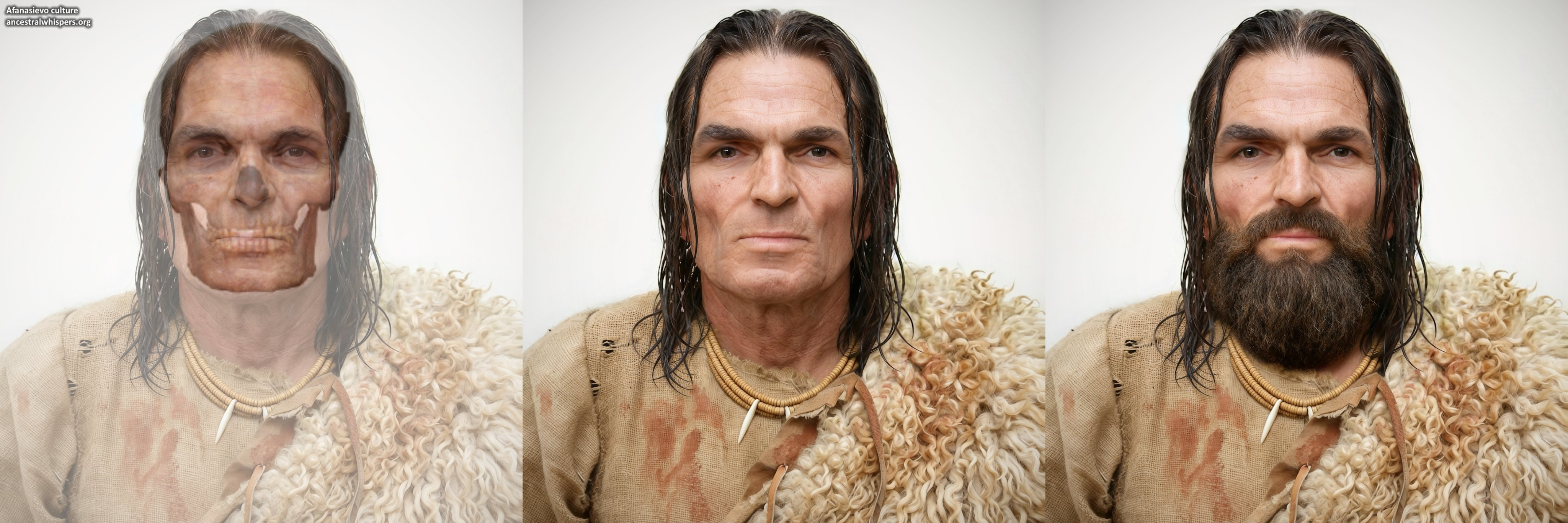
Facial reconstruction of a 5,100-year-old Afanasievan from Mongolia with Yamnaya-like auDNA
He carried Y-DNA haplogroup J1a2b and mtDNA U5a1. His maternal lineage, associated with European hunter-gatherers, was widespread among Indo-Europeans. His paternal lineage, J1a2b, has been previously detected in the Khvalynsk culture; a downstream of this haplogroup also dominates the Y-DNA of the Kura-Araxes culture, possibly suggesting a dispersal of J1a2b from the Caucasus into the Steppe, where a related branch persisted and became the main haplogroup of the Kura-Araxes culture.
The man, belonging to the Paleoeuropoid/Protoeuropoid type, stood roughly 180 cm tall (498mm femur length) and possessed a notably massive and robust skull, with a very long cranial length of 193 mm, massive cranial width of 151 mm, and a very broad cheekbone width of 147 mm.
In Inner Asia, the Bronze Age begins with the emergence of the Afanasievo culture, which spread across vast regions of southern Siberia and Central Asia. Its sites are known from western and central Mongolia, eastern Kazakhstan, the Dzungarian Basin, and even the Middle Zarafshan, though the highest concentration lies in the Altai and the Minusinsk Basin. AMS radiocarbon dates place the Afanasievo horizon between 3300–2500 BCE. Both anthropological and ancient DNA evidence indicate that the Afanasievo culture arose from a migration of populations from Eastern Europe, specifically from the Yamnaya cultural sphere (Solodovnikov et al. 2023).
The Altai Afanasievo individuals rank among the tallest ancient populations of Eurasia (Solodovnikov et al. 2018). A similarly tall stature is seen among Afanasievo individuals from central Mongolia, based on limited material from the Shatar-Chuluu cemetery (where the reconstructed individual was found) near the Khangai range (Tumen 1978; Solodovnikov, Erdene 2022).
Two published Afanasievo individuals have been identified as fifth-degree relatives. One was buried at Inskaya Dol in the northwestern Altai (I11752, BARN-039) [Narasimhan et al. 2019], and the other at the Shatar-Chuluu cemetery in central Mongolia (SHT002, AT-25 (I6221, the reconstructed individual)) [Jeong et al. 2020; Ringbauer et al. 2023]. Although these sites lie 1,410 km apart, both individuals share the characteristic Afanasievo/Yamnaya genetic profile and cluster closely with other Afanasievo samples. Their biological relationship implies that at least one ancestor in their family line must have traveled several hundred kilometers within their lifetime.
Transgender athletes and those athletes with differences of sexual development (DSD) will reportedly be banned from competing in female competitions at the Olympics from early next year.
A report in The Times claims this comes after a science-based review undertaken by the International Olympic Committee (IOC) which looked into the permanent physical advantages of being born male.
Previously, Olympic sports had the power individually to decide whether transgender women could compete if they had reduced testosterone levels.
What’s the backstory to the stories of angels and devils in Lithuanian tales, and how influential were pagan roots in forming their image? In conversation – Lithuanian Literature and Folklore Institute doctoral researcher Solveiga Šlapikienė.
Angels and devils are often seen as beings of opposite natures – symbols of good and evil, a classic binary opposition, even antonyms. Yet alongside their stark contrasts, there are also unexpected parallels, especially in their shared origins. How does Lithuanian folklore explain the creation of angels and devils?
The most common and well-known explanation for how angels came into being involves striking or rubbing stones together – sparks flying from flint and steel could also give rise to angels. In fact, both angels and devils are said to have originated this way. That’s an important detail.
So there are no etiological legends that explain only the creation of angels? Angels and devils always seem to appear together.
Almost always. If angels are mentioned on their own, it’s only in very brief or fragmentary tales, with just a few lines saying that angels were created in such a way – and that’s all. But in any more developed narrative, angels and devils appear side by side.
It’s worth noting that two main categories describe how angels were created. The first says that God created angels together with Lucifer, his opponent, his adversary.
The angels created by Lucifer, or by Liucius as he is sometimes called, were the same in kind as those made by God. But Lucifer, acting as a trickster, tried to imitate God’s creative acts – and failed. His attempts produced distorted, imperfect beings, darkened and flawed copies of divine creations.
Devil Museum in Kaunas, Lithuania. | LRT TV / Screengrab
Another version says that God created all the angels at once, but over time, some rebelled and were cast out. Do many Lithuanian folk tales deal with the human choice between good and evil?
Very many. Across the body of folklore about angels, only a small portion shows angels existing purely in the heavenly realm, without any contact with humans. Most of what we have speaks of guardian angels – those who accompany a person from birth to death.
And, of course, devils often appear alongside them: like a dark angel perched on one shoulder, always nearby, watching and following the person throughout their life.
One of the most popular motifs is that both angel and devil keep a record of human deeds – the angel writes down the good, the devil the bad. When death comes, each brings their book to the bedside, and the balance between good and evil determines where the soul will go: to heaven or to hell.
The presence of both beings beside a person throughout life touches on many aspects of human existence. The angel is most often associated with moments of danger. For instance, if a building is about to collapse, the angel, acting as an inner voice, may warn the person to move aside or avoid an action, thus saving them from harm.
(The video should have sound but works without it.)
I would add — yes, bikes are dangerous but the danger is overemphasized. I believe it is overemphasized because all healthy men would love to ride but are afraid; and the exaggeration of danger justifies staying away; following that is the echo chamber of uninformed agreement and circular reasoning.
Modern motorcycles are definitely safer than bikes from just two decades ago. They are equipped with many traction and braking safety features. Also, airbag jackets and vests for motorcycles are available and moderately priced.
My very consistent attitude toward motorcycles is I never try to convince anyone to ride and am not doing that now. Right now, I am just setting the record straight, as I see it.
Motorcycling is a very free sport. Most riders are very pleasant, polite men; and they are that way because riding uses and exhausts primal animal hormones, thought and sensory processes, and instincts as they were evolved to be used.
Yes, some women ride and I love them for it, but the sport is mostly men. ABN





 American Buddhist Net