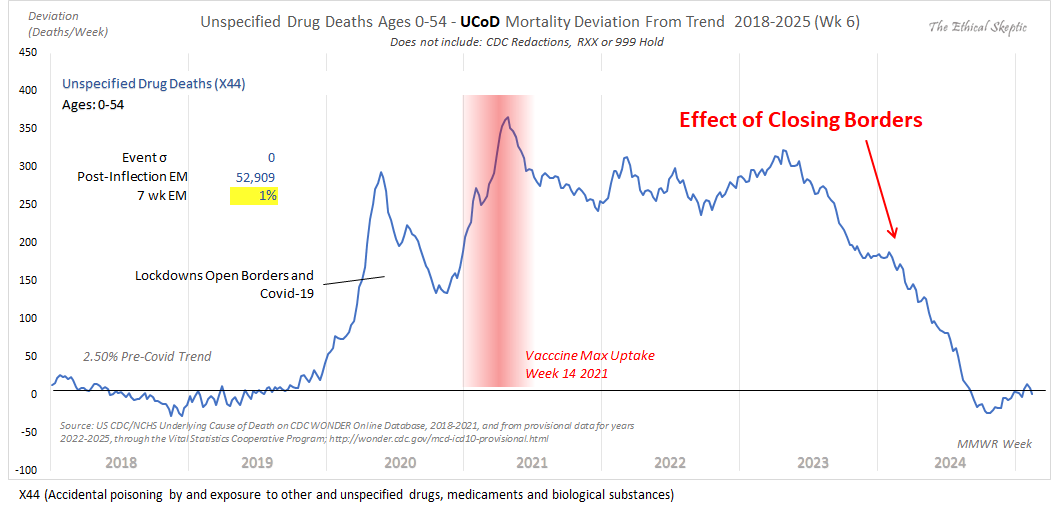
I wonder why TES used a graph that shows decline in unspecified drug deaths beginning in 2024, during Biden’s presidency. Time will tell if Trump actually fixes Venezuela or not. ABN
Jewish Supremists have been doing this for centuries covertly. They make lists and hand them off to covert thugs who attack the people on the lists; and they often attack their children as well (see Gaza for evidence of this). This species of vigilantism is a major factor in the downfall of the West. Toadies are promoted (see US Congress for evidence of this), while talented people who can recognize patterns and are neither greedy nor afraid to speak are destroyed. Another point on those vigilante lists is any JS can put anyone on them. Dude scores a girl you want, put him on the list. Some guy in your class is smarter than you, put him on the list. This is always the deeply evil result of vigilante lists. The org in the video above is a public face, a sanitized version, of this ancient covert phenomenon. Even still it is chilling. Imagine anyone openly doing something like this to Jews. ABN
A second Democrat-run state has been hit by accusations of fraud within the Somali community, prompting a vile response from one lawmaker who was quizzed about it by a constituent.
As Minnesota grapples with one of the biggest fraud scandals in US history, a whistleblower in Maine has now stepped forward alleging state taxpayers have been defrauded out of funds meant for social services.
Christopher Bernardini told NewsNation he worked as a ‘billing guru’ for Portland-based Gateway Community Services for seven years until April 2025 – while they were allegedly defrauding Maine’s Medicaid program.
The company’s founder and CEO, Abdullahi Ali, is a Somali-American who ran for president of Jubaland, a state in Somalia, last year while juggling his role as executive director.
He came under fire at the time amid reports from The Maine Wire that he had boasted of funding the militia to ‘help the troops buy weapons, bullets and food’ while he was in America.
The comments sparked concerns about whether any of the $28.8million in payments his LLC received via MaineCare had been misappropriated.
The Daily Mail has contacted Gateway Community Services for comment.
Maine appears to be one of the most corrupt states in USA.
With a population of a mere 1.3 million, billion dollar plus fraud is major crime, with tendrils running throughout the state government.
Vote fraud, woke fraud, payola fraud to friends and relatives, constant lies and coverups — Maine appears to have it all, including a complicit news media who have actually been paid by the Mills administration to supposedly do public outreach or something but in reality have chosen to not report on any of this fraud, and never run a story critical of Maine Dems.
Traditional Maine culture is high-trust, mild-mannered, kind and honorable.
Foreign and political scam artists have exploited it to the max.
The state is in such bad shape only the federal government can save it. There is no political, judicial, legal, or journalistic entity within the state strong enough to fix the state. ABN
Since Hotez uses the word terrorist loosely, it’s fitting to say that people in positions like his often have dual loyalties.
Not saying he is doing this, but people in positions like his often are subversives, a type of terrorist, who use their authority to poison, lobotomize, maim and otherwise harm innocents who have trusted them.
It’s a parasitic pattern repeated covertly throughout the West for many decades.
Terrorism is a technique used to frighten large populations.
Violent interpersonal and clandestine subversion is a techniques used to weaken specific communities by culling their best individuals.
After several generations of subversive harm, whole communities can be destroyed.
Clandestine subversives of this type are often found in schools, where they misdirect and mind-control students while also gathering information on which ones to target for covert violent attacks.
They can be found in hospitals and doctors offices, in government, media, politics and law.
They use their positions to mislead society, and to identify individuals who may understand what they are doing; then placing them on target lists for physical or sensory harm by covert operators.
The harm is never connected back to them because the lists are secret and would appear meaningless even if discovered.
Some of these lists have been discovered but few understood what they are. Most believed they were merely ‘watch lists’. ABN
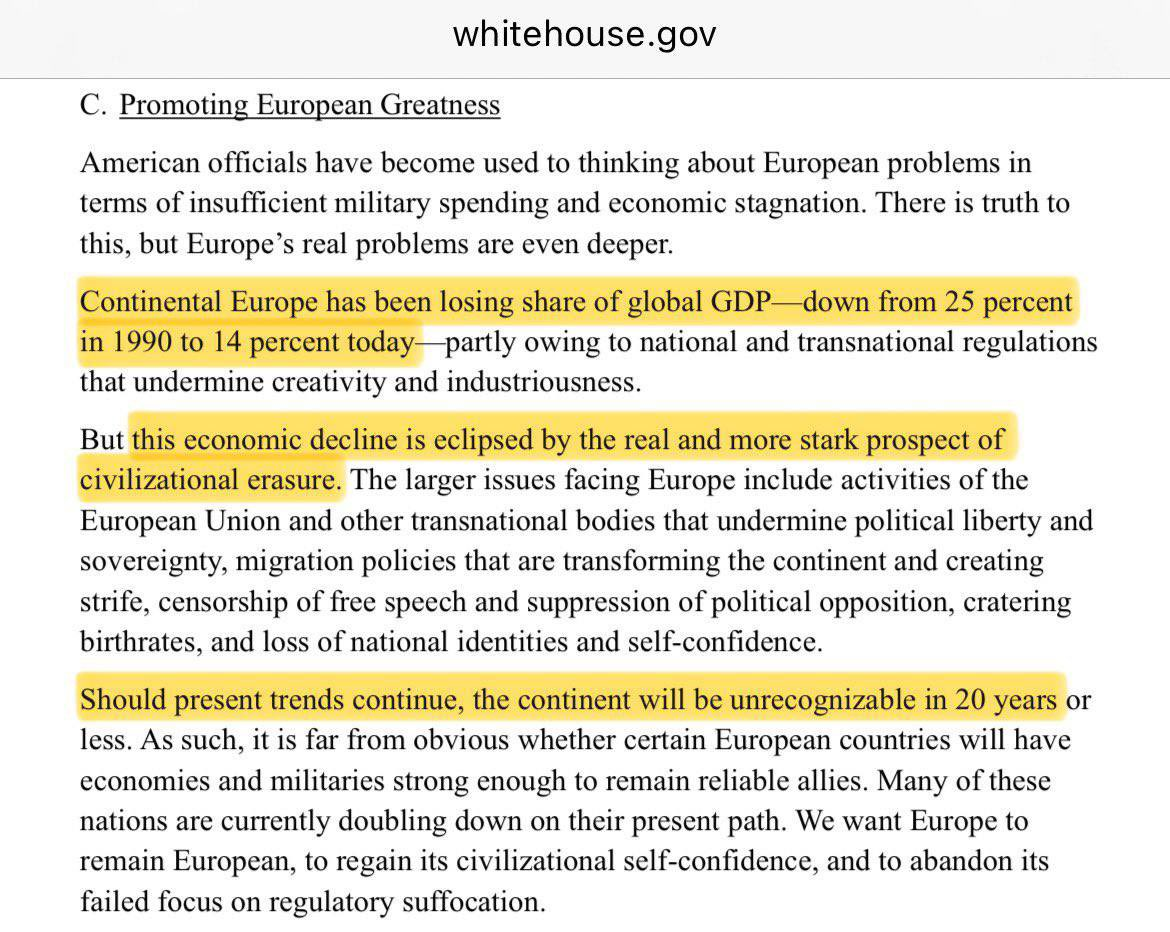
The White House just published what Brussels has spent a decade censoring: Europe has shrunk from 25% of global GDP to 14%, is drifting toward “civilizational erasure,” and on its current course “will be unrecognizable in 20 years.” Not Russian intelligence. Not dissident analysts. Washington, in its own national strategy, marking the time of death.
Europe’s tragedy isn’t that it was defeated by an external force. Its tragedy is that it volunteered for collapse, mistaking moral vanity for strategy, self-harm for principle, and neocon applause for sovereignty. 19 rounds of sanctions meant to cripple Russia instead detonated inside Europe’s own chest cavity; industries fleeing, energy gutted, borders unmoored, farmers revolting, wages eroding, dissent criminalized under “values” crafted by technocrats who have never worked a real job, with utter contempt for Europeans.
And while Europe recited slogans, Russia built substance, built an economic juggernaut. The “gas station with nukes” they mocked is now the 4th largest economy on Earth by PPP, expanding faster than the entire European Union since the SMO began, reindustrializing, reorienting, rewiring Eurasia. The target of Europe’s crusade grew stronger, the crusaders grew poorer. This wasn’t irony. This was inevitability.
Now comes the most brutal line in the US strategy: the warning that some European states soon “may not be strong enough to remain reliable allies.” This is Washington stepping back from a burning house with the calm of an arsonist writing the incident report. The very patron that pushed Europe toward confrontation, long before Trump, is now drafting its alibi, framing Europe’s collapse as an unfortunate accident rather than the predictable consequence of policies its Deepstate encouraged and Brussels enforced with missionary zeal.
The EU won’t recognize the downloading of humiliation, because it arrived disguised as loyalty, and because the script being used to abandon the continent is the same script Europe still insists on performing.
A continent that once birthed Western civilization now prosecutes its citizens for speech, crushes its own farmers under riot shields, torches its industry for green dogma, and markets the whole spectacle as enlightenment. It surrendered its energy to ideology, its industry to Davos hallucinations, its security to America’s whims, and its future to compound interest. A civilization cannot live on abstractions, but its elites can, because they have engineered a system where the costs fall on the people and the graft float upward to those who never bear the consequences.
The NSS isn’t a strategy. It’s a confession in plain sight; Russia absorbed the blow, recalibrated, and rose; Europe dissolved into the very illusions it mistook for strength, while Washington, already preparing the next chapter, quietly wipes its hands of the consequences.
The deep, largely unrecognized, source of Europe and the West’s precipitous decline is we have been infiltrated by hostile, violent gangs which have taken over all Western high-ground.
All of our institutions have been infiltrated and turned against us.
All of them.
Consider what backward Somali gangs were able to do in just a few decades.
Had they not been caught, consider the wealth and power they would have amassed and held.
That was their motive.
Then consider gangs in the past who have quietly infiltrated the West and taken over.
Consider the payoff for their bold plan:
Immense power and wealth, control of all major Western institutions, the power to mind-control and lead Western peoples to their deaths.
That was and still is their motive.
But they are smarter than the Somalis.
Not only have they not been caught, they convinced us to pay for our own execution.
Many do not fully understand this because they are so soft and weak they refuse to contemplate the clandestine violence that has been waged for many generations against talented Western young people.
Why young people?
Because the smartest ones can be identified early and lobotomized, poisoned or maimed before they become adults.
This allows those young victims to live and cause despair and resignation in their communities, but renders them incapable of fighting back or understanding what has happened to them.
It is close to impossible to catch the poisoners and lobotomizers in the act. After one roofie, a lobotomy takes but a few minutes to perform.
And a goon can be trained to do it.
The deed can be done tens of thousands of times per year throughout the West, and very few will notice the pattern.
Put on your ruthless warrior hat and realize the deep reason the West is falling so fast.
It’s not just due to ideas, pathological altruism, the nepotism of our enemies.
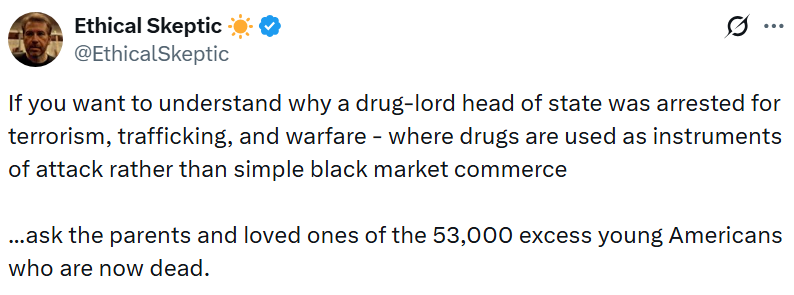
From inside U.S. custody, Hugo Carvajal (former head of Venezuela’s intelligence) just CONFESSED:
-The Maduro regime “weaponized drugs” as part of a deliberate plan to destabilize the U.S.
-Cuban operatives, FARC, ELN, and Hezbollah were given weapons, passports, and immunity to operate from Venezuela They infiltrated America under Biden’s open border policies – armed, obedient, and ready
-Every kidnapping, extortion, and killing? “Acts ordered by the regime”
And it doesn’t stop there.
Carvajal confirms what many suspected: “Smartmatic was born as an electoral tool of the Venezuelan regime… and exported abroad – including to the United States.”
He says he oversaw Venezuela’s election IT chief and that U.S. elections can be rigged with Smartmatic software.
He says POTUS’s actions were justified and may have underestimated how far the regime would go to stay in power.
Carvajal now sits in Rikers Island after extradition, but has become a federal witness in the case against Maduro’s narco-terror regime.
This is an inevitable response. Basic anthropology. ABN
UPDATE: Ofc, this video could be fake or a psyop, but something like this is inevitable and Ireland is a prime candidate as they had a very active IRA for decades. ABN




 American Buddhist Net