The messaging app Telegram has said it will hand over users’ IP addresses and phone numbers to authorities who have search warrants or other valid legal requests.
The change to its terms of service and privacy policy “should discourage criminals”, CEO Pavel Durov said in a Telegram post on Monday.
“While 99.999% of Telegram users have nothing to do with crime, the 0.001% involved in illicit activities create a bad image for the entire platform, putting the interests of our almost billion users at risk,” he continued.
The announcement marks a significant reversal for Mr Durov, the platform’s Russian-born co-founder who was detained by French authorities last month at an airport just north of Paris.
“Telegram’s marketing as a platform that would resist government demands attracted people that wanted to feel safe sharing their political views in places like Russia, Belarus, and the Middle East,” Mr Scott-Railton said.
“Many are now scrutinizing Telegram’s announcement with a basic question in mind: does this mean the platform will start cooperating with authorities in repressive regimes?”
Telegram has not given much clarity on how the company will handle the demands from leaders of such regimes in the future, he added.
Cybersecurity experts say that while Telegram has removed some groups in the past, it has a far weaker system of moderating extremist and illegal content than competing social media companies and messenger apps.
Before the recent policy expansion, Telegram would only supply information on terror suspects, according to 404 Media.
Ordinarily the opinions of one tech billionaire would, perhaps, not matter much to the life of an ordinary American. However, in this era of 2024 election and the Technocracy influence, maybe this interview discussion carries a different set of values.
Tech entrepreneur Peter Thiel, the founder of Palantir, an AI enhanced data processing system that streamlines the organization of technological surveillance methods, gives his views on a variety of current political aspects.
I find the interview as little interesting from a few perspectives. First, while generally supporting President Trump, Peter Thiel says he is choosing to stay out of the political influence game in the 2024 general election. Considering the scale of Thiels prior advocacy and specific action he undertook to put JD Vance into office and then into the VP nominee position for Trump – this decision to now ‘step back’ from 2024 seems a big disingenuous.
Second, and directly related to the first point, Thiel -through Palantir contracts- is now directly enmeshed in the Intelligence Community effort to capture and organize surveillance metadata of Americans. Perhaps, just perhaps, this new financial dependency plays a role in influencing his ‘step back’ decision.
Other points worth noting relate to how Thiel outlines his perspectives on geopolitical events. When you look at Thiel’s communication abilities and perspectives it really shows you how shallow, small and generally naïve these top-tier influence agents can be.
In the first case of its kind in the country, a Charlotte-area man is charged with using AI to manipulate music streaming platforms to siphon off over $10 million in royalties, federal authorities said Wednesday.
Michael Smith, 52, of Cornelius, was arrested Wednesday and is charged with wire fraud conspiracy, wire fraud and money laundering conspiracy, the U.S. Attorney for the Southern District of New York said in a news release.
Each charge carries up to 20 years in prison if convicted. Smith’s complex scheme used automated programs, or “bots,” to stream songs created with artificial intelligence, according to an indictment released Wednesday by the U.S. Attorney’s office and the FBI’s New York Field Office.
He then used the bot accounts to stream those songs billions of times across multiple streaming platforms to boost his royalties to over $10 million, according to the indictment.
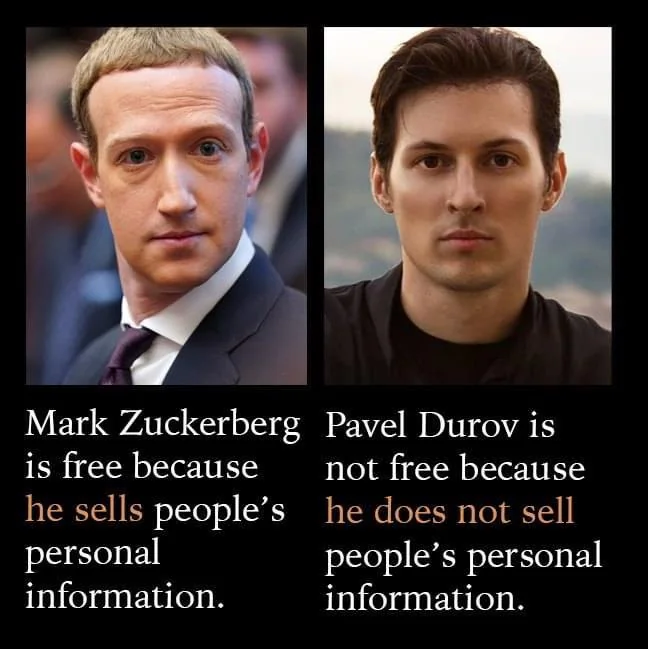
Pavel Durov (lead image) aka Paul du Rove (“vagabond” in French) doesn’t put his money where his mouth is.
This is because more than half the assets and almost half the revenues of Durov’s Telegram group of companies are digital units which Telegram itself programmes, stores, trades, values, and revalues, so the potential for concealment, deception and fraud is unaccountably large. This is the reason Durov has failed to secure the US regulator’s permission to sell shares in his $30 billion valuation of Telegram in a US initial public offering (IPO). In short, the freedom and privacy Durov claims his Telegram social media platform represents is not at all what the financial reports reveal of his money-making.
The first fraud flag was waved by the US Securities and Exchange Commission (SEC) in October 2019 after more than a year of Durov’s money-raising through digital tokens he called Grams which he offered to sell for $1.5 billion. At the time, cornerstone investors in Durov included the Russian oligarch Roman Abramovich and other oligarchs.
Durov — announced the SEC — “seeks to obtain the benefits of a public offering without complying with the long-established disclosure responsibilities designed to protect the investing public… the defendants have failed to provide investors with information regarding Grams and Telegram’s business operations, financial condition, risk factors, and management that the securities laws require.”
In the five years since then, Durov claims to have sold another billion-dollar bond in 2021; $210 million in fresh securities in 2023; and $330 million in paper which Durov floated in March of this year. “The increased demand for our bonds shows that global financial institutions value Telegram’s growth in audience and monetization”, he said (telegrammed) at the time.
These investments weren’t exactly money for value, or vice versa. Durov has admitted he has been buying about a quarter of the debt issues himself. “Valuations are based on market inputs that are not observable,” reported a blockchain industry analyst.
PARIS, Aug 29 (Reuters) – The investigation into Telegram boss Pavel Durov that has fired a warning shot to global tech titans was started by a small cybercrime unit within the Paris prosecutor’s office, led by 38-year-old Johanna Brousse.
The arrest of Durov, 39, last Saturday marks a significant shift in how some global authorities may seek to deal with tech chiefs reluctant to police illegal content on their platforms.
The arrest signalled the mettle of the J3 cybercrime unit, but the true test of its ambitions will be whether Brousse can secure a conviction based on a largely untested legal argument, lawyers said.
In an unprecedented move against a major tech CEO, prosecutors argued Durov bears responsibility for the alleged illegality on his platform, placing him under formal investigation on organized crime charges. He is suspected of complicity in running an online platform that allows the posting of child sex abuse images, drug trafficking and fraud.
Durov’s lawyer said on Thursday it was “absurd” for him to be held responsible and that the app abided by European laws, echoing an earlier statement by Telegram itself.
Being placed under formal investigation in France does not imply guilt or necessarily lead to trial, but indicates judges consider there is enough evidence to proceed with the probe. Investigations can last years before being sent to trial or dropped. Durov is out on bail, but barred from leaving France.
Why should the state control all communications? They have consistently abused their powers. We the plebs can best affect this travesty by understanding it and being mostly on the same page with each other. On a side note, I can’t help but suspect EU bureaucrats are jealous of Durov. ABN
President Donald Trump railed against Meta CEO Mark Zuckerberg in his upcoming book, accusing the tech tycoon of undermining him in the last election and warning of possible jail time.
Trump, 78, recounted meeting with Zuckerberg, 40, and seethed over the 2020 election in his upcoming book “Save America,” set to hit bookshelves on Sept. 3.
“We are watching him closely, and if he does anything illegal this time he will spend the rest of his life in prison — as will others who cheat in the 2024 Presidential Election,” Trump wrote in the book, per a preview obtained by Politico.
The 45th president has lashed out at the Meta chief executive repeatedly in the past. Earlier this year he bucked his own party and expressed support for TikTok, warning, “If you get rid of TikTok, Facebook and Zuckerschmuck will double their business.”
Paris CNN — Telegram founder Pavel Durov was released from police custody in France on Wednesday and transferred to court for questioning ahead of a possible indictment, prosecutors told CNN, days after his dramatic arrest at a Paris airport.
The Russian-born billionaire exited the anti-fraud office outside Paris in what appeared to be a police vehicle on Wednesday afternoon, according to a CNN producer there.
The Paris prosecutor’s office said he would now face “initial questioning and possible indictment” at a court in the French capital.
Durov, 39, was detained at Paris’s Bourget Airport on Saturday on a warrant related to Telegram’s lack of moderation. He was being investigated on charges relating to a host of crimes, including allegations that his platform was complicit in aiding fraudsters, drug traffickers and people spreading child pornography.
“You cannot make it safe against criminals and open for governments,” Durov told CNN in 2016. “It’s either secure or not secure.”
The issue comes down to the highlighted quote from Durov above. At first glance, it may seem reasonable for government, even an ideally good government, to control how criminals communicate electronically. Upon more thought, one wonders why should even an ideally good government presuppose this right of search, seizure, judgement and censorship against electronic communication? Isn’t it enough for even an ideally good government to pursue criminals as they have always been charged to do? That is, without summary search, seizure, judgement and censorship? Compounding factors are no one in their right mind trusts any real-world government with those over-the-top powers, and yet we all know they do it anyway, despite the law. So, should they alone have privacy in their communications, which they abuse against all of us, or should all of us have privacy in our communications which only some of us will abuse? ABN
The publicity circus accompanying the arrest explains why the court decided to share a press release listing the charges against Durov. According to this document, the Paris Public Prosecutor’s Office opened a preliminary investigation against Durov on July 8 related to efforts to combat cybercrime.
The Centre for the Fight against Cybercrime (C3N) and the Anti-Fraud National Office (ONAF) have been involved in the investigation. In all, 12 charges have been filed against “a person unnamed” — a classic French judicial term to imply whoever is in charge of Telegram right now.
The charges can be broken down into four categories:
Firstly, Telegram’s founder has been charged with being complicit in storing and distributing CSAM content, facilitating drug trafficking and facilitating organized fraud and other illegal transactions.
Second, the court claims that Telegram refuses to cooperate with law enforcement when they file a formal request for information or documents.
Third, Durov faces several charges related to Telegram’s cryptographic features as they haven’t been formally declared or certified by French authorities. These seem to be minor offenses according to professor of law Florence G’sell.
Fourth, Durov is accused of taking part in a “criminal association with a view to committing a crime or an offense punishable by 5 or more years of imprisonment”, as well as money laundering.
The charges are both broad and technical at the same time. It’s also hard to know exactly their basis without access to the full investigation.
While France is holding Durov, the people left at Telegram will probably cave to threats that they will be similarly charged if they don’t allow police access to Telegram’s systems and, possibly, testify against Durov. ABN
According to breaking news, French media reported that Telegram founder and CEO Pavel Durov was detained by police in France.
Pavel Durov, the founder and CEO of encrypted messaging service Telegram, was arrested at Le Bourget airport near Paris on Saturday evening. The 39-year-old French-Russian entrepreneur was detained by gendarmes from the GTA (Air Transport Gendarmerie) at around 8pm as he got off his private jet. Durov was accompanied by a bodyguard and a woman.
According to sources, Durov was on the French FPR (wanted persons file) list and was arrested on the basis of a search warrant issued by OFMIN (Office for the Protection of Minors), which is part of the national directorate of the French judicial police.
The reason for Durov’s arrest is shown as illegal content on Telegram.



 American Buddhist Net