
Tag: Buddhist Practice
Does the Universe think? (with Bernardo Kastrup)
228
UPDATE: I’ve watched 45 minutes of this and, so far, it is a beautiful model of how to talk. These guys are both trained philosophers and act like it. They listen charitably (means use the best possible interpretation of what they hear) to each other, delight in rebuttals, and quickly and easily clear up misunderstandings with evident pleasure as they move almost seamlessly together deeper and deeper into their topic without losing sight of where they want to go. Maybe at minute 46 they are going to kill each other in a fit of anger, who knows? Up to minute 45, they provide an exquisite example of how to talk about philosophy. And what FIML can teach partners about how to talk to each other.
The field of FIML is not philosophy per se. It is the idiosyncratic intermeshed fields of the FIML partners themselves. I have often said FIML has no content save what partners bring to it. FIML is a technique which reveals what our content is, what we are bringing to our relationship. Once both partners see clearly through the eyes and ears of each other what both of you are bringing, you will also delight in the fun of being able to talk as well as Kastrup and Hawkins (but about much more than just philosophy). I doubt either one of them does FIML and both of them might find it difficult since so much of their psycholinguistic constellations are defined by academic philosophy, but I know they could do it if they tried. ABN
Concepts don’t exist — as objective, phenomenological, cognitive, or neural structures
The case for removing concepts from cognitive science and AI research
It can be difficult to convince someone that concepts don’t exist. Everyday experience appears to provide overwhelming evidence to the contrary. Concepts are not only intuitively perceived to be active in daily life, they are also a widespread feature of theories across AI and cognitive science, where they are assumed to be necessary for symbolic and logical thought¹. Most who read the title of this post would be tempted to brush off the argument as patently, demonstrably absurd. It’s akin to trying to convince a European 500 years ago that God doesn’t exist, when everything around them appears to be evidence of, and indeed presupposes God’s existence. Any contrary argument is likely to be taken as the result of sophistry or word-wrangling, or because some critical piece has been neglected.
Despite their seeming obviousness, it is worth noting that there is still no complete and unambiguous explanation for what concepts are, or how they work on thoughts —and indeed how to program them into AI. The human ability to learn and create concepts is multifaceted and complex. AI theories and implementations generally only touch on one or two of its features, while neglecting large numbers of counter-cases. This has lead some researchers, notably Lawrence Barsalou, to suspect that the way we think of concepts is flawed. Perhaps the whole notion of concepts — as a native mechanism for grouping experiences — is untenable.
This article is well-worth reading. Below, I have made a few notes based on my reading of it. To my eye, it demonstrates the existence of consciousness as a thing, the existence of a very real subjective world, the high probability that this subjective world is not entirely confined in your head, that consciousness is a primary of existence and not confined to our brains, and also, importantly for this website, why FIML works so well.
(The sections in quotes are from the article.)
Firstly, concepts: they exist within consciousness and are used to reason, analyze, communicate, organize, and so on. They are probably a features of consciousness itself, depending on how you define them. They need not be stable.
Secondly, FIML:
To begin with, there is no scientific experiment or empirical observation that can be used to prove that any given concept “exists”, and by extension that concepts exist at all.
No. FIML practice provides unlimited empirical observations that concepts exist. FIML is a scientific experiment and can easily be repeated as many times as you like.
To objectively prove that any given interpretation matches reality, you would somehow have to compare your subjective mental concepts against an objective view of the real situation. But the latter isn’t possible.
Yes, it is possible. FIML is precisely that—a means ‘to compare your subjective mental concepts against an objective view of the real situation’.
FIML accomplishes this by allowing two subjective consciousnesses to objectively compare their mutually ‘subjective mental concepts’ against each other. To claim that ‘an objective view of the real situation’ can only be achieved by some other means is absurd. The very best means to objectively compare subjective states is to have two honest informants compare them based on a shared micro unit of communication in the real-world in real-time. This is what FIML does.
Continue reading “Concepts don’t exist — as objective, phenomenological, cognitive, or neural structures”The discreteness of concepts is a built-in requirement of language itself, one that does not necessarily reflect what an individual mind is doing.
Woman burned alive on subway in NYC
I do not recommend viewing this video. It is graphic and close to incomprehensible. I am not sure why I am posting it. Maybe it’s because so many people ignored her, we should not ignore that. ABN
Continue reading “Woman burned alive on subway in NYC”Bodhisattva
Bernardo Kastrup, Richard Watson, and Mike Levin — conversation 1
UPDATE: This is a very accessible philosophical discussion during which Kastrup lays out a clear argument for Analytical Idealism. What Kastrup describes is a very good way to understand Buddhist philosophy, which is based on similar thinking but takes it further. I highly recommend this discussion and other videos and essays by Kastrup. He is a perfect advocate for understanding Buddhism since he seems to be entirely unaware of Buddhist thought and entirely devoid of normative Buddhist cliches. ABN
A Good Description of Right Samadhi, the Eighth Element of the Noble Eightfold Path
Theise provides a good description of Right Samadhi at 6:02 min, prompted.
Buddhist philosophy and practice is founded on samadhi states, which might be described as the doors which open to the temple of Deepest Reality. Samadhi states are available to all people. They are the experiential part of Buddhism. They have to be experienced to make sense, and once experienced all of Buddhism will make sense.
Western civilization has almost no traditional awareness of samadhi. We have scores of philosophers and religious thinkers, but no samadhi. It is a glaring omission, one that has led us astray in many ways. Fortunately, today more people are beginning to see what samadhi states are, as Theise illustrates. Be sure to watch the whole clip as it will provide context to what he says about samadhi.
Buddhism is sort of implicitly ‘panpsychist’ or based on consciousness as a primary aspect of reality. Mind Only or Yogacara Buddhism makes this claim more explicitly. Samadhi is beautiful, joyful, wonderful. It will change you very deeply for the better or make you realize you don’t need to be changed at all. ABN
Kastrup responds to my criticisms of Analytic Idealism (part 1)
UPDATE: This is a very good discussion which can be understood within a Buddhist ‘mind only’ framework (or not). I have posted it especially because it seems to conform very well with what the Buddha might have thought and/or how later Buddhists came to understand Buddhist enlightenment, the cessation of all suffering through fully understanding all of reality. This video is the first part of a planned two-part discussion. The second part has not yet been posted. The second part is going to start with the question why the universal mind itself does not experience metacognition. I have some idea how Kastrup will answer that question, but will wait for his take before commenting further. Kastrup’s work in general seems to me to be a good way to consider Buddhist practice and thought from a modern point of view, using vocabularies and concepts we are familiar with or which can be readily accessed. It is important to know that the captions for the above video rarely correctly render the term Markov Blanket. This is an important term for understanding Kastrup’s ideas. More information can be found here: Markov Blanket. ABN
UPDATE 2: Near the end of the discussion linked above, Kastrup says he is incapable of meditation. I hope he reads this because I want to point out to him and others that meditation, or samadhi in Buddhism, is the method for the ‘small self’, which resides inside its Markov Blanket, to commune with the One Mind (Kastrup’s term, which works well with Buddhist thought). Samadhi is a natural state. When you take your attention away from Kastrup’s ‘dashboard’ and open the windows (let’s ignore the wind in his metaphor), your ‘small self’ perceives and experiences One Mind. Like all experience, samadhi states become richer and richer the more we experience and appreciate them. I would like to also encourage Kastrup and others to read this description of the Five Skandhas. The ‘consciousness’ which arises out of the first four skandhas is the consciousness of the small self, the self ensconced in its Markov Blanket. Whether he knows it or not, Kastrup has done an excellent job of describing Buddhist thought and practice in modern terms. I particularly like his work because, as far as I know, he has never mentioned Buddhism. For this reason, he provides a very refreshing take on the Dharma very clearly explicated and coming from a different angle from all others. ABN
Samadhi
Samādhi (Pali and Sanskrit: समाधि), in Hinduism, Buddhism, Jainism, Sikhism and yogic schools, is a state of meditative consciousness. In many Indian religious traditions, the cultivation of Samādhi through various meditation methods is essential for the attainment of spiritual liberation (known variously as nirvana, moksha).[1]
In Buddhism, it is the last of the eight elements of the Noble Eightfold Path.[web 1] In the Ashtanga Yoga tradition, it is the eighth and final limb identified in the Yoga Sutras of Patanjali.[2][3] In Jain meditation, samadhi is considered one of the last stages of the practice just prior to liberation.[4]
In the oldest Buddhist sutras, on which several contemporary western Theravada teachers rely, it refers to the development of an investigative and luminous mind which is equanimous and mindful. In the yogic traditions, and the Buddhist commentarial tradition on which the Burmese Vipassana movement and the Thai Forest tradition rely, it is interpreted as a meditative absorption or trance, attained by the practice of dhyāna.[5]
link
With so much now depending on what Christians, Jews and Muslims think and do and how they interact so poorly with each other and any one else and how their beliefs are based on old stories and not much else, this may be a good time to remind or inform anyone who wants to listen that there are much older and deeper traditions of the mind including how individuals should conduct themselves morally, ethically, spiritually. Samadhi states are but one aspect of ancient traditions that vastly predate Judaism and Christianity and also provide much deeper insights into the workings of the human mind and how to deal with the ever-changing conditions of life. The way the Abrahamic religions are behaving today is an embarrassment to all of humanity. ABN
Bodhisattva in samadhi, Gandhara 2nd Century CE
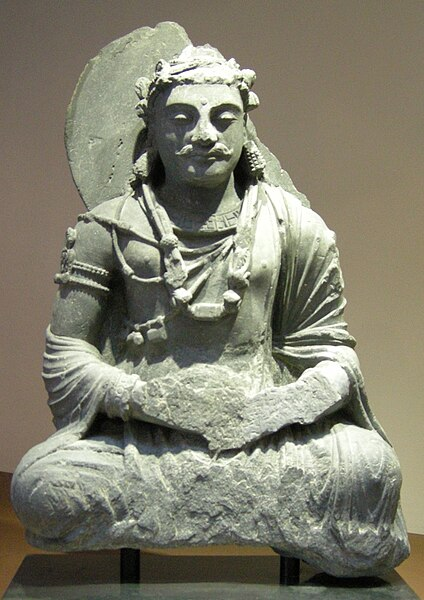
Bodhisattva seated in meditation. Afghanistan, 2nd century CE; attribution
UPDATE: The period this statue dates from and the area in which it was found was Gandhara, which was a major center of Buddhism. A great deal of Buddhism went to China from Gandhara. Chinese Buddhist nuns, to this day, take Sarvastivadan monastic vows which probably came from Gandhara. Buddhist statuary developed in this area under the strong influence of Greek statuary which became prevalent in that region due to the Greek presence brought by Alexander the Great. The earliest attested Buddhist teachings come to us from this area through Pyrrho, the Greek skeptic, who studied with Buddhist monks. Skepticism is clearly based on Buddhist core teachings. See Greek Buddha: Pyrrho’s Encounter with Early Buddhism in Central Asia for more on this topic. I highly recommend that book. ABN
A Christmas message from Alex Karp, CEO of Palantir
Needless to say, misuse of this technology is terrifying and will strike fear into the hearts of clear-thinking moral people everywhere. But this technology exists and is here to stay and will only become more powerful. You cannot ban it or make it go away, so we have to deal with it somehow. Much has been made of the fact that Karp is Jewish. In the hands of a Jewish supremist, this tech would destroy our world overnight. Western civilization would disappear from the face of the earth overnight and all other civilizations would follow soon after. So far, Karp has not destroyed our world and has not shown signs of being a Jewish supremist, so for now, maybe we do not need to fear his control over this tech, for now. Those are the cards and that is the game. What if Obama or Harris controlled this technology? Or Fauci or Daniel Penny’s prosecutor? Who controls Karp? I always hope for an enlightened elite and waste little time expecting there to be no elite. At the same time, I am well-aware elites are always out of touch with the primary essential fundamentals of life. They always make terrible mistakes and so far have never succeeded in self-correcting. So, should we all be afraid starting yesterday? Does Palantir confirm in modern guise the First Noble Truth of earthly delusion and suffering? Right now it looks that way to me. ABN
Joseph Campbell on OM
Pentagon study hints at reincarnation being real after finding consciousness ‘never dies’
A study conducted by US Army Intelligence has suggested that reincarnation is real because consciousness ‘never dies.’
Entitled ‘Analysis and Assessment of The Gateway Process,’ the 29-page report was drafted by US Army Lieutenant Colonel Wayne M McDonnell in 1983 and declassified by the CIA in 2003.
The mind-bending official Pentagon study was commissioned to better understand what its Army intel colleagues were doing sending personnel to a small institute in Charlottesville, Virginia that was working on the ‘Gateway Experience.’
The then-secretive ‘Gateway’ project, based to McDonnell’s analysis, was ‘a training system designed to bring enhanced strength, focus and coherence… to alter consciousness.’
From there, Gateway’s ambitious goal was to shift the practitioner’s consciousness ‘outside the physical sphere so as to ultimately escape even the restrictions of time and space.’
At least according to McDonnell, the Monroe Institute’s discoveries that wound up bolstering the case for reincarnation were profound.
‘When consciousness returns to the Absolute [Monroe jargon for a realm outside spacetime] it brings with it all the memories it has accumulated through experience in reality,’ as he distilled the Institute’s finding that memories pass on from life to life via reincarnation.
The Buddhist term is rebirth rather than reincarnation. The study mentioned, which might be of interest to some, is here: Analysis and Assessment of Gateway Process. ABN
Bernardo Kastrup: A Research Conversation in Consciousness
2:14
I agree with a lot of what Kastrup says in this discussion. One important thing he seems to be missing or misunderstanding (or chose not to discuss) is the fundamental dramatic nature of consciousness, of conscious life, which as with everything else is fundamental to nature itself as he describes it. Nature is not just impersonal forces or impersonal thought or impersonal anything but also drama. The dramas are bigger than us, just as all of nature is. And there are more beings than just humans who participate in these dramas. And we are all touched at many levels and in many ways by drama. We are not just traveling on an impersonal road only able at best to feel contented, well situated, in tune. We are also actors in dramas, some of which are our own making, some not. I like the way he says motives or intentions flow through him but are not his; they are elements of impersonal nature. I think he is inkling the dramas when he senses that. ABN
Anhedonia for the masses now? — insights from schizoid personalities
I’ve been noticing something remarkable lately- everyone I interact with at work just is completely checked out. Used to be just me faking and masking, now it’s the most extroverted amongst us that I am clocking a seismic shift in.
Has the world finally caught up to my perpetual state of disconnection? Where I’ve long inhabited emotional neutrality, now everyone seems to drift—listless and anesthetized by invisible systemic pressures.
Is this mass schizoid experience a diagnostic canary in society’s collapsing coal mine? Economic precarity, technological alienation, and relentless performative expectations have seemingly drained collective vitality. What I’ve experienced as individual pathology now appears a widespread condition: a numbing adaptive response to late-stage capitalist entropy.
Are we all becoming involuntary ascetics with our affect flattened?….a synchronized emotional shutdown? And if so, what will remain special about how we see the world?
I found this post and replies to it interesting and related to Buddhist practice and thought. I personally learned in my childhood and youth, through unregulated experience, states like dissociation, depersonalization, or ‘checking out’. I do not believe that in moderation those are ‘disordered’ states. As a young adult, I did not ever think there was anything wrong with me for experiencing states like that. Augmented or probed deeply through meditation, dissociative-type states appear to me to be related to Buddhist samadhi states, probably even part of the same continuum. Western civilization is awesome in many ways, but generally lacks a deep appreciation of samadhi states as they are practiced and learned (and learned from) in Buddhism, Taoism, yoga, and similar traditions. Basically, the West lacks the vocabulary for the beauty and depth of samadhi states, which may appear to some, or be wrongly defined by some, as psychologically ‘disordered’, ‘depersonalized’, ‘dissociative’, ‘anhedonic’, or ‘checked out’. Taken too far samadhi could become an unwholesome trance state, but this is normally not a problem as proper Buddhist practice also includes rational thought, mindfulness, contemplations on others, compassionate activity. I believe I am not too far off in the gist of this comment simply because there is virtually no common vocabulary in the West known to many that describes deep meditative states or samadhi states; ergo, the West does not have a good understanding of them. The quoted post above and the comments under it at the link above comes from a subreddit on Schizoid Personality Disorder. I am not saying there is no such thing as SPD or anhedonia, but maybe some people who think those terms apply to them are only thinking that way because Western psychology does not have a deep enough vocabulary to couple with their experiences. I believe the insight that things have changed since covid is valid and maybe there is a lot of good in that. Taking no pleasure in a world of lies and bs can also be seen as awakening to the First Noble Truth of worldly suffering and delusion. ABN
 American Buddhist Net