In the trial of Linda Sun, the former aide to New York governors who is accused of acting as a Chinese agent, the court has heard evidence that Sun forged the signature of Gov. Kathy Hochul, had close contact with Chinese consular staff, and purchased luxury items with payouts from China.
The former aide to Hochul and former New York Gov. Andrew Cuomo was indicted in 2024 over allegedly using her position to push the agenda of the Chinese Communist Party in return for millions of dollars paid to her husband’s business. Sun has pleaded not guilty.
Sun is on trial in federal court in the Eastern District of New York in the New York City borough of Brooklyn, with former colleagues and coworkers taking the stand to testify.
After almost two weeks of a trial that is expected to run until mid-December, here are some key takeaways so far.
Delegation Invitation Letters Allegedly Forged
Federal prosecutors alleged that Sun put together an official invitation letter to help Chinese officials travel to New York state. Without approval, she allegedly signed then-Lt. Gov. Hochul’s signature on the letter, which was on official letterhead. According to the prosecution, officials from Henan Province, China, used that letter to apply for visas to travel to the United States.
I received this from a friend in Korea, about the collapse of the mainstream conservative party in that country:
“This column examines how South Korea’s conservative ruling party effectively imploded from within—through weak leadership, lawfare, compromised party discipline, and the refusal to confront entrenched judicial power.
But more critically, it reveals how this collapse created new openings for CCP influence in a country that is supposed to be one of America’s strongest allies.
For more than a decade, Korea’s mainstream conservative party maintained regular political exchanges and MOUs with the CCP’s International Department, while failing to build any meaningful ties with the U.S. conservative movement.
During the recent constitutional crisis and the unprecedented lawfare campaign against President Yoon, that same party chose to stand aside, distance itself from its own government, and legitimize narratives that weakened the presidency.
The result was a complete institutional breakdown inside Korea’s ruling party—a breakdown that now leaves the country more vulnerable to external pressure, political manipulation, and CCP-aligned influence networks.
What happened in Korea mirrors the exact patterns some have repeatedly warned about:
• CCP influence operations through formal and informal political channels
• Weak center-right parties unwilling to confront authoritarian pressure
• Bureaucratic and judicial structures overpowering elected leadership
• Lawfare deployed to dismantle constitutional authority
• The absence of a global conservative network capable of defending vulnerable allies
This is not merely a Korean domestic issue.
It is a strategic shift that affects the Indo-Pacific balance and creates opportunities for Beijing at a moment of heightened geopolitical competition.
I believe this analysis may be useful to the work of observers, especially regarding CCP strategy, regional authoritarian alignment, and the vulnerabilities emerging inside U.S. allied democracies.”
Imagine infiltrating someone else’s religion to convince them they must worship you.
Huge sums of money and decades of clandestine skullduggery within Christian circles has led to precisely that outcome.
Jewish Supremists, by definition, hate everyone that is not them. They cannot be appeased or compromised with because they are psychopathic narcissists.
We saw it with the Jewish Supremist Bolsheviks in Russia and Eastern Europe, and we are seeing it again in Gaza today.
JS is also behind the destruction of the West and the Ukraine War, but that is less obvious for many. ABN
President Lee Jae-myung’s regime is cracking down on dissent, free speech, & opposition. Political arrests (5+), censorship bills (2), ongoing fraud claims. Over 80% of Koreans distrust China, yet laws shield criticism? Echoes global censorship trends.
1/ Nov 1: Conservative activist Kim Moon-soo arrested amid claims of targeting right-wing voices & election fraud probes.
2/ Nov 3: Raid on ex-PM Hwang Kyo-ahn’s home by special prosecutor—SWAT involved, protesters clash. Tied to exposing alleged vote rigging.
3/ Nov 3: Gen. Kwak Jong-keun accused of false testimony; prosecutors allegedly pressuring for fabricated claims re: martial law.
4/ Nov 4-5: UN disarmament talks distract from domestic turmoil, including “insurrection” charges against opponents.
5/ Nov 8: Revelations of int’l election cartels (e.g., AWeb) linked to fraud; key figures like Hwang targeted for investigations.
6/ Nov 11: Lee orders severe punishments for “hate speech & misinformation” on social media—new Hate Speech Act could jail critics up to 5 yrs, esp. anti-China views. Platforms must delete content, deport foreigners.
7/ Nov 11: Bill to halt Lee’s own criminal trials, claiming they threaten national security—self-serving attack on justice!
8/ Nov 12: Ex-PM Hwang arrested for “inciting insurrection” after supporting Yoon’s martial law. Raid injures protesters; he remains silent in custody.
9/ Nov 12: Ex-spy chief Cho Tae-yong detained over Yoon’s martial law—purging previous admin officials.
This is authoritarian creep—share to raise awareness! Sources: Yonhap, Korea Herald, Al Jazeera.
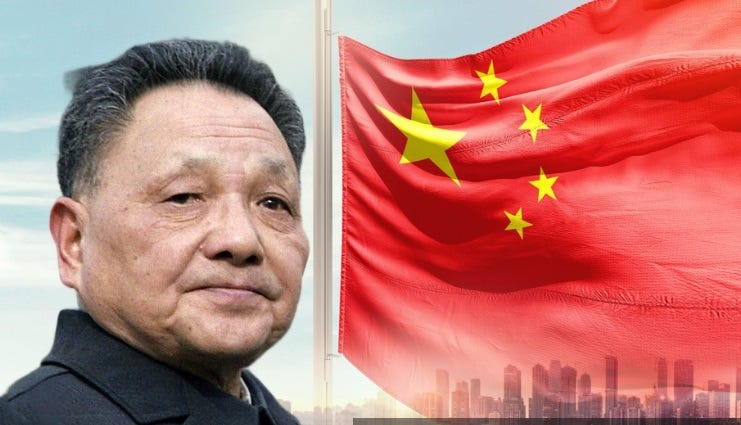
When China got a break: Deng Xiaoping imported the Japanese high growth formula
After nearly three decades of ideological campaigns on the people of China, and likely more than 60 million people killed in the process, even the died-in-the-wool communists had after the death of strongman Mao become tired of party-political programmes (see Part I for more on those). Consequently, it was an uphill battle for Mao’s chosen heir, Hua, to generate any enthusiasm and support. Instead, a growing majority in the upper echelons of the Chinese Communist Party felt keenly that continuity was not attractive, as things had not panned out that well. Instead, the decision-makers ordained that it was time for a change in direction, namely by allowing a reality-oriented pragmatist to take the helm who would focus on delivering results – such as economic development, strengthening the nation and making the Chinese people better off.
Every so often there are moments in world history when the senior decision-makers over nations are neither incompetent agents serving foreign agendas, nor evil, genocidal psychopaths.
The time was ripe for Deng Xiaoping, who had joined the early Communist Party of China in the 1920s and had been on Mao’s Long March in1934. Moreover, he had already been in positions of influence before, but had been unceremoniously deposed several times, sent to labour camps or had otherwise been suppressed. Known as a calm, able and even-handed administrator who had not been involved directly in the cynical anti-human policies of the previous decades, Deng was rehabilitated in 1977 and appointed Vice Chairman of the CCP. He was also appointed Vice Premier of the State Council and member of the Politburo.
Deng picked up the pieces and restored economic order. He was now generally supported, especially as Hua’s unsuccessful attempt to pin the blame for the biggest policy disasters on particular people, such as the “Gang of Four”, had merely driven home the realisation that China had lost many years, even decades in terms of prosperity.
The remainder of 1977 and much of 1978 were a time of preparation for Deng Xiaoping. Then, in December 1978, he gave a key speech, which has since been interpreted as Deng officially taking over the leadership in China.
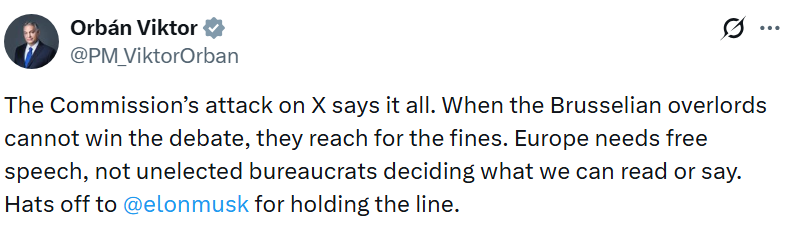
We are under sanctions, financial sanctions of European Union because we don’t let the illegal migrations to come to Hungary and to the European Union as well.
So we have to pay, just to inform you, we have to pay every day one million euro as a punishment to the Brazilian budget, because we stopped the migrants. This is the absurd world we are living now in Europe.




 American Buddhist Net
