Grandmother at Dublin protest against mass immigration: "I'm here for my children…my grandchildren…..our Celtic race..our culture, our traditions, and our Christian catholic religions, and I don't want Ireland to become an Islam stronghold" pic.twitter.com/25qDbgFlZn
— Tommy Robinson 🇬🇧 (@TRobinsonNewEra) May 6, 2024
In Thailand, Cambodia and Sri Lanka, Buddhists see strong links between their religion and country, as do Muslims in Malaysia and Indonesia
As some practices and philosophies related to Buddhism have become more commonplace in the United States and other Western countries, many Americans may associate Buddhism with mindfulness or meditation. In other parts of the world, however, Buddhism is not just a philosophy about mind and body – it is a central part of national identity.
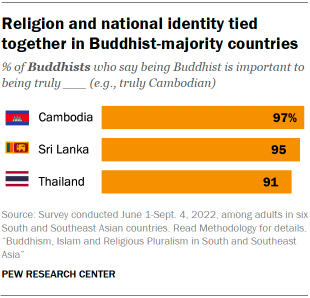
In Cambodia, Sri Lanka and Thailand – countries where at least 70% of adults are Buddhist – upward of nine-in-ten Buddhists say being Buddhist is important to being truly part of their nation, according to a 2022 Pew Research Center survey of six countries in South and Southeast Asia.
For instance, 95% of Sri Lankan Buddhists say being Buddhist is important to be truly Sri Lankan – including 87% who say Buddhism is very important to be a true Sri Lankan.
Although most people in these countries identify as Buddhist religiously, there is widespread agreement that Buddhism is more than a religion.1 The vast majority of Buddhists in Cambodia, Sri Lanka and Thailand not only describe Buddhism as “a religion one chooses to follow” but also say Buddhism is “a culture one is part of” and “a family tradition one must follow.”
Most Buddhists in these countries additionally see Buddhism as “an ethnicity one is born into” – 76% of Cambodian Buddhists hold this view, for example.
Trump phoned into Hannity's show last night to declare "we have to stop the anti-Semitism that's just pervading our country right now." He says the US needs to get the "courage" to support Israel even more unreservedly. "I think Biden is not on the side of Israel," Trump posits pic.twitter.com/nlh7GBJkzv
Here it is! The full speech I gave at #CPACHungary that the establishment is losing its absolute mind about.
I spoke the forbidden truth: The Great Replacement is no longer a theory – it’s reality. White Europeans are being replaced in their own countries at an ever… pic.twitter.com/L33UE3P6tv
This is an excellent speech, brief and straight to the point. I hope everyone watches it. A voice of reason in a sea of madness, Eva has become a significant leader for the entire contemporary West. ABN
Studies have found a pronounced decline in male effective population sizes worldwide around 3000–5000 years ago. This bottleneck was not observed for female effective population sizes, which continued to increase over time. Until now, this remarkable genetic pattern was interpreted as the result of an ancient structuring of human populations into patrilineal groups (gathering closely related males) violently competing with each other. In this scenario, violence is responsible for the repeated extinctions of patrilineal groups, leading to a significant reduction in male effective population size. Here, we propose an alternative hypothesis by modelling a segmentary patrilineal system based on anthropological literature. We show that variance in reproductive success between patrilineal groups, combined with lineal fission (i.e., the splitting of a group into two new groups of patrilineally related individuals), can lead to a substantial reduction in the male effective population size without resorting to the violence hypothesis. Thus, a peaceful explanation involving ancient changes in social structures, linked to global changes in subsistence systems, may be sufficient to explain the reported decline in Y-chromosome diversity.
In an exclusive interview with Remix News, Dutch political commentator and lawyer Eva Vlaardingerbroek warns Europeans that they must take a stand against rapid demographic change or become a minority in their native countries.
You’ve spoken a lot about White rights and the White replacement. But of course this kind of opens you up to these accusations of racism. So, how do conservatives deal with this Catch-22 of not wanting to be replaced in their native countries, but also not wanting to be attacked with this term?
You can’t. That’s the thing, you can’t. So you have to pick a side. Of course, you’re going to be attacked if you say, “Hey, this continent, Europe, has been predominantly White for the entirety of its history, and now suddenly within one generation, a few bureaucrats have decided against the will of the people that we should suddenly be a minority. Why do we agree with that, or why do we allow that to happen?” If you say that, you are going to be attacked.
But the only other option then you have is saying nothing and have it happen, so the choice is yours, and I’ve made my choice. I think there are many ways in which you can defend yourself, of course, against this ridiculous attack, so I’m sure that they’re going say about me that I’m a terrible racist again. No, that’s not true. I don’t think that any race is superior to another. I just think that mine is also not inferior to that of others.
Antisemitism used to mean “someone who doesn’t like Jews,” but nowadays it means “someone that Jews don’t like for some reason or another.” The deliberate trick here is to make you think there is something wrong not with the Jewish baby killers, liars, or scum who are doing bad things but with the person noticing and reacting to the bad things these miscreants are doing.
So, what are the bad things that most people notice about Jews? Before naming and defining the most important ones, let’s first find out what Jews themselves say about antisemitism. Is it a rational and logical reaction to Jewish behaviour? Or is it, as most Jews claim, an irrational hatred of a totally harmless people who have been the innocent victims of human jealousy, vindictiveness, and persecution since the beginning of time?
Theodore Herzl, the Jewish father of Zionism, believed that hostility towards Jews was a natural consequence of their behaviour:
This perfectly understandable reaction follows from the defects of the Jews… The Jews are a people distinct and separate from others, whose interests are different, and often in conflict with those of the peoples among whom they live.[1]
A fact shared by Chaim Weizmann, the first president of the State of Israel:
Whenever in a country the number of Jews reaches a certain level of saturation, that country reacts against them… Now, this reaction is not antisemitism in the ordinary or vulgar sense of the word, but a universal social and economic consequence of Jewish immigration; it is impossible to ignore it.[2]
“It seemed to me,” writes Bernard Lazare, the Jewish author of the book Antisemitism, its History and Causes,
that an opinion as universal as antisemitism, having flourished in all places and at all times, before the Christian era and after, in Alexandria, Rome, Antioch, Arabia, and Persia, in medieval and modern Europe, in a word, in all parts of the world where there have been and where there are Jews, it seemed to me that such an opinion could not be the result of a whim and a perpetual caprice, and that there must be deep and serious reasons for its blossoming and its permanence.[3]
Democrats did everything they could to make Black people become a cancer to this country. Why?
Because we didn’t need them, they envied our growth and independence. We are now witnessing a bitter slave master retaliating by showing his old slaves what his new desperate… pic.twitter.com/s6s0Icq6GN
— Dom Lucre | Breaker of Narratives (@dom_lucre) April 24, 2024
A low-profile case decided Wednesday by the Supreme Court could have big implications for employers’ diversity, equity, and inclusion programs.
Muldrow v. City of St. Louis was a case about a female police officer who alleged that she was transferred from one department to another because of her sex. She argued that the transfer violated Title VII of the Civil Rights Act, which forbids “race, color, religion, sex, or national origin” discrimination with respect to employment “compensation, terms, conditions, or privileges.”
She lost in the lower court because she could not show that the transfer caused her “significant” harm. The lower court held that the transfer “did not result in a diminution to her title, salary, or benefits” and caused “only minor changes in [her] working conditions.”
A unanimous Supreme Court reversed, holding that any harm—whether significant or insignificant—satisfies Title VII.
…Until Muldrow, cases challenging DEI programs faced the hurdle of having to prove “significant” harm. A judge might say, “Yes, you were discriminated against, but you didn’t really suffer.” To this, Kavanaugh and others would answer “discrimination is harm,” but that claim wouldn’t have gotten you anywhere.
A judge or jury sympathetic to DEI programs could easily say that a black person who was forced to work on certain projects to meet a client’s racial quota hadn’t suffered “significant” harm. Or that an Asian person denied the benefits of a mentorship program given to black employees hadn’t suffered “significant” harm. Or that a white person forced to undergo training telling her to “be less white” hadn’t suffered “significant” harm.
Today, that hurdle is gone. The harm requirement may now be satisfied by anything as simple as discomfort, status, or interest level. Functionally, discrimination alone is all that must now be proved.
That means that anti-DEI lawsuits just got a lot easier.
Ever since he was a child he’d had “incessant,” intrusive thoughts about his left hand’s fourth and fifth fingers, the sensation that they weren’t his, that they didn’t belong to his body. At night, he’d wake from nightmares that his fingers were burning or rotting.
The young Quebec man was so desperate to get rid of his fingers he contemplated building a small, makeshift guillotine. “He couldn’t imagine himself living for the years to come with those fingers,” according to a recently published case report.
Instead, a surgeon at his local hospital agreed to an elective amputation in what is being called the first described case of “digits amputation” for body integrity dysphoria, or BID, a rare and complex condition characterized by an intense desire to amputate a perfectly healthy body part, such as an arm or a leg.
The Quebec case involved an ambidextrous 20-year-old whose attempts at “non-invasive” relief, including cognitive behavioural therapy, Prozac-like antidepressants and exposure therapy, only increased his distress.
It’s set to be a massive change for a country that was still up until recently 97.5% ethnic Japanese, according to the CIA World Factbook.
A Bloomberg report details how rapidly declining native birth rates, an aging society and a chronic labor shortage is fueling the importation of millions of foreigners who “are changing the face of Japan.”
The number of foreign workers in Japan has now exceeded 2 million, a 12.4% increase on 2022. The East Asian country needs at least 647,000 working-age immigrants per year to meet its 11 million worker shortage by 2040.
A BBC News report about Japan’s previous refusal to adopt mass migration highlighted how the country was “stuck in the past,” with that past being characterized as “a peaceful, prosperous country with the longest life expectancy in the world, the lowest murder rate, little political conflict.”
Organized crime is Mexico’s fifth-largest employer, accounting for between 160,000 and 185,000 people and the only way to crack down on the problem is to prevent the recruitment of new members in a country where criminal groups enlist 350-370 people into their ranks every week. These are the conclusions of a study by the Complexity Science Hub Vienna, published Thursday in the journal Science. It is one of the most ambitious approaches to the difficult task of quantifying in numbers the power that criminal groups hold in Mexico.
The lead researcher on the study, former Mexico City police officer Rafael Prieto-Curiel, says the path is clear: “Neither through the courts nor through the prisons. The only way to reduce violence in Mexico is to cut off cartel recruitment.” The researchers combined data on murders, missing persons, incarcerations, and cartel interactions between 2012 and 2022 to reach this conclusion.
One of the most relevant findings from the study is that despite the imprisonment of thousands of members, the size of criminal organizations is larger than it was 10 years ago. Mexican authorities sentence around 6,000 cartel members to prison terms every year. However, Mexico’s cartels had 60,000 more members in 2022 than they did in 2012.
I’m aware dating isn’t allowed in Islam, but I’ve been dating a Muslim guy for a year now. He’s talking about marriage and trying to convince me to convert. I just have to vent.
I wish islam was more open minded. Why would it ever be a good idea to follow a book word for word from thousands of years ago when people still believed the earth was flat? Why would people want to reject modernization?
I’m not religious myself but if I did accept a higher power he wouldn’t send people to hell for eating pork or not covering your hair. He wouldn’t make people gay and then expect them to deny themselves of any romance for their entire lives as a “test” It just seems so outdated and controlling and man made. My boyfriend although he calls himself Muslim he tells me he believe in evolution and is okay with me not wearing hijab, he has had premarital sex and occasionally smokes weed but says he has stopped. But when I try to convince him to have a more open mind when it comes to religion it’s like he reverts back to a close minded person.
I don’t mind my future kids being religious but I can’t have them learning that being gay is wrong and that my daughter has to cover her hair to protect herself from men… I don’t want them to be afraid of their loving god sending them to hell for simple things even my boyfriend has done.
I love him but sometimes the religion aspect is so frustrating. And I feel like when I question it too much he gets offended and I worry he starts thinking I’m not worth all this trouble.
Is anyone else here in a relationship with a Muslim? I hope I’m not alone.
I am posting this because I find religion and culture almost always interesting. Judge the comments at the link above as you like. Religion can be a strong form of culture, and as such extremely rigid, impenetrable, impossible to join in from outside. Each culture and religion has different gradations of this.
My experience with Buddhism is the religion is very mild toward non-Buddhists, even open and accepting, but when the religion is deeply imbued with a historical culture, problems may occur as Buddhists who are doubly-bound by culture and religion very often believe or act as if they believe that their culture and Buddhism are ‘the same’ or ‘one thing’.
In cases like that, you might encounter irreconcilable difficulties if you are from a different culture. For example, some old-school Buddhists might believe that you cannot possibly understand the Dharma if you do not speak their language, even when the Buddha said precisely the opposite. ABN


 American Buddhist Net