The International Longshoremen’s Association (ILA) and the US Maritime Alliance (USMX) have until January 15 to agree on a new contract. This is the result of a temporary deal reached in October.
President Trump announced his support for the workers’ position following a meeting with Harold Daggett, the president of ILA, and Dennis Daggett, the union’s executive vice president.
…the main point that most overlook.
In Asia and Europe, port automation is happening rapidly. However, in Asia and Europe they have rules and regulations against foreign ownership of their ports. In Europe, Asia and particularly China, ports are considered critical national security infrastructure by the politicians who represent the people. In the USA our politicians represent the multinational corporations and as a result we have sold the majority of our ports to Saudis, Qataris, Europeans and Chinese owners.
If Chinese ports are automated in China, they are operated by Chinese owners. If American ports are automated in the USA, they are operated by Chinese owners. It doesn’t take a genius to see the problem.
Palantir CEO Alex Karp appeared at the Reagan National Defense forum, and does a great job advocating for the U.S. to win the artificial intelligence race. Karp believes it is possible to insert “values” into the software at strategic places of connection, and thereby control the outputs. The question within the AI race then becomes, whose values? Ours or our enemies?
In a series of video segments placed onto a Twitter Thread, you get a good sense for what Palantir, Karp, Peter Thiel, Elon Musk and newly appointed White House Czar of AI, David Sacks, are trying to do inside this global race toward artificial intelligence as applied to government systems.
The video segments at the above link provide a decent sense of what Karp thinks and where USA may be headed. Very much worth listening to what he has to say. It’s true we all fear the ominous possibilities AI tech and Palantir may hold for the world. But it is also true, those technologies may produce wonderful outcomes. Karp is very optimistic about the tech (which is his job) and also about USA. I tend to be optimistic in both of those areas myself (not my job) and also believe we would all do well to look favorably on our future and those most in charge of it today — Thiel, Karp, Musk, Trump, RFK, et al. ABN
On November 19, President-Elect Donald Trump announced that Howard Lutnick, CEO of Cantor Fitzgerald and co-chair of his transition team, would be his nominee for Commerce Secretary. Lutnick’s company Cantor Fitzgerald and its subsidiaries are multinational in scope, promote the implementation of the United Nations’ Sustainable Development Goals (which have major implications for debt politics and economic activity), and are even directly partnered with foreign state-owned firms that recently came under scrutiny following the release of the contents of the laptop of the current (and recently pardoned) First Son, Hunter Biden.
Lutnick had previously been angling for a job as incoming Treasury Secretary, an unsurprising ambition given Cantor Fitzgerald’s outsized role in the U.S. Treasury market (i.e. the U.S. government debt market) and its relationship to dollar stablecoins, which are rapidly becoming one of the main purchasers of U.S. debt. It is unknown currently why Lutnick was passed over for Treasury, despite endorsement for the position from Elon Musk and RFK Jr., and appointed to Commerce instead. However, Trump’s previous Commerce Secretary, Wilbur Ross, was widely believed to have been given the role to repay a past favor of major significance. In Ross’s case, it was his assistance in rescuing Trump from bankruptcy in the early 1990s. At the time, Ross worked for Rothschild Inc., and when clarifying why the European banking dynasty had bailed out the future President, Ross stated “the Trump name is still very much an asset.” Shortly before, Rothschild Inc. had been bankrolling the entry of Robert Maxwell, intelligence asset for Israel and arguably the Soviet Union, into the American economy, with a specific focus on New York City.
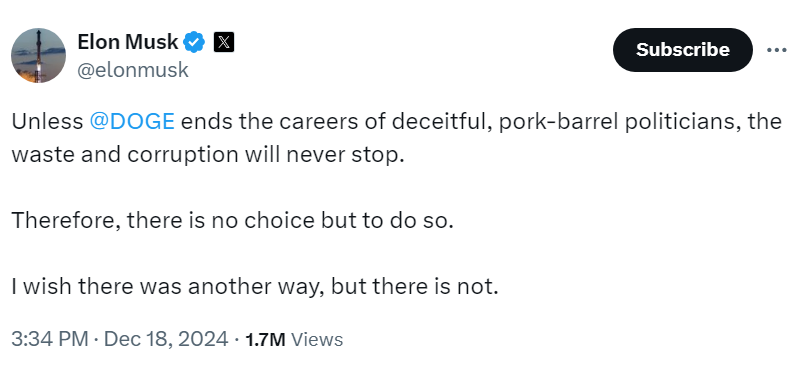
I have been waiting for someone, anyone, to outline the reality of what the Dept of Government Efficiency (DOGE) is all about. Unfortunately, perhaps due to the history of the matter, it appears no one really “gets it.” So, with that in mind, and accepting that even the operators of DOGE may not have a fulsome comprehension of the dynamic, here is what it all means.
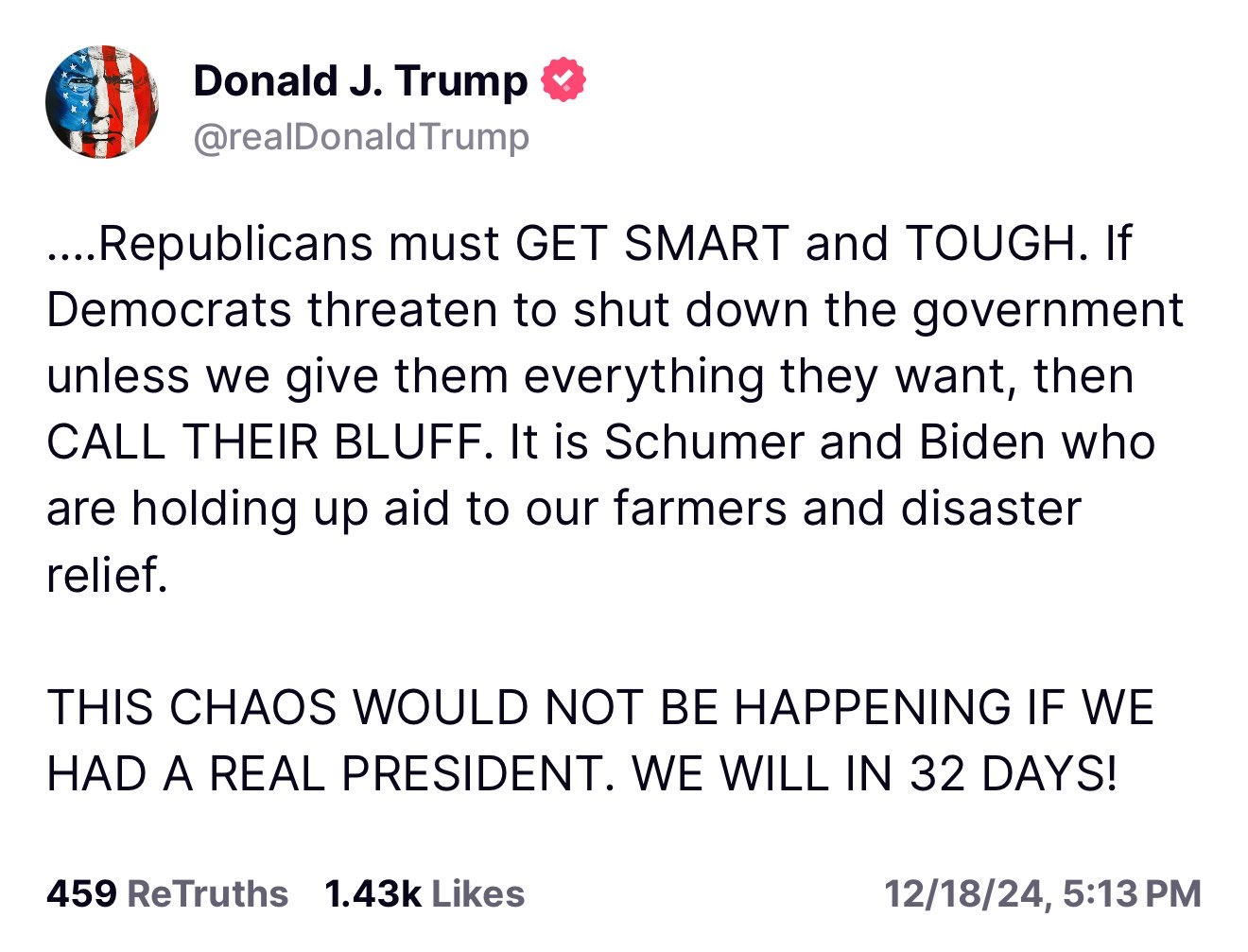
Few people realize the last Federal Budget that passed through “regular order” was for Fiscal Year 2008, signed by President George W Bush in September of 2007. Every budget since has been outside regular order; a series of continuing resolutions, omnibus spending packages and short-term funding mechanisms. {CITATION}
That is correct. In the past 17 years, all federal spending has been ‘short-term’ or ‘stop-gap’ spending measures, generally known as “Continuing Resolutions,” where the govt (House and Senate) continue to perpetually resolve to fund the government. The CRs as they are known, punt the spending debate by accepting a baseline of prior spending and tweaking around the edges.
The key takeaway to begin thinking about DOGE is to understand that REGULAR ORDERhas not been used since Fiscal Year 2008.
Title III of the Congressional Budget Act outlines a legal timeline that each President and Congress must follow {SEE HERE}. Prior to 2007, Continuing Resolutions were only used to resolve short term arguments about spending priorities.
♦ BACKGROUND – The President is required by law to submit his budget by the first Monday in February. Yes, even when an election takes place and a President doesn’t assume office until January 20th, the first Monday in February is still the legal requirement for the new White House budget proposal.
The Presidents’ budget is then submitted to The House of Representatives, where two weeks later the Congressional Budget Office, reviews the budget and issues an opinion as to the cost of the budget. No later than six weeks after the President submits his budget all House committees send the House Appropriations Committee their spending proposals [April 15].
Through May and June, each budgetary appropriations bill from the House is sent to the Senate. The Senate receives the House appropriations bills, then reviews through the Senate Appropriations Committee (Thune just picked Susan Collins as Chair). The Senate proposes their spending priorities based on the House bill because the House has constitutional authority to originate all spending [June 15]. The House and Senate budgets are “reconciled” using parliamentary procedures [June 30] and then sent to the President for signature.
The fiscal year begins October 1st.
That’s the regular order process.
Again, regular order has not been followed since Fiscal Year 2008, signed by George W Bush in September of 2007.
♦ The Problem – When congress doesn’t follow regular order they end up with a series of “continuing resolutions” (CRs) where spending is decided on a short-term basis because they don’t have an agreed budget. The problem with CRs is what’s called “baseline budgeting” where all prior spending is the baseline for the continuation of spending proposals. The baseline accepts all previous spending priorities, then adds to them with the new spending needs.
[This is a very clear, succinct, and valid overview of what is going on. I highly recommend reading the entire piece, which is not long. The more we understand, the more likely we are to support what is happening. ABN]
Aprominent Chinese economist has suggested there are discrepancies in China’s official data, questioning the true state of the world’s second-largest economy.
The critique by Gao Shanwen, chief economist at SDIC Securities and a former official at China’s central bank, comes as many economists question China’s officially reported figures and as the country continues to grapple with a property sector crunch, high youth unemployment and a range of other issues.
China reported GDP growth of 5.2 percent last year and set a target of around 5 percent for 2024. However, the People’s Daily, a state-run newspaper, recently tempered expectations by emphasizing there is no need to “worship speed.”
One area of concern is the relationship between GDP growth and employment. Gao noted that before the pandemic, economic growth reliably translated into increased urban employment. However, he said this correlation has broken down in recent years.
“If we think the employment data is credible, then economic growth is too high,” he said. “If we think the economic growth data is credible, then the employment data is too low.”
Gao also pointed to irregularities in consumption and investment trends.
Presidential candidate Elena Lasconi, the leader of the reformist party Save Romania Union (USR), announced a pro-European rally in Bucharest’s Victoriei Square this Thursday, December 5.
“Join me in the march to support European values,” Lasconi urged in a message shared Tuesday evening. The rally is scheduled for 5:00 PM in Victorei Square, as detailed in the official Facebook event.
Elena Lasconi advanced to the second round of Romania’s presidential elections, scheduled for December 8, alongside ultranationalist independent candidate Călin Georgescu. She has repeatedly positioned herself as pro-Europe and pro-democracy, opposing Georgescu’s controversial stance on Romania’s EU and NATO membership.
In older interviews and statements, ultranationalist Călin Georgescu, the frontrunner in the first round with roughly 2.1 million votes, has questioned Romania’s membership in the EU and NATO. As these declarations started to surface after his shocking first-round win, young people and students across Romania began taking to the streets to voice their support for European democracy and opposition to nationalist and extremist ideologies.
Thus, the presidential runoff between Lasconi and Georgescu has been shaping up to be a contest between pro-European reformism and ultranationalist skepticism.
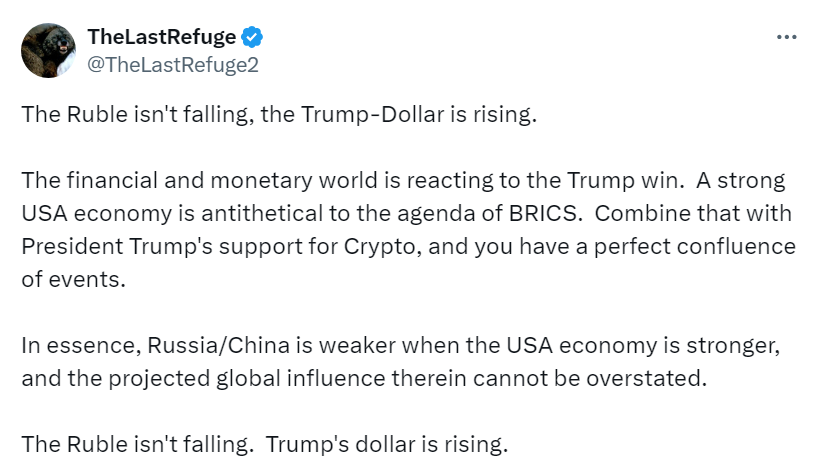
Go big picture. The FED will slow rate drops not because politics per se’, but rather it is a tacit admission they know the MAGAeconomy is going to explode – red hot.
Trump’s policies create actual deflation. We’ve seen it before. We know it first-hand. Goods prices will drop. Food prices will drop. Gasoline prices will drop. The dollar will skyrocket. Service prices will go up, but only because demand increases.
As President Trump imports American wealth back into the USA, we benefit. The multinationals, and their pretending financial media have to pretend not to know this; but you can see it in reactionary data.
The FED knows the Trump economic plan leads to almost immediate dynamic growth. Yes, they suck, but they suck because they pretend not to know how good President Trump is for the USA economy. Nothing more.






 American Buddhist Net