In defense of Jeffrey Sachs — Ron Unz

A few agitated commenters have once again begun denouncing Prof. Jeffrey Sachs for allegedly being responsible for the Western looting of Russia during the 1990s.

Frankly, a decade or two ago I’d vaguely had the same opinion since I’d always seen him described in the newspapers as one of the key economic advisors to the Russian government of that period and had read some article somewhere making that claim. But I’d never explored this matter and over the last couple of years I’ve become convinced that my impression was entirely mistaken.

Therefore, I’d urge that people read Sachs’ article providing his version of the history, very similar to what he’d said in his 2005 book, which I’d read earlier this year. I’d also strongly suggest that people watch his detailed interview, which he apparently arranged after Taibbi and the other hosts had casually made that same mistaken accusation in a previous show.

Over the last couple of years I’ve watched a number of his interviews in which he discussed these matters, and all I can say is that he’s either being honest or he’s about the best liar in the history of the human species.

As far as I can tell, the only reason people believe Sachs was responsible was one 1998 article published in the Nation plus portions of Naomi Klein’s 2007 book. Mistaken ideas sometimes get into circulation and are then repeated back and forth so many times that everyone assumes they’re correct. But I’ve carefully read those two sources and I found Sachs’ account much more persuasive.

More importantly, President Putin and the top Russian leaders have denounced the 1990s policies as one of the greatest economic disasters of the 20th century and have been scathing in their denunciations of the American advisors who they blamed for the looting of their country and the total impoverishment of the Russian population. However, they’ve never included Sachs in that category, and instead they have always treated him with respect and friendship.

I think that Putin and his leadership team have a much better idea of what really happened during the 1990s than any of us do, and the identities of the heroes and the villains. So I trust Putin’s judgment on such things.

This issue has major importance because of Sachs’ current status as one of the foremost critics of American policies. Indeed, in my articles I’ve made that point that Sachs has probably now become the highest-ranking American ideological defector of the last one hundred years, or at least no other obvious names come to mind:

link

I have been extremely suspicious of Sachs and avoided posting any of his material on this site. I am willing to consider Ron’s argument but also can’t not notice, once again, it’s one Jew defending another. ‘The best way to control the opposition is to lead them’. If you click on the link to Ron’s comments and read some other comments, you will get a fuller picture of this issue. I, for one, remember the rape of Russia and that Sachs was a prominent exponent of economic ‘shock therapy’ not only in Russia but also South America, if memory serves. I may be wrong and am willing to change my view of Sachs but am not eager to do so. Below is a recent video of Sachs commenting on Ukraine. In that video, he blames everything on ‘USA’ when the reality appears to be different and rife with his tribe always at or near the top. So, I dunno. Best to be suspicious, yet at the same time ready to forgive anyone who honestly repents and changes their ways. Of course, Sachs is claiming he never was doing bad things in Russia and Ron’s use of Putin’s non-criticism of Sachs is illuminating, but there are surely many dark wrinkles inside of that. A non-confession, non-repentance, I-was-always-right-and-good argument might be true, but consider the sources. ABN
Continue reading “In defense of Jeffrey Sachs — Ron Unz”

How 20k Haitians Stormed Ohio to Take Jobs that Were Never Advertised

The Haitian Invasion of Ohio has created a lot of buzz. There are a lot of unexplained aspects of it that people find odd. One of these strange happenings is that locals… 

reported that the jobs the Haitians came for were never advertised to the local population. So how did the Haitians find out about them?

It turns out that a network of federal grant recipient organizations have quietly seized control of nearly the entire job market in the US… 

and work to ensure that openings remain “hidden” so that refugee’s can take them ahead of American citizens. How many job openings remain hidden? The internal estimates of this network put the number of hidden openings at 80% of all available jobs.

link

Why Western energy policies are driving manufacturing away

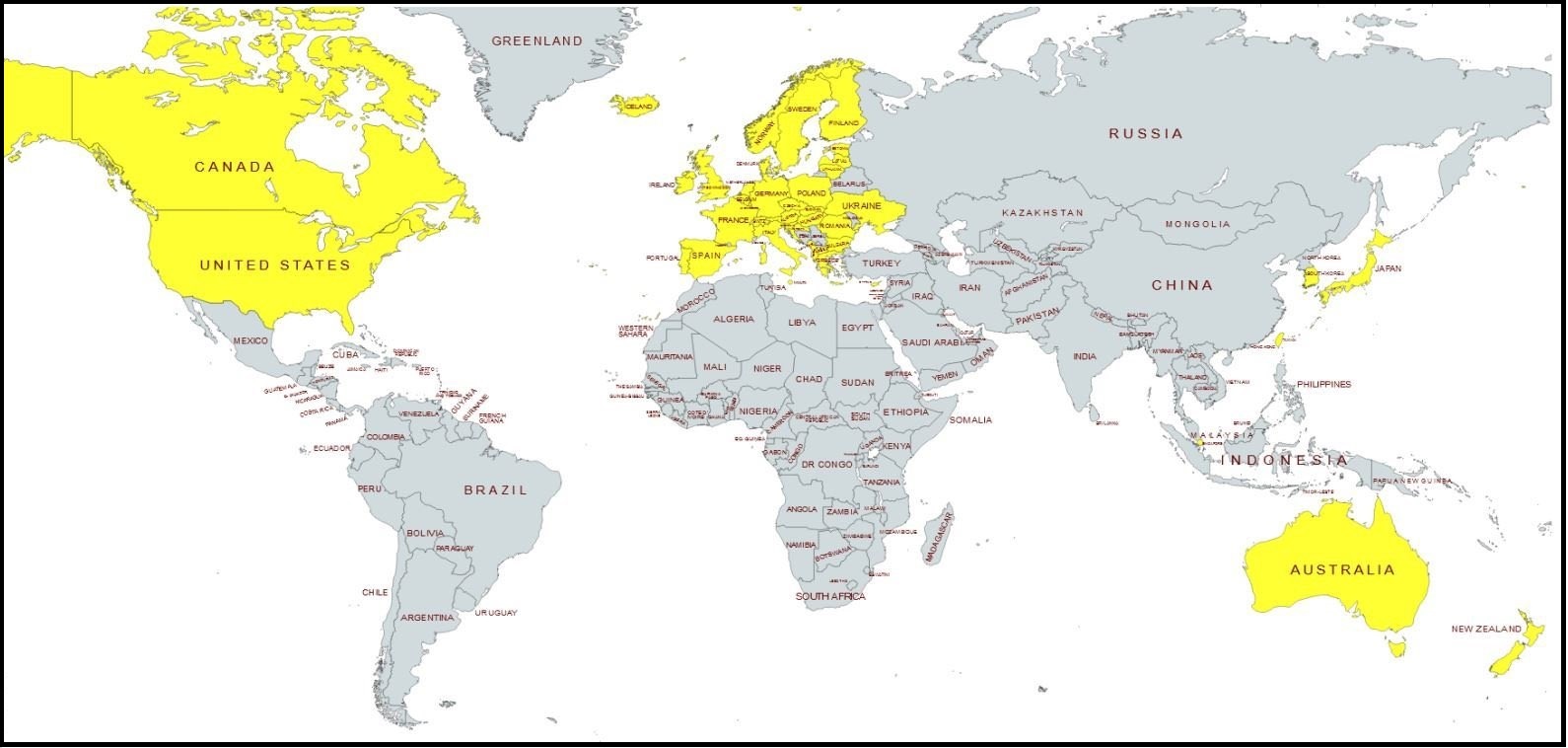
…if you look at the investment footprint -where the multinational corporations actually put all of that money they have been extracting from the Western consumers, you will see they have spent the past generation investing heavily in the “GREY Zone” within the map below.  With that reality as the backdrop, would the multinationals lose or benefit from the “Build Back Better” agenda that pushed the YELLOW zone into a system of forced drops in the standards of living?

What you will note from the post-COVID “build back better” pushers, also not coincidentally the same interests who pushed the Russian sanction regime, is their investments in the grey zone act as offsets for the current collateral damage.

In essence the multinationals created a win/win.  Their BBB policy within the yellow zone intentionally drives prices higher, while their investments were hedged creating low ‘total cost of goods’ (TCG) manufacturing systems outside the West. 

..it is a self-fulfilling prophecy; one you might note is exactly the preferred outcome of the Barack Obama worldview.  The West spreads the wealth to the Grey zone, then the 3rd world (non west) starts to replace the economic strength of the West because they are not restrained by the insufferable policies of the climate control/energy policy group.

The West ends up in a position where we cannot compete not only on the issue of ‘cheap labor’, the historic problem, but also on the issue of cheap reliable and abundant energy production.

On the financial side, the citizens within the Western Build Back Better zone suffer through inflation and massive losses in stand of living, while the alternative areas gain the benefit of better competitive manufacturing prices.  The multinationals simply shift the area from which they make money.

The “exfiltration of wealth” we have previously discussed, ends up as investment into manufacturing systems we cannot compete with.

The attendees of the World Economic Forum benefit because the multinationals who make up the WEF assembly have prepositioned their assets and investments.  This is being done by design.  None of the downsides to this energy policy affect the WEF bank accounts, the only people who suffer are the citizens forced to pay higher prices and fewer jobs.

This dynamic is not going to stop unless the West immediately reverses course on energy production.

link

Yet another proof the West is ruled by people who hate the West. Every single policy in the West is designed to weaken and harm the West, no exceptions. ABN

Nearly 50 years ago, Vanguard disrupted the investing world by launching the first index fund for individual investors. Now comes the sequel

Nearly 50 years ago, Vanguard disrupted the investing world by launching the first index fund for individual investors. Here comes the sequel.

Investors have tried everything to avoid paying those pesky capital gains tax bills in their mutual funds. Now Vanguard’s got an ETF share class for that — and by most indications, it could upend the $28 trillion fund industry. 

The world’s second largest investment company after BlackRock, the Malvern, Pennsylvania-based Vanguard has experimented with a method for constructing exchange-traded fund share classes of its existing mutual funds over the past two decades. It’s been so successful that the company reportedly used the structure in 14 stock funds that booked $191 billion in gains for investors as of 2019 and paid out a total tax bill to the Internal Revenue Service of $0.

It’s a mouth-watering metric that took on even more significance after Vanguard’s prized patent expired last year. Now, Charles Schwab, Morgan Stanley, Fidelity, and roughly a dozen other companies have filed applications with the Securities and Exchange Commission to copy the structure. While it’s unclear whether the agency will approve the applications, its eventual decision holds enormous sway not only on the industry but also potentially over hundreds of billions of dollars in revenue for the Treasury.

link

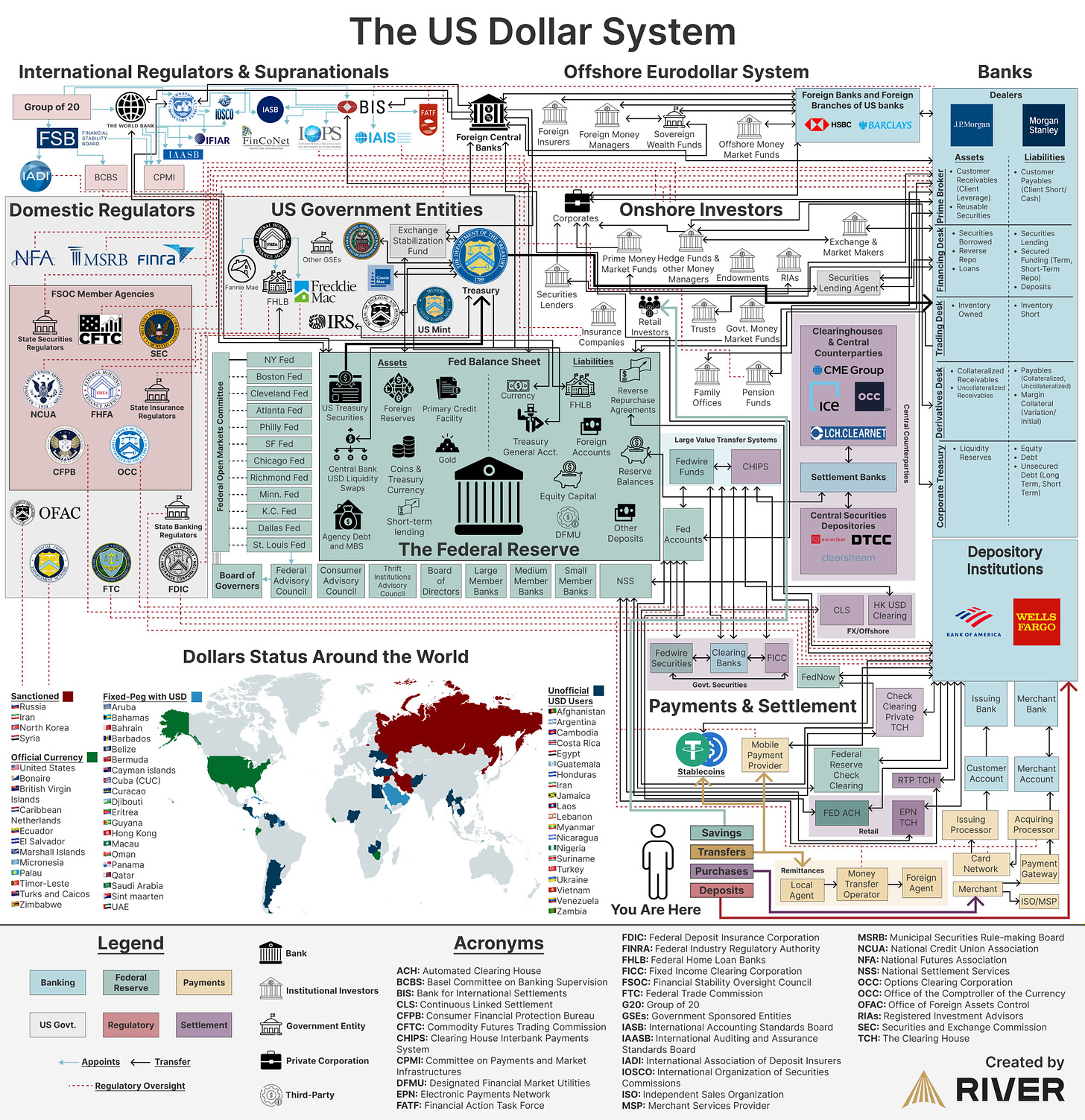
The Shadow Money System That Rules the World: And why the dollar isn’t going away

In any alternative media space, you are sure to find much talk about US dollar dominance, as well as optimistic forecasts of its imminent decline. This is also true in the radical right, where nationalists pine after an end to US imperial hegemony and the rise of a more multipolar world.

Often though, this hope is little more than wishful thinking, with unlikely challengers to US power much overhyped. This is especially true concerning US dollar hegemony, a topic that is ripe for misunderstanding at the best of times.

It’s important to keep in mind that people have been forecasting the decline of the dollar ever since it attained its status as global reserve currency. As far back as 1960, the economist Robert Triffin was warning of an “imminent threat to the once-mighty US dollar”. Understanding the reason for Triffin’s pessimism, and why it turned out to be misguided, is crucial to understanding today’s global monetary system and the enduring dominance of the dollar.

Triffin’s concerns were more informed than most: his “Triffin dilemma”, as it came to be known, highlighted an inherent problem with a country’s national currency also serving as the reserve currency of choice for the international system. The country supplying the world with the reserve currency has to produce a surplus of money, thereby creating a trade deficit. In other words, the supplier country needs to be continually losing money to fill up the reserves of other countries and make the currency a low-risk option to hold as a reserve. But if the supplier country becomes too indebted to the rest of the world in this scenario, then its currency ceases to be such a low-risk asset, and that’s the dilemma.

…For all the scare-mongering from libertarians about “Fed money-printing”, it is international bankers — outside the regulations of the US Federal Reserve — who are the ones in control of creating the US dollar supply on international markets. Big commercial banks create Eurodollars using the offshore system without the backing of the Federal Reserve. This is done through fractional lending, where dollar deposits are used as collateral to loan out a higher amount of dollars.

link