China is constructing a secret military base in Tajikistan, satellite images reveal, as it seizes on the rising threat to security posed by Taliban-ruled Afghanistan.
Beijing has been building the base in one of the most remote corners of the world for almost a decade. China signed a security pact with Tajikistan in 2016.
The facility, carved out of mountains that rise 13,000ft high, has look-out towers and troops from both countries, which now hold regular joint military drills shown on Chinese state media.
Neither government has publicly acknowledged the existence of the base, which extends a former Soviet outpost. But the images show a steady pace of construction, including access roads to the base.
Concern is rising that Beijing plans to do the same in neighbouring nations, as it boosts relations with Tajikistan at a time when Russia, its usual economic and security partner, is embroiled in its invasion of Ukraine.
On July 4, president Xi Jinping cemented growing ties with Tajikistan in his third state visit.
“The situation is that of a vacuum, and the vacuum is filled by China,” said Parviz Mollojonov, a political scientist and acting country director for International Alert, a UK-based NGO that promotes peace.
“Since the deterioration of the situation in Afghanistan, China uses the concern of the Tajik government to build in the security sector.”
Central policy and money laundering have created networks that aid traffickers.
A mixture of unintended consequences and indifference has left China playing a significant role in America’s fentanyl crisis. This has become a point of heated contention between Beijing and Washington. U.S. politicians accuse China of deliberately stoking the U.S. drug crisis; China responds that it has done its part and the United States is scapegoating.
But the actual story of Chinese regulation is far more complex and messy—and shows how powerful the profit motive is and how regulatory effects can have unintended consequences. The Chinese government regulates the production and distribution of fentanyl and its precursor chemicals, but stopping the trade is a challenge. Policies aimed at boosting China’s chemical and pharmaceutical development and exports have instead created a vast cottage industry of hundreds of thousands of small chemical plants and active pharmaceutical ingredient (API) manufacturers—and with it, a vast money laundering industry that takes advantage of the advanced real-time settlement capabilities of China’s banking system.
A U.S. Customs and Border Protection (CBP) officer finds pills in a parcel at John F. Kennedy Airport’s postal service facility in New York on June 24, 2019. Dozens of law enforcement officers sift through packages, looking for fentanyl. JOHANNES EISELE/AFP VIA GETTY IMAGES
Understanding how to control fentanyl requires understanding how to make it. Fentanyl has many variants with similar sounding names that are chemically distinct but cause similar reactions in the body; the variants are merely different icing on the same cake.
Since its creation in 1959, researchers have developed at least three different manufacturing methods for fentanyl, each relying on different precursor chemicals as part of the process. Criminals have continued to adapt these processes to use a broader set of more readily available precursor chemicals—like using margarine because you’re all out of butter. The potential manufacturing methods are limitless. Criminals seeking to profit from fentanyl and governments seeking to control its supply are locked in a never-ending competition, with each new countermeasure spurring further innovation to circumvent it.
For many years, Chinese regulators attempting to uphold the country’s traditionally strict anti-drug policies faced a challenge as new variants of fentanyl emerged faster than they could be administratively added to the list of controlled substances. Between 2012 and 2015, only six new fentanyl variants emerged, but there were 63 new variants in 2016 alone. In response, the Chinese government placed all variants of fentanyl on the controlled substances list as of May 2019.
Since the election of Margaret Thatcher’s Conservative government in 1979, Britain has undergone a great experiment. Economically, the UK became the exemplar of neoliberalism in Europe. Politically, the UK has quietly transitioned to a postnational state, undergoing one of the greatest demographic transformations in the West.
Although the landslide victory of Tony Blair’s “New Labour” in 1997 may have seemed like a return to the model of European social democracy that Britain exemplified after the Second World War, Blair’s “Third Way” represented rather the embrace of neoliberalism by the establishment Left, summed up nicely by their spokesman Peter Mandelson’s declaration that “we are all Thatcherites now”.
Under the leadership of both the Conservative Party and New Labour, Britain has transitioned from a traditional industrial and manufacturing powerhouse to a highly financialised rentier economy. The effects have been profound. The average Briton is considerably worse off and entire regions have been left behind at the same time London has become a booming centre of international finance. The UK has been denationalised by decades of mass-immigration and cultural leftism, and has become the prime example of “anarcho-tyranny”, where the state punishes minor offences and acts of dissent against the liberal consensus with extreme force, while serious crime runs out of control in major cities.
The Rentier Regime
The fundamental transformation in the British economy since the 1980s is the movement away from an economy that made things to an economy that made money . Up to then, Britain’s economic might had been centered on its manufacturing. Britain was the birthplace of the industrial revolution, and the dual expansion of its colonial empire and rapid advances in engineering allowed for the creation of a vast trading network, where colonies provided the raw materials and markets for British manufacturing. Northern English cities like Manchester, Sheffield and Newcastle became manufacturing powerhouses serving the world.
…The graph below demonstrates the explosion in London-based financial services in delivering growth for the British economy
UPDATE: This is an exceptionally good article. It covers much more than even a longish sample can convey. I highly recommend reading it. It has clarified and altered my understanding of the UK. ABN
June 26 (UPI) — The Japanese yen fell below 160 against the U.S. dollar on Wednesday, its lowest point in more than 37 years as Tokyo scrambled to determine what appropriate intervention measures to take.
The record fall of the yen follows Japanese and South Korean national forecasters expressing alarm on Tuesday after the depreciation of their currencies. The United States had placed Japan on its watch list of currency manipulators last week.
The yen fell to 160.39 during London trading hours at one period, its lowest point since 1986. On April 29, the yen fell to 160.24 against the U.S. dollar, leading to intervention by Japan’s central bank.
As the AI market matures, there is a stark realization in public sectors elsewhere that this is America’s AI world.
You can just picture Sam, Elon, Satya, and Jensen in a Silicon Valley karaoke joint somewhere belting out that ‘80s classic: We are the world.
While governments try to wrap their heads around how to legislate for the Brave New World the US tech industry has thrust upon them, they’re also jostling to grow domestic AI industries. As the AI market matures, there is a stark realization in public sectors elsewhere that this is America’s AI world — the rest of us just live here.
If You Can’t Beat ‘Em, Incentivize ‘Em
Reining in Big Tech means different things in different countries, of course. In China, the Great Firewall is being maintained, more or less. Starting July 9, developer access to ChatGPT will be cut off in China, and domestic rivals are flocking to fill the Sam Altman vacuum. Slightly further down the sliding scale of governmental control is the European Union, which passed the AI Act in March and recently told Meta to stop scraping people’s Facebook data (oh, Meta!) to train its large language models. But EU member states are keen to set themselves up as an AI hub — especially France, which CNBC reports is vying with ex-EU member the UK to attract AI investment.
The pace at which AI has damagedcountlessindustries is whiplash-inducing. And no one understands this better than a writer who in 2023 was excelling at his copywriting job with a team of writers 60 people strong — and by the next year found himself the last human standing, arm in arm with AI imitators he was expected to drag along and get up to speed.
“They wanted to use AI to cut down on costs,” the writer told the BBC, using the pseudonym Benjamin Miller.
At first, the new workflow was this: his manager would feed a headline into an AI model, and it would generate an outline that the team were expected to work with, with Miller doing the final edits.
But that was just the beginning. Months later, management decided to cut humans out of the loop almost completely. Going forward, the AI model would generate articles in their entirety. Shoddy automation was here, and as a consequence, most of the writers lost their jobs. Miller kept his — though his role was going to be a bit different than before.
Now, he was tasked with polishing up the AI’s lackluster prose, and, to quote the BBC, “make it sound more human.” If only there was a way of doing that with, uh, human writers.
Dehumanizing Drudgery
Soon, Miller was the only human employee left on the team. It was down to him, and him alone, to fix up all the AI-generated articles.
“All of a sudden I was just doing everyone’s job,” Miller told the BBC. “Mostly, it was just about cleaning things up and making the writing sound less awkward, cutting out weirdly formal or over-enthusiastic language.”
“It was more editing than I had to do with human writers, but it was always the exact same kinds of edits,” he added. “The real problem was it was just so repetitive and boring. It started to feel like I was the robot.”
And so Miller found himself in the unenviable position of legitimizing the intrusion of AI into his very own job by making the extremely fallible models appear more capable than they actually are. This hasn’t been a fate exclusive to writers; in the service industry, for example, an army of underpaid, outsourced workers secretly worked behind the scenes to power the “AI” drive-thrus at the fast food chain Checkers.
I worked as a translator for many years. Gradually, computers took over and I moved on. I found it liberating to be replaced by machines. The other day I posted a song supposedly composed and played by AI. I think the song is pretty good and is a masterpiece of composition, employing almost every major lyrical and musical trope in its genre. It’s humorous, cleverly mocking, has many good lines—I think her name was Hailey. Where’d you run? The song was based on a Tik Tok clip with the pictured women making a reference to a sexual act. She was joking. The video was widely received with good humor. You can find more reactions at the link. As for the musicality of the tune, I play guitar but AI selected riffs ‘twice as better than I will’. Lots of people dump on music, especially country, because it’s just simple patterns. Steve Pinker has said as much. But AI is going to show Pinker that even his exalted thoughts and prose can be imitated. They too are just simple patterns, tropes. AI is revealing the core of Buddhism, itself the root of skepticism and stoicism, by forcing us see and feel the amalgam of experience and memory that is human ‘creativity’, its transience, emptiness and copyableness by a machine. ABN
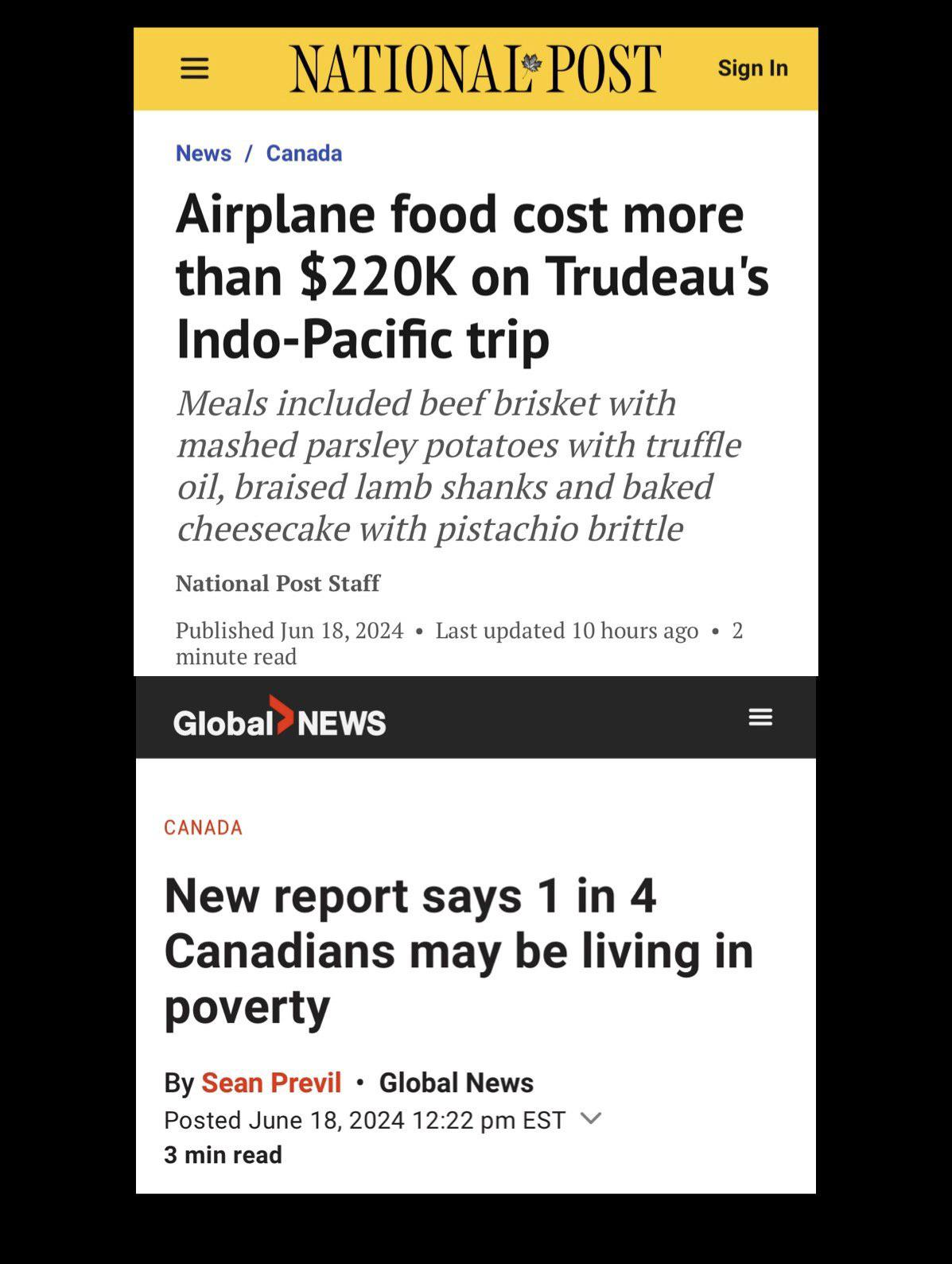
How cabal treats indentured slaves who face the public for them while pretending to rule. Notice how cheap it is to infiltrate and takeover a country. You can buy a few hundred of these for peanuts while ‘earning’ total control of Canada, for example. ABN
NVIDIA today announced Nemotron-4 340B, a family of open models that developers can use to generate synthetic data for training large language models (LLMs) for commercial applications across healthcare, finance, manufacturing, retail and every other industry.
High-quality training data plays a critical role in the performance, accuracy and quality of responses from a custom LLM — but robust datasets can be prohibitively expensive and difficult to access.
Through a uniquely permissive open model license, Nemotron-4 340B gives developers a free, scalable way to generate synthetic data that can help build powerful LLMs.
The Nemotron-4 340B family includes base, instruct and reward models that form a pipeline to generate synthetic data used for training and refining LLMs. The models are optimized to work with NVIDIA NeMo, an open-source framework for end-to-end model training, including data curation, customization and evaluation. They’re also optimized for inference with the open-source NVIDIA TensorRT-LLM library.
Britain is the world leader in anti-Russian politics. The Brits hate Putin and zealously encourage the Ukies to fight their Russian cousins to the last drop of blood. The Russians and the Ukies were ready to sign a deal in February 2022, until British PM Johnson arrived in Kiev to convince the Ukies to drop it. And so they did. Ever since then, the Brits have been the leading force pushing the Ukies to fight, and convincing NATO members to help them fight. The Brits are leading the global anti-Russian campaign. These are the facts. However, the explanation of these facts evaded me until now.
Recently a promising young reporter called Dood (or maybe Doodj), spoke to a leader of the Russian pro-Western opposition, the runaway ex-oligarch Michael Chodorkovsky [Mikhail Khodorkovsky]. Mr Ch has been relegated to the shadows and margins of history, though once upon a time he was the richest tycoon in Russia, and one of the wealthiest men in the world. Now he is worth just below one billion dollars, peanuts as oligarchs count.
He was one of the Dirty Seven [semiboyarshina] oligarchs who seized control of Russia during Yeltsin’s feeble rule. They all were more or less Jewish, and their solidarity and destructiveness could only compete with their ruthlessness and greed. Many of my friends consider Zionists to be apex predators, while Jews are cute and furry prey. They are mistaken – these seven Russian oligarchs were not Zionists, they were just Jews out to destroy everything in their way. These seven men practically destroyed millennium-old Russia. They pauperised its people, reduced its industry to ashes, they sold the factories for scrap; they stole all private bank holdings. They even ruined Russian democracy when they shelled Parliament in 1993 using Yeltsin’s tanks, and then, with the assistance of American advisors, by faking the re-election of President Yeltsin in 1996.
Like locusts attacking a tree, each Jewish oligarch took over a different branch: Mr Berezovsky went after the auto industry, and Russia stopped producing cars; Mr Gusinsky seized television, and turned it into offensive propaganda; Mr Chubais managed the world’s largest transfer of wealth since 1917. Mr Chodorkovsky took over all of Russia’s oil and gas. Everywhere they stole all they could steal, built yachts and palaces, mocking ordinary Russians by their conspicuous consumption. Their official rule ended sometime after 2005 when Mr Berezovsky convinced Yeltsin to pass his reign over to young Mr Putin, and then Mr Putin told the oligarchs to stay away from the state or else. Mr Ch laughed and said he will get rid of Putin. Putin put him into jail and nationalised the oligarch’s mammoth Lukoil oil company. Ten years later, Mr Ch was allowed to leave and so he did. Russian oil is still in the hands of the Russian state, and it still remains the basis of Russian prosperity.
Now, in a recent interview, Mr Ch revealed to a young reporter that the real owner of Lukoil was the late Lord Rothschild, who just (Feb 24) passed away at the ripe old age of 89. It was quite a surprise, to find out that the old Jew was still quick enough to pocket all of Russia’s oil as he was kicking out the godless communists. We Russians actually did hear such a rumour as it was happening, but we did not take it seriously at the time. Blaming “Rothschild” is like blaming “Lizard People”; an antisemitic trope. There is no such person in real life, I thought. But after the publication of Doodj’s video, I looked back in the Times archives and found that it was not a fiction:
So it was known even then, but I (and others) could not believe it at the time. Even now, we tend to discount antisemitic facts along with the antisemitic tropes that flood the Internet.
But this is the key to why the Brits are so keen to undermine Russia. Lord Rothschild is as British as 5 o’clock tea. The Brits can have an Indian PM, a Paki Lord Mayor of London, and Ghurkhas as their elite troops, but the Bank of England belongs to the Jews. Englishmen are just miners to keep Lord Rothschild’s global bank running tickety-boo. And Jews are famous for keeping control of whatever has passed through their clutches. Even the Royal Family became quasi-Jewish: they circumcise their boys and believe they are descendants of King David.




 American Buddhist Net