I was actually not aware that Trump was being exclusively targeted this badly in these new Epstein files.
Okay so my thoughts on this.
I think the TPS [Transnational Private Sector] views Trump as;
unpredictable to their regulatory interests (antitrust, tariffs, tech control) despite operating according to what has been asked of him.
They view him willing to impose disorder on alliances (NATO funding, Ukraine hesitations, trade hostility).
And they see a major trigger for domestic volatility (Jan 6 legacy, institutional distrust, judiciary confrontations).
I don’t think the TPS wants Trump to be destroyed, just weakened enough that policy continuity is preserved in a predictable manner.
Leaking Epstein material obviously chips at the moral legitimacy of Trumps values-driven voter base.
It does not require courts or congress.
It exploits pre-existing distrust within conservative blocs around corruption, elitism, and moral hypocrisy.
This is a standard approach when the TPS prefers reputational attrition over direct confrontation.
Its creating maximum late-cycle damage when Trump cannot rebuild trust while it frames the conversation into “character integrity”, which hits his evangelical + traditionalist segments the hardest.
See I think Trump’s true “fortress” is not policy.
It’s identity.
His base tolerates corruption, aggression, chaos.
What they do not tolerate, is child-abuse associations.
Hence its highly politically radioactive.
Morality fractures this demographic without interrupting the economics.
It makes sense to me.
With these leaks, you shave off 3–5% of hesitant or values-based conservative voters.
You reduce enthusiasm while increasing abstention rates, and shift swing-state margins enough to control the outcome.
Evan has made some good predictions based on inside information and many good analyses based on experience in the Middle East. His posts typically ignore ethnic, racial and religious loyalties, which is a limitation in my mind, but also a plus because it keeps his analyses free from those complexities. ABN
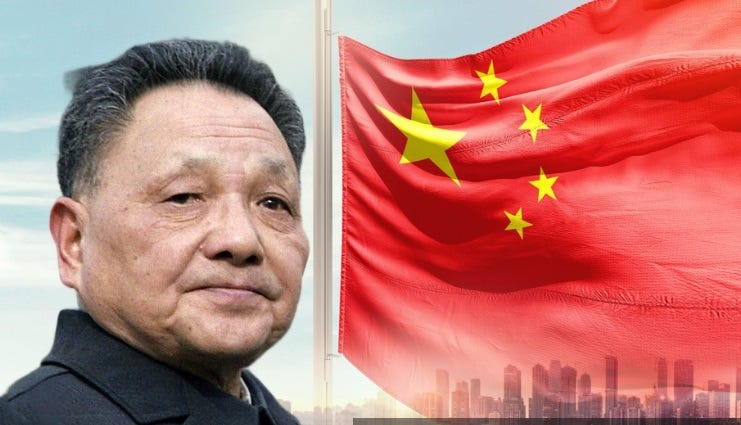
When China got a break: Deng Xiaoping imported the Japanese high growth formula
After nearly three decades of ideological campaigns on the people of China, and likely more than 60 million people killed in the process, even the died-in-the-wool communists had after the death of strongman Mao become tired of party-political programmes (see Part I for more on those). Consequently, it was an uphill battle for Mao’s chosen heir, Hua, to generate any enthusiasm and support. Instead, a growing majority in the upper echelons of the Chinese Communist Party felt keenly that continuity was not attractive, as things had not panned out that well. Instead, the decision-makers ordained that it was time for a change in direction, namely by allowing a reality-oriented pragmatist to take the helm who would focus on delivering results – such as economic development, strengthening the nation and making the Chinese people better off.
Every so often there are moments in world history when the senior decision-makers over nations are neither incompetent agents serving foreign agendas, nor evil, genocidal psychopaths.
The time was ripe for Deng Xiaoping, who had joined the early Communist Party of China in the 1920s and had been on Mao’s Long March in1934. Moreover, he had already been in positions of influence before, but had been unceremoniously deposed several times, sent to labour camps or had otherwise been suppressed. Known as a calm, able and even-handed administrator who had not been involved directly in the cynical anti-human policies of the previous decades, Deng was rehabilitated in 1977 and appointed Vice Chairman of the CCP. He was also appointed Vice Premier of the State Council and member of the Politburo.
Deng picked up the pieces and restored economic order. He was now generally supported, especially as Hua’s unsuccessful attempt to pin the blame for the biggest policy disasters on particular people, such as the “Gang of Four”, had merely driven home the realisation that China had lost many years, even decades in terms of prosperity.
The remainder of 1977 and much of 1978 were a time of preparation for Deng Xiaoping. Then, in December 1978, he gave a key speech, which has since been interpreted as Deng officially taking over the leadership in China.
We are under sanctions, financial sanctions of European Union because we don’t let the illegal migrations to come to Hungary and to the European Union as well.
So we have to pay, just to inform you, we have to pay every day one million euro as a punishment to the Brazilian budget, because we stopped the migrants. This is the absurd world we are living now in Europe.
The German Federal Audit Office (Bundesrechnungshof) has dismantled the government’s hydrogen strategy. Neither on the supply side nor on the demand side do the results even remotely align with the ambitious political targets. Germany faces yet another subsidy ruin.
Berlin is in a state of hangover. The ongoing economic crisis is mercilessly exposing the delusions of the so-called green transformation. After the collapse of battery production – think of subsidy ruins like Northvolt – the retreat of industry from “green steel,” and the failure of the energy transition under the weight of wind and solar, which have become bottomless subsidy pits, the next major project is now under heavy attack: the hydrogen strategy.
Audit Office Steps Out of the Shadows
In a recent report, the Federal Audit Office examined the German hydrogen economy – political art at its finest. Since 2020, the sector has been flooded with subsidies. For 2024 and 2025 alone, more than €7 billion in funding has been allocated. Plenty of lubricant for an engine that has been sputtering from day one and still refuses to start.
Private investors, enticed by guarantees and state-backed prices, add more than €3 billion annually. And what’s the result after five years of constant funding? Devastating. Current production of green hydrogen stands at a mere 0.16 gigawatts. Another 0.2 gigawatts are under construction.
In other words: a market that practically doesn’t exist is already consuming around €8 billion every year—public and private – like a black hole.
I am recommending to Senate Republicans that the Hundreds of Billions of Dollars currently being sent to money sucking Insurance Companies in order to save the bad Healthcare provided by ObamaCare, BE SENT DIRECTLY TO THE PEOPLE SO THAT THEY CAN PURCHASE THEIR OWN, MUCH BETTER, HEALTHCARE, and have money left over. In other words, take from the BIG, BAD Insurance Companies, give it to the people, and terminate, per Dollar spent, the worst Healthcare anywhere in the World, ObamaCare. Unrelated, we must still terminate the Filibuster!
President Donald Trump has announced a landmark deal aiming to expand Medicare coverage to include certain weight-loss medications, a move that could dramatically change access to these treatments for millions of older Americans. On November 6, Trump revealed that his administration had struck agreements with Eli Lilly and Novo Nordisk, the makers of popular weight-loss drugs including Ozempic and Wegovy, to reduce costs and allow for broader Medicare coverage starting in 2026.
Under the arrangement, prices for GLP-1 drugs—used both for diabetes and obesity—will be slashed for Medicare and Medicaid beneficiaries. The prices of Ozempic and Wegovy will fall from $1,000 and $1,350 per month, respectively, to $350 when purchased through through the TrumpRx.gov website set to launch in January 2026,
I am an economic nationalist. To me, the country comes before the economy; and the economy exists for the people. I believe in free markets, but I do not worship them. In the proper hierarchy of things, it is the market that must be harnessed to work for man – and not the other way around. — Pat Buchanan





 American Buddhist Net