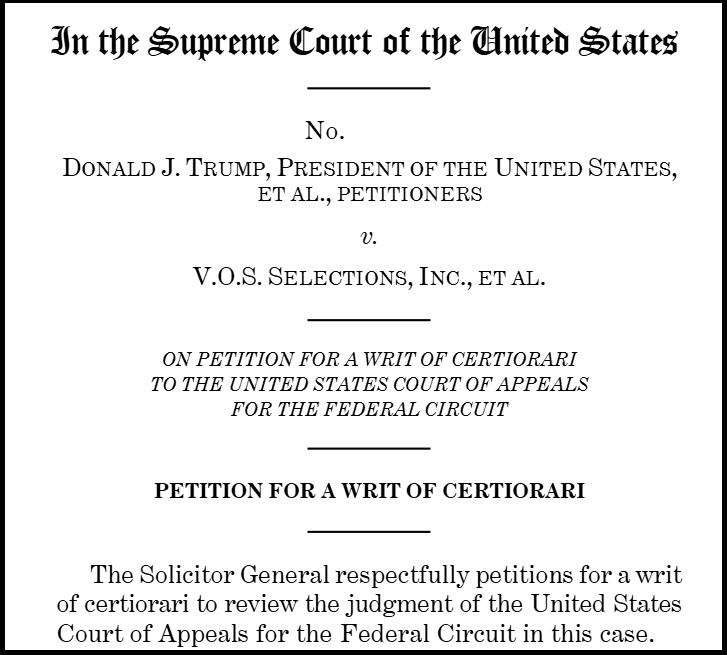
U.S. Solicitor General D. John Sauer has asked the Supreme Court to accept the case by next week, hear arguments in early November and “expedite” its ultimate ruling “to the maximum extent feasible.” [Appeal Here] with [Expedited Review Request Here]
At issue is the president’s authority under the International Economic Emergency Powers Act (IEEPA), a 1977 law Trump used to impose baseline tariffs between 10 and 50 percent on goods from countries who do not have Free Trade Agreements with the U.S.
President Trump also declared fentanyl drug shipments a national emergency, providing the administration’s justification for imposing tariffs on Canada, China and Mexico.
From the request for expedited consideration, “The en banc Federal Circuit’s erroneous decision has disrupted highly impactful, sensitive, ongoing diplomatic trade negotiations, and cast a pall of legal uncertainty over the President’s efforts to protect our country by preventing an unprecedented economic and foreign-policy crisis,” Sauer notes.
Adding comments from Treasury Secretary Scott Bessent, “The recent decision by the Federal Circuit is already adversely affecting ongoing negotiations. World leaders are questioning the Presi-dent’s authority to impose tariffs, walking away from or delaying negotiations, and/or imposing a different calculus on their negotiating positions.”
Moreover, “[t]he frameworks for trade agreements already in place contain additional provisions whereby the trade partners agree to significant purchases from and/or in-vestments in the United States.” … “If these agreed upon frameworks were unwound and the investments and purchases had to be repaid, the economic consequences would be catastrophic.” (more)
On a per capita basis, the highly intelligent became ten times more numerous in England between 1000 and 1850
Human populations have evolved over time, not only during prehistory but also well into recorded history. This evolution has affected a wide range of mental and behavioral traits: cognitive ability, time preference, propensity for violence, monotony avoidance, rule following, guilt proneness, and empathy, among others.
Such traits vary among human populations because different cultures have imposed different demands on mind and body. In general, the cultural environment will favor those who can better exploit its possibilities, just as the natural environment will. There has thus been a process of coevolution: we make culture, and it remakes us—by selecting those among us who survive to pass on their genes. This coevolution has proceeded along different trajectories in different populations.
This is not a BOMSHELL, but Putin’s views are always interesting if only because he is head of the Russian Federation. Most of what he says is straightforward and true. I like Trump’s comment (see below) on China’s victory celebration, It is also straightforward and true. ABN
The big question to be answered is whether or not President Xi of China will mention the massive amount of support and “blood” that The United States of America gave to China in order to help it to secure its FREEDOM from a very unfriendly foreign invader. Many Americans died in China’s quest for Victory and Glory. I hope that they are rightfully Honored and Remembered for their Bravery and Sacrifice! May President Xi and the wonderful people of China have a great and lasting day of celebration. Please give my warmest regards to Vladimir Putin, and Kim Jong Un, as you conspire against The United States of America. PRESIDENT DONALD J. TRUMP
China has immensely more reason to be grateful to USA than not. This includes not just the results of WW2 but also their receiving enormous amounts of American technology, knowhow, money, and good will since the 1980s. USA was not involved in the Opium Wars of the 19th Century; that was the Jewish Sassoon dynasty backed by the British Empire. I like the tone of Trump’s post. Gratitude toward USA and the West would go a long way toward healing this world. ABN
I don’t want to keep talking about crypto because it’s not my area of expertise.
But I want to respond to the post below because I’ve seen too many of these “feel good” assertions, as if we are on the verge of breaking away from a “dying” system and about to “earn our freedoms”.
These are luxury beliefs with no grounding in reality.
Bitcoin doesn’t dissolve the old frame. It proves how the TPS [Transnational Private Sector] rewrites frames.
Gold worked not because people “believed” in it,
but because a handful of people within states and empires enforced it with armies, trade routes, regulation and convertibility rules.
The masses just did as they’re told.
There’s a whole power structure mandate that you’re completely neglecting.
The dollar works NOT because of “habit,” but because the FIC transacts in it and the MIC enforces it globally.
Saddam shared a very similar philosophy on the dollar. That it was a fiat worth nothing based on false belief.
He quickly found out that it was much more than that.
So did Gaddafi.
Ok.
So it’s NOT just “belief” that adds value to a currency.
It’s enforcement of the power structure that punishes anyone who deviates from it.
Lot of people think companies like Apple, NVIDIA, Microsoft are sovereign giants calling the shots because of their multi-trillion dollar valuations.
That’s not how it works.
At all.
It’s the financiers that call the shot.
Through proxy voting and board control, they set policy on dividends, ESG, executive pay, even mergers.
Apple, NVIDIA etc may look powerful, but they’re ultimately operators inside an index fund empire. They are constrained by semiconductor subsidies, export controls, and defense-linked AI/Chip contracts.
These CEO’s rely on JPMorgan, Goldman Sachs, Citi, etc, for credit lines, bond issuance, and stock buybacks. This level of capital availability is political.
Tied to TPS interests.
Defense firms like Raytheon are structurally embedded in the MIC. Their demand is guaranteed by Pentagon budgets, not free markets.
Energy firms like Chevron are tied to FIC-MIC loops (petrodollar, US security guarantees).
The regulatory chokepoints that Trump loves to slap on US companies like export controls, antitrust threats, sanctions frameworks, making it look like he’s working for the people, is just a facade.
It’s all to simply remind firms that they’re licensed to operate within TPS rules.
The fact is that these companies are powerful at the operational level (deciding products, engineering, marketing) but subordinate at the strategic level (capital flows, bloc alignment, geopolitics).
Once a firm is swallowed by the TPS, it means financiers drive the decisions.
U.S. officials say RCMP stonewalling on the Chinese-precursor-supplied Falkland superlab — described by DEA chief Derek Maltz as a “major disaster” — among the reasons behind Trump’s punitive tariffs
WASHINGTON — Canada’s federal police refused to investigate or cooperate with the United States Drug Enforcement Administration on a British Columbia fentanyl superlab probe tied to chemical-precursor shipments from China into Vancouver in late 2022, according to senior U.S. officials. More than a year later — only after the U.S. Treasury sanctioned Iranian-Canadian businessman Bahman Djebelibak and his Health Canada–licensed company Valerian Labs, naming them as part of a Chinese fentanyl trafficking syndicate that Washington sought to disrupt — did the RCMP finally open a siloed investigation. The force continued to refuse coordination or information sharing with the American agents who had initiated the case. In an exclusive interview, Derek Maltz, DEA Acting Administrator in 2025 with oversight of the matter, called the B.C. superlab case a “major disaster.”
This explosive information, confirmed to The Bureau by current and former senior U.S. officials, has never before been reported in the Falkland, B.C., superlab case, which was covered internationally by outlets including The New York Times. It amounts to a rare public rebuke that elevates the matter from a Canadian policing failure into a high-consequence geopolitical dispute.
It also helps explain Washington’s decision on July 31 to impose 35 percent tariffs on Canada, reinforcing President Donald Trump’s claim that senior officials had warned him Ottawa failed to cooperate or devote sufficient resources to interdictions against Chinese- and Mexican-linked drug trafficking networks blamed for killing hundreds of thousands of North Americans.
What people thought America could be – a beacon of democracy – was the last thing it became. In reality, it’s a corporate machine that has given rise to the Transnational Private Sector (TPS).
The TPS is a coalition of corporate giants, led by the Financial-Industrial Complex (FIC) with firms like JPMorgan, Goldman, and BlackRock, alongside the Military-Industrial Complex (MIC), Consumer-Industrial Complex (CIC), and Techno-Industrial Complex (TIC).
This collective force operates beyond borders, transcends nationality, and prioritizes profit over public welfare.
When Jamie Dimon, JPMorgan’s CEO, warned in October 2024 that wars in Ukraine and the Middle East could destabilize the global economy, he wasn’t just forecasting. He was asserting the TPS’s dominance over policy.
To understand this power, you have to examine the game theory driving the TPS’s clash with nations.
This concept that I have developed deliberately sets aside the idea of good, evil, right, or wrong. Geopolitical dynamics are examined through the lens of incentives, power, and measurable outcomes, not moral judgments. The focus is the strategic interplay of actors, stripped of ethical narratives.
___
Game theory provides a framework for understanding geopolitical strategies by analyzing the incentives that drive actors’ decisions.
There are two distinct game types: finite and infinite. Both these games shape global interactions. Finite games are zero-sum with defined endpoints, and clear winners and losers. It’s akin to a corporate quarter where profit maximization is the sole objective.
One player wins, the other loses.
Infinite games, conversely, lack a conclusion, have no end, prioritizing sustained participation through long-term stability, akin to a nation’s multi-generational survival strategy.
States operate within infinite games.
They do not expire. They do not tap out.
Their permanence compels them to prioritize enduring stability over immediate gains. For instance, China’s $1 trillion Belt and Road Initiative, spanning decades, secures global trade networks to ensure long-term economic influence. BRICS nations, through $10 billion in yuan-based trade, foster mutual economic resilience for mutual prosperity.
This cooperative approach engenders a form of morality rooted in reciprocity: mutual support today ensures mutual survival tomorrow. Such strategies reflect a commitment to societal development and stability, as states must maintain legitimacy and resources for their populations over time.
The TPS operates as a corporate entity, fundamentally detached from societal obligations. Unlike states, the TPS bears no responsibility to citizens, public welfare, or long-term development. Its imperative is profit maximization within finite time horizons, driven by shareholder demands and market cycles.
I am reposting this so it can get more views. I had time last night and this morning to watch the entire video. It’s well-worth the time as it will provide a very convincing way of understanding global and national economics, war and geopolitics. ABN
UPDATE: Central banks are the single greatest control mechanism of human behavior. Their power extends well beyond their relations with other banks. It determines a lot of what happens in your country. And they are not under the control of voters. So its an extrademocratic institution which happens to be the most powerful[~2:04].
The above is Carlson’s paraphrase of a major point made by Werner, who then continues by saying, ‘the founding of the bank of England, which is a private company, a central bank, was done in order to wage war. Central banking and warfare are very closely linked’.
The US Federal Reserve is no different; it is also a central bank and was founded at roughly the same time as the Bank of England in order to prepare for WW1.
Moreover, both countries established the income tax at this time. The income tax ‘allows’ government to borrow money from the central banks.
Werner presents the strongest and clearest argument I have heard that central banks start wars and profit from them; and that central banks cause asset bubbles (e.g. real estate, equities) in order to bust small banks and consolidate power.
You can jump to the ~2:04 time stamp to hear this, and if that’s all the time you have, definitely do it.
Best is to listen to the entire interview as Werner provides a great deal of important background with many other insights into money, banking, credit and how to do all of that much better than allow a central bank to have secretive, authoritative control over your country. ABN





 American Buddhist Net