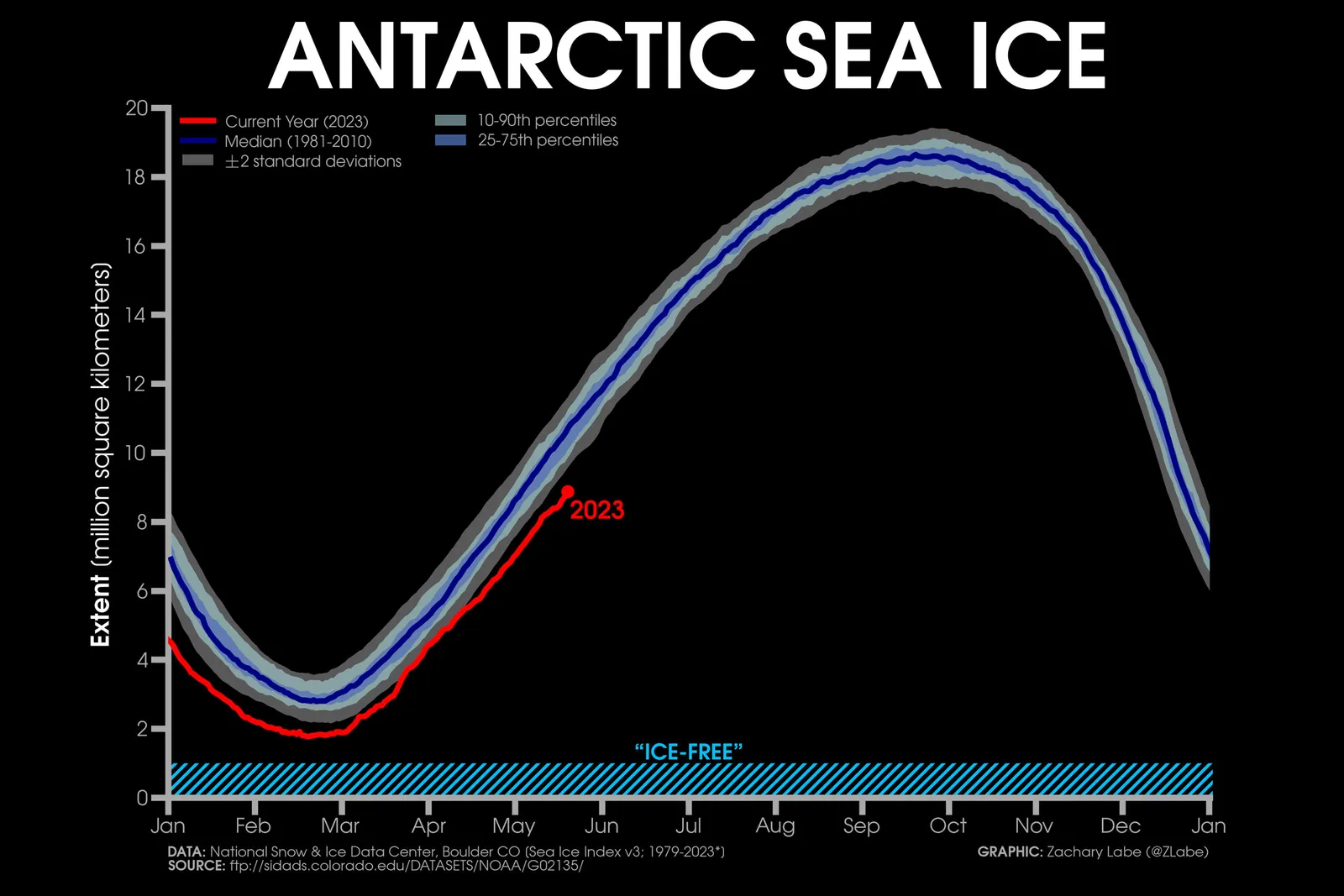
“Every single day so far in 2023, we’ve observed sea ice that’s been below average,” says climate scientist Zachary Labe of Princeton University and the National Oceanic and Atmospheric Administration, who created the graph below. The dark-blue line shows the median area of sea ice between 1981 and 2010, a figure called the “extent” that researchers measure in millions of square kilometers. The red line below all the others is the extent so far in 2023.
“In fact,” Labe continues, “it broke its lowest point ever recorded in the satellite era. Which was striking, because last year, we also had broken that record.”
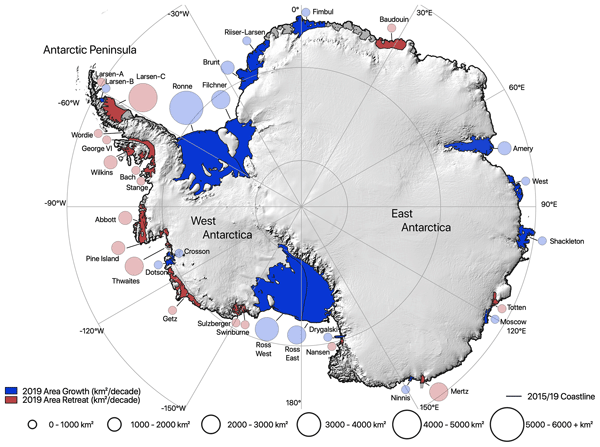
Antarctic ice shelves provide buttressing support to the ice sheet, stabilising the flow of grounded ice and its contribution to global sea levels. Over the past 50 years, satellite observations have shown ice shelves collapse, thin, and retreat; however, there are few measurements of the Antarctic-wide change in ice shelf area. Here, we use MODIS (Moderate Resolution Imaging Spectroradiometer) satellite data to measure the change in ice shelf calving front position and area on 34 ice shelves in Antarctica from 2009 to 2019. Over the last decade, a reduction in the area on the Antarctic Peninsula (6693 km2) and West Antarctica (5563 km2) has been outweighed by area growth in East Antarctica (3532 km2) and the large Ross and Ronne–Filchner ice shelves (14 028 km2). The largest retreat was observed on the Larsen C Ice Shelf, where 5917 km2 of ice was lost during an individual calving event in 2017, and the largest area increase was observed on Ronne Ice Shelf in East Antarctica, where a gradual advance over the past decade (535 km2 yr−1) led to a 5889 km2 area gain from 2009 to 2019. Overall, the Antarctic ice shelf area has grown by 5305 km2 since 2009, with 18 ice shelves retreating and 16 larger shelves growing in area. Our observations show that Antarctic ice shelves gained 661 Gt of ice mass over the past decade, whereas the steady-state approach would estimate substantial ice loss over the same period, demonstrating the importance of using time-variable calving flux observations to measure change.
MEMPHIS, Tenn., May 9, 2023 /PRNewswire/ — US Biologic, Inc., a leading global entity in the development, commercialization, and distribution of orally delivered vaccines, announces USDA Conditional Licensure of its novel oral vaccine against the wildlife spread of Borrelia burgdorferi, the bacterium responsible for Lyme disease, the number one vector-borne disease in the U.S.
The only known vector is the blacklegged tick, which is infected primarily by feeding on small wildlife mammals, particularly white-footed mice. The vaccine, called “Borrelia Burgdorferi Bacterin,” is spray-coated onto pellets that the mice consume.
Field trials demonstrating real-world impact have been conducted and co-published by the Cary Institute of Ecosystem Studies, the CDC, the Connecticut Agricultural Experiment Station (CAES), the University of Pennsylvania, the University of Tennessee Health Science Center, Yale University, and others.
The product meets all Conditional Licensure requirements, including uniquely addressing an emergency condition and demonstrated safety. “We thank the USDA for their efforts to help launch innovative products,” says Dr. Steve Zatechka, US Biologic Chief Regulatory Officer & Chief Manufacturing Officer.
US Biologic will provide the product in residential settings, public lands, including parks, and commercial areas, such as golf courses and other recreational facilities. The Company will work closely with federal and state health agencies and pest management professionals that service the areas most at risk for infection, as well as partners like the Global Lyme Alliance and the Lyme Disease Association, Inc.
… These results negate claims that the increase in C(t) since 1800 has been dominated by the increase of the anthropogenic fossil component. We determined that in 2018, atmospheric anthropogenic fossil CO2 represented 23% of the total emissions since 1750 with the remaining 77% in the exchange reservoirs. Our results show that the percentage of the total CO2 due to the use of fossil fuels from 1750 to 2018 increased from 0% in 1750 to 12% in 2018, much too low to be the cause of global warming.
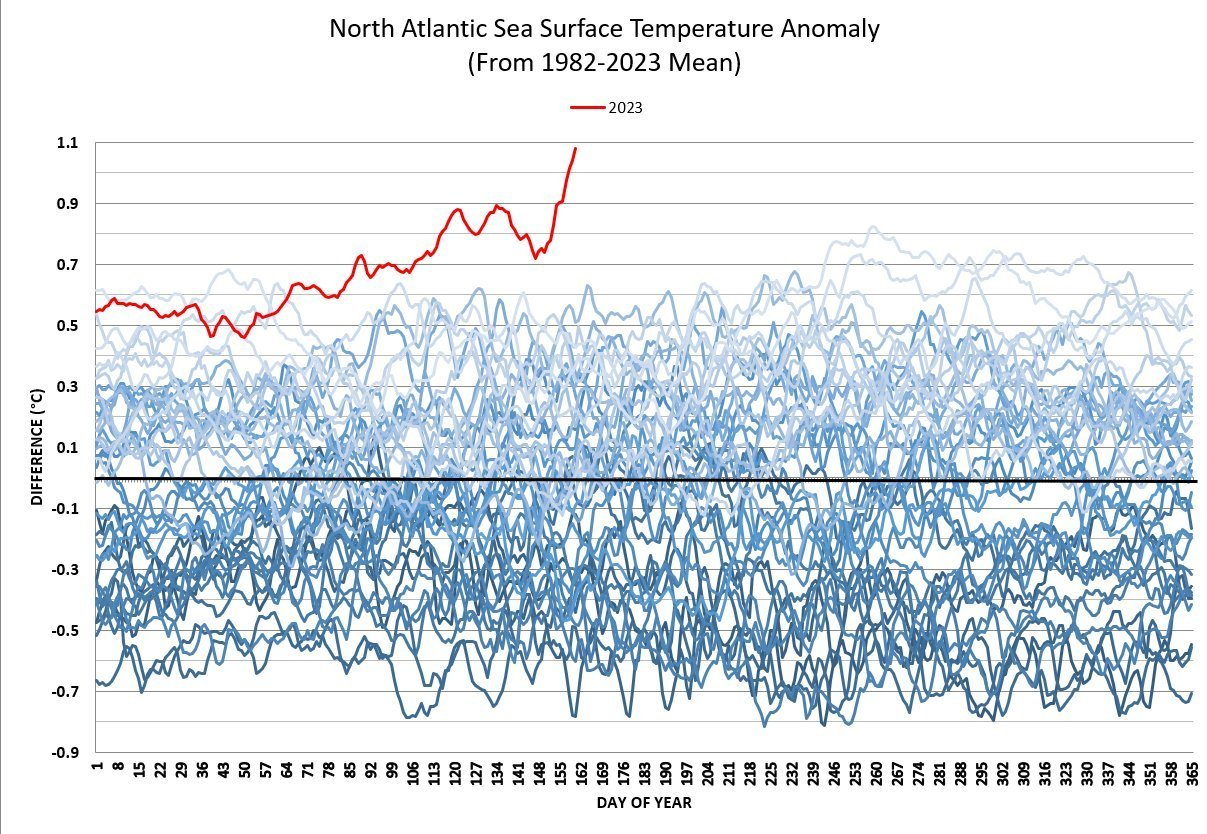
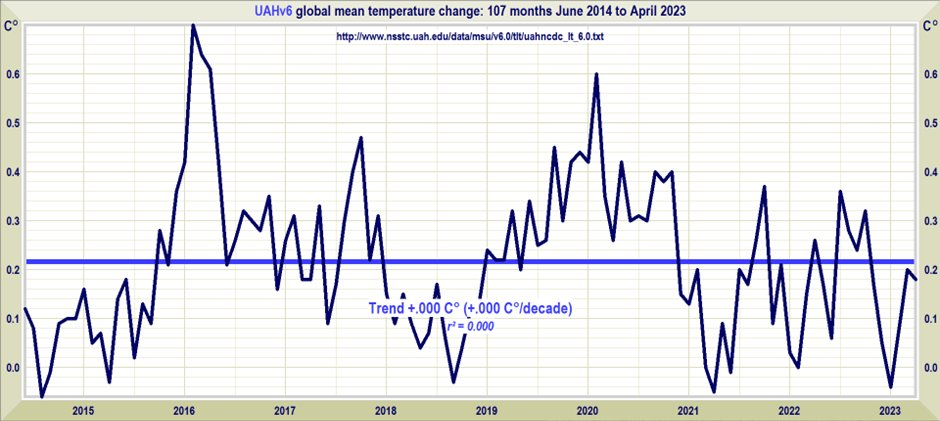
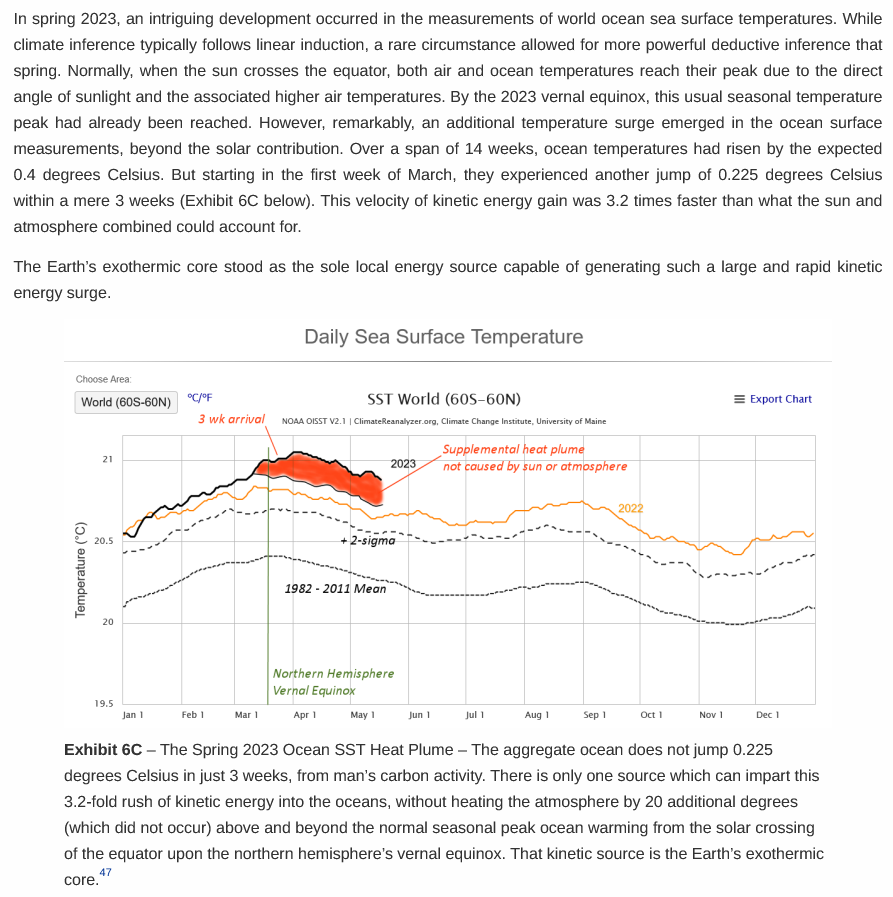
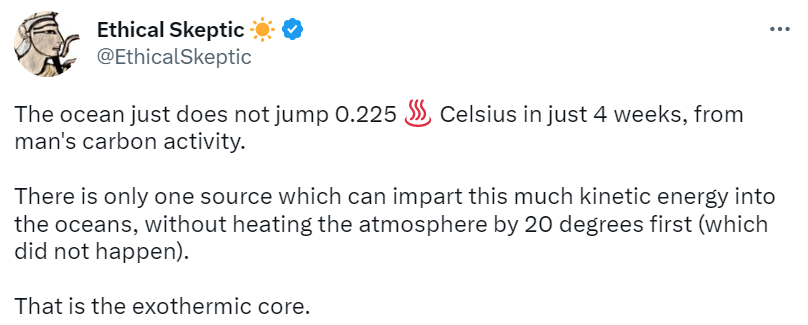
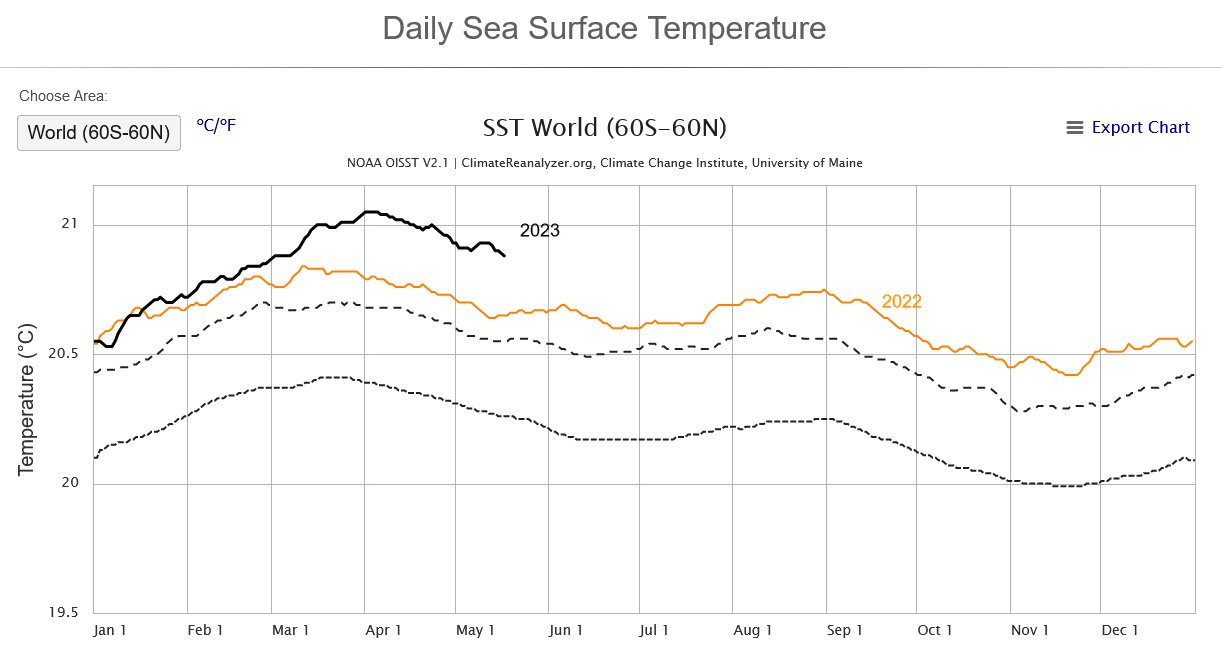
The world’s oceans have suddenly spiked much hotter and well above record levels in the last few weeks, with scientists trying to figure out what it means and whether it forecasts a surge in atmospheric warming.
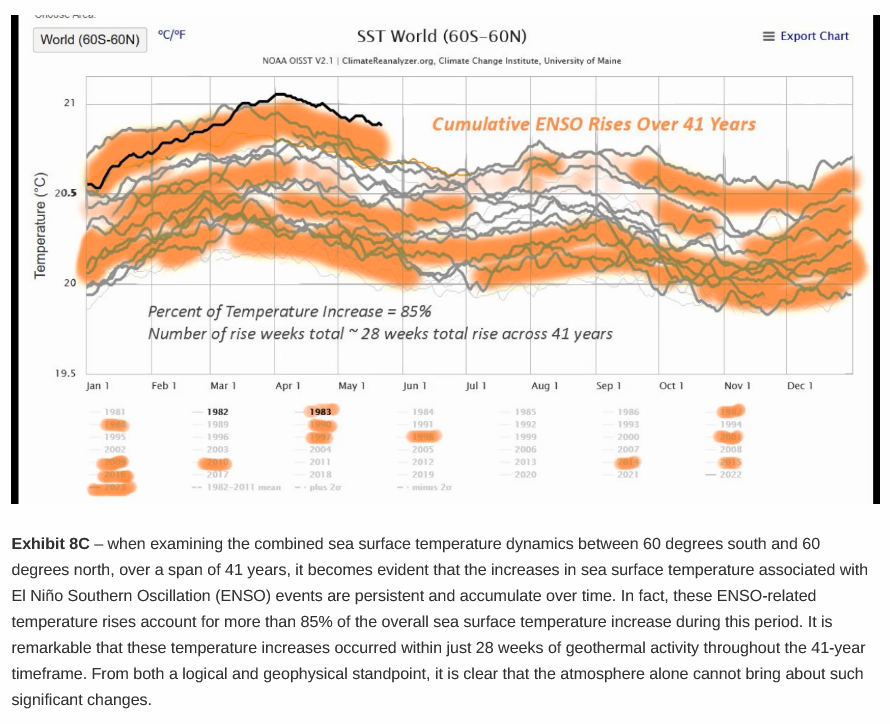
Some researchers think the jump in sea surface temperatures stems from a brewing and possibly strong natural El Nino warming weather condition plus a rebound from three years of a cooling La Nina, all on top of steady global warming that is heating deeper water below. If that’s the case, they said, record-breaking ocean temperatures this month could be the first in many heat records to shatter.
From early March to this week, the global average ocean sea surface temperature jumped nearly two-tenths of a degree Celsius (0.36 degree Fahrenheit), according to the University of Maine’s Climate Reanalyzer, which climate scientists use and trust. That may sound small, but for the average of the world’s oceans — which is 71% of Earth’s area —to rise so much in that short a time, “that’s huge,” said University of Colorado climate scientist Kris Karnauskas. “That’s an incredible departure from what was already a warm state to begin with.”
Climate scientists have been talking about the warming on social media and amongst themselves. Some, like University of Pennsylvania’s Michael Mann, quickly dismiss concerns by saying it is merely a growing El Nino on top of a steady human-caused warming increase.
Other climate scientists, including National Oceanic and Atmospheric Administration oceanographer Gregory C. Johnson, say it doesn’t appear to be just El Nino. There are several marine heat waves or ocean warming spots that don’t fit an El Nino pattern, such as those in the northern Pacific near Alaska and off the coast of Spain, he said.
“This is an unusual pattern. This is an extreme event at a global scale” in areas that don’t fit with merely an El Nino, said Princeton University climate scientist Gabe Vecchi. “That is a huge, huge signal. I think it’s going to take some level of effort to understand it.”
UPDATE: Note that St. Mann ‘quickly dismisses’ the new evidence. This is exactly what we have just seen with covid ‘science’ when authorities quickly dismissed, even ridiculed, early treatments including innocuous vitamin D3 while simultaneously promoting dangerous vaxxes. Similar layers of mind-control are determining our foreign policy in Ukraine, our open border, and the baleful rise of wokeness and urban crime. There is a pattern and it is pretty obvious and it is not beneficial to moral, clear-thinking, normally cooperative citizens. These are enemy ideas being used to destroy our nation state and civilization. ‘Our side’, the only side we have, is reason, real science, clear thinking, compassion and wisdom. This is a heavy burden for any population to carry, but carry it we must. There is no other way forward. ABN
In the context of implementing the European Flood Directive in Greece, a large set of rainfall data was compiled with the principal aim of constructing rainfall intensity–timescale–return period relationships for the entire country. This set included ground rainfall data as well as non-conventional data from reanalyses and satellites. Given the European declaration of climate emergency, along with the establishment of a ministry of climate crisis in Greece, this dataset was also investigated from a climatic perspective using the longest of the data records to assess whether or not they support the climate crisis doctrine. Monte Carlo simulations, along with stationary Hurst–Kolmogorov (HK) stochastic dynamics, were also employed to compare data with theoretical expectations. Rainfall extremes are proven to conform with the statistical expectations under stationarity. The only notable climatic events found are the clustering (reflecting HK dynamics) of water abundance in the 1960s and dry years around 1990, followed by a recovery from drought conditions in recent years.
The study, conducted by scientists at Notre Dame University, confirms fears that the containers of commonly used products like ketchup and mayonnaise are leaching out levels that pose a threat to human health.
“Not only did we measure significant concentrations of PFAS in these containers, we can estimate the PFAS that were leaching off creating a direct path of exposure,” said study co-author Graham Peaslee, Ph.D., professor of physics in the Department of Physics and Astronomy at Notre Dame.

 American Buddhist Net