Freeze and frost warnings are in place in the northern parts of New York, New Hampshire, Vermont, and Maine.
The National Weather Service (NWS) has said summer temperatures will quickly drop into the 20s between 2am and 8am ET Saturday morning, potentially killing crops, outdoor vegetation, and possibly freezing outdoor pipes around homes and businesses.
A freeze warning is one of the most severe types of cold-weather alerts from the NWS, meaning that residents need to take immediate action because temperatures are about to fall below 32°F for an extended period of time.
Forecasters warned that temperatures which stay below 28°F for long stretches can kill most types of commercial crops and residential plants left outside.
The warning covers six counties in Maine, three counties in northern New York, Vermont’s Essex County, and New Hampshire’s Coos County.
Ben Davidson, founder of Space Weather News, told the Matt Beall Limitless podcast that a rapid magnetic pole shift, potentially triggered by a solar ‘micronova,’ could unleash tsunamis, climate chaos and mass extinction.
Though his speculative ‘micronova’ theory, a sudden solar explosion triggering a pole shift, lacks mainstream support, Davidson insisted the underlying geomagnetic cycle is ‘bulletproof’ science.
‘This is a near extinction-level event, and we are in the middle of it right now!’ Davidson said, emphasizing a cycle that occurs roughly every 6,000 years, with a more severe event every 12,000 years.
See also As the World Turns, which makes similar claims but for a different reason. Worst case is the earth’s axis flips some 127 degrees (if memory serves), causing mile high tsunamis that will wipe out almost everything. I’ve posted numerous article on this topic and, personally, find it credible. There is no way to prepare for an axial shift except move to the top of a tall mountain. ABN
Choking smoke spewed by wildfires is far more dangerous than previously thought, a new study has found, with death tolls from short-term exposure to fine particulates underestimated by 93%.
Researchers found that 535 people in Europe died on average each year between 2004 and 2022 as a result of breathing in the tiny toxic particles known as PM2.5 that are released when wildfires rage.
Under standard methods, which assume PM2.5 from wildfires is as deadly as from other sources, such as traffic, they would have expected just 38 deaths a year.
For every extra microgram of PM2.5 fouling 1 cubic metre of air, they found that all-cause mortality rose by 0.7%, respiratory mortality went up by 1% and cardiovascular mortality rose by 0.9%.
Federal authorities have moved further to reverse course on the Biden administration’s embrace of offshore wind power infrastructure in recent days, earning praise from regional fishermen.
The Bureau of Ocean Energy Management (BOEM) has taken two key actions in the past week in pursuit of bringing an end to offshore wind development throughout the country, including in the Gulf of Maine.
At the end of July, BOEM said that it would be rescinding all designated Wind Energy Areas (WEAs) on the U.S. Outer Continental Shelf (OCS), a move in alignment with an Executive Order issued by the President on his first day in office.
WEAs are areas that have been deemed suitable by the federal government for “commercial wind energy activities” that “present[ed] the fewest apparent environmental and user conflicts.”
This move aims to officially end the federal practice of “designating large areas of the OCS for speculative wind development.” As a result of this, 3.5 million acres of unleased federal waters will be released across many parts of the country, including in the Gulf of Maine.
The EPA has crafted a proposal that would undo the government’s “endangerment finding,” a determination that pollutants from burning fossil fuels, such as carbon dioxide and methane, can be regulated under the Clean Air Act.
The finding haslong served as the foundation for a host of policies and rules to address climate change. The EPA’s proposal to revoke the finding is currently under review by the White House Office of Management and Budget.
“Silvics of North America” describes the silvical characteristics of about 200 conifers and hardwood trees in the conterminous United States, Alaska, Hawaii, and Puerto Rico.
Individual articles were researched and written by knowledgeable Forest Service, university, and cooperating scientists.
They were reviewed by their counterparts in research and academia. The project took 10 years to complete.
The revised manual retains all of the essential material from the original publication, plus new information accumulated over the past quarter of a century. It promises to serve as a useful reference and teaching tool for researchers, educators, and practicing foresters both within the United States and abroad.
It’s an active, icy body ejecting material, and possibly the most important visitor from beyond our solar system yet.
2/ On July 21, 2025, Hubble locked on to 3I/ATLAS and confirmed what many suspected: It’s really fast (58 km/s), it’s interstellar (eccentricity > 6) and it’s active, leaking ice into space. We’re not just watching it, we’re interacting with it.
3/ This makes 3I/ATLAS only the third confirmed interstellar object ever observed after ‘Oumuamua (2017) and 2I/Borisov (2019).
But this one we’re catching it in far greater detail. With ground + space telescopes, spectroscopy and trajectory modeling.
4/ Hubble’s imagery shows a fuzzy, comet like coma, a sign of outgassing.
But the real revelation came from Gemini South and NASA’s Infrared Telescope Facility.
Their combined spectroscopic analysis (published July 22) confirms: water ice is present in the coma.
5/ Using near-infrared spectra and radiative modeling, researchers found that the coma is composed of:
30% large water ice grains. 70% Tagish Lake like dust (D-type asteroid analog) The ice signal is real and visible in the 2.0 μm absorption band.
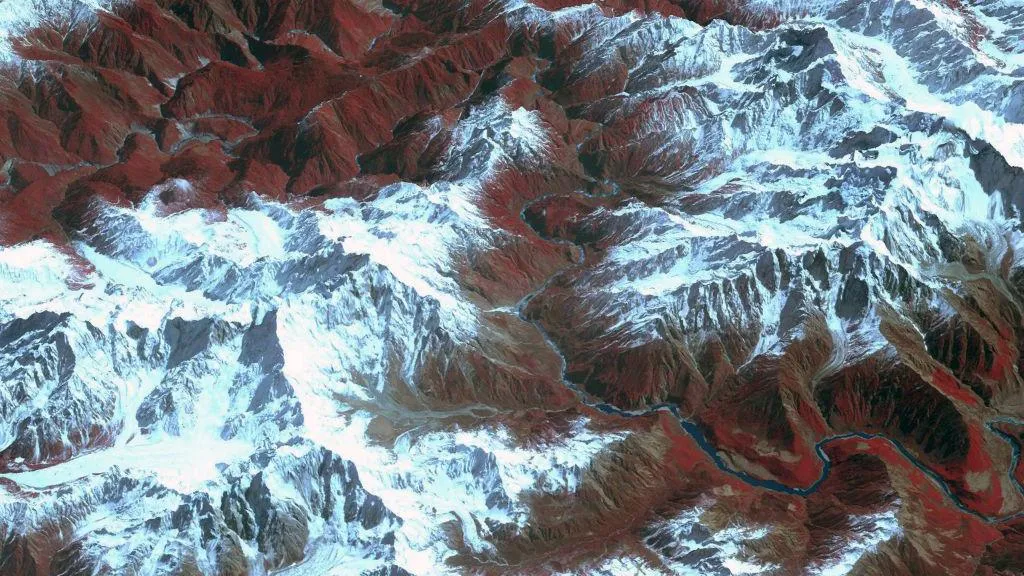
Chinese authorities have begun constructing what will be the world’s largest hydropower dam in Tibetan territory, in a project that has sparked concerns from India and Bangladesh.
Chinese Premier Li Qiang presided over a ceremony marking the start of construction on the Yarlung Tsangpo river on Saturday, according to local media.
The river flows through the Tibetan plateau. The project has attracted criticism for its potential impact on millions of Indians and Bangladeshis living downriver, as well as the surrounding environment and local Tibetans.
The dam is situated in the Yarlung Tsangpo canyon, said to be the world’s largest and deepest canyon on land
Beijing says the scheme, costing an estimated 1.2tn yuan ($167bn; £125bn), will prioritise ecological protection and boost local prosperity.
When completed, the project – also known as the Motuo Hydropower Station – will overtake the Three Gorges dam as the world’s largest, and could generate three times more energy.
Experts and officials have flagged concerns that the new dam would empower China to control or divert the trans-border Yarlung Tsangpo, which flows south into India’s Arunachal Pradesh and Assam states as well as Bangladesh, where it feeds into the Siang, Brahmaputra and Jamuna rivers.
On a day in early June, state forester Will Phifer carried a pill bottle-orange canister into a southeastern Oklahoma forest, tied it to a shaded tree trunk and left. The area was a confirmed spot for a growing population of tree-killing beetles called emerald ash borers, which likely seeped into the state from the east.
The container held what scientists hope is a solution to controlling the harmful pest: more than 100 minuscule parasitoid wasp eggs.
“These emerald ash borer eggs are laid on the outer bark of the tree,” Dieter Rudolph, forest health specialist for Oklahoma Forestry Services, said. “So, this wasp will go find them and basically inject an egg into the emerald ash borer egg.”
Instead of producing an emerald ash borer larva, the host egg will hatch a new wasp.


 American Buddhist Net