An image that illustrates the value of FIML practice

click on image for larger

FIML practice is like JWST compared to normal interpersonal speech, which is like Hale at best. Like the telescope, FIML is a technical advance that allows for much greater clarity and resolution. In Buddhist terms, FIML is partner-based mindfulness that provides an objective control on understanding in addition to much better clarity. ABN

Psychology as “signs of something else”

When we see a human behavior as a “sign of something else” we begin magnifying it.

When we live in a culture where people normally do this, we tend to think it is right to do this even to ourselves.

People often feel relieved when their “signs of something else” have been analyzed—either professionally or by self-administered questionnaires—to reveal what that “something else” is.

Once analyzed and categorized, the “something else” itself becomes a sign, or a meta-sign, a diagnosis that explains behavior while directing us to a cure based on whatever that “something else” is.

The DSM reads like a Ptolemaic system of circles and spheres. In it signs are identified, quantified, and classified to indicate what they stand for, what their “something else” is.

Professionals are needed to do this work of course, and though the manual rests on “scientific” tests and other measurements, it changes every few years and very few people are getting better because of it. Moreover there is very little consensus among thoughtful people, including psychologists, about what the classifications of “mental illness” or “personality disorder” actually mean.

This is a sure sign that something is wrong.

I submit that what is wrong is our systems of classification of mental disorder do not describe the actual disorders because these descriptions exist on a different level from the disorders themselves.

It is widely observed that many disorders as currently classified blend into each other, share attributes, are co-morbid. It is also widely known that when disorders are extreme, sufferers can exhibit symptoms of all of them.

This indicates that the human mind is a complex system that becomes disordered by over-emphasizing or under-emphasizing parts of its system.

And this may be why drugs, psychedelics, shock therapy, or shamanic rituals sometimes help. Because they reset the entire system.

If you don’t want to use drugs, can’t get psychedelics, don’t want to undergo shock therapy or shamanic ritual, I suggest you try FIML practice. If you have a good partner, are fairly intelligent, and want to truly optimize your psychology (not just terminate your ambiguous disorder), FIML will probably do this for you. In fact, even if you can get psychedelics, FIML is better.

A disorder is unique to its system and though we can speak of some generalities that may apply to it, these generalities exist at a different level from the disorder itself and cannot provide a cure.

To cure a disorder the disorder must be experienced as it is happening by the sufferer. If too much of the disorder is revealed at once or the sufferer is simply confronted with its classification, more harm than good may result. If small bits of the disorder are revealed over a longish period of time, however, the sufferer will be much more likely to gain beneficial insight into the disorder.

In my view, all people everywhere are deeply disordered and thus all people everywhere would benefit from FIML practice. People who may not benefit from FIML include, among others, those who cannot self-observe, who are severely alcoholic, whose disorder prohibits self-analysis (narcissism, for example) and, sadly, those who cannot find an honest partner.

first posted MARCH 14, 2018

Consider “diagnosing” a child as “trans” because some adult observed a “sign” that they are. If you listen to parents and teachers who just know some child, or even baby, is trans, you will always hear them say that something the child did, or said, or reacted to was a sure sign they are trans. This explanation is typically accompanied by a knowing smile on the adult’s face indicating an absurd sense of certainty based on their very mistaken notion of what perceived interpersonal signs even are. ABN

UPDATE: Psychology as a pseudoscience of sign misinterpretations has never been clearer or more tragic than with trans diagnoses of children leading to surgery or hormone therapy. ABN

These videos may contain valuable instruction or confirmation for some Buddhists and FIML practitioners

There are other articles with similar videos in today’s Daily Mail. I watched three of the vids at the link and found they confirm the First Noble Truth in ways we can relate to today. They also show the value of having a stable ethical practice like the Noble Eightfold Path.

FIML practice can be described as a modern pair-work take on Buddhist mindfulness and concentration. FIML provides an objective way to clearly see yourself in real life while also helping your partner to do the same.

This world is rife with delusion. Many people lose their lives to it. Others crack up very badly. I make no judgement of anyone. Contemplating our own mistakes and excesses as well as those of others can be a sort of Buddhist Contemplation of the First Noble Truth, the truth of suffering. ABN

Dual-Process Theories of the Mind as means to analyze real-world, real-time interpersonal data

…Despite their differences, dual-process theories share the common idea that thoughts, behaviors, and feelings result from the interaction between exogenous and endogenous forms of attention. Both types of attention can be applied to representations to increase or decrease their level of activation. As the activation level of a representation increases, so does its accessibility, which in turn increases the probability that it will influence behavior. In times of conflict [When a FIML query is initiated], accessibility can be managed (i.e., maintained or inhibited) during the stream of processing by the control of attention. In a sense, the “source” of attention (LaBerge, 2000), that is, whatever mechanism that applies the activation to the representation, can be thought of as the gateway of accessibility that is the essence of controlled processing.

Individual Differences in Working Memory Capacity and Dual-Process Theories of the Mind

FIML practice is a form of mindfulness training with the addition of controlled attention processing which enables rapid gathering of real-world data followed by analysis thereof. This controlled attention processing is a learned behavior shared by both partners. The general concept of this learned/trained behavior is explained in How to do FIML. Individual partners adapt this learned/trained behavior to their own lives. In this sense FIML itself has no content. It is wholly a technique that allows rapid analysis of agreed upon objective interpersonal data. ABN

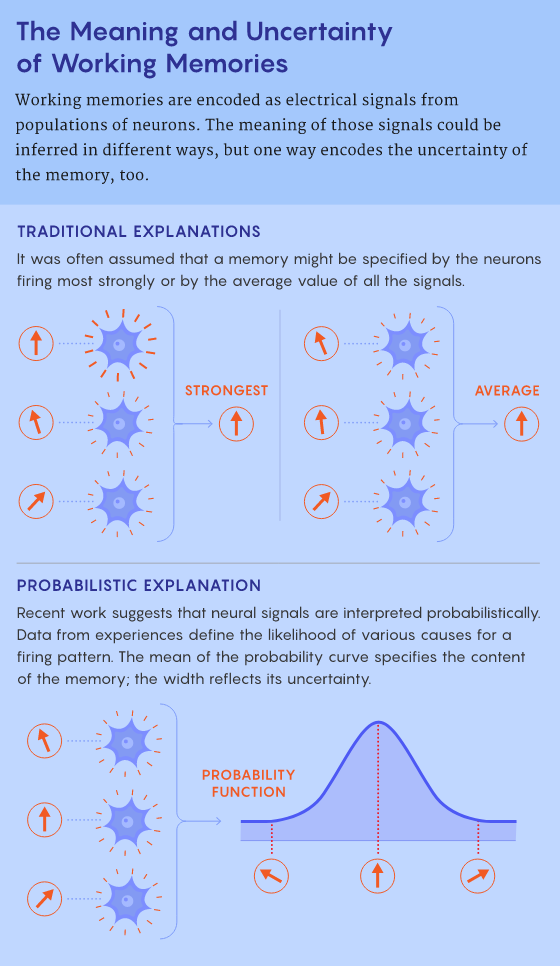
Neural noise indicates our working memory may encode Bayesian probabilities of its contents

The uncertainty in working memory may be linked to a surprising way that the brain monitors and uses ambiguity, according to a recent paper in Neuron from neuroscience researchers at New York University. Using machine learning to analyze brain scans of people engaged in a memory task, they found that signals encoded an estimate of what people thought they saw — and the statistical distribution of the noise in the signals encoded the uncertainty of the memory. The uncertainty of your perceptions may be part of what your brain is representing in its recollections. And this sense of the uncertainties may help the brain make better decisions about how to use its memories.

…the idea that we are walking around with probability distributions in our heads all the time has a certain beauty to it. And it is probably not just vision and working memory that are structured like this, according to Pouget. “This Bayesian theory is extremely general,” he said. “There’s a general computational factor that’s at work here,” whether the brain is making a decision, assessing whether you’re hungry or navigating a route.

link

FIML practice works precisely with the probabilistics of working memory. If the range of doubt in a perception is stronger than normal, it may prompt a query. If the range is stronger than normal and may indicate danger, a query is more likely. It would make sense that our assessments of these factors would be Bayesian. When perceptions are psychologically important, any Bayesian analysis will require assessing the subjective context into which the perception enters, which implies further Bayesian analyses. It would be wonderful if we had machines that could do this for us, but they will only be invented years from now if ever. For now, we can use our own minds to accomplish this through FIML practice. If you can understand the linked article, you should be able to see the value of FIML which collapses a Bayesian probability curve into the certainty of a single point. Psychologically, when this is done hundreds of times, the results are extremely satisfying. ABN

Engineering Illusions of The Science

Much of what most people believe is science, is not science. A lot of people might agree with that sentiment, but there is a more important corollary that will make some scientists flip their lids, which is that most of what scientists believe is science, is not science.

We really are that far down the road of misunderstanding or totalitarianism or something.

The story I’m about to tell begins with a warm and fuzzy documentary, but spirals into threats made to a highly respected scientist who took his family into hiding. The tale begins with an essay I wrote many years ago (you can skip it…this is the better essay) that I believe displays something like the infection of science with a virus. This was a story for which I was particularly well suited to examine for reasons you will come to understand if you don’t know me already. Upon digging into this story, what I found was quite troubling as it points to the subtle presence of hard-to-identify corruption that is therefore likely more the norm in “The Science”™ than an outlier.

link

This morning my FIML partner told me an essay by Mathew Crawford (linked above) says exactly what I always say about FIML practice—that it just takes practice and that almost anyone can do it with not even that much effort. I am 100% certain Mathew could learn basic FIML in a few hours if he has a suitable partner or a good teacher. In fact, I hereby volunteer to teach him the “tricks” for free. You do not need to be really smart to do FIML. You do have to be willing to practice. Sadly, the hardest part of learning FIML is finding an honest partner who also wants to learn. While math tricks can get attention, FIML can open your mind to levels of conscious understanding you cannot even imagine today. I guarantee it. ABN

The Five Skandhas

The Buddha’s explanation of the five skandhas is intended to help us understand the emptiness of the self. It is a short explanation aimed at his most intelligent students.

The Sanskrit word skandha means “heap” or “aggregate” in English. Sometimes the Buddha compared the skandhas to heaps of rice. They are the “heaps” of psycho-perceptual data that comprise the “contents” of our minds. The five skandhas are conditioned dharmas (literally, “conditioned things”), which is to say that they are impermanent and empty, and when improperly understood lead to delusive attachments characterized by greed, anger, and ignorance. The purpose of the Buddha’s five skandha explanation is to help us see through the skandhas, or disentangle ourselves from them. In some Buddhist texts the five skandhas are called the “five covers” because they cover our minds and prevent us from seeing deep levels of reality. In others they are called the “five yin (versus yang)” because they cloud the mind and hide the truth from us. I will discuss each of the five skandhas in the sections below.

1) The first skandha is form. Form, in this case, means anything that leads to, or is capable of leading to, the next skandha. Forms can be visual, auditory, or sensory. They can be dreams, memories, feelings, or moods. Forms are often described as being “obstructions” because, though they may lead to complex thought and activity, they are also hindrances to mental clarity since the activity they lead to is essentially delusive. It is important to remember that the five skandha explanation is an explanation of the deluded mind and its thought processes.

The Abhidharma-mahavibhasa Shastra categorizes the skandha of form into three types:

a) Visible forms with a referent in the outer world such as color, size, length, position, shape, and so on.

b) Invisible forms with a referent in the outer world that are associated with the other sensory organs such as sounds, smells, tastes, and the sensations arising from physical contact.

c) Invisible forms with no referent in the outer world such as dreams, memories, thoughts, feelings, and so on. Though a dream may be “visible” to the dreamer, it is called “invisible” here because no one else can see it. This last category of forms is associated with what the Buddha called “mental dharmas.”

2) The second skandha is sensation. Following the appearance of a form, the mind reacts to it with a sensation that is either positive, negative, or neutral. We either like it, don’t like it, or are neutral about it. Though it is possible to become conscious of this skandha, most of us most of the time are not.

Sensations are generally categorized into two types:

a) Sensations of the body coming from the outside world through any of the sensory organs, such as sights, sounds, smells, tastes, and so on.

b) Sensations of the mind which may or may not come from the outside world. These include moods, feelings, memories, dreams, thoughts, ideas, and so on.

Both kinds of sensation are, of course, based on the prior appearance of a form. Greed and anger have their roots in the skandha of sensation, for if we enjoy a positive sensation we are liable to become greedy about it, while if we do not enjoy it, we are liable to become “angry” or irritable concerning it. The deep meaning of greed is “excessive attraction” to a sensation that we deem to be agreeable or positive, while the deep meaning of anger (or hatred) is “excessive aversion” to a sensation that we deem disagreeable or negative. Neutral sensations often are the result of our ignorance or lack of understanding, though as we progress in Buddhist practice they may be the result of wisdom.

Positive and negative sensations associated with the body are generally considered to be weaker than those associated with the mind, though both types of sensations often are interrelated. An example of this mixture and distinction might be a light slap in the face. While the physical sensation is only mildly unpleasant, the mental sensation will be quite strong in most cases. And yet both are interrelated.

3) The third skandha is perception. This skandha refers to the deepening of a sensation. It is the point where the mind begins to latch onto its sensations. At this point conscious recognition of form and sensation normally begins. It is possible to become conscious of the first and second skandhas as they are occurring, but most of us generally are not. During the skandha of perception we begin making conscious distinctions among things.

4) The fourth skandha is mental activity. This skandha refers to the complex mental activity that often follows upon the skandha of perception. Once we have identified (perceived) something, long trains of mental associations become active. Our bodies may also begin to move and behave during this skandha. For example, the simple perception of a travel poster may set in motion a great deal of mental activity. We may begin recalling an old trip or begin fantasizing about a new one. If we are photographers, we may admire the composition of the photo, step closer to it, make an effort to remember it, and so on. All of these behaviors belong to the skandha of mental activity.

5) The fifth skandha is individual consciousness. It is a product of the first four skandhas and is completely conditioned by them. This is what we normally, more or less, think of as being our “self.” The Buddha taught the five skandhas primarily to help us understand that this “self” or consciousness is empty since it is entirely based on the conditions found in the first four skandhas.

The Ekkotarika-agama explains this point very well. It says, “The Buddha said that the skandha of form is like foam, the skandha of sensation is like a bubble, the skandha of perception is like a wild horse, the skandha of mental activity is like a banana tree, and thus the skandha of individual consciousness is nothing more than an illusion.” The trunk of a banana tree is made of leaves curled together. From the outside, it may look substantial, but if we examine it closely we will find that one leaf pulls away from the next, leaving ultimately nothing behind. The trunk looks substantial, but in truth it is “empty.” In just this way, our individual consciousness may look substantial to us, but if we peel it apart, we find that there is no self within—it is empty.

How to Understand the Five Skandhas

Though most of us are not normally aware of the first two skandhas it is possible to become aware of them through meditation and mindfulness practices. Though it is easier to begin understanding the five skandhas by thinking of them as being separate and distinct, it is important to realize that any of the last four skandhas can give rise to the skandha of form. Mental activity itself, for example, can generate whole new trains of forms, sensations, and perceptions.

Another important thing to understand about the five skandhas is that our minds move very quickly from one to the next. The five skandhas produce a snow storm of impressions and mentation, upon which rests our unstable conscious world. When we become overly attached to this snow storm or to the consciousness built upon it, we generate the karma that ultimately fuels the five skandhas in the first place.

The Explanation of Mahayana Terms (en 1212) says that the skandhas can be understood as being either good, bad, or neutral. The goodness mentioned in this explanation should be understood as being a relative goodness that arises within the phenomenal world—though it is “good,” it is not the same as an enlightened vision that completely sees through the five skandhas. For this reason, we will use the word “positive” in place of “goodness” in this discussion. The Explanation says that positive activation of the five skandhas can be of three types: activation by a positive form, such as a Buddhist image; activation by skillful means, such as a desire to help someone; and activation within a pure-minded person. The Explanation says that the three bad or negative types of activation of the five skandhas result from: simple badness within them, as may have derived from low motives or moodiness; contaminations within them, such as selfishness during an act of kindness; and negativity that is simply the result of bad karma. The Explanation says that the three neutral types of activation are: formal activations that result from the performance of rituals; activations resulting from the practice of a skill; and neutral changes among the skandhas themselves.

How to Contemplate the Five Skandhas

The second noble truth of Buddhism is the cause of suffering. Generally, this cause is explained as clinging to a false self. By contemplating the five skandhas, we learn to understand both that the self is empty and why it is empty. This contemplation appeals to the rational mind for it allows us to use reason to convince ourselves that the “self” we call our own is, in truth, an illusion.

In contemplating the five skandhas we should be mindful that we begin to generate karma during the skandha of perception. At the same time, it is important to realize that the very forms we see and the sensations that result from them are heavily conditioned by our past actions, by the accumulation of karmic “seeds” or influences that are already stored in our minds. Two people may see exactly the same form, but have very different responses to it because their karma is not the same. Since their karma is different, their sensations and perceptions, and especially their mental activity and consciousness will be very different.

The Numerical Teachings of Great Ming Dynasty Tripitaka says (en 1213) that the most important way to understand the five skandhas is to realize that each of them is empty. As we become familiar with the five skandhas, we will find it easier to identify each one and contemplate its emptiness. We can think about them from first to last or from last to first.

If we choose to think of them from last to first, our contemplation will consist of a series of questions, whose answers should be considered deeply. We begin by asking ourselves what the skandha of individual consciousness is based upon. The answer is the roiling mentation of the skandha of mental activity. The skandha of mental activity becomes apparent as soon as we sit down to meditate. Having identified this skandha and appreciated its fundamental emptiness, we can ask ourselves what it is based upon. The answer is the skandha of perception. First the mind seizes one of its impressions (the skandha of perception), then a long train of thought and emotion follows (the skandha of mental activity). Having appreciated this process, we then ask ourselves what the skandha of perception is based upon. The answer is sensation—of the many forms and feelings passing through our minds, one of them gave rise to either a positive or negative sensation (neutral sensations are usually ignored by the mind). It is this sensation that led to the skandha of perception. If we can appreciate this, then we can ask what the skandha of sensation is based upon. The answer is form—either an outer or inner form. Were it not for this form, none of the other skandhas would have arisen.

If we choose to contemplate from the first skandha to the last, we may choose a form and then carefully watch how our minds process it. We will see that form leads to sensation, then to perception, then to mental activity, and lastly to individual consciousness—a state of mind deeply colored by the skandhas below it. Bear in mind that when the five skandhas are simply happening of themselves and no one is watching them, we are normally unconscious of the activity of the first two skandhas. Before most of us are even aware of what we are perceiving, we have begun to react to it. It requires some skill to see that forms give rise to positive, negative, or neutral sensations before they give rise to the skandha of perception, but this is the case in a normally active mind.

The quotation cited previously from the Ekkotarika-agama can also be used as a very fine contemplation. The agama said, “The Buddha said that the skandha of form is like foam, the skandha of sensation is like a bubble, the skandha of perception is like a wild horse, the skandha of mental activity is like a banana tree, and thus the skandha of individual consciousness is nothing more than an illusion.” The skandha of form is like foam in a stream—at any moment scores of forms contend for our attention. The skandha of sensation is like a bubble—suddenly we react to a single bubble within the foam. The skandha of perception is like a wild horse—we can never be sure which way our mind will turn at this point. The skandha of mental activity is like a banana tree—it consists of many things wrapped together. And thus, the skandha individual consciousness is empty, an illusion.

ABN

UPDATE: FIML practice can be understood in terms of the five skandhas in this way: A FIML query begins at or interrupts the skandha of mental activity. Through training and prior agreement, partners learn to identify a fraught psychological response at the second or third skandha–sensation or perception–and thereby shift away from habitual mental activity to FIML mental activity. The FIML query at this points implicitly asks is my habitual perception based on fact? The FIML query should be made in as neutral a tone as possible to avoid influencing your partner. Your partner’s reply will either confirm or refute your habitual perception. FIML is a dynamic and very powerful form of mindfulness that allows partners to be much more objective about the granular workings of their minds. After hundreds of FIML queries, partners will establish a database of objective insight into their own (and each other’s) psychology that is much more accurate than what can be done alone or through general discussion with anyone. ABN

first posted NOVEMBER 2, 2021

Working memory is key to deep psychological transformation, Part 2

Part 1

Part 3

In science, working memory is generally thought of as either:

  • …the sketchpad of your mind; it’s the contents of your conscious thoughts.”   (Earl Miller, a professor of neuroscience at MIT’s Picower Institute for Learning and Memory)
  • Or “…a core component of higher cognitive functions like planning or language or intelligence.”   (Christos Constantinidis, a professor of neurobiology and anatomy at Wake Forest School of Medicine) [Source for both]

Obviously, both versions are valuable and probably both are roughly true. Some “contents” of working memory are indeed sketchpad-like—a crack in the sidewalk or a passing bird—while others clearly are “core components of higher cognitive functions” and, I would add, long-term memory including all psychological factors.

Our psychology—be it “natured” or nurtured—functions in real-life in real-time because we remember it. It bears on us because it is in our minds, because it colors our minds, shades our thoughts and actions.

Working memory is key to understanding human psychology because it shows us how we really are functioning, thinking, acting, feeling in real-time.

Working memory is also fleeting. If you want to use working memory to understand your real-life psychology, you have to be able to analyze it in real-time. This means you have to capture its contents and examine them as near to their appearance in working memory as possible.

You can do this alone with good effect, but when you do it alone you are prone to self-referential bias and other mistakes. When you do it with another person, they can help you avoid self-referential mistakes as well as other less serious ones.

This is how FIML practice works and why it is done the way it is. FIML analyzes data discovered in the working memory.

So how do you do that? You do that by immediately noticing when something significant about the other person’s speech or behavior enters in your mind or arises in your working memory. Generally, that something will have psychological impact on you, though you might just be curious or notice it for other reasons.

Whether working memory is an independent sketchpad or a component of higher functions, analyzing whatever you feel like analyzing in it is valuable. Sometimes even very little things can have great psychological import.

Analyses of working memory through FIML practice are most productive when they entail what I have called “psychological morphemes.”

Psychological morphemes are the smallest units of human psychology. Metaphorically, they are a word or a letter as compared to a phrase, a paragraph, or even a book. They are the building blocks of larger psychological structures and also may occur as unique isolates.

Whenever a psychological morpheme appears in working memory, it is always interesting. Psychological morphemes almost always signal the onset of a larger psychological interpretation, one either stored in long-term memory or one arising just now.

By working with any and all psychological morphemes as they appear in your and your partner’s working memories and by working with them repeatedly, both partners will come to understand that some of these psychological morphemes have deep roots in their cognitive systems while others do not.

For example, a fleeting expression or tone you observe in your partner may cause you to feel jealous or disrespected. Do FIML immediately and find out what it was.

It’s either true or false or in-between. If you have a good and honest relationship with your partner, most of the time you will find a negative psychological morpheme that appeared in your working memory was false and that it is part of a psychological habit of yours that has deep roots in other cognitive functions.

A great benefit of FIML is repeated analyses of mistaken psychological morphemes leads to their extirpation, sometimes quickly sometimes more gradually. A second benefit of FIML is it makes all communications between partners much clearer and more satisfying. A third advantage is most of these gains lead to better understanding and competency with all people.

Part 3

first posted NOVEMBER 14, 2018

Covid politics is a macroscopic example of a psycholinguistic problem which occurs microscopically in all interpersonal relations

The ways we talk and don’t talk about covid are similar in kind to the ways we talk and don’t talk interpersonally. This fact is as painful in all important interpersonal relationships as it is painful on a national and global scale concerning covid.

Interpersonally, it is extremely difficult for almost all people to examine psycholinguistically important moments in real-time if they have not been trained or self-taught. Similarly, it is extremely difficult for almost all people to examine almost any aspect of covid if they do not share mostly the same conclusions.

Psychologically humans exist on a spectrum that grades from the unique microscopic moments of unique individual experience to the macroscopic landscape shared by many individuals belonging to a psychological collective. Just as a psychological collective can be created (or discovered) by naming it so individual moments can be defined by individuals naming them, often incorrectly.

Unique individual moments can also be predefined by a psychological collective. Many individuals perceive human life to be precisely that, something defined by a collective. It is very difficult for many individuals to see this and almost impossible for most individuals to be able to talk about this in real-time, real-world situations that are psychologically stressful and thus also psychologically important.

If you lament the disaster of our national covid dueling monologues, stop and consider that your important individual interpersonal relationships suffer similar problems. Dueling monologues arise when microscopic dialogues do not happen, which they rarely do anywhere in the world throughout all history. This problem is big and small, ecompassing the size of individual lives and entire human epochs. It is founded on the psycholinguistic difficulty of talking about talking as it is happening without being distracted by habits, customs, manners.

When talking about talking as it is happening happens, almost everyone becomes confused or angry or dismayed. You have to see this problem. Then figure out how to deal with it. You can do this in your own way (please report back to me if you are successful). Or you can do it through FIML practice which is described in many posts on this site. If you can see what FIML corrects, then the basic description of how to do FIML will be easy to understand. If you can do basic FIML many times, you will share a fundamental skill with your partner that will make your lives much better.

If FIML looks easy but you can’t do it, you probably don’t understand it. If you think you already are doing it, maybe but I doubt it. If you can’t make any sense of it, talk about it with your partner. Once you see what FIML is, you will love it because it frees you from a most basic and common form of human misunderstanding.

first posted NOVEMBER 24, 2021

Covid politics is a macroscopic example of a psycholinguistic problem which occurs microscopically in all interpersonal relations

The ways we talk and don’t talk about covid are similar in kind to the ways we talk and don’t talk interpersonally. This fact is as painful in all important interpersonal relationships as it is painful on a national and global scale concerning covid.

Interpersonally, it is extremely difficult for almost all people to examine psycholinguistically important moments in real-time if they have not been trained or self-taught. Similarly, it is extremely difficult for almost all people to examine almost any aspect of covid if they do not share mostly the same conclusions.

Psychologically humans exist on a spectrum that grades from the unique microscopic moments of unique individual experience to the macroscopic landscape shared by many individuals belonging to a psychological collective. Just as a psychological collective can be created (or discovered) by naming it so individual moments can be defined by individuals naming them, often incorrectly.

Unique individual moments can also be predefined by a psychological collective. Many individuals perceive human life to be precisely that, something defined by a collective. It is very difficult for many individuals to see this and almost impossible for most individuals to be able to talk about this in real-time, real-world situations that are psychologically stressful and thus also psychologically important.

If you lament the disaster of our national covid dueling monologues, stop and consider that your important individual interpersonal relationships suffer similar problems. Dueling monologues arise when microscopic dialogues do not happen, which they rarely do anywhere in the world throughout all history. This problem is big and small, ecompassing the size of individual lives and entire human epochs. It is founded on the psycholinguistic difficulty of talking about talking as it is happening without being distracted by habits, customs, manners.

When talking about talking as it is happening happens, almost everyone becomes confused or angry or dismayed. You have to see this problem. Then figure out how to deal with it. You can do this in your own way (please report back to me if you are successful). Or you can do it through FIML practice which is described in many posts on this site. If you can see what FIML corrects, then the basic description of how to do FIML will be easy to understand. If you can do basic FIML many times, you will share a fundamental skill with your partner that will make your lives much better.

If FIML looks easy but you can’t do it, you probably don’t understand it. If you think you already are doing it, maybe but I doubt it. If you can’t make any sense of it, talk about it with your partner. Once you see what FIML is, you will love it because it frees you from a most basic and common form of human misunderstanding.

first posted NOVEMBER 24, 2021

Covid politics is a macroscopic example of a psycholinguistic problem which occurs microscopically in all interpersonal relations

The ways we talk and don’t talk about covid are similar in kind to the ways we talk and don’t talk interpersonally. This fact is as painful in all important interpersonal relationships as it is painful on a national and global scale concerning covid.

Interpersonally, it is extremely difficult for almost all people to examine psycholinguistically important moments in real-time if they have not been trained or self-taught. Similarly, it is extremely difficult for almost all people to examine almost any aspect of covid if they do not share mostly the same conclusions.

Psychologically humans exist on a spectrum that grades from the unique microscopic moments of unique individual experience to the macroscopic landscape shared by many individuals belonging to a psychological collective. Just as a psychological collective can be created (or discovered) by naming it so individual moments can be defined by individuals naming them, often incorrectly.

Unique individual moments can also be predefined by a psychological collective. Many individuals perceive human life to be precisely that, something defined by a collective. It is very difficult for many individuals to see this and almost impossible for most individuals to be able to talk about this in real-time, real-world situations that are psychologically stressful and thus also psychologically important.

If you lament the disaster of our national covid dueling monologues, stop and consider that your important individual interpersonal relationships suffer similar problems. Dueling monologues arise when microscopic dialogues do not happen, which they rarely do anywhere in the world throughout all history. This problem is big and small, ecompassing the size of individual lives and entire human epochs. It is founded on the psycholinguistic difficulty of talking about talking as it is happening without being distracted by habits, customs, manners.

When talking about talking as it is happening happens, almost everyone becomes confused or angry or dismayed. You have to see this problem. Then figure out how to deal with it. You can do this in your own way (please report back to me if you are successful). Or you can do it through FIML practice which is described in many posts on this site. If you can see what FIML corrects, then the basic description of how to do FIML will be easy to understand. If you can do basic FIML many times, you will share a fundamental skill with your partner that will make your lives much better.

If FIML looks easy but you can’t do it, you probably don’t understand it. If you think you already are doing it, maybe but I doubt it. If you can’t make any sense of it, talk about it with your partner. Once you see what FIML is, you will love it because it frees you from a most basic and common form of human misunderstanding.

A perfect moral, dramatic, pragmatic, linguistic, psychological, spiritual, and emotional act…

…is a proper FIML query.

It is perfect (in no special order) morally because it seeks truth and goodness between two people; dramatically because it uses our innate dramatic instinct to question our own deep sense of live drama in the moment; pragmatically because it is eminently practical; linguistically because it is an extremely good use of language, possibly the best use; psychologically because it benefits both the self and other in profound ways while also revealing deep behavioral patterns painlessly; spiritually because it stimulates the spirit and spiritual metacognition, bringing both partners closer to their ideals; and emotionally because it forestalls false negative and destructive emotional responses, replacing them with joyful understanding. FIML is a pursuit of truth shared by two people. It is a technique, a method, that can be used in any religion, philosophy, world-view, or lifestyle. In the beginning, FIML does not even depend on scrupulous truthfulness because the practice itself will reveal the value of truthfulness, which ultimately will require almost no effort. Truthfulness is an instinct or inkling of deepest consciousness. Once seen, it calls forth itself.

ABN