…The linking of right-wing populism with Zionist-friendly causes has also been pursued by political strategists and intellectuals like Steve Bannon and Yoram Hazony since the 2010s. Their distinctive approaches—Bannon’s political organizing versus Hazony’s think tank-building—represent two avenues that the American conservative movement has taken to make the world safe for Zionism in the populist era.
All things considered, what’s unfolding here appears to be a part of a backup plan for international Jewry to preserve itself in a 21st century marked by significant geopolitical upheaval. In a world where the United States can’t always be counted on to slavishly defend Israel, Jewish interest groups will strive to have all their bases covered by buying off populist parties abroad. As more and more voters in the West grow disillusioned with the post-World War II order, populist parties are well-positioned to upend traditional conservative and liberal parties and assume the levers of power.
As a result, the shiftiest elements of the transnational Jewish community will make attempts to insinuate themselves in these populist parties to ensure that they don’t become explicitly anti-Israel, much less antisemitic. Europe’s natural tendency, as evidenced by the scores of mass expulsions of the Jews across the Old Continent over two millennia of recorded history, is one of directly confronting the excesses of Jewish economic and political machinations.
To prevent this persistent element of European politics from making a comeback, Jewish interest groups have made it a point to defang White political power on both sides of the pond since the end of World II. In a post-liberal order, where the United States is no longer the unipolar power and its NGO appendages have lost their credibility, the Jewish diaspora will continue its subversive agenda albeit with a few tweaks in its strategy. Enter kosher populism—the only form of White grievance politics allowed in Jewish-dominated polities.
White advocates would be wise to not fall for the glossy exterior of regime-approved “populist” movements. While they may appear to be anti-system, their flaws with respect to challenging Jewish influence, ruin whatever positives they bring to the table. A hardened political cynic would view philosemitic populist organizations as containment vehicles designed to deradicalize Whites and prepare them for their eventual replacement by millions of foreign interlopers. Under normal circumstances, the White segment of the electorate would be gravitating towards nationalist parties that confront Jewish political power head on.
It can’t be stressed enough that European ethnic nationalism and strong anti-Zionist political movements are not permitted in the West. By leveraging hate speech laws, enforcing deplatforming across social media and financial sectors, and promoting controlled opposition groups, the Jewish lobby has thoroughly shaped the discourse in a way that prevents a friend-enemy distinction from ever materializing—the critical factor in undermining the Jewish supremacist projects.
Thanks to the Talmudic sleight of hand a certain faction of Jews has employed in their infiltration of nationalist groups, they ensure that Whites become cognitively polluted by Judaized talking points and expend vast resources and political energy in futile causes. In the meantime, the transnational criminal enterprise that is the Jewish global network continues to act with impunity—be it in the Middle East through the further consolidation of Israel’s geopolitical standing or by accelerating the demographic annihilation of the West via mass migration.
A strict policy of social distancing from institutions that are committed to preserving the Judeo-American Empire is of the essence. Given the demographic crises facing so many Western countries, it makes little sense to strike a Faustian pact with the Jewish institutions responsible for these developments.
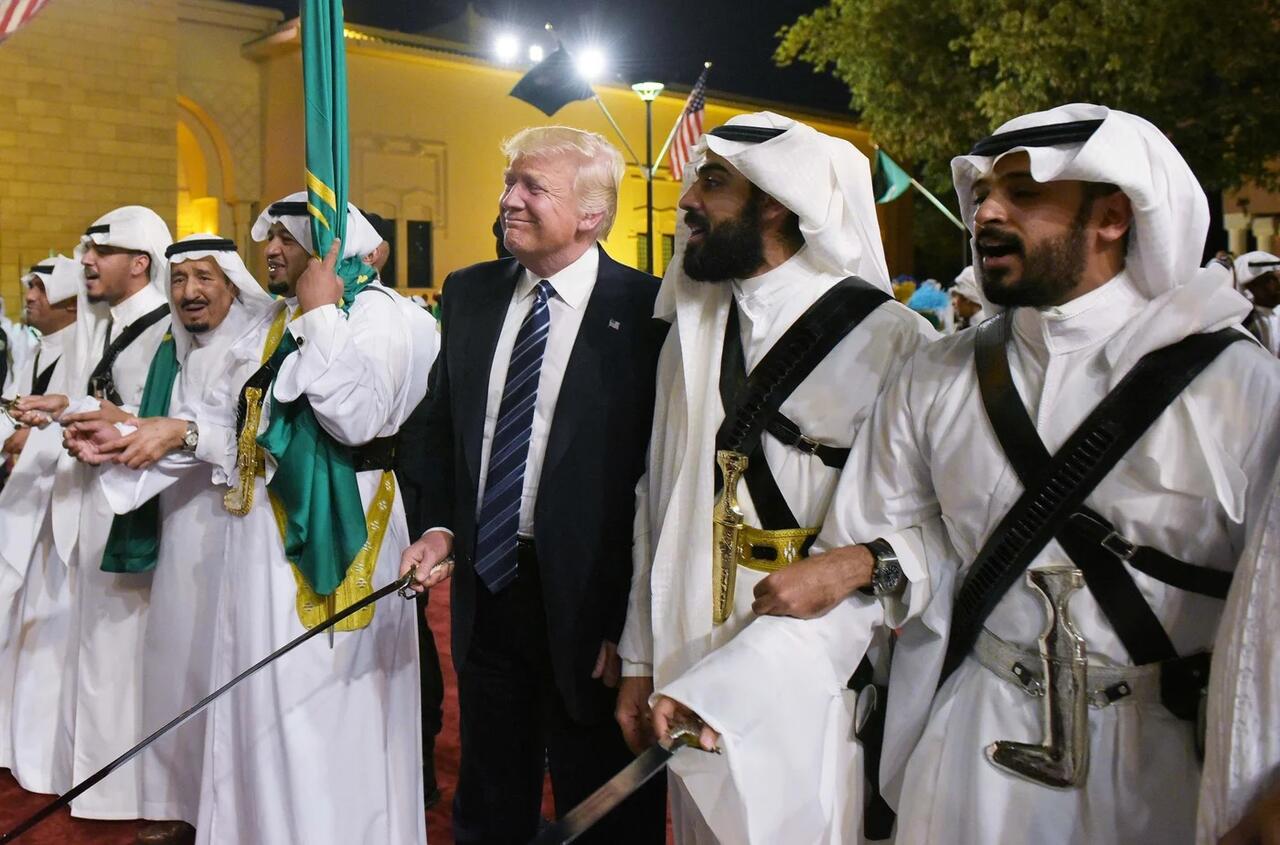
US President Donald Trump seems to think Israel could ruin his big trip to the Middle East, and it’s causing trouble. Trump appears to want the Middle East to have a respite from war and mass starvation during his trip to the oil-rich Gulf starting on Tuesday. He is signaling that he can leave Israel in the dust if it doesn’t go along for the ride.
Trump’s May 2017 visit to the kingdom during his first term. AFP
“Rift is too strong of a word, but frustration is bubbling,” a senior western official in the region told Middle East Eye.
Several sensitive dossiers are jostling together ahead of Trump’s visit that are irking Israeli Prime Minister Benjamin Netanyahu, analysts and diplomats say.
The most consequential file for Trump is the ongoing nuclear talks with Iran, which US Vice President JD Vance said this week have been “so far, so good”.
For months, Trump has scorned Netanyahu on the talks as his closest media allies attack “Mossad agents” trying to hamstring the US leader. By his own admission, Trump even resisted Israeli pressure to launch a preemptive attack on the Islamic Republic.
Secretary of the Treasury Scott Bessent: “I’m happy to report that we made substantial progress between the United States and China in the very important trade talks. First, I want to thank our Swiss host. The Swiss government has been very kind in providing us this wonderful venue, and I think that led to a great deal of productivity we’ve seen. We will be giving details tomorrow, but I can tell you that the talks were productive. We had the vice premier, two vice ministers, who were integrally involved, Ambassador Jamieson, and myself. And I spoke to President Trump, as did Ambassador Jamieson, last night, and he is fully informed of what is going on. So, there will be a complete briefing tomorrow morning.”
U.S. Trade Representative Ambassador Jamieson Greer: “This was, as the Secretary pointed out, a very constructive two days. It’s important to understand how quickly we were able to come to agreement, which reflects that perhaps the differences were not so large as maybe thought. That being said, there was a lot of groundwork that went into these two days. Just remember why we’re here in the first place — the United States has a massive $1.2 trillion trade deficit, so the President declared a national emergency and imposed tariffs, and we’re confident that the deal we struck with our Chinese partners will help us to work toward resolving that national emergency.”
The Exposure Of This Operation Is Not Only Critical For National Security But From Stopping Israel’s Planned Imminent Attack On Iran That Respected War Planners Warn Has A High Probability Of Triggering A New Global War
A Gulf diplomatic source, who declined to be named or disclose his position, told The Media Line, “President Donald Trump will issue a declaration regarding the State of Palestine and American recognition of it, and that there will be the establishment of a Palestinian state without the presence of Hamas.”
The source also added, “If an announcement of American recognition of the State of Palestine is made, it will be the most important declaration that will change the balance of power in the Middle East, and more countries will join the Abraham Accords.”
The source confirmed that economic agreements will certainly be present, but many of them have already been announced, and we may witness the Gulf states being exempted from tariffs.
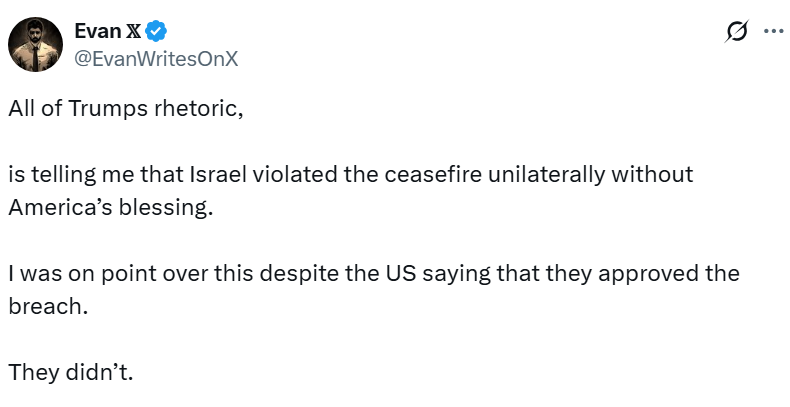
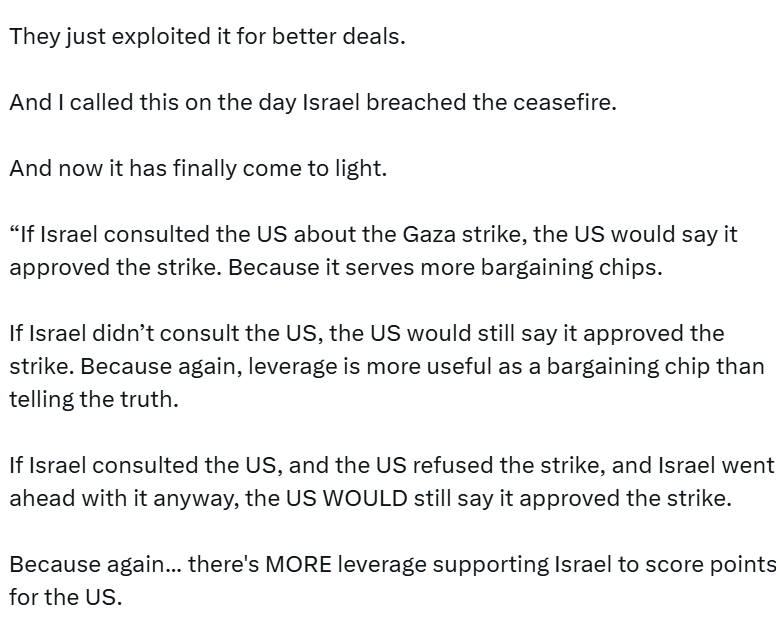
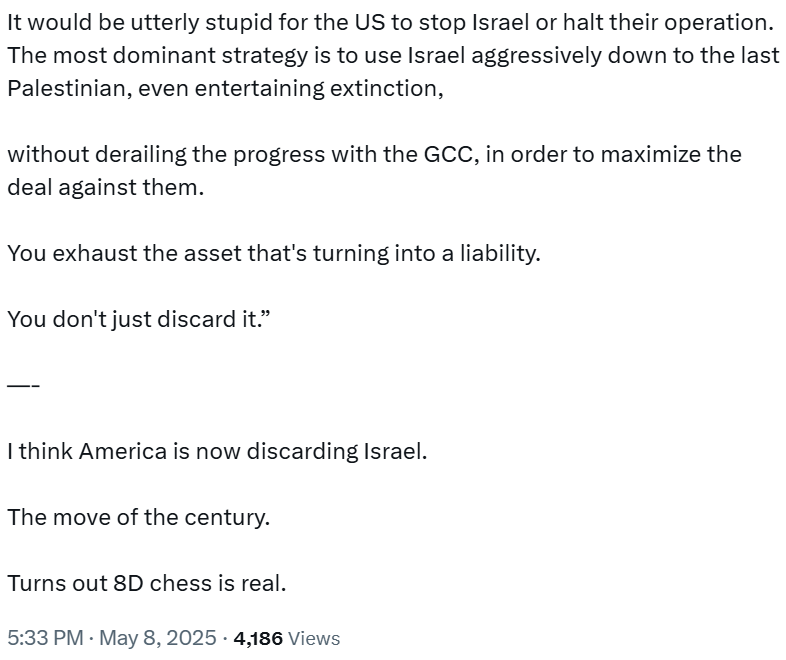
UPDATE: This is very big if true and shows that Trump is ditching Netanyahu/ Israel while simultaneously handing off local hegemony of the Middle East to the GCC. Trump appears to want to form partnerships above the fray in both the ME and Europe, where he is seeking a partnership with Russia as a foundation for ending the Ukraine War and increasing world prosperity. His trade resets can also be viewed in this light. ABN
Evan X has made the point for some time that USA controls Israel and will abandon Israel when it is in USA’s interests. It does appear likely that USA is now in the process of discarding Israel and letting the Gulf Cooperation Council (GCC) become the aggregate hegemon of the Middle East while USA withdraws. USA here actually means the various financial and military groups that control USA, but the basic point is the same. For USA, the next question is: are American Jewish Supremists supporting this or are they being side-swiped? Money and power rule in the world of elite power. It makes sense that Jewish Supremists may back away from Israel, the state, to further their own interests globally and inside USA. If we see a continuing exodus from Israel of wealthy Jews, we may be seeing this plotline playing out. ABN
US President Donald Trump is disappointed with Prime Minister Benjamin Netanyahu, Israel Hayom reports, citing two “senior sources close to the president.”
According to the Hebrew-language daily, in closed-door conversations Trump said he was going to make progress on his objectives in the Middle East without waiting for Israel.
On a deal with Saudi Arabia, Trump wants Israel to be a central part of an agreement, but “Netanyahu is delaying making the necessary decisions,” writes Israel Hayom’s Ariel Kahana, who interviewed Trump at Mar-A-Lago last year.
Trump is also still upset with Netanyahu and his circle over what he sees as an attempt to push the White House into military action against Iran’s nuclear program, say the sources.
Israeli officials were caught off guard by Trump’s announcement that the US had reached a ceasefire with the Houthis in Yemen this week, and by the start of US-Iran nuclear talks in April.
President Trump hosted Norwegian Prime Minister Jonas Gahr Støre in the Oval Office and took questions from reporters on Thursday. The majority of the question from both the U.S. and Norwegian media encompass the current effort to negotiate a ceasefire in Ukraine.
One of the ceasefire ‘sticking points’ per se’, is that immediately following the breakout of the conflict the government of President Zelenskyy changed many of their constitutional rules to include the legal elimination of opposition parties in the country, removal of religion or faith-based social influence that runs counter to the Ukrainian Nazi mindset, the cessation of elections in Ukraine, and other “emergency measures” intended to assist the stability of Zelenskyy’s government as they entered a war footing.
The results of the legal changes and constitutional framework, which included non-recognition of any lost territory, is now being leveraged by Zelenskyy in negotiations for a ceasefire. President Zelenskyy is now saying the ceasefire terms proposed, which include accepting regional losses of geography to Russia, are not constitutionally possible and he has no power to agree to them.
In essence, Zelenskyy’s emergency government changed the constitutional power of the President, cemented a new constitutional status during war, and now says those previous changes make it impossible to accept proposed terms. This self-fulfilling creation, intentionally done with forethought for exactly this kind of current scenario, is the baseline for frustration toward the Ukraine position. President Trump notes this Ukraine position is frustrating, while thousands die weekly in the process. WATCH:
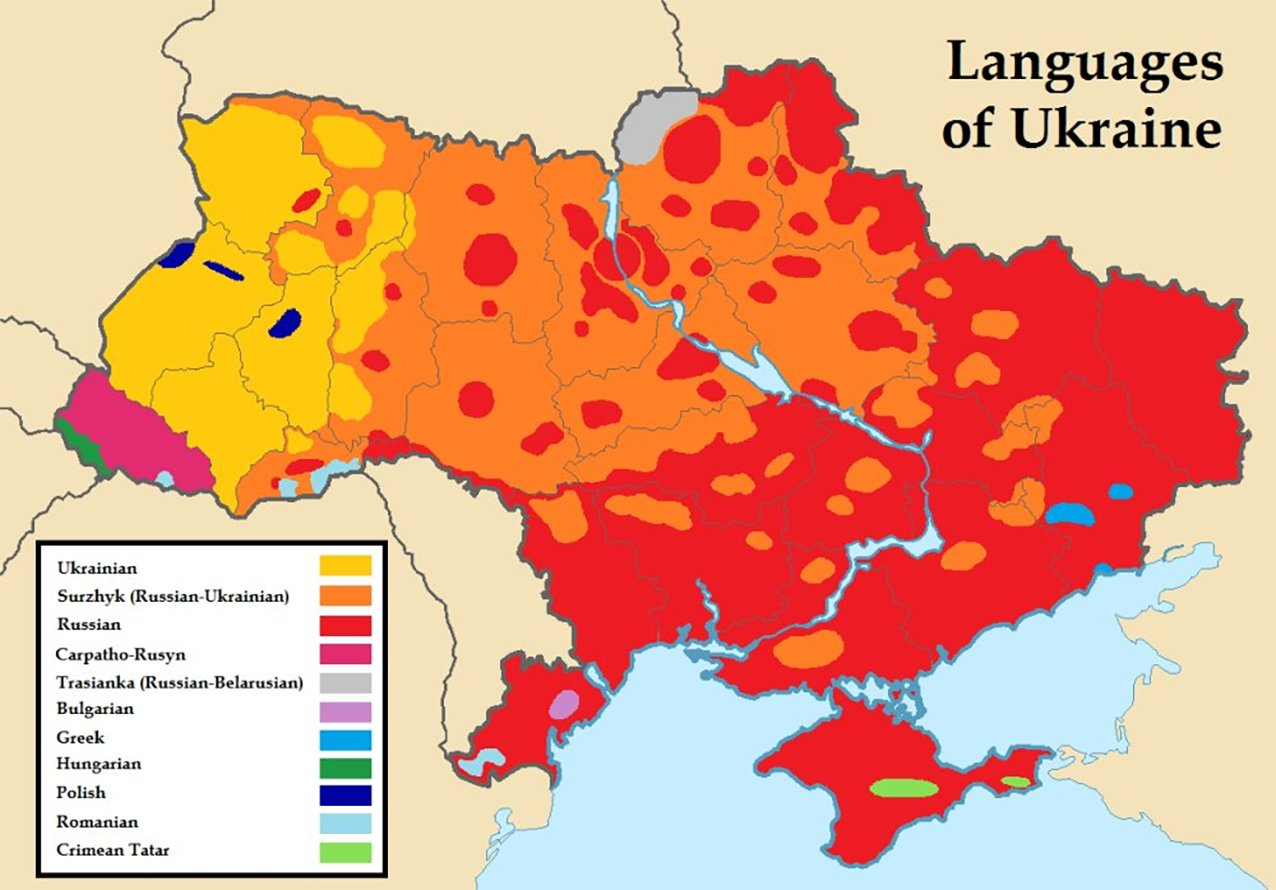
UPDATE: I do not consider Zelensky to be a Ukrainian or working for the benefit of Ukraine. Crimea is old Russian territory and vital to their access to the Black Sea. Much of Ukraine was always part of Russia, so a lot of the back and forth on territory lost or gained is, sadly, nonsense. Here is a map of languages spoken in the territory in question. It’s a very telling map and ridiculous to pretend the history of this region is not very Russian. Crimea was ‘given’ to Ukraine by Khrushchev at the stroke of a pen. Odessa became a Russian navy harbor in 1794 by decree of the Russian Empress, Catherine the Great. ABN
What people thought America could be – a beacon of democracy – was the last thing it became. In reality, it’s a corporate machine that has given rise to the Transnational Private Sector (TPS).
The TPS is a coalition of corporate giants, led by the Financial-Industrial Complex (FIC) with firms like JPMorgan, Goldman, and BlackRock, alongside the Military-Industrial Complex (MIC), Consumer-Industrial Complex (CIC), and Techno-Industrial Complex (TIC).
This collective force operates beyond borders, transcends nationality, and prioritizes profit over public welfare.
When Jamie Dimon, JPMorgan’s CEO, warned in October 2024 that wars in Ukraine and the Middle East could destabilize the global economy, he wasn’t just forecasting. He was asserting the TPS’s dominance over policy.
To understand this power, you have to examine the game theory driving the TPS’s clash with nations.
This concept that I have developed deliberately sets aside the idea of good, evil, right, or wrong. Geopolitical dynamics are examined through the lens of incentives, power, and measurable outcomes, not moral judgments. The focus is the strategic interplay of actors, stripped of ethical narratives.
___
Game theory provides a framework for understanding geopolitical strategies by analyzing the incentives that drive actors’ decisions.
There are two distinct game types: finite and infinite. Both these games shape global interactions. Finite games are zero-sum with defined endpoints, and clear winners and losers. It’s akin to a corporate quarter where profit maximization is the sole objective.
One player wins, the other loses.
Infinite games, conversely, lack a conclusion, have no end, prioritizing sustained participation through long-term stability, akin to a nation’s multi-generational survival strategy.
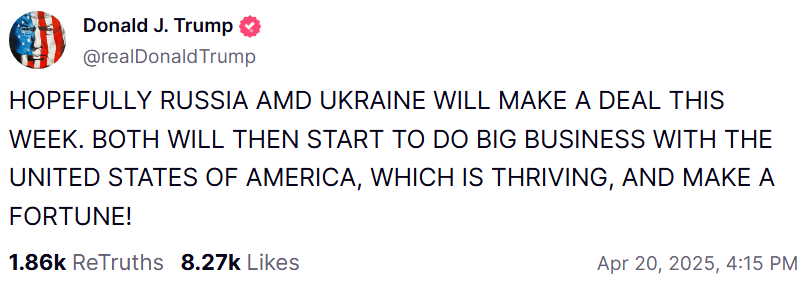
Donald Trump is ready to walk away from trying to negotiate a Russia-Ukraine peace deal within days unless progress is made, a top US official has warned.
If the president doesn’t see signs that an agreement is on the horizon he will call it a day because he has ‘other priorities’ to focus on, US Secretary of State Marco Rubio said on Friday.
‘We’re not going to continue with this endeavor for weeks and months on end. So we need to determine very quickly now, and I’m talking about a matter of days whether or not this is doable in the next few weeks.
‘If it is we’re in. If it’s not, then we have other priorities to focus on as well,’ Rubio said in Paris, after meeting European and Ukrainian leaders.
Rubio said Trump was still interested in a deal but was willing to move on if there were no immediate signs of progress.
‘If it’s not possible, if we’re so far apart that this is not going to happen, then I think the president’s probably at a point where he’s going to say, ‘well, we’re done’, he said.
‘The United States has been helping Ukraine over the last three years, and we want it to end, but it’s not our war,’ Rubio added.



 American Buddhist Net