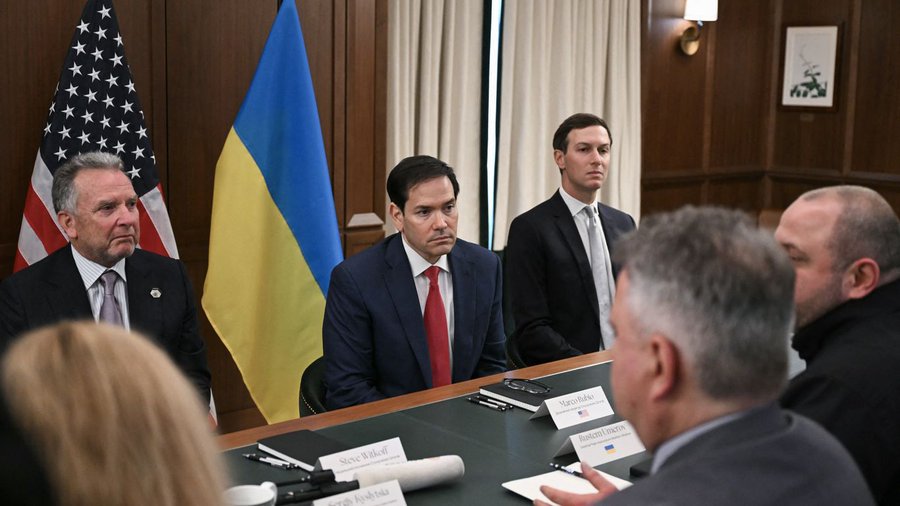
On Sunday, Secretary of State Marco Rubio, Trump emissaries Steve Witkoff and Jared Kushner met with the Ukraine negotiating team in Florida to further discuss acceptable terms for a broader ceasefire and end to the war.
Still trying to recover from corruption charges against his senior presidential team, Volodymyr Zelenskyy was not at the talks. Instead, the Ukraine delegation was led by State Security Council Secretary Rustem Umerov, while Zelenskyy went to Paris for an emotional support session with Emmanuel Macron.
Secretary Rubio and Secretary Umerov spoke before and after their 5-hour negotiation session. Secretary Rubio emphasized the main topic as securing the long-term future of Ukraine both from a security position and from an economic prosperity position.
This state security aspect comes as the Ukraine delegation is facing pressure to accept, they will lose most -if not all- of the Donbas region to Russia. “The end goal is obviously not just the end of the war. Obviously, that’s central and fundamental,” Rubio said. “It’s also about securing an end to the war that leaves Ukraine sovereign and independent and with an opportunity at real prosperity.”
In better-than-expected news, the EU is now saying they will not comply with any removal of sanctions against Russia. If the U.S-Russia and Ukraine work out a negotiated settlement that permits legal or economic relief for Vladimir Putin, the European Union will not agree and will instead make up their own decision on the issues.
Europe is holding this position as a threat, because President Trump is not fully consulting with them on all the granular details. However, this is the type of threat that is exactly beneficial to what appears to be the long-term strategy of Trump.
If Europe refuses to remove sanctions or legal threats against Russia, but the U.S. negotiates the removal of U.S treasury and financial sanctions against Russia, then the Europeans have chosen to stay behind the locked door of economic benefit. More than two-thirds of the world does not participate in the sanctions at all.
If Europe and Canada continue blacklisting Russia, the U.S-Russia energy development program gains exclusive benefits to Trump, Putin and other allies like Mohammed bin Salmon (Saudi Arabia), ASEAN nations and even Japan.
In very practical terms, someone like Viktor Orban (Hungary) would like nothing more than to violate ongoing Brussels sanctions against Russia, and as a consequence create a fracture point for European Union exit.
In practical terms, what would this look like? Well, the entire world would have lower energy prices, lower oil and natural gas prices, and lower gasoline prices by big margins. Meanwhile, Europe would have a massive disparity in their much higher energy costs – likely double the rest of the world. Think about the ramifications. Hungary, Georgia, Montenegro, and Serbia with 50% lower prices on gasoline and electricity than the EU. lolol It would be funny.
Unfortunately, with this in mind I find the EU threats hollow. As soon as the U.S-Russia-Ukraine work out a peace and security agreement, Europe will comply with whatever terms are negotiated for Russia. Failure to do so only isolates the Europeans and will create a problem amid their collective mindsets.
Lev Tahor, a 200-300 member ultra-Orthodox Jewish sect founded in 1988, promotes isolationist practices and has faced U.S. federal charges since 2021 for child exploitation, including forced underage marriages and sexual abuse, per DOJ indictments and Wikipedia summaries of peer-reviewed investigations.
Lev Tahor has a documented history of international raids for child abuse allegations, including Canada’s 2014 removal of 14 children, Mexico’s 2018 rescue of two, Guatemala’s 2024 extraction of 160 minors, and Colombia’s November 2025 rescue of 17, as confirmed by Reuters, AP, and BBC reports.
The fall of Andriy Yermak – Zelensky’s fixer, enforcer, gatekeeper, and indispensable ally, isn’t a “corruption scandal.” It’s Washington slapping the table. NABU, the U.S.-trained attack dog of Ukrainian politics, didn’t raid the Presidential Office by accident. It raided to remind Zelensky that the war isn’t his to command, the peace process isn’t his to veto, and the leash around Bankova Street is held in Washington, not Kiev and certainly not European chihuahuas.
Because the real story isn’t Yermak’s resignation. The real story is the West turning on itself over how to end a war Russia has already won.
The fall of Andriy Yermak, Zelensky’s most loyal ally and the de facto power manager of Ukraine, is not a scandal. It is a strike from above. NABU, the U.S.-funded, U.S.-trained anti-corruption bureau, didn’t raid the home and office of Ukraine’s most powerful unelected official by coincidence. And in any other country, his resignation after a corruption raid would be a political scandal. In Ukraine, it’s a geopolitical detonation.
Yermak wasn’t just a chief of staff, he was the shadow architect of the regime, the man through whom every appointment, every oligarchic negotiation, every Western request, and every wartime decision had to pass. And the speed of his resignation makes clear this was less about corruption, and more about pressure — engineered, timed, and executed by the one actor that can pull such a lever, Washington.
For months, the U.S. has been split between the neocons clinging to fantasies of a battlefield reversal, and the rising bloc of realists (JD Vance et. al) who have finally accepted what the frontlines have shown for over a year, Russia has already won. Ukraine’s army is shattered, NATO’s ammunition reserves are exhausted, and American voters are done with a war that offers no victory and no strategy. The realists now want a controlled, face-saving diplomatic exit, that locks in territorial losses quietly while Washington claims it “secured peace.” Zelensky has resisted every inch of this pivot because peace ends his power. And Yermak was the immovable pillar of that resistance, insulating Zelensky from any pressure to negotiate, the filter preventing unwanted messages from reaching the president. By purging him through a NABU raid, the U.S. has isolated Zelensky.
Meanwhile, the EU is panicking. European leaders fear peace more than war because peace forces accountability… why did they destroy their own industries, torch their energy security, plunge their economies into recession, and funnel hundreds of billions into corruption for a war Washington itself is now preparing to fold? Brussels supported Zelensky unconditionally not out of conviction but out of sheer self-preservation. If the war ends, they must answer for the ruin they inflicted on their own populations. Europe needs perpetual conflict to postpone the political reckoning. Washington, by contrast, wants a face saving offramp. This is the real EU–US divide: Brussels wants to delay the inevitable, Washington wants to manage it, and Kiev wants to deny it. Only one of them has the power to dictate the timeline, and it isn’t Europe.
Moscow sees the Western fracture, senses the desperation, and understands its advantage. Putin’s message has been cold and consistent: either negotiations occur on terms that reflect the battlefield reality and addreses the root cause of the conflict, or Russia will continue grinding down NATO’s proxy forces until nothing remains to negotiate with. For Russia, both paths lead to victory. Russia has no reason to rush, it is the West running out of time, weapons, unity, and credibility.
And when European publics finally realize their leaders sacrificed prosperity, stability, industry, and geopolitical autonomy for a war that ended exactly where Moscow predicted it would, the political reckoning will be seismic. Yermak’s fall is not the end of an era, it marks the beginning of the collapse for the EU.
A report in The Wall Street Journal details how Trump’s team – including his son-in-law Jared Kushner and special envoy Steve Witkoff – have been negotiating with Russia on how to ‘bring their $2 trillion economy in from the cold’.
Witkoff reportedly hosted Kirill Dmitriev – Putin’s ‘handpicked’ negotiator – and Kushner at a waterfront Miami Beach estate to draw up a plan to end the war, while also ensuring American businesses beat their European counterparts to making money once the conflict ended.
Dmitriev is said to have pushed for the $300 billion of Russian central bank assets frozen in Europe to be used for joint US-Russian investment projects, and a ‘US-led reconstruction’ of Ukraine.
There were also reportedly talks of pursuing a joint mission between Elon Musk‘s SpaceX and Russia to reach Mars, a far cry from the ‘space race’ of the 20th century.
Russia’s strategy, according to the report, is to convince the Trump administration that they are a ‘land of opportunity’ – and not a threat.
The Kremlin reportedly hopes to ‘reshape the economic map of Europe’, while also creating friction between the US and its allies on the continent and beyond, potentially giving Putin the last laugh in negotiations.
MILAN — Finland has released a new Arctic security strategy that seeks to define the country’s growing role in a region facing overlapping claims by friends and foes alike.
Nearly one-third of Finland’s land mass lies above the Arctic Circle, in the region of Lapland.
There are eight countries with territory within or north of the Arctic Circle that are members of the Arctic Council: Canada, Denmark, Finland, Iceland, Norway, Russia, Sweden and the United States.
This week, the Danish news outlet Politiken reported that the Trump administration has on several occasions tried to set up high-level meetings with Greenlandic authorities without Denmark present.
Drone manufacturer Quantum Systems and the Lithuanian electronics company ADV Defense have signed an agreement for future cooperation.
The agreement lays the foundation for industrial partnership in the Baltic region, focusing on the use of unmanned systems in Lithuania and along the eastern flank.
The memorandum of understanding was signed at the German-Baltic Defense Industry Conference in Vilnius.
The partnership aims to combine German and Lithuanian expertise with technological innovations to create mission-proven unmanned systems and strengthen the defense-industrial base of the region.
Lithuanian company ADV Defense. Photo credits: company website
The agreement supports Quantum Systems’ long-term strategy of establishing a strong industrial presence on NATO’s eastern flank. Currently, the company is building a large electronics manufacturing facility in Lithuania, which is set to double the production capacity of ADV Defense.
In the trial of Linda Sun, the former aide to New York governors who is accused of acting as a Chinese agent, the court has heard evidence that Sun forged the signature of Gov. Kathy Hochul, had close contact with Chinese consular staff, and purchased luxury items with payouts from China.
The former aide to Hochul and former New York Gov. Andrew Cuomo was indicted in 2024 over allegedly using her position to push the agenda of the Chinese Communist Party in return for millions of dollars paid to her husband’s business. Sun has pleaded not guilty.
Sun is on trial in federal court in the Eastern District of New York in the New York City borough of Brooklyn, with former colleagues and coworkers taking the stand to testify.
After almost two weeks of a trial that is expected to run until mid-December, here are some key takeaways so far.
Delegation Invitation Letters Allegedly Forged
Federal prosecutors alleged that Sun put together an official invitation letter to help Chinese officials travel to New York state. Without approval, she allegedly signed then-Lt. Gov. Hochul’s signature on the letter, which was on official letterhead. According to the prosecution, officials from Henan Province, China, used that letter to apply for visas to travel to the United States.
The mission of this website is to call attention to possible foreign and domestic malign influences on voting systems across our country with evidence obtained from open sources. This evidence raises significant concerns about whether our democratic system is under attack due to the use of foreign-owned electronic voting systems to run our elections and count our votes.
Are unauthorized and malicious foreign software engineers and administrators in hostile countries accessing our voting records and manipulating our elections? Is some of the work funded by one or more South American cartels? Is the personal voting information from past elections stored on Chinese servers in an eastern European country? Are actors able to control and alter the outcomes of our elections? Have they been doing so?
The timelines below trace the evolution of the coding and software that form the electronic DNA of America’s electronic voting and tabulation systems as they have developed over the years. The summary timeline provides the chronological history in brief. Just follow the yellow line. It connects pieces of evidence and raises important questions.
The full timeline includes more than 200 events between 1997 and 2024. Everything is linked to the original sources.
This evidence should concern all Americans. If we have lost control of our votes, we have lost control of our democratic process and our constitutional republic.
This claim fits well with information many of us have been seeing for years. It connects China, Serbia and Venezuela, as well as the makers of electronic voting machines used in USA. The story has always been shadowy and lacking essential details or recognition by law enforcement. Emerald claims Trump is preparing to take down Maduro in Venezuela primarily over their election fraud in USA. ABN
The Club des Cent (sometimes referred to in intelligence literature as the “Cercle des Cent” or simply “Le Cercle”) is a secretive, invitation-only foreign policy group that has operated since the early Cold War period. It is distinct from the gourmet dining club of the same name in Paris (the actual “Club des Cent” for food critics). The intelligence-related group is often called Le Cercle in French sources or The Pinay Circle in Anglo-American ones, named after its most influential early chairman, former French Prime Minister Antoine Pinay.
Origins and Structure
Founded in the early 1950s by Antoine Pinay and French Prime Minister Jean Violet (a lawyer with close ties to French intelligence, particularly the SDECE – the predecessor of DGSE).
Created as a private, anti-communist forum to coordinate Atlanticist (pro-NATO, pro-US–Europe alliance) foreign policy and intelligence efforts outside official channels.
Membership has always been small, elite, and transnational: senior politicians, intelligence officers, bankers, diplomats, industrialists, and occasionally royalty. Former members or attendees include:
Franz Josef Bach (German diplomat and CDU politician)
Alan Clark (British Conservative MP)
Giulio Andreotti (Italian PM)
Otto von Habsburg
Henry Kissinger (attended at least once)
David Rockefeller
Margaret Thatcher (met with the group)
Senior figures from MI6, CIA, French SDECE/DGSE, German BND, Belgian Sûreté, etc.
Involvement in Covert Operations
Le Cercle has never been an operational intelligence agency, but it functioned as a high-level private intelligence coordination and strategy group. Its documented or strongly alleged involvement includes:
Anti-communist propaganda and psychological warfare
Financed and coordinated anti-Soviet and anti-leftist operations in Europe through linked organizations such as the Interdoc network and the Institut de Politique Internationale.
Funded anti-communist trade union activities and media operations.
Africa and the “Françafrique” network
Jean Violet and other Cercle members were deeply involved in French neocolonial networks in Africa, especially through the Safari Club (a 1970s intelligence alliance between France, Iran, Saudi Arabia, Egypt, and Morocco designed to bypass CIA restrictions after the Church Committee).
Supported interventions in Congo/Zaïre, Chad, and elsewhere.
1980s anti-neutrality campaigns in Europe
Coordinated private funding and strategy against European neutralism and the peace movement (especially in West Germany and the Netherlands). Linked to the creation of front organizations that received covert CIA and MI6 funding.
The “Clockwork Orange”–style operations in the UK
British Cercle members (Julian Amery, Brian Crozier, Nicholas Elliott) were implicated in attempts to destabilize the Labour government of Harold Wilson in the 1970s via smear campaigns involving MI5 and private intelligence networks.
Support for the 1980s Reagan–Thatcher hardline policies
Acted as a back-channel between European conservative circles and the incoming Reagan administration, particularly on intermediate-range nuclear forces (INF) deployments in Europe.
Secrecy and Current Status
The group deliberately avoids publicity. Meetings are held twice a year in different countries, always under heavy security and with no minutes published.
After the end of the Cold War, its focus reportedly shifted toward the Middle East, Islamic terrorism, and later Russia/China.
As of the 2010s–2020s, it is believed to still exist in a much reduced form, sometimes under different informal names, with younger Atlanticist politicians and intelligence veterans.
In summary, the Club des Cent / Le Cercle was one of the most important private covert action networks of the Cold War era – not an official agency, but a place where senior Western intelligence officers, politicians, and financiers could plan and fund operations that official agencies could not or would not touch. Its influence peaked in the 1970s–1980s and has significantly declined since, but its model of private–public coordination continues to fascinate researchers of “deep politics.”
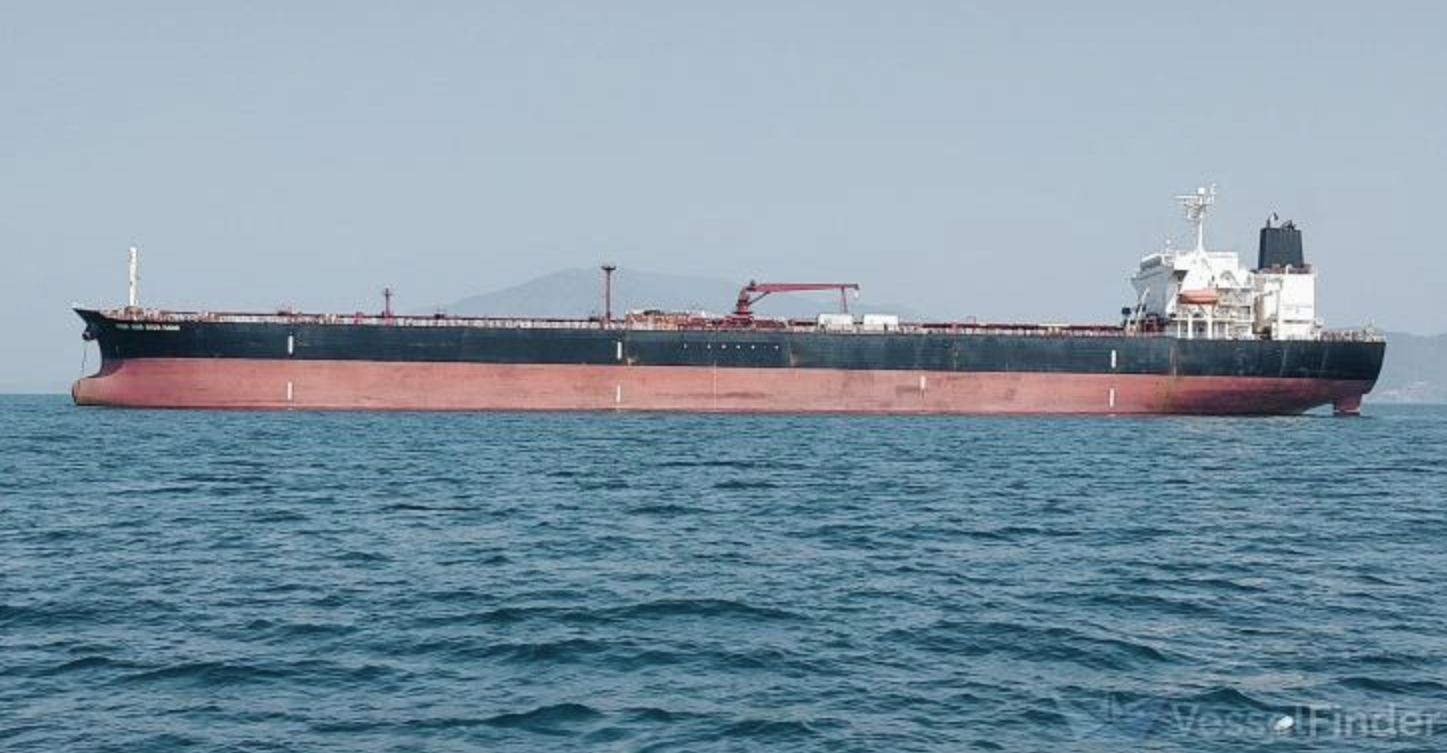
The Russian tanker Seahorse from the so-called shadow fleet, which is subject to sanctions, turned around on its way to Venezuela after a US warship blocked its route.
This follows from data from a ship tracking service collected by Bloomberg.
On November 13, the Russian tanker Seahorse was carrying fuel to Venezuela when the USS Stockdale destroyer blocked its path.
The tanker Seahorse. 2023. Photo credits: vesselfinder.com
The Russian vessel then changed course and headed towards Cuba.
The US warship, in turn, sailed near Venezuelan territorial waters in the direction of Puerto Rico.
Since then, the Seahorse has twice tried to approach Venezuela, but both times turned back and remained in the Caribbean Sea.
The intentions of the US destroyer towards the Russian vessel are unclear, and a spokesperson for the US Southern Command refused to comment on the ship’s movements.
Mass migration poses an existential threat to Western civilization and undermines the stability of key American allies.
Today the State Department instructed U.S. embassies to report on the human rights implications and public safety impacts of mass migration.
Mass migration is a human rights concern. Western nations have endured crime waves, terror attacks, sexual assaults, and the displacement of communities.
U.S. officials will urge governments to take bold action and defend citizens against the threats posed by mass migration.
Officials will also report policies that punish citizens who object to continued mass migration and document crimes and human rights abuses committed by people of a migration background.
These issues have plagued citizens of Western nations for years:
In the United Kingdom, thousands of girls have been victimized in Rotherham, Oxford, and Newcastle by grooming gangs involving migrant men.
Many girls were left to suffer unspeakable abuse for years before authorities stepped in.
In Sweden, an Eritrean migrant convicted of raping a 16-year-old girl was allowed to remain in the country after a judge ruled that the incident was not an “exceptionally serious crime” and did not warrant deportation.
In Germany, nine men – several of whom were migrants – were convicted for the gang rape of a 15-year-old girl.
A German woman who insulted one of the rapists online was given a harsher sentence than the perpetrators themselves.
U.S. officials will now scrutinize policies in Western nations that give leniency to migrant crime and human rights abuses or that create two-tiered systems that prioritize migrants at the expense of their own citizens.
The United States supports the sovereignty of our allies and calls on governments to constructively engage with the growing numbers of citizens concerned about mass migration.
The United States stands ready to assist our allies in solving the global crisis of mass migration.
Unexpected and delightful to see. This is a major sea change in mass immigration invasions across the West. This is a bold, strong statement and I believe Trump will pursue it forcefully. ABN







 American Buddhist Net
