A new study has found that individuals with major depressive disorder report mind wandering over twice as often as healthy adults. These individuals saw their mind wandering as more negative. Mind wandering was more frequent in depressed individuals who reported experiencing more negative and less positive moods. The research was published in the Journal of Affective Disorders.
Mind wandering is the spontaneous shift of attention away from a current task or external environment to internal thoughts or daydreams. It typically occurs when people are engaged in routine or low-demand activities. During mind wandering, people think about their past, future, or unrelated topics. Mind wandering can foster creativity and problem-solving, but frequent or excessive mind wandering has been linked to negative outcomes, including rumination and poor emotional regulation.
In individuals with depression, mind wandering tends to focus on negative thoughts, regrets, or worries, contributing to a persistently low mood and feelings of hopelessness. Studies suggest that people with depression experience more frequent and uncontrollable mind wandering, which can exacerbate symptoms. This tendency to ruminate increases cognitive load and interferes with concentration and productivity.
Study author Matthew S. Welhaf and his colleagues aimed to better understand the frequency of mind wandering in individuals with major depressive disorder in everyday life compared to healthy individuals. They also aimed to explore the content of mind wandering. Unlike most previous studies that relied on formal scales and assessments, this study applied an experience sampling design, having participants report their experiences several times per day.
The authors hypothesized that individuals with major depressive disorder would mind-wander more frequently, focusing more on the past. Additionally, they expected the frequency of mind wandering to be associated with negative moods.
Study participants included 106 adults, all native English speakers and up to 40 years old. Fifty-three were healthy controls with no history of mental health disorders, and the other 53 had been diagnosed with major depressive disorder. Participants with major depressive disorder were slightly older, with an average age of 28, compared to 25 years among the healthy participants. Approximately 70% of participants in both groups were women.
The study authors provided participants with a handheld electronic device with the Experience Sampling Program 4.0 installed. Over 7–8 days, participants were randomly prompted eight times a day (between 10:00 a.m. and 10:00 p.m.) to report on their current experiences, amounting to a maximum of 56 prompts throughout the period. On average, participants completed around 43–44 prompts, with similar numbers in both groups.
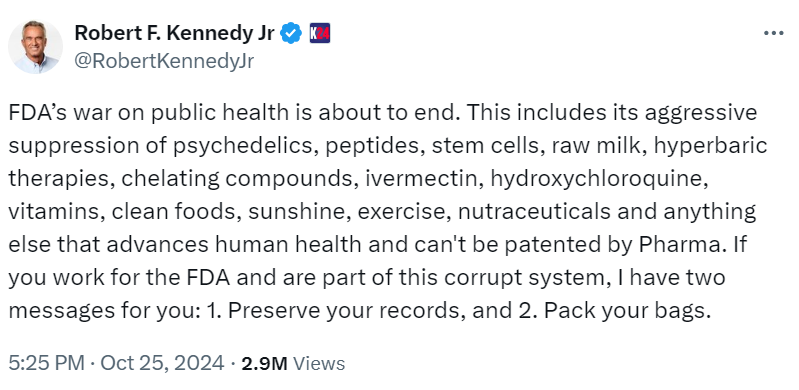
FDA’s war on public health is about to end. This includes its aggressive suppression of psychedelics, peptides, stem cells, raw milk, hyperbaric therapies, chelating compounds, ivermectin, hydroxychloroquine, vitamins, clean foods, sunshine, exercise, nutraceuticals and anything else that advances human health and can’t be patented by Pharma. If you work for the FDA and are part of this corrupt system, I have two messages for you: 1. Preserve your records, and 2. Pack your bags.
A group of doctors who defied the COVID narrative has just compiled 18 alternative cancer treatments that WORK!
Not only are these powerful interventions back by science, but most of them are extremely affordable or completely free.
The first anti-cancer therapy is glucose management through a ketogenic diet. By drastically reducing carbohydrate intake, the ketogenic diet helps starve cancer cells of their primary fuel source, glucose.
Second on the list is exercise. The report says that regular physical activity boosts immune function (critical for fighting cancer), reduces inflammation, and combats fatigue.
Vitamin D3 is also essential. The report says, “Low levels of vitamin D have been linked to an increased risk of cancer. Supplementing with vitamin D3 may support the immune system and help prevent cancer cell proliferation.”
One of the more interesting items on the list is the inclusion of Ivermectin and Fenbendazole. Ivermectin is believed to “interfere with cellular processes essential for cancer cell viability” whereas Fenbendazole inhibits cancer cell division and induces cancer cell death.
New cultivation methods are making psychedelic mushrooms stronger, and fiendishly potent varieties are kicking in faster and lasting longer—even if you eat only a fraction of what you would with another variety. Subsequent testing showed that one batch of Mattucci’s mushrooms contained almost 5 percent psychedelic alkaloids, which was once unheard of within the Psilocybe genus. Typically, mushrooms contain 1 percent of these psychoactive compounds, although species like Psilocybe azurescens are generally stronger, and some varieties within the Panaeolus genus are even more potent.
More regulations on fluoride in drinking water may be coming due to the new court order last week, experts say.
Fluoride, commonly added to drinking water to prevent cavities, has come under scrutiny.
Several cities have now stopped adding fluoride to their drinking water. But whether the whole landscape will change depends on what the Environmental Protection Agency (EPA) will do next.
How Much Fluoride in Water Might Be Safe?
On Sept. 24, U.S. Federal Judge Edward Chen ordered the EPA to strengthen its rules around fluoride in drinking water.
The decision was made in light of The National Toxicology Program’s (NTP) report in August, which found that 1.5 milligrams of fluoride in drinking water is sufficient to pose neurodevelopmental risks in children.
The EPA calculates a margin of exposure to determine a safety buffer between the exposure and hazard levels. For fluoride, the exposure rate should be one-tenth of the hazard level, lawyer Michael Connett said.
Since the NTP’s report found 1.5 milligrams per liter to be potentially risky, exposure risks could start from 0.15 milligrams per liter, Connett added.
Americans’ current exposure level of 0.7 milligram per liter—”the level presently considered “optimal” in the United States – poses an unreasonable risk of reduced IQ in children,” Chen wrote in his ruling.
Currently, the EPA sets the maximum level for fluoride at 4 milligrams per liter, significantly higher than the risk level cited in the recent study.
I have a friend who manages the water facilities in a fairly large city. She is a credentialed chemist and objects to fluoride most of all because in its raw form it is a very harmful substance and the workers who add it to drinking water are rarely, if ever, properly trained or dressed to do that job safely. ABN
A doctor who took his own life left a heartbreaking suicide note saying he had ‘run out of gas’ as he warned of the immense pressure medics are under.
Dr Will West was in the third year of his ophthalmology training at George Washington University School of Medicine and Health Sciences in Washington D.C.
His suicide at the age of 33 devastated his friends and family, as well as those he worked with.
The devoted doctor, who was nicknamed ‘Iron Will’ for his determination, said it was not one single event which had led to his death but highlighted the immense pressure of his residency which his family say prevented him seeking help.
‘To those who will be negatively affected by my actions, I’m so sorry. I have simply run out of gas and have nothing left to give,’ West wrote in the note obtained by the Washington Post.
A GOP senator has reintroduced a bill that would triple the concentration of THC that the hemp could legally contain, while addressing multiple other concerns the industry has expressed about the federal regulations.
Sen. Rand Paul (R-KY) filed the legislation, titled the Hemp Economic Mobilization Plan (HEMP) Act, on Tuesday. The measure is identical to a version he’s proposed last Congress.
Hemp and its derivatives were legalized under the 2018 Farm Bill, but the industry has experienced multiple setbacks in the years since—and the proliferation of intoxicating cannabinoid products has led to pushes in Congress and state legislatures across the country to reign in the largely unregulated market.
In the interim, one of the most common complaints that lawmakers have heard from hemp businesses is that the crop is federally defined as containing no more than 0.3 percent THC. They say that’s too low, and so Paul’s bill would increase that threshold to 1 percent.
A federal court in California ruled late Tuesday against the Environmental Protection Agency, ordering officials to take action over concerns about potential health risks from currently recommended levels of fluoride in the American drinking water supply.
The ruling by District Court Judge Edward Chen, an appointee of former President Barack Obama, deals a blow to public health groups in the growing debate about whether the benefits of continuing to add fluoride to the water supply outweighs its risks.
Environmental nonprofit Food & Water Watch and a handful of anti-fluoride groups, like the Fluoride Action Network, have been in court for nearly a decade after the EPA denied their petition against local water utilities adding in the mineral.
While Chen was careful to say that his ruling “does not conclude with certainty that fluoridated water is injurious to public health,” he said that evidence of its potential risk was now enough to warrant forcing the EPA to take action.
“In all, there is substantial and scientifically credible evidence establishing that fluoride poses a risk to human health; it is associated with a reduction in the IQ of children and is hazardous at dosages that are far too close to fluoride levels in the drinking water of the United States,” the judge wrote in his ruling.
The more of us know this, the more doctors will feel pressure to cut their shit. Voting is always dubious in USA, but our collective grapevine is always strong when enough of us have the right information. Share what you know with others. No need to argue. Just let others know what you think — that someone else has different information, a different opinion. Being too polite and not talking is big part of what got us into the mess we are in today, on this and many other issues. ABN


 American Buddhist Net